
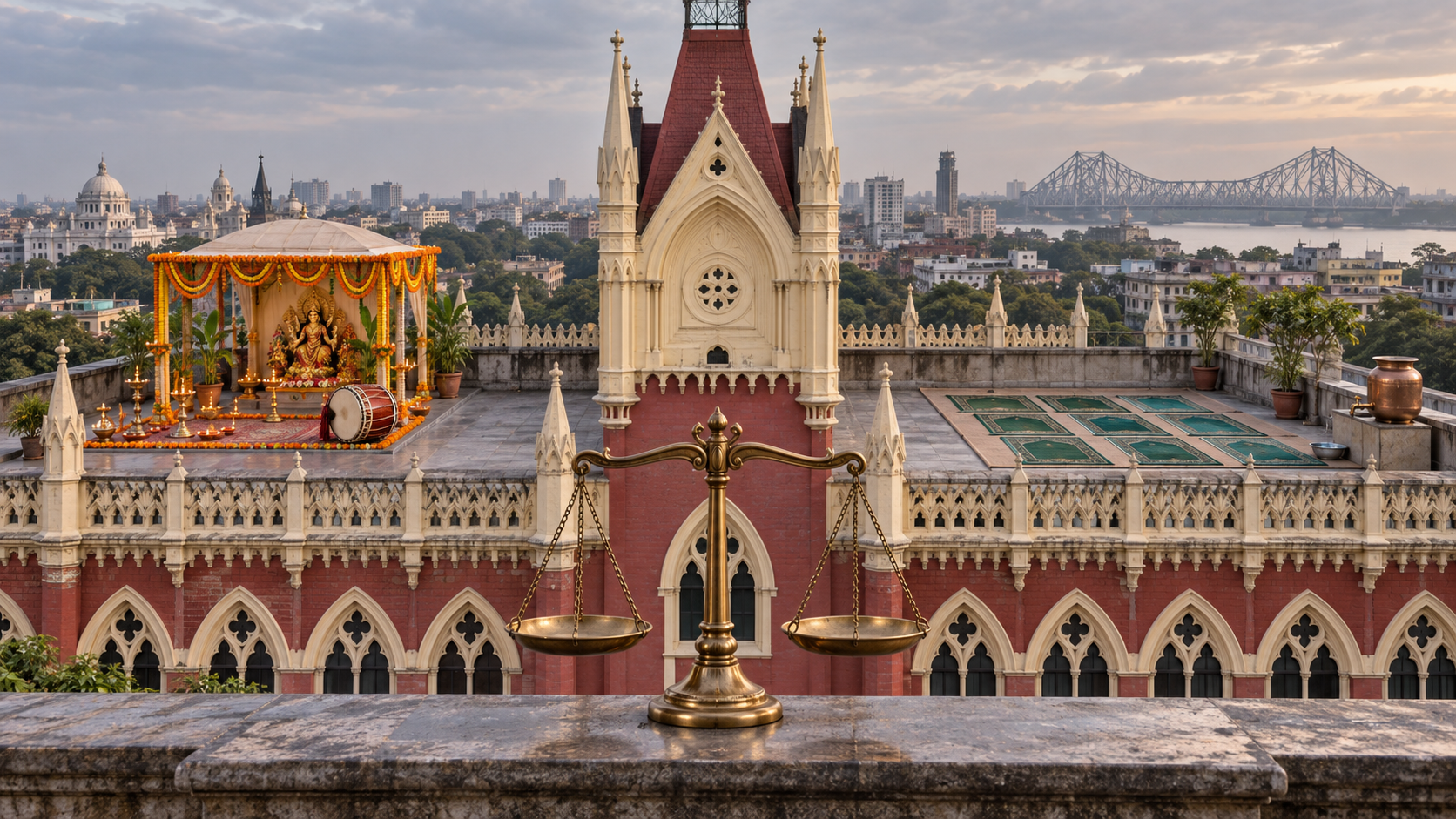
If you reached this page asking whether Calcutta High Court denied Hindus the right to hold Durga Puja on its rooftop while allowing Muslims to offer namaz there, the honest answer is narrower than the circulating claim. A serious equality concern has been raised, but unequal treatment has not yet been established by the limited facts available.
The known procedural facts are that a division bench rejected a PIL seeking Durga Puja on the High Court rooftop, while Chief Justice Ghuge questioned the petition’s maintainability. The controversy also includes a claim that namaz continues on the rooftop. The described judicial response did not settle whether that practice exists with official permission, whether the two uses are comparable, or whether one neutral policy governs both.
What the reported rejection does – and does not – decide
The first discipline is to separate procedure from substance. Maintainability asks whether a court should entertain a particular petition in its presented form. Depending on the case, that threshold can involve the petitioner’s standing, the nature of the relief, the proper respondent, the evidentiary record, or whether another administrative or legal route should be used. It is not automatically a judgment on the underlying grievance.
That means the rejection of this PIL should not be translated into a broader claim that the court declared unequal religious treatment lawful. It also should not be translated into proof that the allegation of unequal treatment is true. It establishes that the requested relief was not granted through this proceeding; the precise legal effect depends on the written order and its reasons.
If you are assessing the dispute, obtain the operative order before drawing a conclusion. Check whether maintainability appears as a written ground, whether other grounds were recorded, and whether the court issued any direction to its administrative side. Courtroom questions may reveal what concerned the bench, but the written order is the safer basis for stating what was actually decided.
The same care applies to silence. A bench’s failure to address the namaz claim in the described proceeding may leave an important question unanswered, but silence is not a judicial finding that namaz is officially permitted. Nor is it a reason to abandon the question. It is a reason to seek the administrative record that can answer it.
Test unequal treatment with a like-for-like comparison
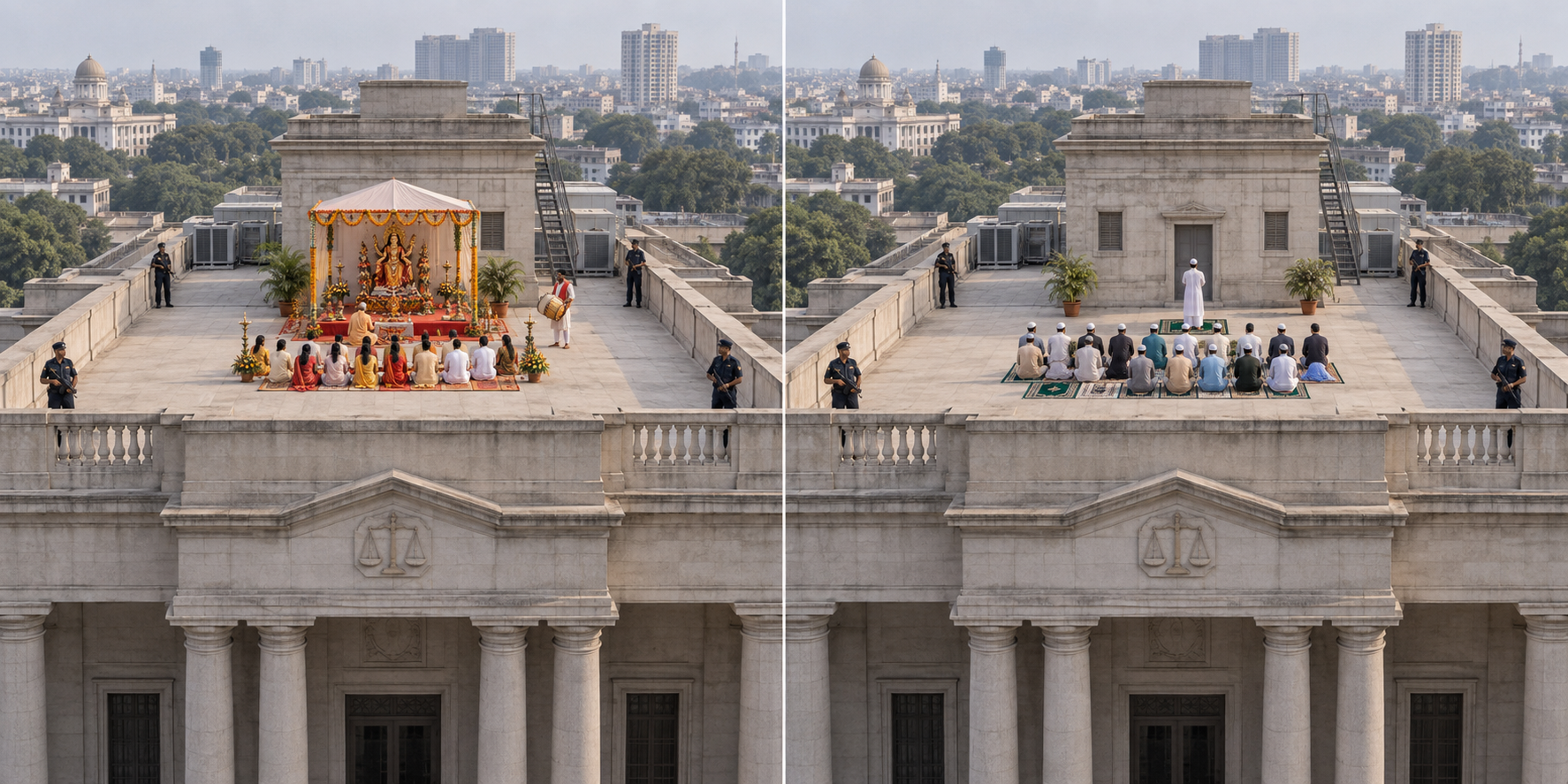
The relevant equality question is not whether Durga Puja and namaz are theologically similar. They are not required to be. The practical question is whether the same institution applies the same neutral criteria to comparable requests for religious use of the same premises.
Before calling the situation discriminatory, fill in both sides of the comparison:
- Place: Is the claimed namaz conducted on the same rooftop, in another part of the building, or somewhere outside the controlled court premises?
- Administrative status: Was either activity expressly permitted, informally tolerated, historically accommodated, or prohibited? Tolerance and written permission are not the same fact.
- Decision-maker: Did the same administrative authority consider both uses, or did the Puja request reach a judicial bench while the other practice remained an administrative matter?
- Organiser: Who requested each use of the premises, and in what capacity? A request from employees, an association, a litigant, or an outside body may travel through different procedures.
- Physical requirements: What crowd size, duration, structures, electrical arrangements, sound, fire precautions, access controls, or cleaning obligations were proposed or accepted?
- Timing and frequency: Is the comparison between an annual event and a recurring practice? Frequency alone does not decide fairness, but the administrative conditions must be recorded rather than assumed.
- Stated reason: Was the Puja request refused because of a general no-observance rule, a rooftop-use restriction, security, safety, disruption, heritage concerns, or a procedural defect? Ask for the actual written reason.
- Applicable policy: Is there a published rule governing religious activity on court property, and has that rule been applied consistently?
If the same authority knowingly prohibits a Hindu observance while allowing a materially comparable Muslim observance in the same place and under similar conditions, the unequal-treatment concern becomes substantially stronger. If the activities differ in relevant ways, those differences must be documented and tested. They must not be invented after the event to excuse a selective result.
Equal treatment does not necessarily mean that every religious request must be approved. A neutral rule could permit comparable observances subject to published conditions, or it could restrict religious use of the rooftop for everyone. The central requirement is consistency: the rule, evidence and reasons should not change with the identity of the worshippers.
Key takeaways before you share or act
- The PIL’s rejection is a procedural outcome; it does not by itself resolve the underlying equality question.
- The claim that namaz continues on the rooftop needs proof of place, practice, permission and administrative knowledge.
- A strong comparison must examine the same premises, authority, conditions and time period.
- The most useful demand is a written, religion-neutral policy applied consistently to all applicants.
- Criticise the responsible institutional decision, if the records support it; do not substitute hostility toward worshippers for scrutiny of the rule.
Build the record before making the legal claim
If you want accountability rather than a short-lived social-media dispute, build a record that another person can independently check. Use this sequence:
- Read the final order. Record the case number, parties, date, relief requested, reasons stated and operative directions. Do not rely on a headline as a substitute for the order.
- Read the prayer in the petition. Determine whether the petitioner asked for direct permission, challenged an existing refusal, sought a general policy, or requested parity with another practice. Those are different forms of relief.
- Locate the administrative decision. Ask whether a written application for Durga Puja was submitted, which office received it, and what written response followed. A judicial rejection and an administrative refusal should not be merged into one event without proof.
- Verify the comparator. For the claimed namaz practice, record the exact location, dates or regularity, organisers, photographs or video with verifiable context, and any permission, circular, correspondence or acknowledgement by the administration.
- Request the governing rule. Address a precise written question to the appropriate court administrative office: what policy governs religious observances on the rooftop or other controlled premises, who can apply, what conditions apply, and whether the policy covers every faith equally?
- Create a dated chronology. Put each application, response, court filing, order and claimed observance in sequence. A chronology exposes whether the alleged comparison concerns the same policy period and the same authority.
- Have the record reviewed before further litigation. A local lawyer can determine the proper procedural route, parties and relief. A failed PIL does not tell you whether a corrected proceeding, an administrative representation, or no further legal action is appropriate.
Keep three labels in your notes: verified fact, allegation and unanswered question. For example, the PIL’s rejection belongs under verified procedural facts. Continued rooftop namaz should remain under allegation until its occurrence and institutional status are documented. The existence of a uniform written policy remains an unanswered question unless the policy is produced.
This distinction matters legally as well as morally. Publicly accusing named people or an institution of religious discrimination without adequate records can create avoidable legal exposure and can weaken a legitimate grievance. If you plan to name individuals, file another case or publish allegations as fact, obtain advice from a lawyer familiar with the relevant court procedures.
A pro-Hindu case is strongest when it asks for one rule
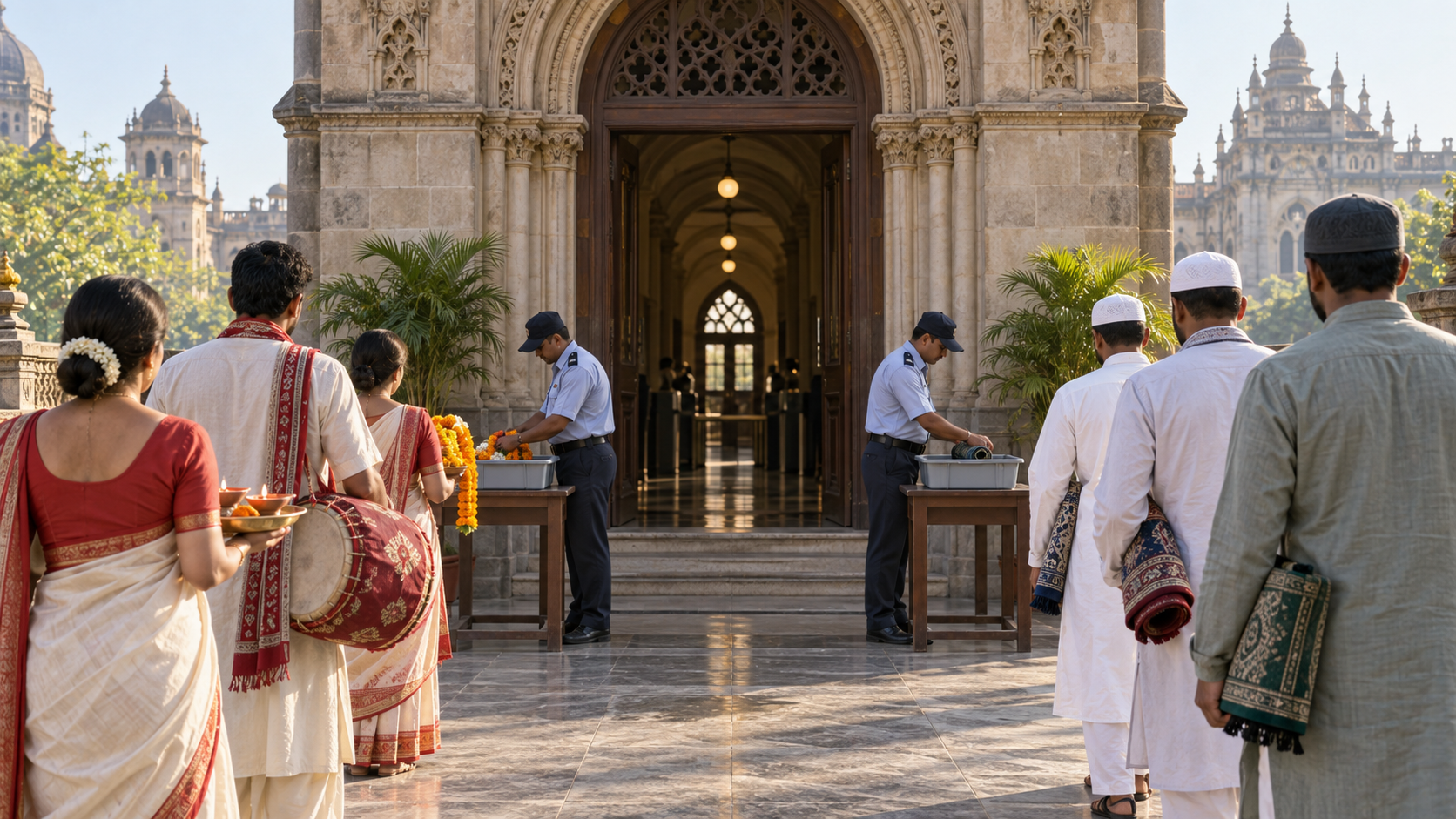
Hindus should not be expected to accept a selective restriction merely because it is presented as administrative convenience. If comparable use of court property is available to one religious community, a Hindu request deserves consideration under the same published criteria. That is a demand for equal civic dignity, not a demand for special treatment.
At the same time, the Hindu interest is not served by stating more than the evidence proves. Dharma does not require us to replace inquiry with accusation. Restraint here is not passivity; it is how you make an argument durable enough to survive procedural scrutiny and public challenge.
A sound public demand has four parts:
- Publish the policy for religious and ceremonial use of court-controlled premises.
- Provide the same application channel and decision criteria to every community.
- Give written reasons when permission is granted, conditioned or refused.
- Provide a defined administrative review route so that a disputed decision does not immediately become a communal confrontation.
Institutional neutrality is not achieved by treating a Hindu observance as uniquely intrusive while leaving another religious practice outside scrutiny. Neither does neutrality require every application to succeed. It requires the authority to identify legitimate conditions in advance and apply them without changing the standard according to the faith involved.
Your next step is concrete: obtain the written order, complete the like-for-like comparison, and send one focused request for the policy governing religious use of the rooftop. If the records reveal unequal treatment, advocate from those records. If they do not support the circulating claim, correct the claim before sharing it. Hindu advocacy gains authority when its factual standard is as firm as its demand for fairness.
References

Leave a Reply
You must be logged in to post a comment.