
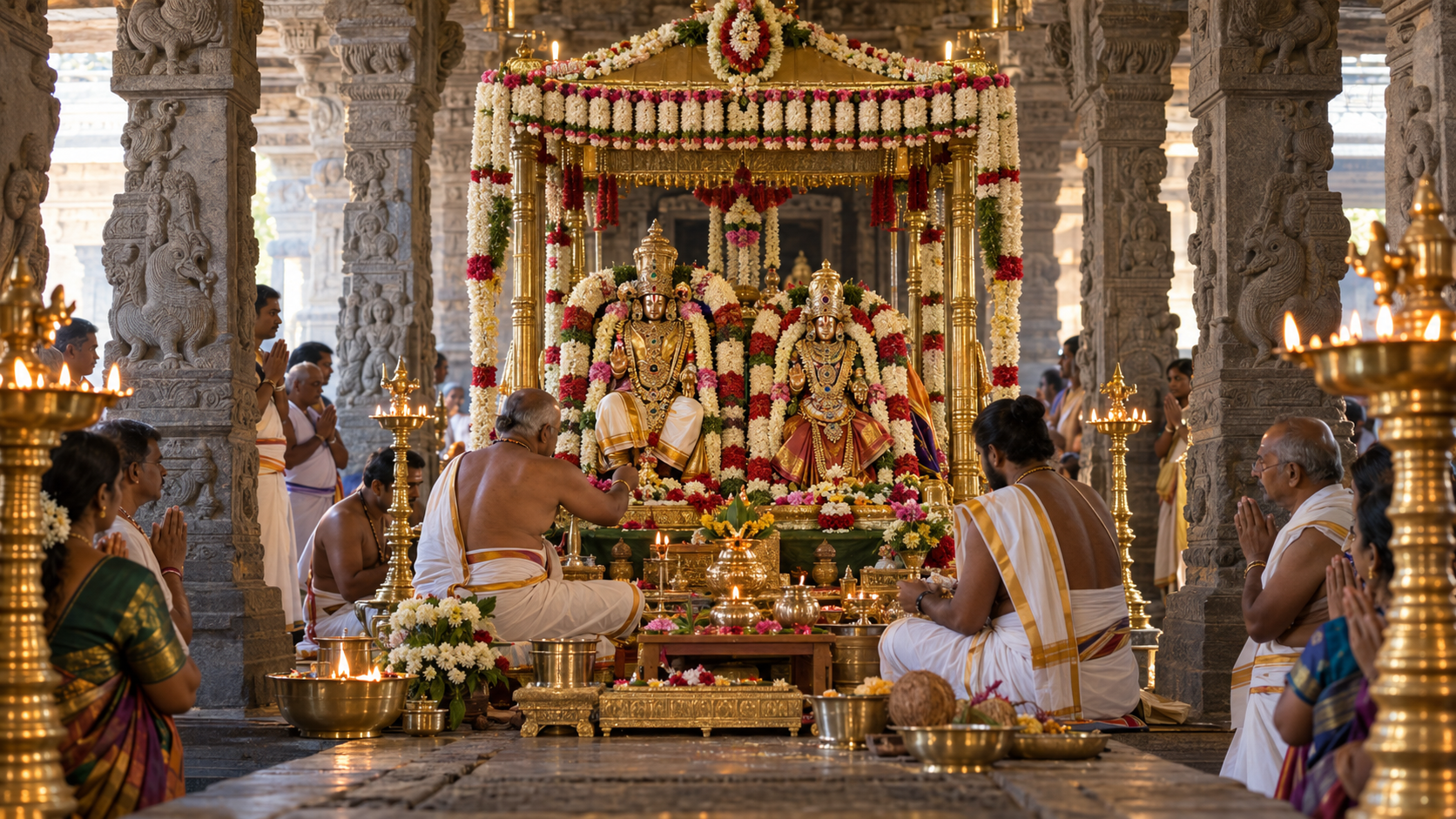
You have seen a temple announce a Thirukalyanam, but the notice may not tell you what the celebration means or what a devotee is expected to do. Is it a symbolic wedding, a festival, a formal act of worship, or all three?
The safest answer begins with one distinction: a Thirukalyanam is not merely a human wedding transferred to a temple stage. It is a divine marriage celebrated within a particular devotional tradition. You will understand it better when you first identify whose Thirukalyanam is being observed, then let that temple’s own liturgy, narration, and customs explain the occasion.
What makes a Thirukalyanam divine
The vocabulary marks an important boundary. In this usage, kalyanam refers to marriage among mortals, while Thirukalyanam identifies marriage celebrated for immortal deities. The prefix is therefore not decorative. It places the event inside worship.
That changes your role. You may see features that resemble a wedding, but you are not attending chiefly as a social guest evaluating arrangements. You are present for darshan and communal worship. The visible ceremony gives devotees a way to contemplate auspicious relationship, order, mutuality, and divine presence.
This also explains why the celebration can be solemn and joyful at once. Music, ornamentation, recitation, offerings, and gathering do not turn worship into entertainment. They allow a community to express reverence through beauty. If you attend only for the spectacle, you will notice the decoration but miss what the decoration is serving.
Do not force every detail into a literal human biography. A divine marriage can be approached at several levels: as a sacred event within a deity’s tradition, as a liturgical celebration enacted by a temple, and as a theological image of powers brought into harmonious relation. The temple may emphasize one of these readings more than another.
Identify the particular tradition before interpreting the ceremony
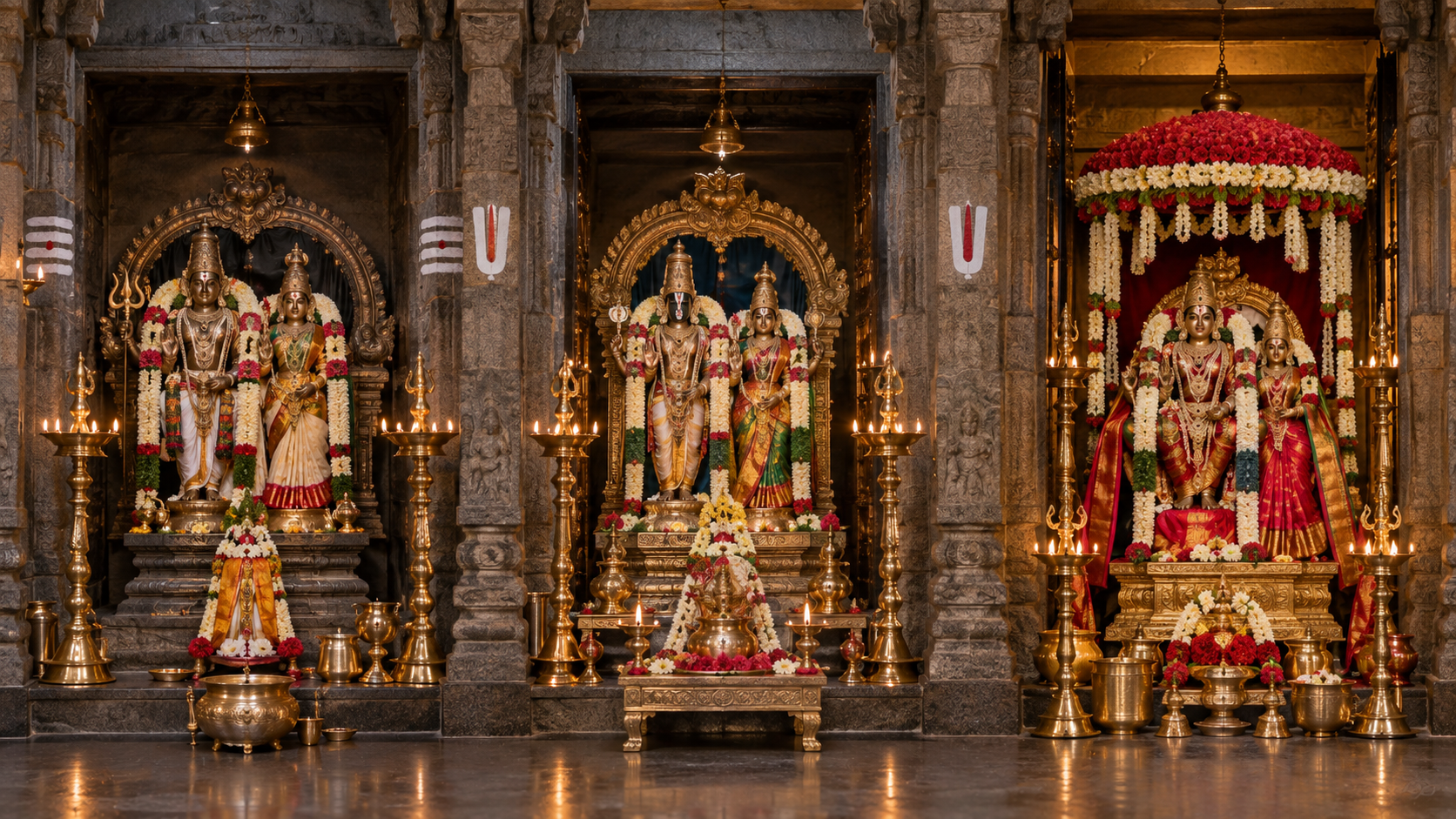
Many people hear “divine wedding” and immediately think of one familiar divine couple. That shortcut is unreliable. Thirukalyanam traditions can also be associated with Vayu, Agni, Yama, Chitragupta, Kubera, and the Navagrahas. A general explanation of one celebrated couple may therefore be irrelevant to the observance in front of you.
Start with the event notice and answer three questions: Which deity or divine form is named? Which temple is conducting the celebration? Does the temple provide its own account of the occasion? These details matter more than a generic description found elsewhere because a shared name does not guarantee an identical ritual sequence or theological emphasis.
- Use the complete event name. “Thirukalyanam” alone is too broad. Record the deity’s name and any title printed beside it.
- Ask the hosting temple first. The priest, office, noticeboard, or official announcement can tell you the local schedule and expectations.
- Keep identity and interpretation separate. A deity’s name may be certain even when the meaning of a particular gesture is not yet clear.
- Do not supply a missing consort name from memory. If the announcement does not identify the divine participants, ask rather than merging traditions or repeating an uncertain claim.
- Distinguish local custom from universal rule. Say “this temple observes” when describing a practice you have seen in one place.
This discipline is especially important when speaking with children or sharing photographs online. A confident but guessed caption can travel farther than the correction. A modest description such as “the temple’s Thirukalyanam celebration for Kubera” is better than adding an unsupported story, spouse, sequence, or promise of benefits.
How to participate respectfully at a temple
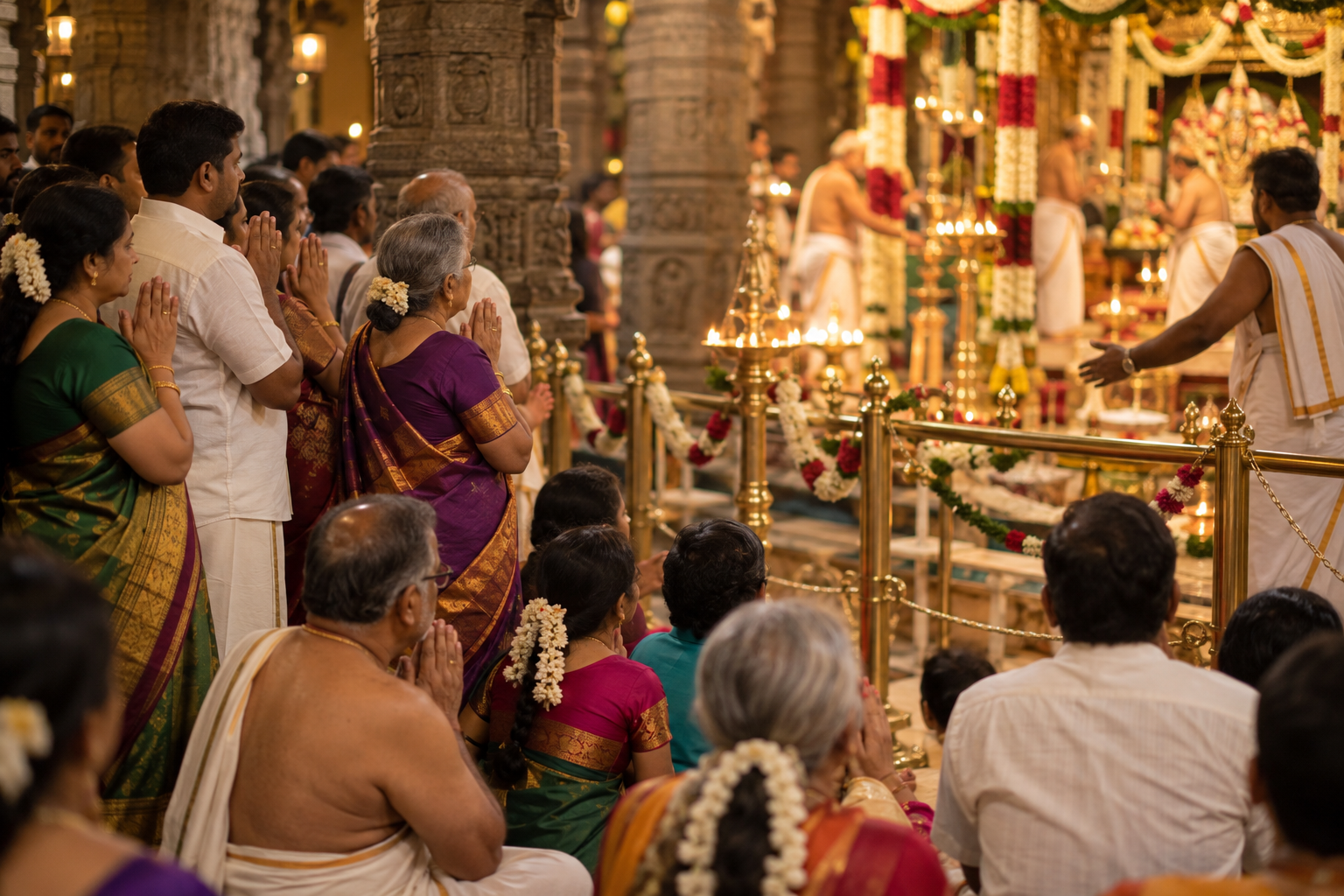
You do not need expert knowledge before attending. You do need enough preparation to avoid treating one temple’s sacred observance as an open-ended public performance. A short check with the host will usually settle the practical questions that generic advice cannot.
- Confirm the schedule. Ask when devotees should arrive, whether the announced time marks the beginning or a later public portion, and whether entry changes during any part of the observance.
- Ask what participation is available. Find out whether worship is open to everyone, whether prior registration is needed for any sponsored offering, and whether ordinary darshan remains available without sponsorship.
- Check what may be brought. Do not assume that flowers, food, cloth, or other offerings will be accepted. The temple may have specific arrangements, and an unrequested item can create work rather than serve the worship.
- Follow the local standard of dress and conduct. If you are unsure, ask before arriving. Inside, watch where devotees stand or sit and follow instructions without pressing toward the ritual area.
- Keep phones secondary. Confirm whether photography or recording is permitted. Even when it is allowed, avoid blocking darshan, interrupting recitation, or placing a camera between another devotee and the sacred focus.
- Receive only what is offered. If the temple distributes prasadam or another blessed item, follow the local cue. Do not reach across ritual boundaries or remove decorative and offered objects on your own.
If you cannot attend, resist the urge to reconstruct an unfamiliar temple rite from short video clips. You can mark the occasion through the devotional practices already established in your home, listen to an authorized transmission if the temple provides one, or support the temple through its stated channels. Simplicity is more respectful than imitation without context.
What to notice once the ceremony begins
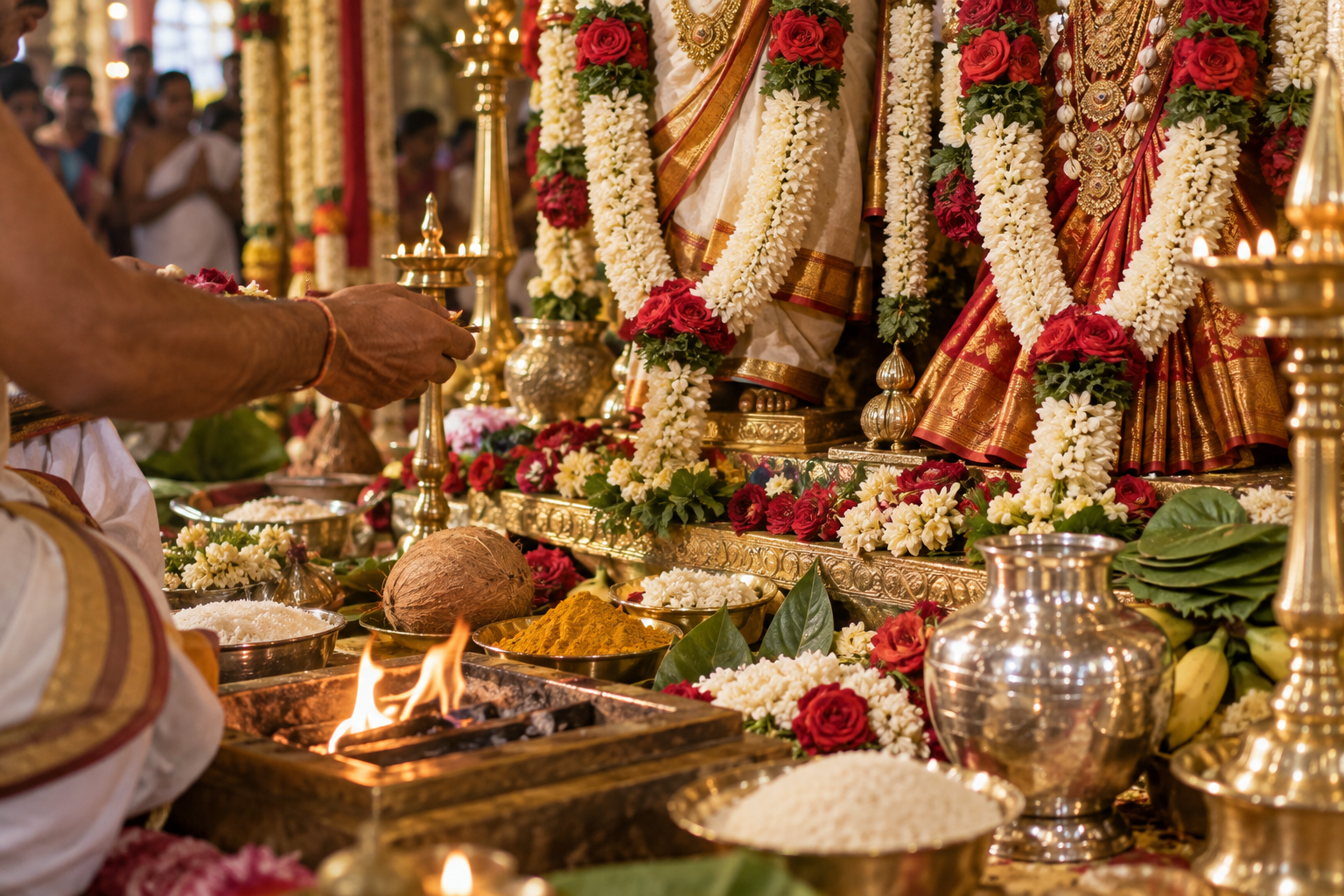
A Thirukalyanam becomes easier to understand when you watch for relationships rather than isolated objects. Notice how the divine presence is approached, how the officiants guide the sequence, how the gathered community responds, and how beauty is directed toward worship. You need not know the name of every act to recognize that the parts belong to an ordered whole.
Listen closely to any explanation offered by the temple. A local narration may tell you why this observance is held, which divine qualities are being honored, or how devotees should understand a particular moment. Treat that explanation as belonging to the named tradition, not as a formula to impose on every Thirukalyanam.
Notice the community as well. A divine marriage is not meaningful only at the ritual center. Devotees make space, observe discipline, share the occasion, and direct collective attention toward the deities. Your own contribution may be quiet: arriving on time, leaving a clear line of sight, listening during recitation, helping a family member understand the etiquette, or accepting that you do not yet know what a gesture means.
Finally, ask what the celebration invites you to cultivate after you leave. “Divine marriage” should not be reduced to a promise that attending will produce a desired human marriage or automatically solve a household problem. A more durable reflection concerns how you uphold harmony, responsibility, fidelity, reverence, and right relationship in the obligations already before you.
Key takeaways
- A Thirukalyanam is a divine marriage observed as worship, not simply a human wedding enacted with sacred characters.
- The deity’s complete name and the hosting temple are essential context; the word “Thirukalyanam” by itself does not identify one universal story or sequence.
- Traditions may concern deities beyond the divine couples most familiar to you, including Vayu, Agni, Yama, Chitragupta, Kubera, and the Navagrahas.
- Ask the temple about timing, offerings, access, sponsorship, dress, and photography instead of relying on assumptions carried over from another celebration.
- Do not guess a consort, ritual meaning, promised benefit, or universal rule when the local tradition has not supplied it.
- Participate through attentive darshan, disciplined conduct, and reflection on the divine qualities the observance places before you.
Your next step is simple: read the full temple announcement and ask one precise question before you go—“What should a first-time devotee know about this Thirukalyanam?” That answer will prepare you better than memorizing a supposedly universal script, and it will let the living tradition speak in its own voice.
References

Leave a Reply
You must be logged in to post a comment.