
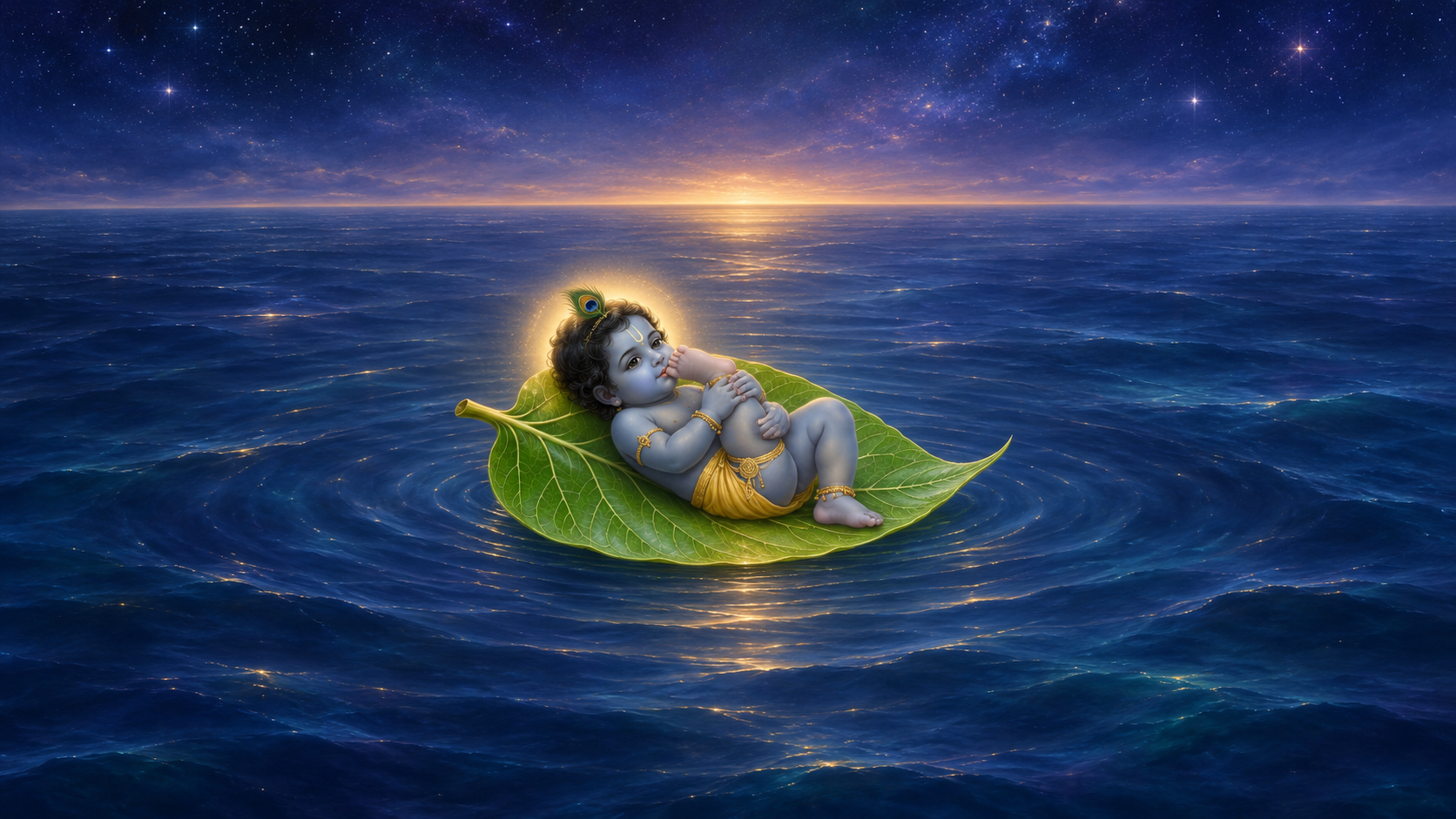
You may have seen the image and wondered how its gentle details fit together: infant Krishna lies on a leaf in immeasurable waters, calmly drawing his own foot to his mouth. Is it simply an endearing picture of Bala Krishna, or is every element carrying a deeper meaning?
The most useful answer begins with the image as a whole. The dark-skinned child, tiny banyan leaf, cosmic waters and right toe held to the mouth belong to a single symbolic composition known as Bala Mukunda or Vatapatrasayi, the one who reclines on a banyan leaf. Its meaning emerges from the relationships among those details: apparent fragility rests within divine completeness.
Begin with the image’s deliberate reversal

In ordinary life, an infant is dependent. A leaf is incapable of serving as a secure bed. Open water makes both seem more vulnerable, not less. Yet Krishna is neither frightened nor struggling. The scene places everything that should appear helpless at the centre of perfect composure.
That reversal is the first interpretive key. The child appears to need support, but the image invites you to see him as the source of security. The leaf seems too small, but it bears him. The waters have no visible boundary, but they do not overwhelm him. What looks fragile by worldly measurement is not fragile in its relation to the divine.
This does not require you to pretend that ordinary vulnerability is unreal. The image makes a subtler distinction: visible smallness is not the same as spiritual insufficiency. A person, community or civilization may pass through conditions in which familiar structures disappear. Vatapatrasayi directs attention to what remains when position, possession and external protection can no longer provide certainty.
When you look at the image, ask two concrete questions. Which elements would normally make the scene dangerous? Which figure behaves as though danger has the final word? The distance between those answers is where the symbolism begins.
The banyan leaf joins endurance with delicacy
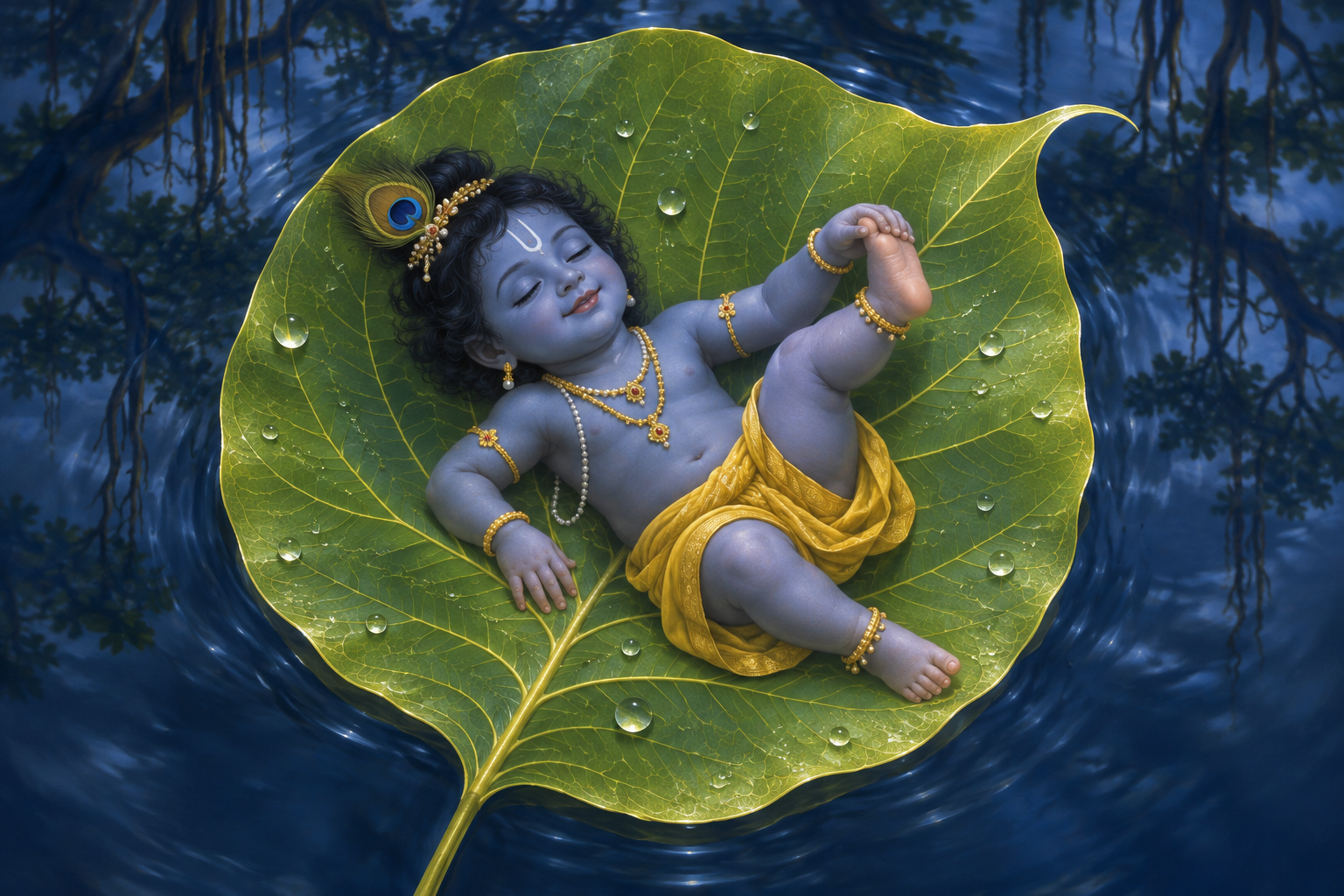
The banyan is expansive, rooted and long-lived. Its spreading form naturally evokes continuity across time. Vatapatrasayi, however, does not recline beneath the whole tree. He rests on one leaf: light, finite and apparently temporary.
That distinction matters. If you reduce the leaf to a generic sign of nature, you miss the tension built into the image. The enduring tree is present through its smallest bearer. Immensity is represented without being displayed. The part carries the memory and identity of the whole.
The leaf also supplies a boundary. The waters extend beyond the frame, while the leaf gives the infant a definite place. Form has not vanished into formlessness. A small, living surface holds a centre amid an environment without visible landmarks.
You can use this detail as a practical test whenever you encounter an interpretation of Vatapatrasayi. Does it account for both sides of the leaf: its connection to an enduring banyan and its own delicacy? An explanation that sees only permanence misses the leaf’s fragility. One that sees only fragility misses the tree whose life the leaf expresses.
The toe-to-mouth gesture forms a circle of completeness
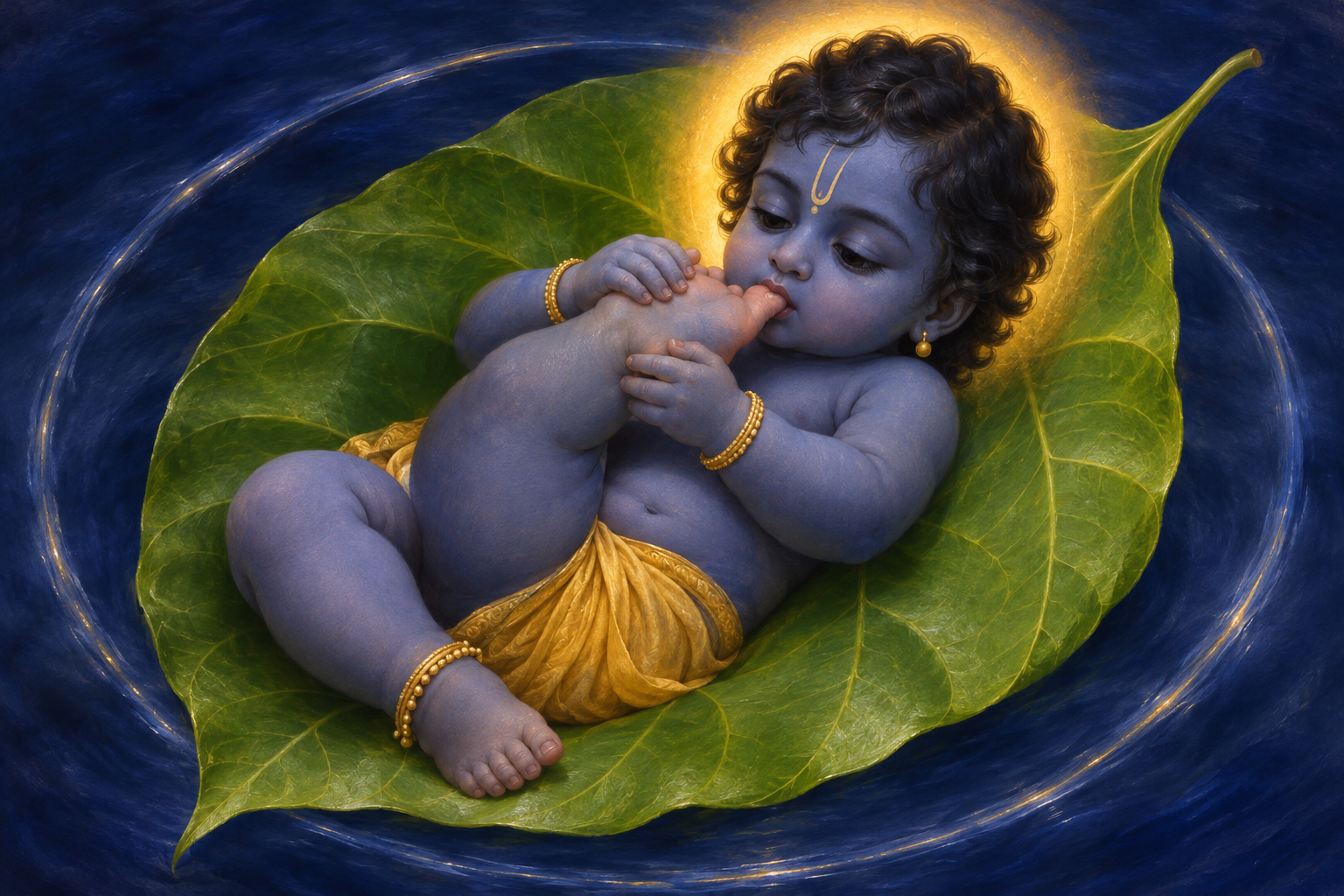
A baby bringing a foot to the mouth is entirely natural. That familiarity keeps the image intimate. Krishna does not cease to look like a child in order to signify the divine. The ordinary action is precisely what allows the extraordinary meaning to appear without spectacle.
The gesture also closes the body into a visual circuit. Foot and mouth, usually treated as opposite ends of the embodied person, meet. The foot is associated with contact, movement and the ground. The mouth receives nourishment and gives expression. In Vatapatrasayi, Krishna turns neither toward an external object nor toward another provider. The movement begins and ends within his own form.
This makes self-sufficiency visible without turning it into cold isolation. The child remains playful, embodied and approachable. Divine completeness is shown as contentment rather than possession, domination or display.
There is a further devotional resonance. Hindu worship often approaches the divine feet as a place of humility and surrender. Here the Lord’s own foot is drawn to his mouth. The one whose feet the devotee reveres is complete in himself; subject, object and enjoyment are gathered into one figure.
The detail that it is the right toe should be preserved when identifying the image, but it should not become a licence for invented codes. Unless your sampradaya, teacher or textual tradition supplies a specific explanation, do not force the scene into a simplistic claim that right automatically means good and left means bad. The secure symbolic meaning lies in the bodily circle and Krishna’s effortless contentment; more specialized readings should be identified as such.
The cosmic waters establish scale without defeating Krishna
The waters are not decorative scenery. They remove the ordinary coordinates by which you would locate and protect a child. There is no palace, household, shore or visible community. Nothing in the surrounding world explains Krishna’s security.
Water is mobile and difficult to grasp. A leaf floats by yielding to it rather than hardening itself against it. Krishna’s repose therefore should not be mistaken for rigidity. The image does not show him defeating the waters with force. It shows that their scale and movement cannot disturb his centre.
This is why the scene can speak directly to a person facing uncertainty. Its instruction is not that you can control every surrounding condition. Nor does it ask you to romanticize disorder. It asks you to distinguish the changing field from the centre by which change is understood. If your reading focuses only on catastrophe, you have let the waters displace Krishna from the symbolic centre.
Notice the contrast during darshan: the background is vast, but the infant commands attention; the water moves, but Krishna rests; the setting is austere, but the gesture is tender. The picture trains the eye to find the stable centre without denying the unstable field.
Take the image into contemplation without flattening it

Darshan is not merely an exercise in decoding symbols. Once you understand the composition, let it correct the way you direct attention. A simple contemplation can keep the image intact:
- First observe before interpreting. Name only what is present: Krishna as an infant, the single banyan leaf, the surrounding waters and the right toe at his mouth.
- Then identify the contrasts: child and cosmos, small surface and boundless setting, movement and repose, apparent dependence and inner completeness.
- Ask what you have been treating as your only source of security. Is it a role, institution, possession, reputation or circumstance that can change?
- Return your attention to Krishna rather than mentally enlarging the waters. Let the calm centre determine how you see the surroundings.
- Carry one distinction into the day: conditions may be unstable without making dharmic action meaningless. Choose the next right action from steadiness rather than from panic.
This practice is not a promise that devotion will remove every difficulty. Its value is more disciplined: it helps you notice when the mind gives surrounding conditions more authority than the divine centre. Vatapatrasayi does not make the waters disappear. He reveals that they are not ultimate.
Key takeaways
- Read Krishna, the leaf, the waters and the toe-to-mouth gesture as one composition, not as disconnected symbols.
- The infant form reverses ordinary expectations of helplessness: apparent dependence contains divine completeness.
- The banyan leaf holds together two truths, the continuity of the tree and the delicacy of a single living form.
- The foot meeting the mouth creates a circle of self-contained fullness while preserving the natural playfulness of a child.
- The cosmic waters represent a field without familiar security, but their vastness never becomes the centre of the image.
- Do not assign a specialized meaning to every detail unless a named lineage or teaching actually provides it.
The next time you stand before Vatapatrasayi Krishna, resist the urge to solve the picture at a glance. Follow its movement from the waters to the leaf, from the leaf to the child, and from the child’s foot back to his mouth. Then remain with the composure at its centre. That is where an attractive image becomes a usable spiritual teaching.
References

Leave a Reply
You must be logged in to post a comment.