

If you are trying to decide whether an agricultural reform is genuinely pro-farmer, ask a harder question than whether it raises yield or opens a market: when weather, prices, credit or logistics fail, who actually carries the loss?
A farmer-centered system cannot eliminate uncertainty. It can stop treating the cultivator as the default owner of every uncertainty. That requires a visible allocation of risk, capital that reaches the farm before decisions become irreversible, enforceable agreements and an end-to-end system connecting crop choice with the eventual buyer.
Diagnose the farm as a chain of risks
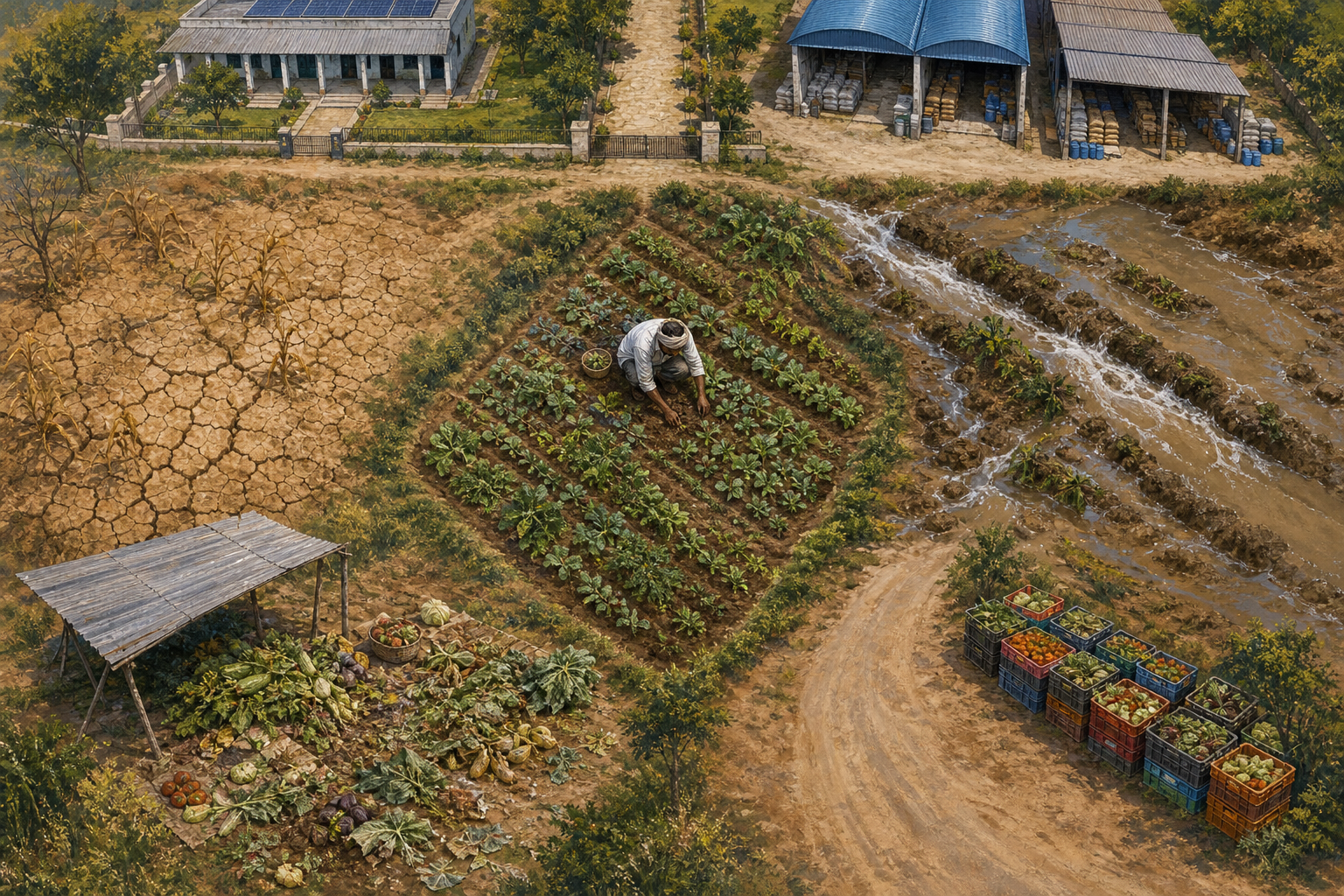
Most agricultural debates begin with production: better seed, more inputs, improved technique and higher output. Those measures matter, but production is only one part of the farmer’s exposure. A larger harvest does not guarantee resilience if the farmer financed it with debt, cannot store it and must accept a weak price from the only available buyer.
Before supporting a programme, draw a risk ledger for one crop from planning to payment. Record what can go wrong, who influences that outcome, who can afford to absorb it and who pays when it occurs. At minimum, the ledger should cover:
- Production risk: weather or crop failure can reduce the quantity or quality available for sale.
- Market risk: the price can fall after the farmer has already committed land, labour and money.
- Credit risk: the financial obligation can remain even when production or price disappoints.
- Knowledge risk: the crop may be chosen without adequate information about local conditions, farming requirements or likely demand.
- Contract risk: unclear grading, rejection, payment or enforcement terms can turn an apparent guarantee into another source of exposure.
- Post-harvest risk: missing transport or storage can force a sale on unfavourable terms or allow produce to lose value.
This ledger corrects a common policy mistake. Risk is often discussed as if it begins with rain and ends at harvest. In reality, the farmer can produce successfully and still lose through price, finance, transport, storage or a failed commercial handoff. If a reform addresses only the field, it has not yet addressed the farmer’s business.
Put each kind of capital beside the risk it can reduce
In a functional industry, risk is normally accompanied by resources for managing it. Financial capital absorbs losses and funds preventive action. Intellectual capital improves decisions and business design. Human capital supplies the skill needed to execute those decisions. Agriculture becomes structurally unfair when the farmer carries the largest bundle of risks while having the weakest access to all three.
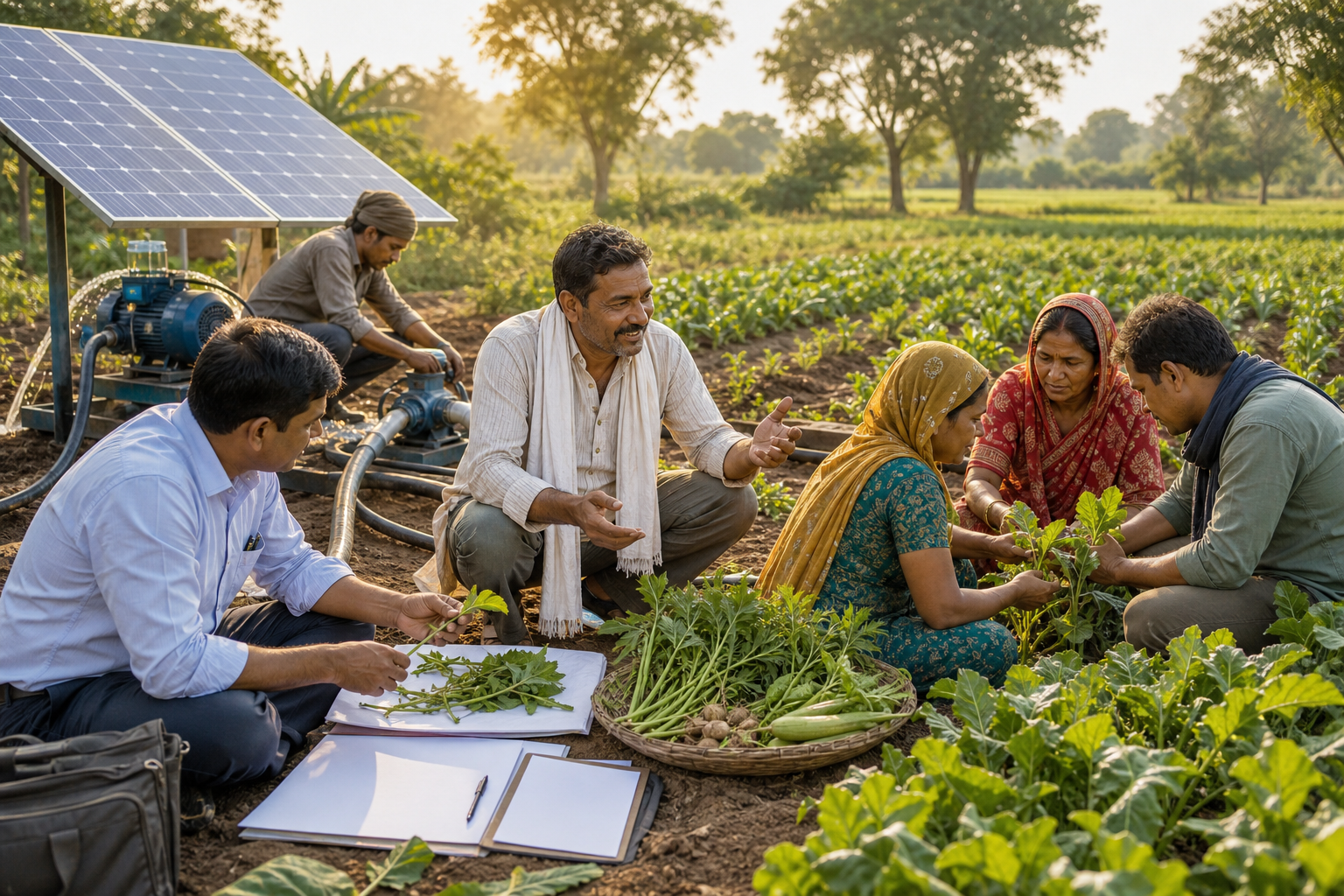
These forms of capital are not substitutes for one another. A loan without sound crop planning can finance a poor decision. Advice without affordable inputs or transport may be impossible to follow. A sales contract without storage, measurement and enforcement may give the buyer more certainty without giving the farmer comparable protection.
| Risk | Capital or institution needed | Evidence of farmer-centered design |
|---|---|---|
| Crop and weather | Local data, timely extension and written shock provisions | The crop decision has a recorded basis, and failure does not automatically remain the farmer’s burden alone |
| Price and buyer | Competitive market access, transparent price discovery and varied contract options | The farmer can see how the price is set and whether another route to market exists |
| Credit | Finance connected to the crop plan and its market route | The lender’s assumptions are not detached from production and sale conditions |
| Post-harvest | Reliable storage, transport and buyer coordination | The farmer is not compelled to sell merely because the produce has nowhere to wait or no way to move |
| Skills and execution | Agricultural extension and continuing feedback | Practical advice arrives before the relevant farm decision, not after the loss |
A subsidy, loan or digital service should therefore be judged as one component of a risk-management system. Ask which named risk it reduces and whether the farmer can use it at the moment that risk is still preventable. If neither answer is clear, the intervention may add activity without adding resilience.
Make contracts transfer risk, not merely lock in supply
Contract farming can give a cultivator an earlier view of demand, quality requirements and the route to sale. It can also become one-sided if the buyer secures supply while retaining broad powers over grading, rejection or payment. The presence of a signature is not proof that risk has been shared.
Before treating a farm contract as protection, check whether it clearly answers these questions:
- Who are the parties, and what quantity or delivery window is actually covered?
- Is the price fixed, formula-based or determined later, and can the farmer understand that mechanism before committing expenditure?
- Who defines quality, who measures it and what evidence must support a rejection?
- What happens when weather or crop failure prevents full delivery?
- Who carries loss during storage and transport, and at what point does responsibility pass?
- When is payment due, and what happens if it is delayed?
- Can a disputed rejection be reviewed before perishable produce loses its value?
- Is there an accessible path for enforcement, rather than a remedy that exists only on paper?
Actual enforceability depends on the applicable law and the wording of the agreement. Farmers and institutions should obtain qualified legal and agricultural review before relying on a contract with substantial financial consequences. The safe principle is broader: every party with commercial control should carry a defined duty and a defined consequence for non-performance.
The case for the Modi government’s farm-law programme rested on this risk-sharing logic: wider competition, contract farming and stronger price discovery could reduce the ability of established creditors, suppliers and buyers to protect themselves while leaving volatility with the farmer. Those are legitimate reform objectives, but an objective is not an outcome. Any market-opening measure still has to pass four practical tests: meaningful choice, understandable information, shared liability and usable redress.
This distinction helps you get beyond a purely partisan verdict. A reform is not farmer-centered merely because it invokes competition, and it is not anti-farmer merely because it changes an existing market arrangement. Follow the risk after the change. If it still stops with the cultivator, the architecture remains incomplete.
Build the system in the order the farmer experiences it
Agriculture cannot be repaired through disconnected schemes delivered at unrelated stages. Crop advice, inputs, credit, contracts, extension, storage, transport and payment must refer to the same production plan. Otherwise, one institution may encourage a crop, another may finance it and a third may discover too late that there is no coordinated buyer or logistics route.
An integrated Smart Agriculture Management System should follow the farmer’s actual sequence of decisions:
- Plan the crop. Combine local growing conditions, actionable agricultural knowledge, expected demand and available market routes before the farmer commits land and inputs.
- Align inputs and finance. Base both on the same crop plan, rather than selling inputs or credit in isolation from the likely sale.
- Present market and contract options. Show the farmer the price mechanism, buyer obligations, delivery requirements and alternatives before expenditure becomes difficult to reverse.
- Provide extension during cultivation. Advice must arrive when the farmer can still alter practice, protect quality or respond to changing conditions.
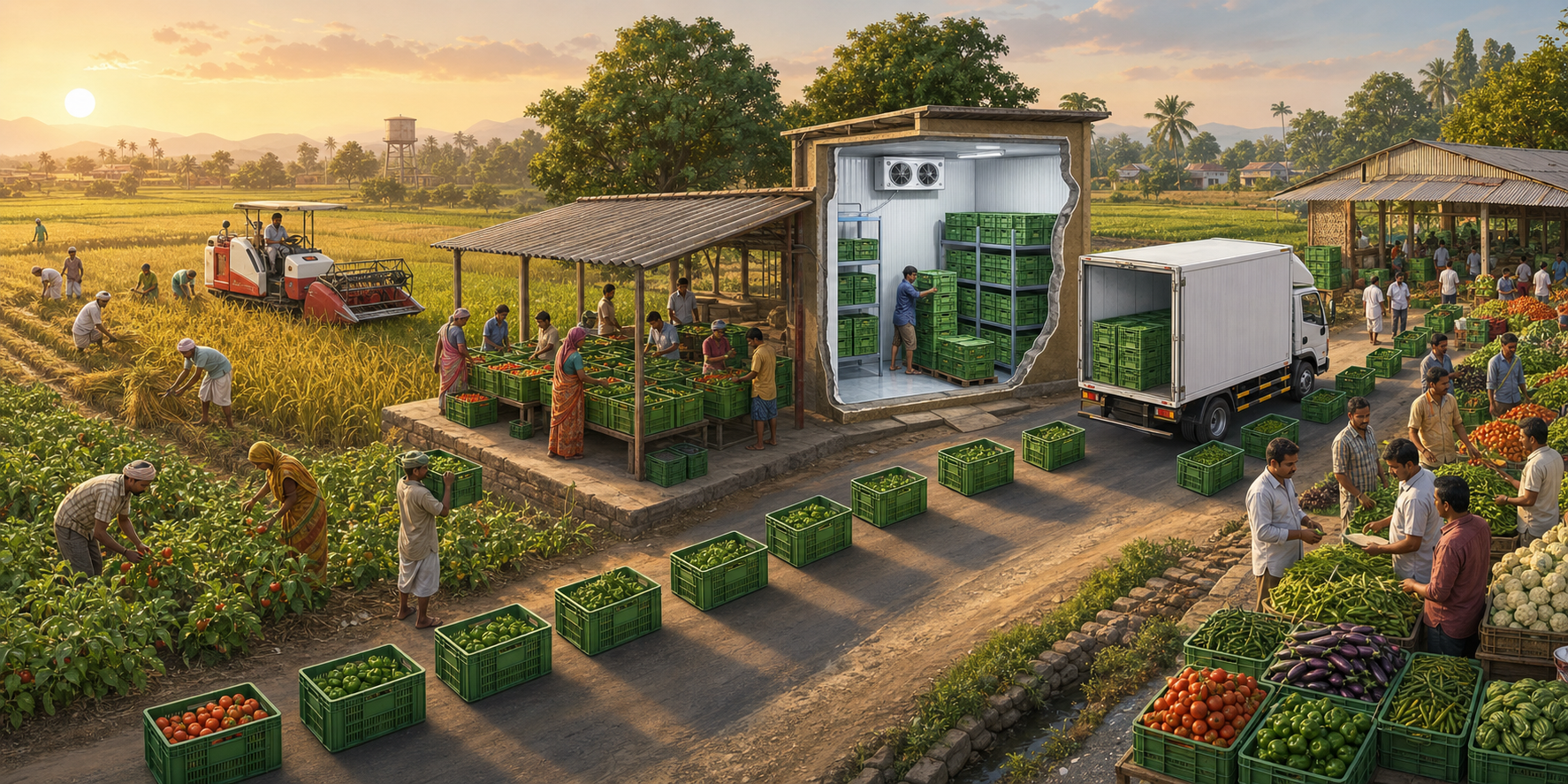
- Coordinate storage and transport before harvest. Waiting until produce is ready can turn a logistical gap into a forced commercial decision.
- Record delivery, grading, payment and outcomes. The next crop plan should learn from what actually happened, not merely from what was promised.
Technology can coordinate these stages, but digitising a fragmented value chain does not automatically make it fair. The platform must show who supplied each recommendation, who changed a term and who is responsible for the next action. Farmers also need a way to correct records and challenge a decision. A buyer or lender should not be the sole controller of the recommendation, transaction record and dispute process that governs its own conduct.
The value of integration is not that one platform controls agriculture. It is that crop planning, finance, skills, logistics and demand stop contradicting one another. Coordination should make obligations visible and choices more predictable while preserving the farmer’s ability to understand and evaluate them.
Key takeaways: apply the farmer-risk test
You can test a proposed law, platform, credit programme, procurement arrangement or contract by asking seven questions:
- Does it name the production, price, credit, knowledge, contract and post-harvest risks it is meant to address?
- For each risk, is responsibility assigned to the party best able to prevent, price or absorb it?
- Can the farmer understand the crop assumptions, price mechanism, quality rules and payment obligations before committing resources?
- Does the farmer have genuine market or contract choices rather than a nominal choice among equivalent terms?
- Are finance and inputs connected to a credible crop plan and route to sale?
- Are extension, transport and storage available at the stage when they can still prevent loss?
- When a shock occurs, is there a written adjustment, enforcement or dispute process, or does the remaining loss simply fall back on the farmer?
Every unanswered question identifies a design gap. Farmer-centered reform does not mean transferring every loss to the state, buyer or lender. It means placing each duty where the information, control and capacity to manage it actually reside. In a Dharmic understanding of economic order, honouring the annadata must include a fair distribution of obligations, not only respectful language.
When you next assess an agricultural proposal, trace one crop from choice to final payment. Mark who decides, who can prevent failure, who can exit and who pays. Support the reform only when the farmer is no longer the unnamed answer to the last question.
References
- DharmaRenaissance Blog — Proven Blueprint to Transform Agriculture: Why Farmers Bear All Risk and How to Fix It
