

You may know Radha chiefly as Krishna’s beloved and still wonder why an Odia sacred narrative identifies her with Lakshmi. Achyutananda Das’s Haribansha gives you a precise key: Radha appears as a lotus-born Devi and an incarnation of Goddess Lakshmi.
That identity is not a decorative detail added to a familiar romance. It tells you how to read Radha’s origin, dignity and relationship with the divine. Begin there, and the account becomes a statement about sacred manifestation rather than an unusual genealogy that must be forced into every other Radha tradition.
Read Radha’s divine identity before the romance
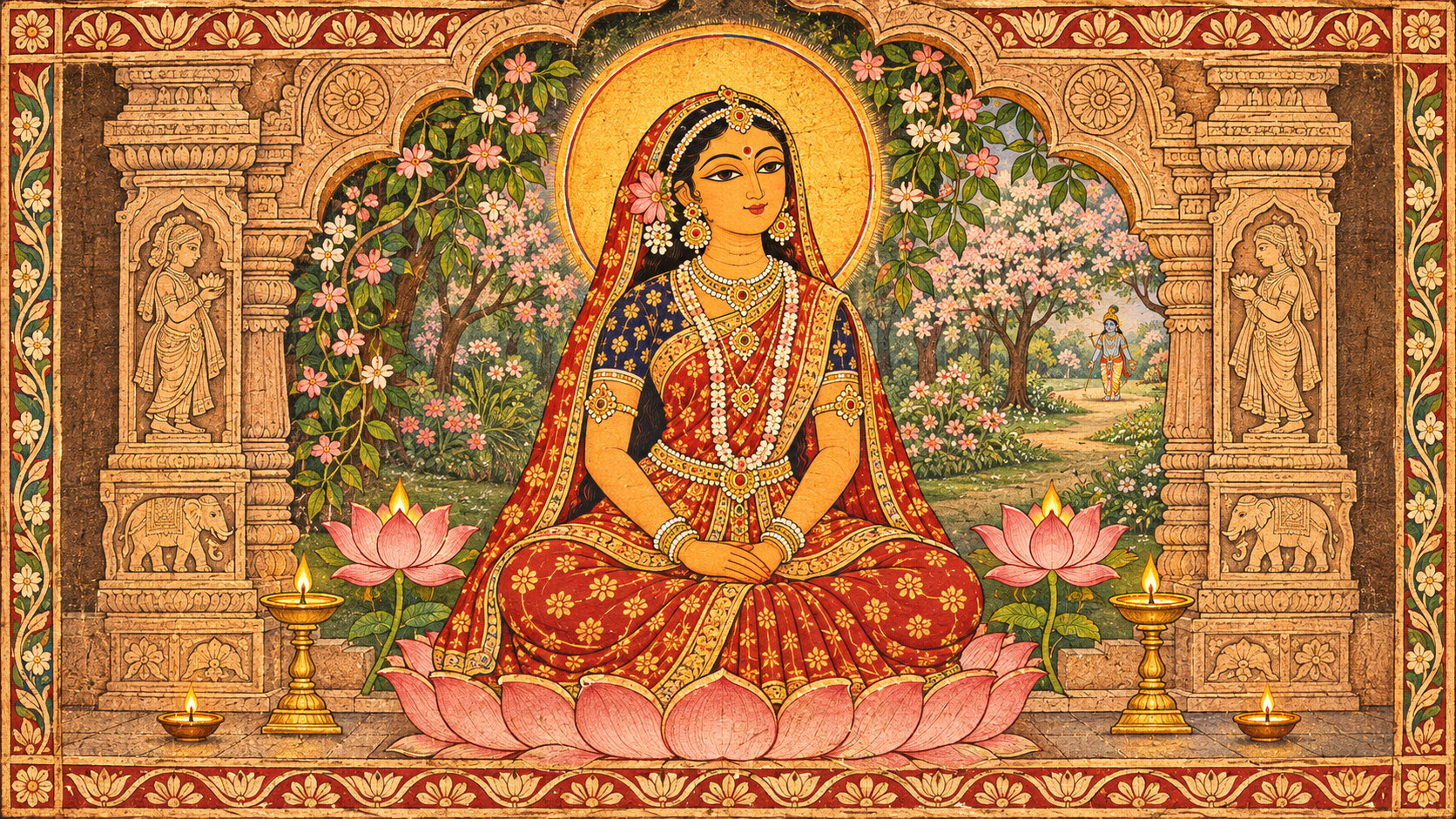
The central claim is theological: Radha is Lakshmi manifest in another form. She should therefore not be approached first as an ordinary woman who later acquires religious importance through her love for Krishna. Her sacred status belongs to her identity from the beginning.
This changes the questions you bring to the narrative. Instead of asking only what happens between Radha and Krishna, ask what their relationship reveals. If Radha embodies Lakshmi, devotion is not travelling in one direction from a human worshipper toward a distant deity. The feminine divine is already present within the relationship.
That distinction also prevents a common misreading. Calling Radha an incarnation of Lakshmi does not reduce her to a substitute name with no character of her own. Incarnation language allows a divine reality to become visible through a particular name, form and sacred history. You can therefore recognise Radha’s distinct devotional presence while understanding the deeper identity assigned to her.
The lotus birth should be read as sacred symbolism

The lotus has a durable place in Dharmic imagery. It rises from water and mud without being defined by them, making it a natural emblem of purity, divine emergence and spiritual transcendence. Describing Radha as lotus-born marks her arrival as extraordinary before any later event is considered.
Read that image symbolically before trying to make it biological. A sacred birth narrative answers a theological question: what kind of being has appeared? In this case, the lotus and the Lakshmi identity reinforce one another. Radha enters the narrative as Devi, not as an ordinary person whose divinity must be proved afterwards.
You should also resist filling every narrative gap with details borrowed from another telling. The description “lotus-born” establishes the character of Radha’s manifestation, but it does not by itself establish every circumstance surrounding that manifestation. Keep the claim the text actually makes, and leave additional names, places and sequences to the traditions in which they are explicitly found.
If you are reading a translation, preserve the lotus image in your notes. Replacing it with a vague word such as “beautiful” loses the symbol that connects origin, purity and divinity.
Why the Odia Haribansha context matters
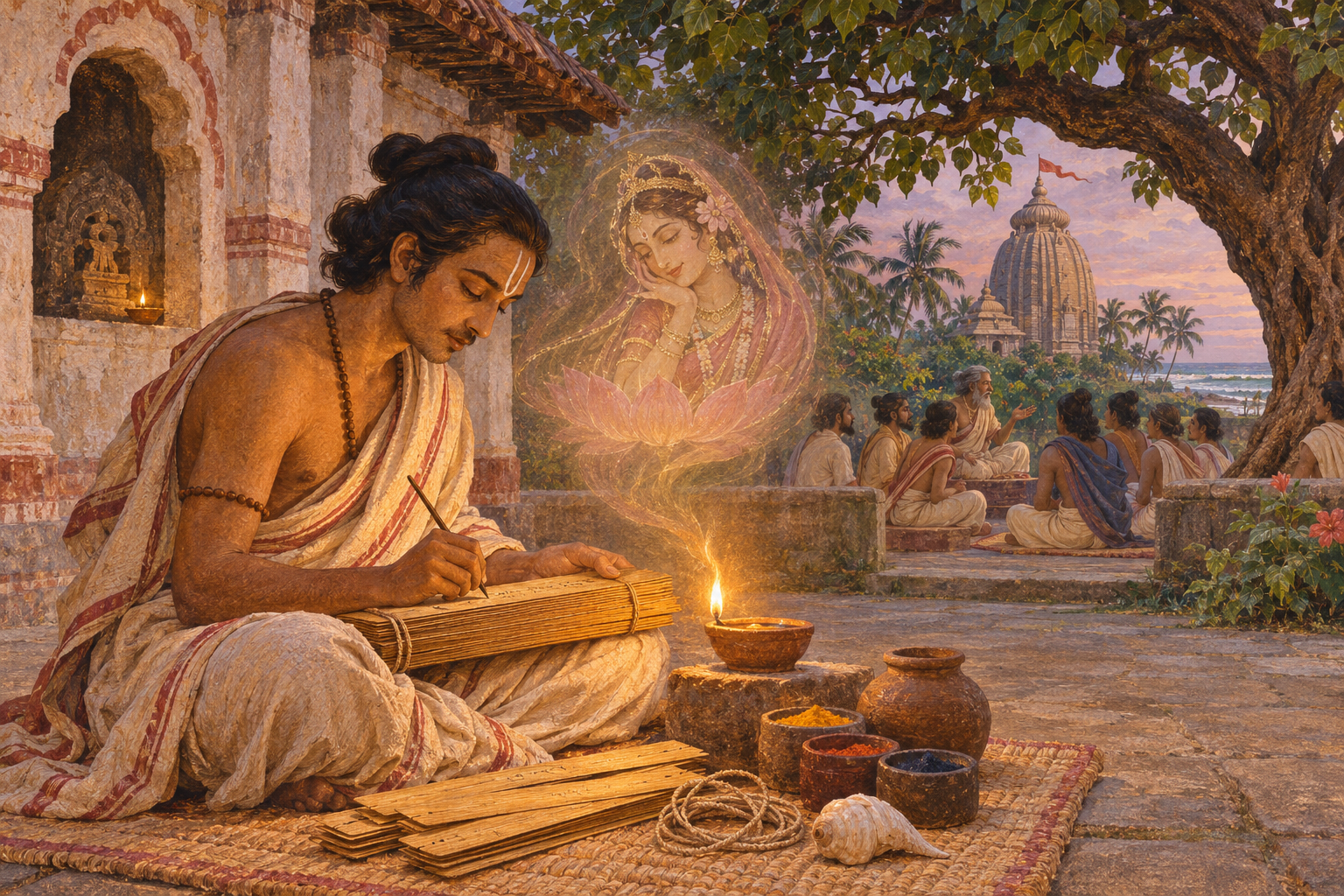
Achyutananda Das was a sixteenth-century Vaishnava saint-poet of Odisha. He belonged to the Panchasakha, a circle of five spiritual writers associated with making Sanskrit sacred learning available to ordinary people in Odia during the Bhakti period.
That setting matters because vernacular sacred literature is not merely Sanskrit material with different vocabulary. Bringing a narrative into Odia places it within the memory, speech and devotional life of Odisha. It enables inherited Vaishnava truths to be received through a regional literary world rather than remaining accessible only through a classical language.
Achyutananda’s Haribansha is a devotional retelling composed across several volumes. The word “retelling” gives you the right expectation: the purpose is not limited to reproducing words mechanically. Devotional narration communicates meaning through selection, emphasis, imagery and theological identification. Radha’s presentation as lotus-born Lakshmi belongs within that interpretive work.
Use the full identification when you cite or discuss the account: “Achyutananda Das’s Odia Haribansha.” Writing only “Harivamsha” can blur the distinction between this Odia composition and other works or recensions carrying a related title. The author, language and regional tradition are not optional bibliographic details; they tell your reader which Radha narrative is actually under discussion.
How to compare this Radha with other traditions
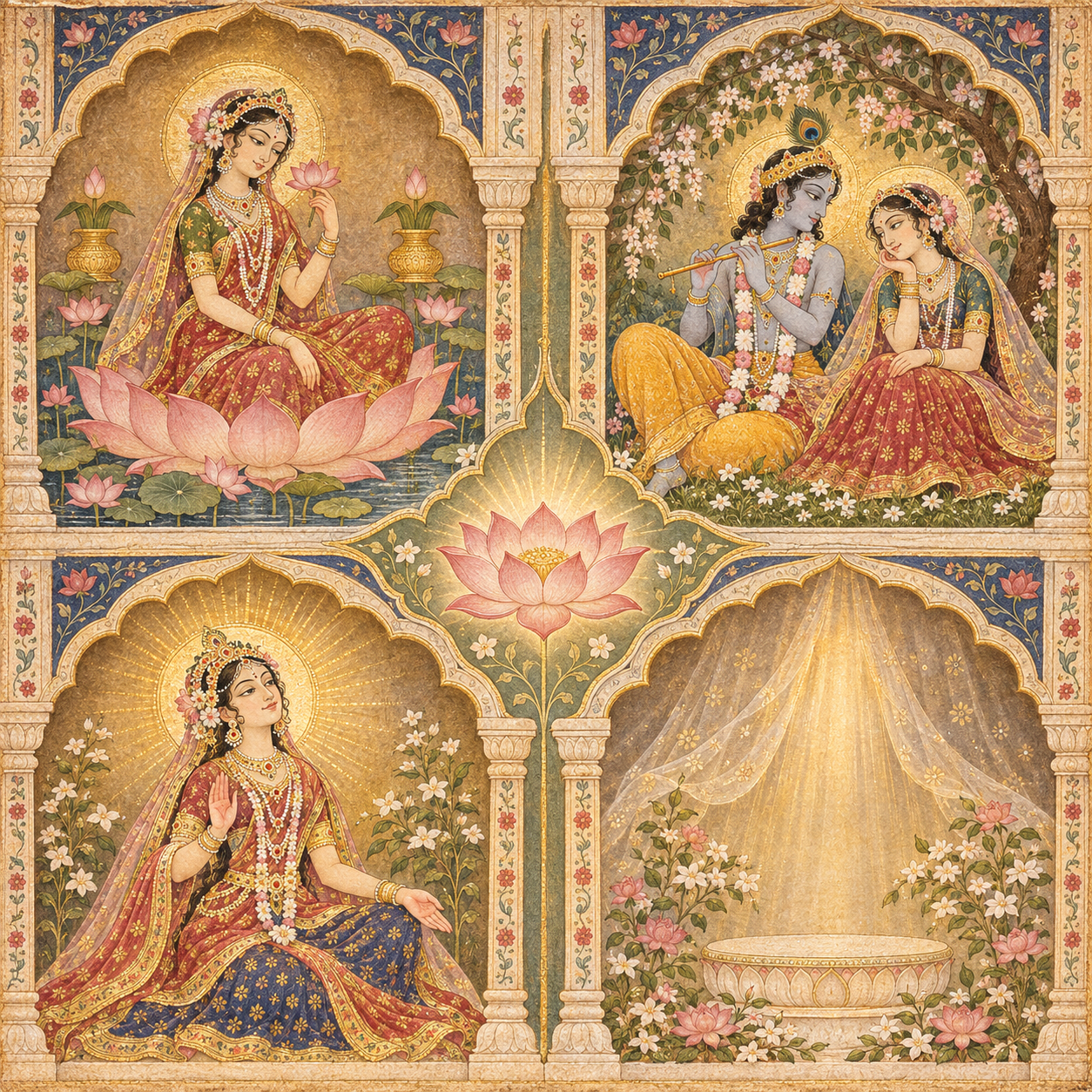
You do not need to make every account of Radha say the same thing. Hindu sacred literature often conveys theology through multiple narrative forms. A difference in origin story can reflect a difference of devotional emphasis rather than a simple contest in which only one text may carry meaning.
- Name the textual home. Record the author, work and language before comparing a detail. Here that means Achyutananda Das, the Odia Haribansha and the devotional culture of Odisha.
- Separate identity from narrative sequence. “Radha is Lakshmi” is the governing identity claim. “Radha is lotus-born” is the form through which that identity is expressed in this telling. Do not collapse the two into a bare chronological fact.
- Preserve the image. Ask what the lotus contributes that an ordinary birth would not. Purity, sacred emergence and divine status are part of the meaning carried by the image.
- Compare theological function, not only plot. When another tradition gives Radha a different origin, ask what each account seeks to reveal about her. Plot comparison alone can make genuine theological variation look like an error.
- Mark the limit of the claim. Say that Radha is presented this way in Achyutananda’s Haribansha. Do not silently turn a text-specific account into a universal description of every Vaishnava tradition.
This method lets you honour a regional scripture without isolating it from the wider Vaishnava world. It also avoids the opposite mistake of dissolving Odisha’s distinctive contribution into a generic account assembled from unrelated tellings.
Key takeaways
- Radha’s defining identity in Achyutananda Das’s Odia Haribansha is divine: she is presented as an incarnation of Goddess Lakshmi.
- Her lotus birth should be read as theological imagery of sacred manifestation, not reduced to an unusual piece of biography.
- The account belongs to the sixteenth-century Odia Vaishnava world of Achyutananda Das and the Panchasakha.
- The Haribansha is a multi-volume devotional retelling, so imagery and theological emphasis are central to how it communicates.
- When comparing Radha narratives, name the text and tradition rather than forcing every version into a single harmonised plot.
When you next encounter this Radha narrative, keep three notes beside the passage: Lakshmi is the identity, the lotus is the interpretive symbol, and Achyutananda’s Odia Vaishnava setting is the textual home. Those three anchors will keep the reading both devotional and precise.
References

Leave a Reply
You must be logged in to post a comment.