

You may be drawn to Shiva because conventional respectability feels cramped. Or you may be troubled by the opposite question: how can a deity who appears indifferent to convention guide anyone who still has duties to family, community and society?
The answer lies in a distinction that is easy to miss. Shiva does not make every rule meaningless. He makes it impossible to treat a human arrangement as the highest truth merely because it is old, orderly or socially approved. His challenge is not an excuse for chaos. It is a test of whether order still serves dharma.
The discomfort created by Shiva is part of the teaching
Society likes visible signs that tell us who is respectable, powerful, pure, successful and trustworthy. Clothing, possessions, titles, manners and institutional rank make people easier to classify. Classification makes collective life manageable, but it also tempts us to confuse a well-managed appearance with moral worth.
Shiva disrupts that confusion through his very form. The ash-smeared deity stands outside society’s neat arrangements of rules, hierarchy and control. He does not present sanctity in the polished form that worldly institutions usually reward. You cannot place him comfortably inside the usual scale of prestige.
That is why the image matters. Ash does not advertise wealth, office or refinement. On Shiva, it prevents social polish from becoming a substitute for spiritual depth. His untidiness is not merely an aesthetic preference. It confronts the assumption that what looks controlled must be good and what looks uncontrolled must be inferior.
You can use this challenge whenever appearance begins deciding your judgement before conduct does. When evaluating a person, teacher or institution, temporarily set aside presentation and ask three concrete questions: What responsibilities are actually being fulfilled? Who is treated fairly when there is no advantage in doing so? What happens when the person or institution is criticised? The answers reveal more than social polish can.
Order becomes a problem when it forgets its purpose

Rules are not automatically opposed to dharma. Families need agreements. Communities need procedures. Institutions need roles. Discipline can protect attention from impulse, and authority can coordinate work that no individual could complete alone. Rejecting all structure would simply allow the strongest personality to dominate without accountability.
The Shiva-like challenge begins when a useful arrangement becomes an unquestionable absolute. A role that once coordinated responsibility becomes inherited privilege. A rule meant to preserve trust survives even after it begins protecting hypocrisy. Discipline turns into surveillance. Stewardship turns into possession. Respect for experience turns into immunity from criticism.
At that point, order is no longer serving life; people are being made to serve the order. The structure may remain efficient and respectable while drifting away from its moral purpose. Shiva’s presence exposes that drift because he cannot be validated by the very hierarchy he unsettles.
When someone defends a rule by saying that it is simply how things are done, ask for the purpose in one sentence. A sound answer identifies a real good: protecting the vulnerable, assigning responsibility, preserving trust, transmitting knowledge or preventing harm. An answer based only on status, embarrassment or obedience deserves closer examination.
This does not mean that every imperfect rule should be broken. It means the burden of justification changes. Age can give a custom weight, but age alone cannot prove that every use of the custom is dharmic. Preserve what still carries its purpose. Reform what has become distorted. Oppose what now protects power at the expense of responsibility.
Bholenath exposes the performance of status

Shiva is called Bholenath, the innocent one. That innocence should not be mistaken for ignorance or carelessness. In this context, it points toward freedom from the constant calculation by which social identity is maintained: Who is watching? What will improve my rank? Which opinion will win approval? How must I appear in order to remain inside the accepted circle?
Much conformity is sustained less by conviction than by anticipation. You imagine the praise or disapproval of others, then adjust yourself before anyone has spoken. The external rule becomes an internal supervisor. This is how social control reaches the mind without needing open force.
Bholenath unsettles that mechanism. Innocence, in this reading, is action without elaborate self-advertisement. It is the capacity to meet a duty without converting the duty into a performance of virtue. It is also the capacity to reject approval when approval requires dishonesty.
Try a simple test before a consequential decision: if nobody could praise you, condemn you or learn that you had made this choice, would you still make it? The answer does not automatically tell you what is right, but it exposes how much of your motivation comes from status. Then ask a second question: if everyone copied your choice, who would carry the neglected burden? That question prevents freedom from becoming disguised selfishness.
Do not turn Shiva into a mascot for rebellion
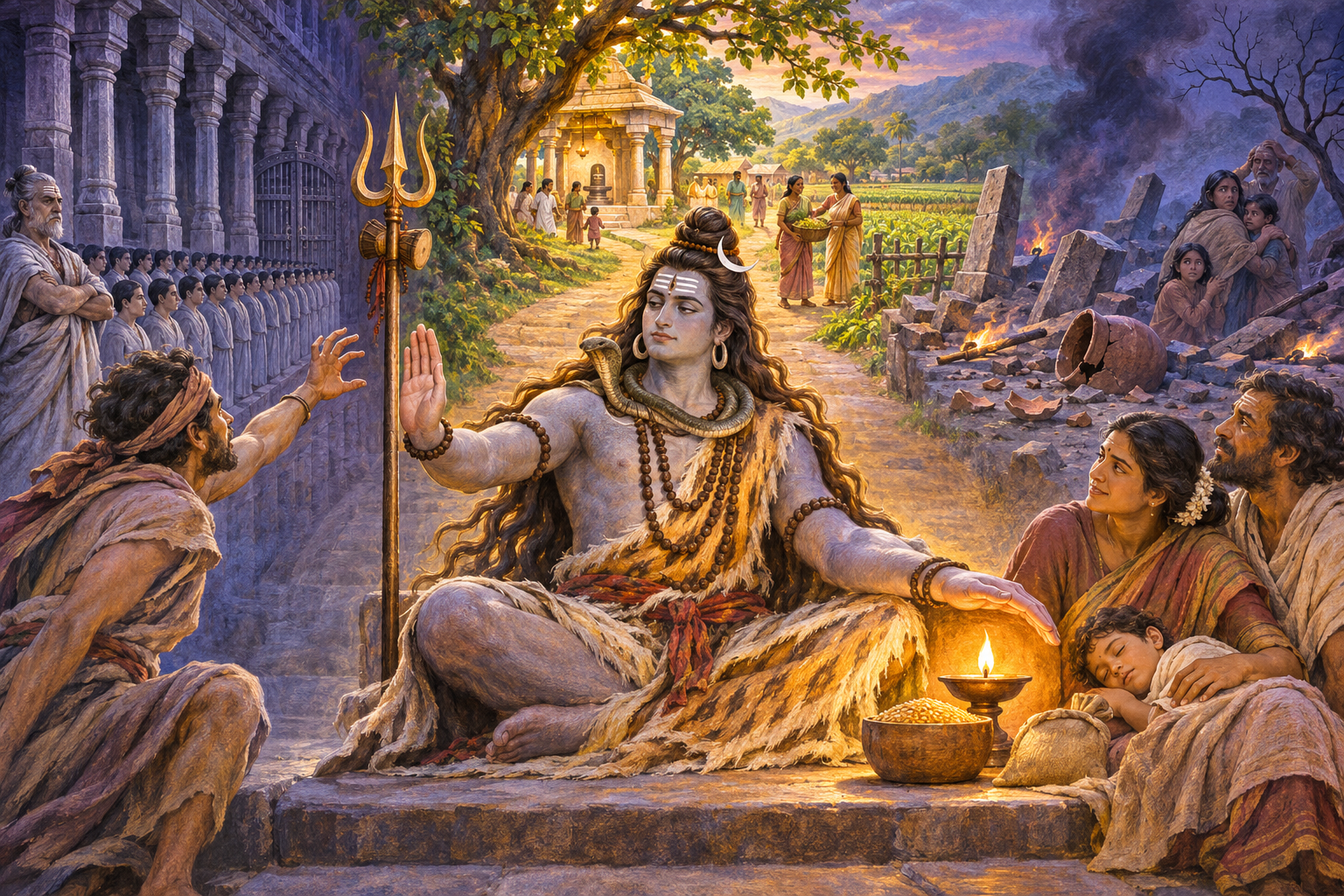
There is an easy but shallow way to interpret Shiva’s challenge: treat every convention as false and every act of defiance as authentic. That merely reverses the hierarchy. Instead of seeking prestige through obedience, a person seeks it through transgression. The audience still controls the performance.
Rebellion can become as vain as respectability. Disorder can also transfer its cost to people who did not choose it. A person who abandons a promise may feel liberated while leaving a dependent person to absorb the consequences. Someone who ignores a communal process may claim independence while relying on others to repair the damage. Neither action becomes dharmic merely because it shocks polite society.
Shiva’s indifference to convention is therefore more demanding than impulsive nonconformity. It asks you to become less governable by vanity while remaining answerable for consequences. That combination matters: freedom from approval, responsibility for action.
Notice the difference between these two statements: I refuse because no one may tell me what to do; and I refuse because this demand violates a duty I can name, while accepting the cost of my refusal. The first centres the ego. The second can be examined, challenged and defended in dharmic terms.
A four-question test for any disputed rule
When a family expectation, institutional policy, customary practice or social hierarchy troubles you, do not begin with obedience versus rebellion. Begin with diagnosis. Write down the rule as plainly as possible, then work through these questions.
- What good is this rule supposed to protect? Name the purpose without using vague words such as tradition, respect or order. Identify the actual duty, person or relationship being protected.
- Who receives the benefit, and who carries the burden? A rule deserves scrutiny when honour flows upward while inconvenience, silence or risk is consistently pushed downward.
- Is the rule applied to conduct or to status? A standard concerned with conduct asks whether the same responsibility is met. A status rule excuses one person and constrains another because of rank alone.
- What would responsible change require? Include the obligations created by your proposed refusal or reform. If you remove a structure, decide how its legitimate work will still be done.
Your answers lead to three different responses. Keep the rule when its purpose is sound, its burdens are proportionate and its application is honest. Reform it when the purpose remains valuable but the method has become unfair or empty. Refuse it when the rule itself demands a violation of truth or responsibility, and be prepared to state openly what duty your refusal protects.
This method also guards against two mistakes. One is defending injustice because disorder feels frightening. The other is destroying a useful form because freedom feels flattering. Shiva’s challenge cuts through both fears by asking whether the form serves what is true, not whether the form is comfortable.
Key takeaways
- Shiva challenges the habit of treating respectability, hierarchy and control as proof of moral worth.
- His position outside conventional order does not make every rule false; it requires each rule to justify the good it protects.
- Bholenath points toward freedom from status calculation, not freedom from consequences.
- Conformity and rebellion can both become performances of ego.
- A dharmic response preserves useful order, reforms distorted order and refuses demands that violate truth or responsibility.
Choose one rule that is creating tension in your life. Write down its purpose, its beneficiaries and its burdens. Then decide whether it should be preserved, reformed or refused. Do not ask only whether your choice will look respectable. Ask what duty it serves, what cost it creates and whether you can defend it without hiding behind either convention or rebellion.
References

Leave a Reply
You must be logged in to post a comment.