
If chanting Krishna’s names feels natural but bowing before a murti feels like a line you cannot cross, the conflict is not trivial. You may be trying to honor both a new spiritual attraction and an inherited warning against idolatry.
Before you either reject sacred images or silence your concern, identify the exact claim being made. A Krishna devotee is not ordinarily asking you to believe that a piece of stone has become a rival god. The claim is that the Supreme Lord may make himself available through a material form without being confined to that form. You may or may not accept that theology, but it deserves a more precise examination than the label ‘idol worship’ allows.
Begin with the question hidden inside ‘idol worship’
The word idol already contains a verdict. It identifies an object as a false god, so applying the word before understanding the worshipper’s belief settles the argument before it begins. If you want an honest interfaith conversation, start with a neutral question: what does this form mean within the practice of the people worshipping?
There are at least three different ideas that are easily confused. An object may be treated as an independent power. An image may function as a reminder of someone who remains absent. Or a sacred form may be received as a chosen means through which the divine becomes approachable. These are not interchangeable claims.
Krishna devotees worship the Lord in forms manifested through metal, wood, stone, fire, or a painted image. The physical material is not denied, but neither is God reduced to it. The form has boundaries; the Lord does not. The worshipper approaches a particular form while affirming that divine presence and power are not exhausted by that visible shape.
You already use material things to approach realities that exceed their physical components. A sacred book consists materially of paper and ink, yet reverence for it is not reverence for cellulose. A divine name passes through breath and vocal cords, yet a person who chants does not regard it as mere acoustics. Matter can carry meaning without containing the whole reality to which it points.
That analogy only takes you part of the way. A Krishna murti is not necessarily understood as a teaching aid that helps the mind imagine an absent deity. Within bhakti, the form is approached relationally: the devotee comes to see Krishna, be seen by Krishna, bow, chant, make an offering, and render service. The decisive question is therefore not whether the image resembles Krishna. It is whether the unlimited Lord can freely choose a limited, visible form through which to receive devotion.
The burning bush changes what can be ruled out

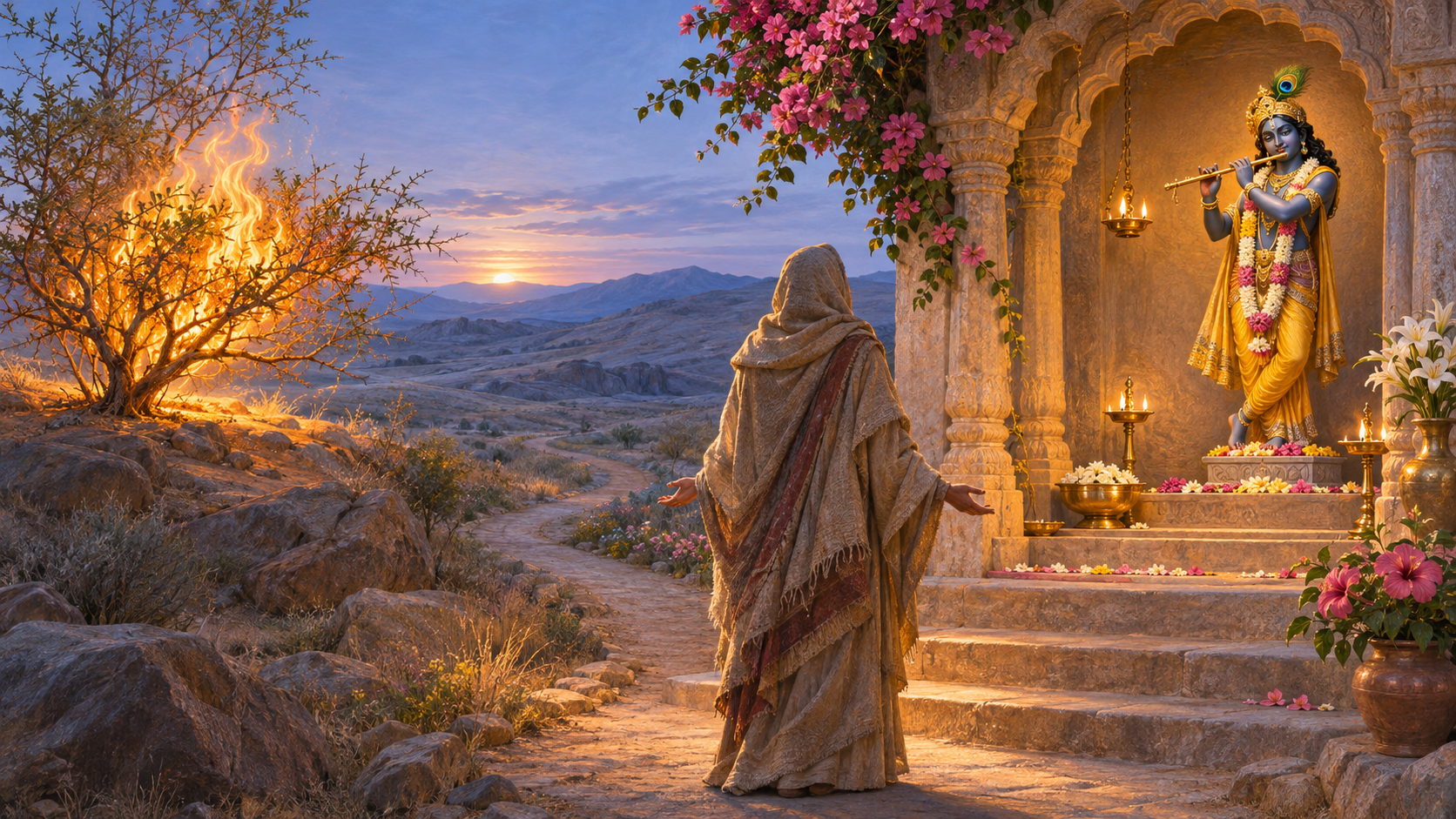
The encounter between Moses and the burning bush gives a questioning Christian a useful starting point. Moses sees a bush in flames that is not consumed, hears God address him from the fire, and is told to remove his footwear because the ground has become holy. The reluctant future leader then receives the service for which he is being called. This childhood encounter with the story led one future Krishna devotee to conclude that God can appear wherever and however God chooses.
Three distinctions in that scene matter when you think about sacred images:
- Divine freedom comes before human categories. Fire and vegetation do not dictate what God may do through them.
- Ordinary matter can become the site of a holy encounter without ceasing to be material. The bush remains a bush, yet the encounter is not merely botanical.
- Bodily reverence can express recognition rather than superstition. Removing footwear does not worship the soil; it acknowledges the presence that makes the place holy.
The burning bush does not, by itself, prove the theology of murti worship. A particular biblical theophany and the sustained worship of a temple form belong to different theological settings. Treating them as identical would obscure the real differences between traditions.
What the story does challenge is the absolute statement that God cannot become present through matter. Once that claim falls away, the discussion becomes more exact: Does God choose to become approachable in this form? How does a community recognise and receive that presence? What response follows if the presence is real? Those questions do not guarantee agreement, but they move you from ridicule to theology.
This also exposes a common error in debates about images. A prohibition against making a false substitute for God is not automatically proof that God lacks the power to reveal himself through anything visible. Human manufacture and divine initiative are different claims. Before rejecting a murti, ask which of those claims the devotee is actually making.
The Virgin’s smile reveals the grammar of an offering
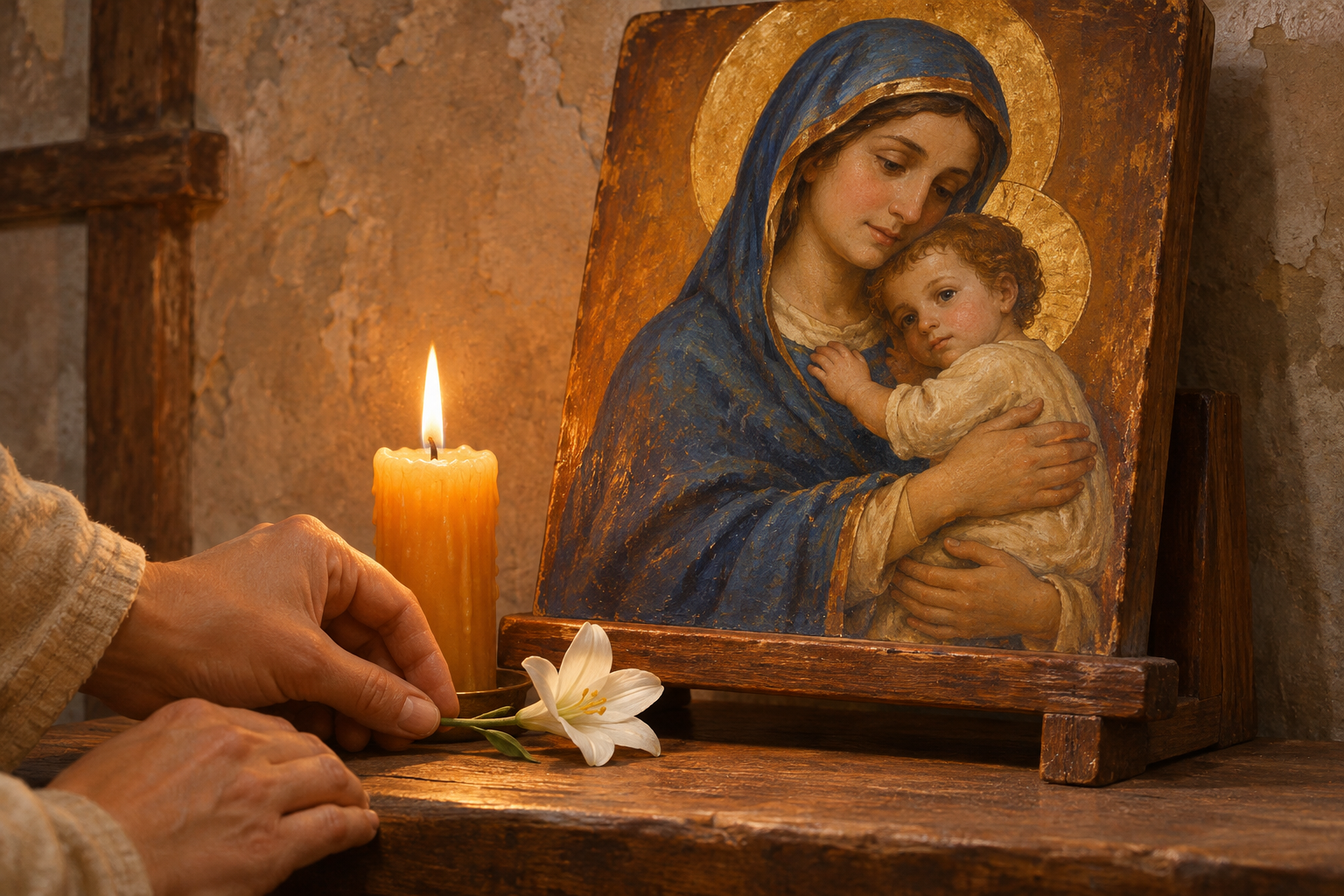
A second childhood story supplies the relational dimension that abstract arguments can miss. In the tale, a poor street entertainer becomes a monk but has no learned or prestigious gift to present. Seeing a sorrowful image of the Virgin Mary in Notre Dame, he waits until he is alone and offers the skill he possesses: he juggles until he is exhausted. An abbot arrives expecting to rebuke him, but the two then see the Virgin’s face smiling in acceptance.
The value of this story does not depend on treating it as historical proof of a miracle. Its importance lies in what it lets you notice about devotion. The entertainer is not performing for stone. He addresses a person through a sacred form. His offering has value not because juggling is a prescribed monastic ritual, but because he gives his ability, effort, and attention without calculation.
That is also why external acts in bhakti should not be dismissed as crude transactions. A bow, a song, or an offering is material, but material expression does not make a relationship materialistic. Human beings also express gratitude through words, meals, letters, and gestures. Love that never assumes a form can remain only an intention. Devotional practice gives the intention a body.
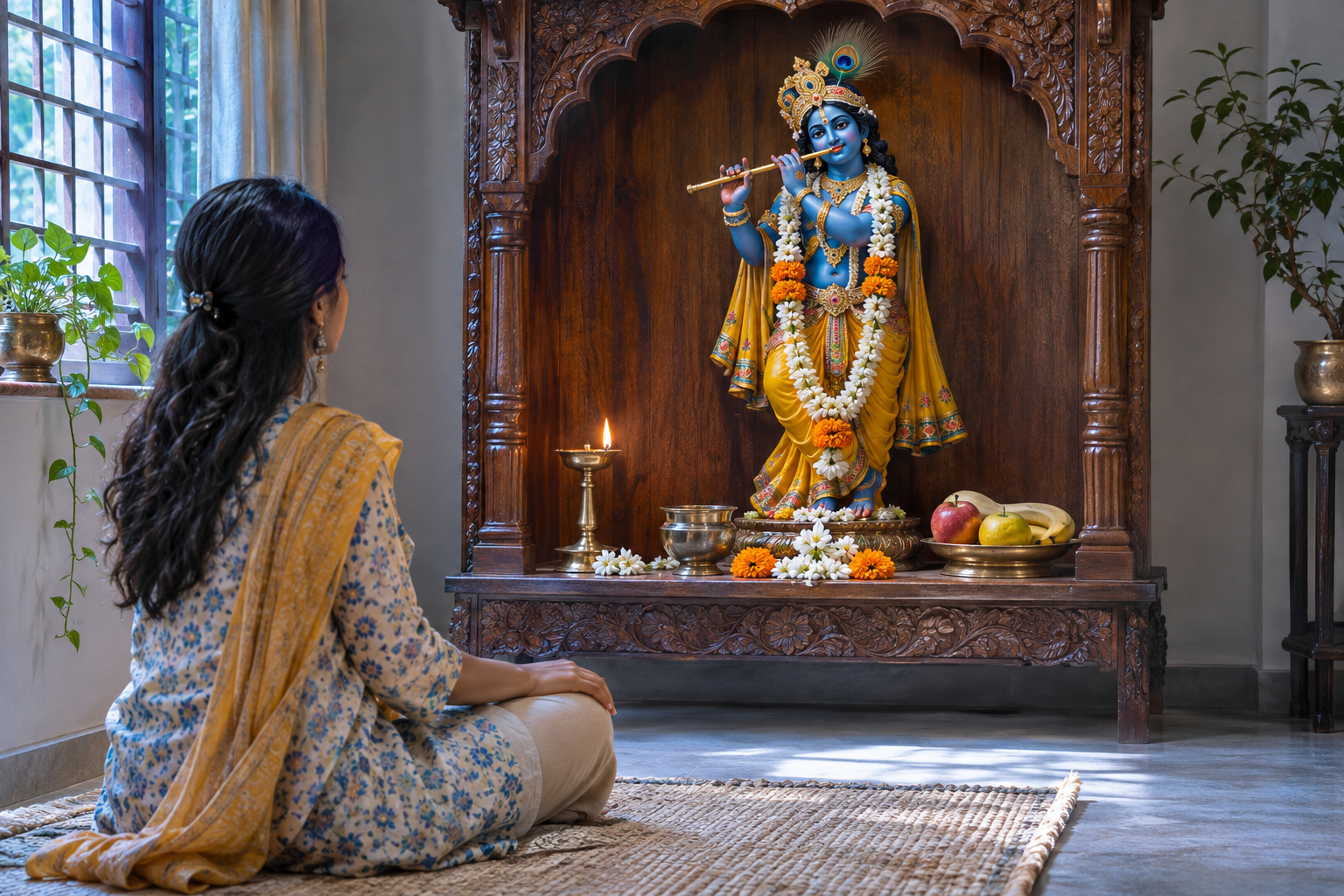
There is still an important difference between using an image to concentrate your own emotions and approaching a form believed to be responsive. In the first case, the image works primarily on your mind. In the second, you understand yourself to be meeting someone. Krishna worship belongs to that second grammar. This is why a devotee does not ordinarily treat the altar as a decorative display or a convenient backdrop for photographs.
When you enter a temple, notice this relational behavior before forming a judgment. Do people act as though they are inspecting an art object, or as though they have entered the presence of a person? Watch how they wait, bow, chant, offer service, and avoid casual treatment of the altar. The conduct will often explain the theology more clearly than the word image does.
What changed on the road from Christianity to Krishna
Kripamoya Das grew up in a Methodist setting in Cornwall. The burning bush had impressed him since early childhood, while the story of the juggling monk awakened sympathy for a Catholic form of devotion that was otherwise foreign to his surroundings. Years later, when he encountered Krishna devotees, he was attracted to the chanting of the maha-mantra but resisted their worship of sacred forms. It seemed culturally Indian and unnecessary to spiritual life.
The resistance weakened when those childhood stories returned to him. If God could address Moses from fire, and if an offering could be directed through the image of Mary, then wood, stone, metal, and paint could not be rejected merely because they were material. The deeper question was whether God had the freedom to make those materials a place of encounter. That recognition eventually allowed him to understand the deity addressed in his Christian childhood and Krishna, the speaker of the Gita, as the same Supreme Person.
That final identification is his spiritual conclusion. It is not a formula that every Christian, Hindu, or interfaith visitor must sign. Christian traditions disagree among themselves about images, and Vaishnava worship has its own theological claims. Moses’ encounter, Marian devotion, and Krishna’s murti should not be flattened into three names for an identical ritual.
The journey is useful because it demonstrates continuity without pretending sameness. A person need not begin by insulting the faith that formed him. He can return to one of its strongest convictions – that God is free, active, and able to make himself known – and ask whether his objection to another tradition is consistent with that conviction.
You can use the same method even if you reach a different conclusion. Preserve the real concern behind your inherited teaching. Distinguish a warning against false gods from a claim that God cannot use matter. Learn what the other tradition believes before deciding whether it violates or enlarges your understanding. An honest interfaith journey does not require immediate agreement; it requires accurate disagreement.
How to approach a Krishna murti without pretending certainty
If this question is personal for you, use a sequence that keeps curiosity, reverence, and judgment in their proper places:
- Write your objection as one complete sentence. Is your concern that God cannot be present through matter, that making an image limits God, that a particular form lacks divine authorisation, or that bowing would violate your conscience? These are different objections and require different answers.
- Use the community’s own word before using a hostile label. Ask a devotee what murti means in that tradition and whether the form is understood as a symbol, a manifestation, or a personal presence. Do not assume the answer from the material you can see.
- Ask what makes this form worshipful. Does every carved object qualify, or is the form received and served within an authorised devotional practice? The answer will tell you whether the worshipper believes human craftsmanship controls God or that divine initiative makes worship possible.
- Observe temple etiquette without performing belief you do not hold. Remove your shoes where required, remain quiet near worship, do not touch the altar or its objects, and ask before taking photographs or presenting an offering. Respect is not the same as assent.
- Keep understanding, participation, and conviction separate. You can understand why a devotee bows without bowing yourself. You can join congregational chanting without having resolved every theological question. You can also find a practice coherent before deciding whether it is true.
- Bring the question into the spiritual practice you can perform honestly. If chanting Krishna’s names is sincere for you, continue chanting. Ask God for clarity rather than forcing yourself into either enthusiasm or refusal. A borrowed gesture will not settle a question that requires conviction.
As you observe, evaluate the effects that the practice is meant to cultivate. Does approaching the murti call the devotee out of casualness and into attention? Does it produce service rather than possession, humility rather than control, and remembrance rather than distraction? These effects do not independently prove divine presence, but they help you understand the kind of relationship the ritual is forming.
Key takeaways
- The label ‘idol’ assumes that the object is a false god; learn what the worshipper believes before applying that verdict.
- The burning bush does not prove murti worship, but it challenges the claim that God is unable to become present through matter.
- Krishna’s sacred form is approached relationally, not merely viewed as religious art or used as a visual reminder.
- You can visit, ask questions, and observe respectfully without pretending to hold a conviction you have not reached.
- A responsible interfaith bridge preserves real theological differences while testing whether an inherited objection is logically consistent.
Your next step need not be conversion or rejection. Visit a Krishna temple, ask one precise question about what devotees believe they are doing before the murti, and remain long enough to observe the worship rather than only the object. If you leave understanding why the form is addressed as a person, you will have crossed the first and most important distance – from judging an unfamiliar practice to seeing the question it is trying to answer.
References
- Dandavats – How Moses and the Virgin Mary brought me to Krishna
- Kripamoya.com – How Moses and the Virgin Mary brought me to Krishna

Leave a Reply
You must be logged in to post a comment.