

You may have opened the second question of the Prashna Upanishad expecting a breathing technique. Instead, you encounter a dispute among the powers of embodied life and an exalted hymn to prana. It is easy either to reduce prana to the air entering your lungs or to inflate it into a vague name for everything divine. Both readings miss the argument.
The chapter is asking you to reconsider what makes a living person a coordinated whole. Speech, sight, hearing, mind, and the elemental powers all have real functions, but none is self-sustaining. Prana has primacy because the other powers depend upon it. Once you recognize that pattern of dependence, the teaching becomes clearer and much more useful for sadhana.
The question is about dependence, not anatomy
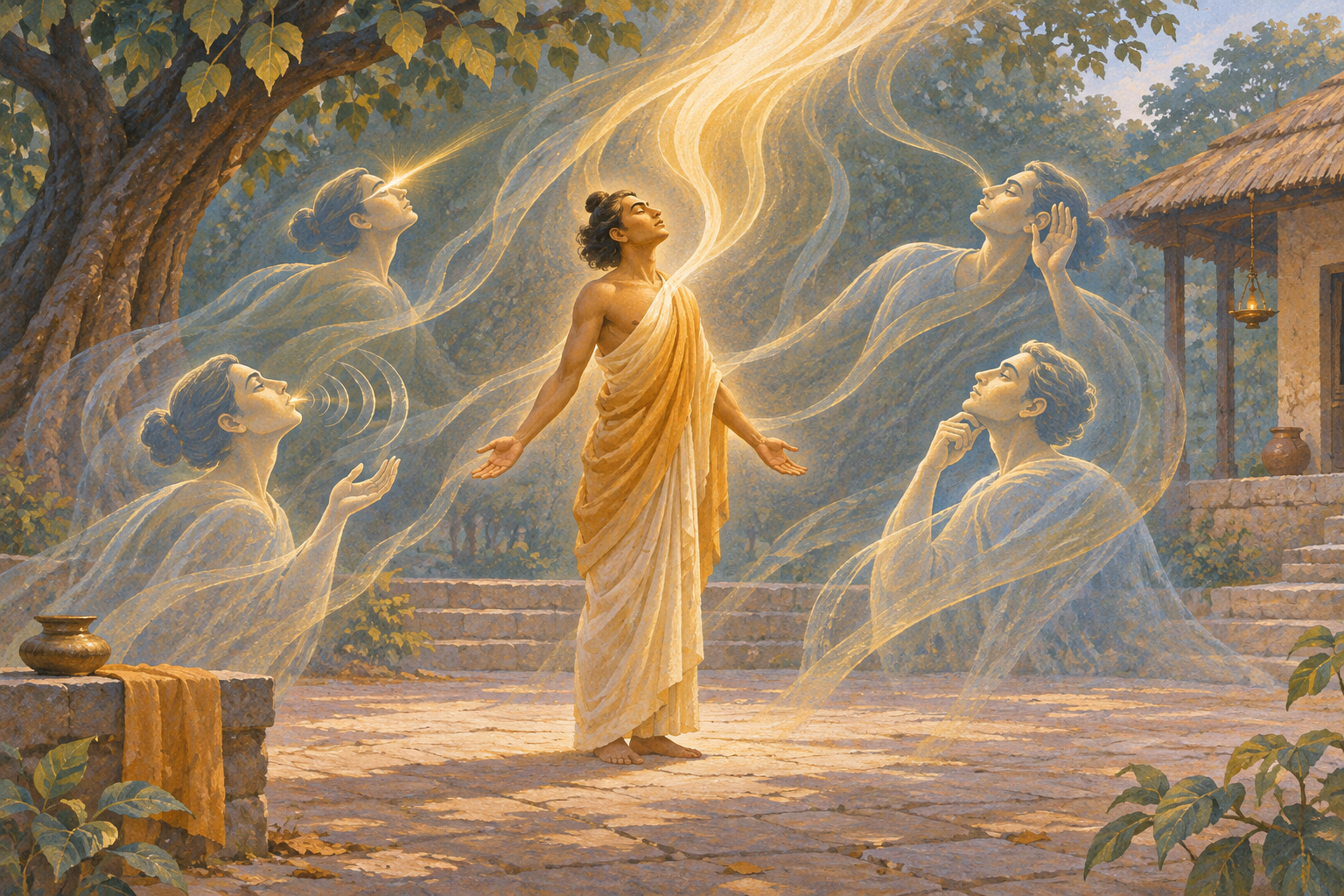
The Prashna Upanishad is traditionally associated with the Atharvaveda and organized around six questions addressed to the sage Pippalada. Its second question turns to the powers that uphold an embodied being: Which powers sustain life, which make their presence manifest, and which is foremost?
The faculties and elemental powers present themselves as the true supporters of the person. Each can point to an indispensable function. Without sight, the visible world disappears. Without hearing, sound cannot be received. Without speech, meaning cannot be expressed. Without mind, experience cannot be gathered and interpreted. Their claims are not foolish; their mistake is to treat an important function as an independent foundation.
Prana answers through a demonstration. When prana makes as if to depart, the other powers begin to follow. When prana becomes steady, they become steady. The relationship is compared to bees following their leader as it rises and settling when it settles. The episode supplies the chapter’s central test: the foremost power is not the one that speaks most impressively about itself, but the one whose departure makes the others unable to remain.
This is why primacy does not mean exclusivity. The Upanishad does not declare that speech, sight, hearing, or mind is unreal. It places them in an order. They retain their distinct functions, yet their activity rests upon a life-power they do not generate for themselves.
That distinction should guide your reading. Whenever the chapter calls prana supreme, ask, “Supreme in relation to what?” Here the answer is precise: prana is supreme among the powers sustaining and coordinating embodied life. Keeping that scope in view prevents both a narrowly physical reading and an uncontrolled metaphysical one.
Prana includes breath but cannot be reduced to air

“Vital breath” is a useful translation of prana, but it is not a complete definition. Breathing is the most immediate bodily sign through which you can approach the idea. Prana, however, is presented as the sustaining principle that makes the coordinated activity of the living being possible. Air is something that moves into and out of the body; prana names the life-power by which the organism’s faculties are upheld.
This distinction matters because three common shortcuts distort the teaching:
- Prana is not simply oxygen. Oxygen belongs to a physical account of respiration. Prana belongs to a scriptural account of living power and dependence. The two concepts answer different kinds of questions, even though breathing gives you an experiential doorway into the latter.
- Prana is not merely the feeling of having energy. Alertness, fatigue, enthusiasm, and agitation are changing experiences. None of them, by itself, defines what the Upanishad means by the principle supporting the senses and mind.
- Prana should not automatically be treated as a synonym for every ultimate reality. The language of praise is expansive, but the question under discussion concerns the power that sustains manifested life. A claim has to be interpreted within the question it answers.
You therefore do not have to choose between saying that prana is “only breath” and saying that it is an undefined cosmic substance. A more faithful reading begins with the relationship shown in the narrative: breath makes prana perceptible to you, while prana is conceptually larger than the mechanical movement of breathing.
The hymn expands prana from the person to the cosmos

After prana’s primacy has been demonstrated, the other powers praise it. The language moves beyond the individual body and associates prana with cosmic functions such as fire, the sun, wind, and rain. This widening of scale is not decorative excess. It prevents you from imagining life as an isolated private possession sealed inside one body.
The same ordered vitality is recognized through two perspectives. Within the person, prana sustains the faculties. In the wider world, life depends upon interlocking cosmic conditions. The Upanishadic method places the human being and the cosmos in correspondence without reducing one to the other.
The image of spokes fixed in a wheel’s hub sharpens the point. A spoke remains distinct and performs its own work, but it cannot form a wheel by floating independently. Sacred knowledge, ritual activity, social power, and the functions of embodied life are similarly presented as resting in prana. The image teaches ordered plurality: many powers, one sustaining center.
When you read the hymn, use two passes. On the first, mark every bodily, natural, ritual, and cosmic reference. On the second, ask what relationship each image expresses. Does it show nourishment, movement, manifestation, support, or dependence? This keeps the hymn from turning into a list of impressive divine names. It becomes a carefully structured vision of how life holds diverse activities together.
It also protects against an egoistic misreading. The teaching does not say that your individual personality commands the sun, rain, senses, or sacred order. It asks you to see that the life you call “mine” participates in conditions you did not create. The proper response to prana’s greatness is therefore humility, not self-magnification.
How to turn the teaching into a disciplined contemplation

The second question gives you a contemplative framework, not a technical pranayama manual. It provides no basis for inventing breath-retention ratios or forcing the breath. You can work with its teaching directly by preserving the sequence of question, demonstration, praise, and reflection.
- Read the dispute before interpreting the hymn. Note which faculties claim to sustain the person. This establishes the problem the praise of prana is meant to solve.
- Make a map of dependence. Write down each faculty named in the narrative and the work it performs. Beside it, record what the departure episode reveals: an essential function is still not an independent source of life.
- Observe natural breathing without manipulating it. During your usual period of japa, meditation, or scriptural study, let the breath remain unforced. Notice that speech can fall silent, the eyes can close, and a thought can pass while breathing continues. Do not conclude that breath and prana are identical; use the observation to recognize the asymmetry between a changing faculty and the life that supports its activity.
- Apply the teaching to the faculty you overvalue. If you identify strongly with intellect, eloquence, sensory experience, or willpower, ask what happens when that faculty mistakes its contribution for sovereignty. The chapter’s answer is not to despise the faculty but to return it to its proper place.
- Carry the insight into conduct. Speech supported by prana should not become careless speech. Intelligence supported by life should not become arrogance. A faculty received within a larger order is to be disciplined and used responsibly, not worshipped as self-created.
This contemplation is especially useful when spiritual study becomes overly intellectual. The mind may understand every term and still imagine itself to be the master of the person. The departure episode cuts through that conceit. Mind is a luminous instrument, but an instrument is not the ground of its own operation.
The same correction applies when practice becomes preoccupied with unusual sensations. A change in warmth, breathing, mood, or concentration does not by itself establish spiritual attainment. The chapter’s central insight is relational and ethical: the powers of life are mutually ordered, and their sustaining center is not a possession manufactured by the ego.
Key takeaways
- The second question gives prana primacy among the powers that sustain embodied life; it does not make the other faculties unreal.
- The withdrawal episode is the argument’s decisive moment: speech, senses, and mind reveal their dependence when prana appears ready to depart.
- Breath is your nearest experiential doorway to prana, but inhaled air and the Upanishadic life-principle are not interchangeable definitions.
- The cosmic hymn expands the teaching from individual life to a wider order of fire, sun, wind, rain, sacred activity, and social existence.
- Prana’s primacy should produce humility and disciplined use of the faculties, not claims of personal cosmic power.
- The chapter supports contemplation of natural breath and dependence, but it should not be treated as a standalone manual for forceful breath control.
On your next reading, underline every claim of independence and circle every image of dependence. That small discipline changes the chapter from an abstract hymn into a map of living order. Let your breath remind you of prana, but let the Upanishad keep prana larger than breath.
References

Leave a Reply
You must be logged in to post a comment.