
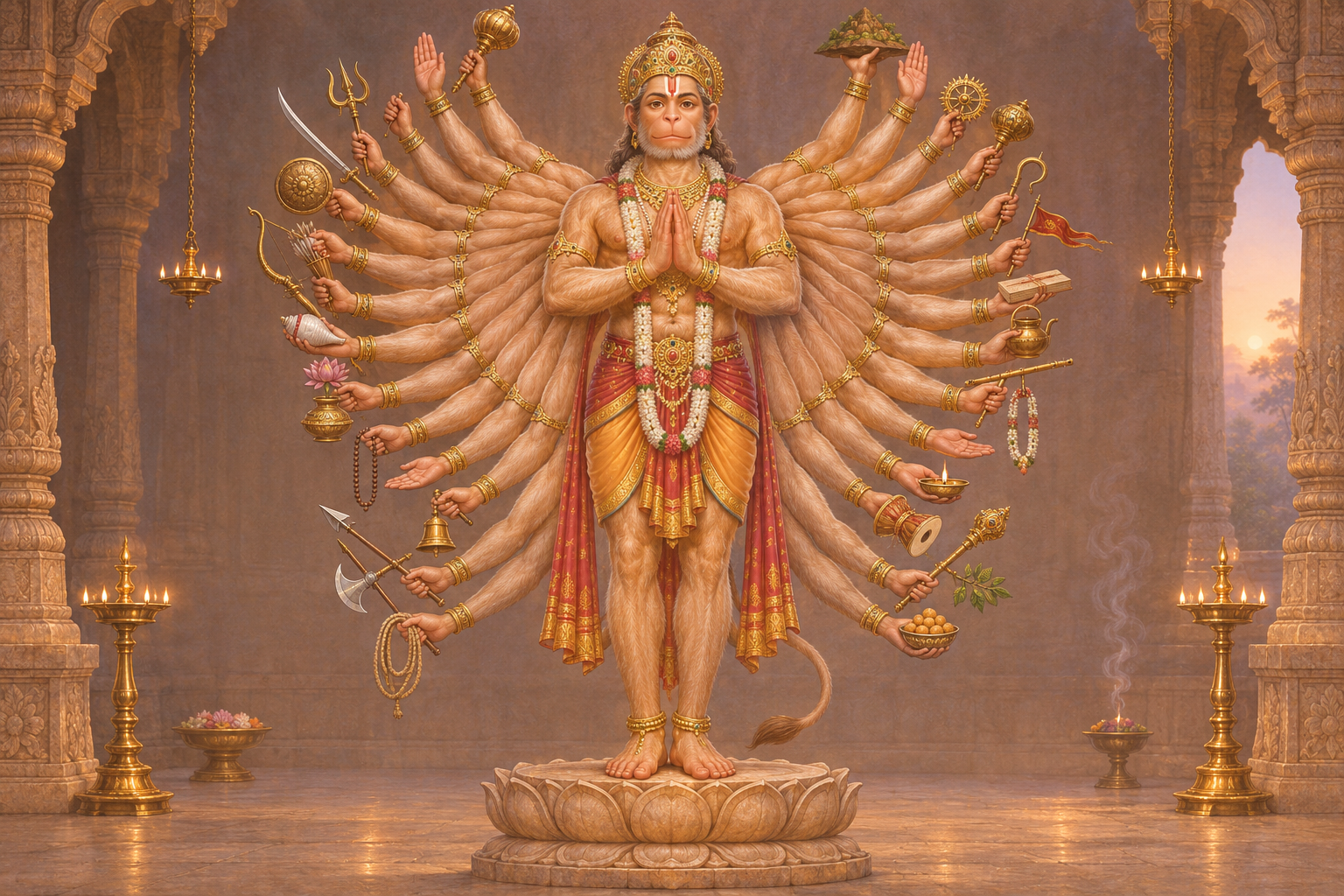
You have found an unusual image of Hanuman: one composed face, a dense circle of arms, and perhaps too many objects to identify at a glance. Is it Panchamukhi Hanuman, an artist’s imaginative variation, or a recognised sacred form?
Begin with what the image actually shows. The rare Dvatrimshatbhuja Hanuman is distinguished by the combination of one face and thirty-two arms. Once you establish those two features, you can read the form without turning every hand into a speculative story.
Identify the form before interpreting its details
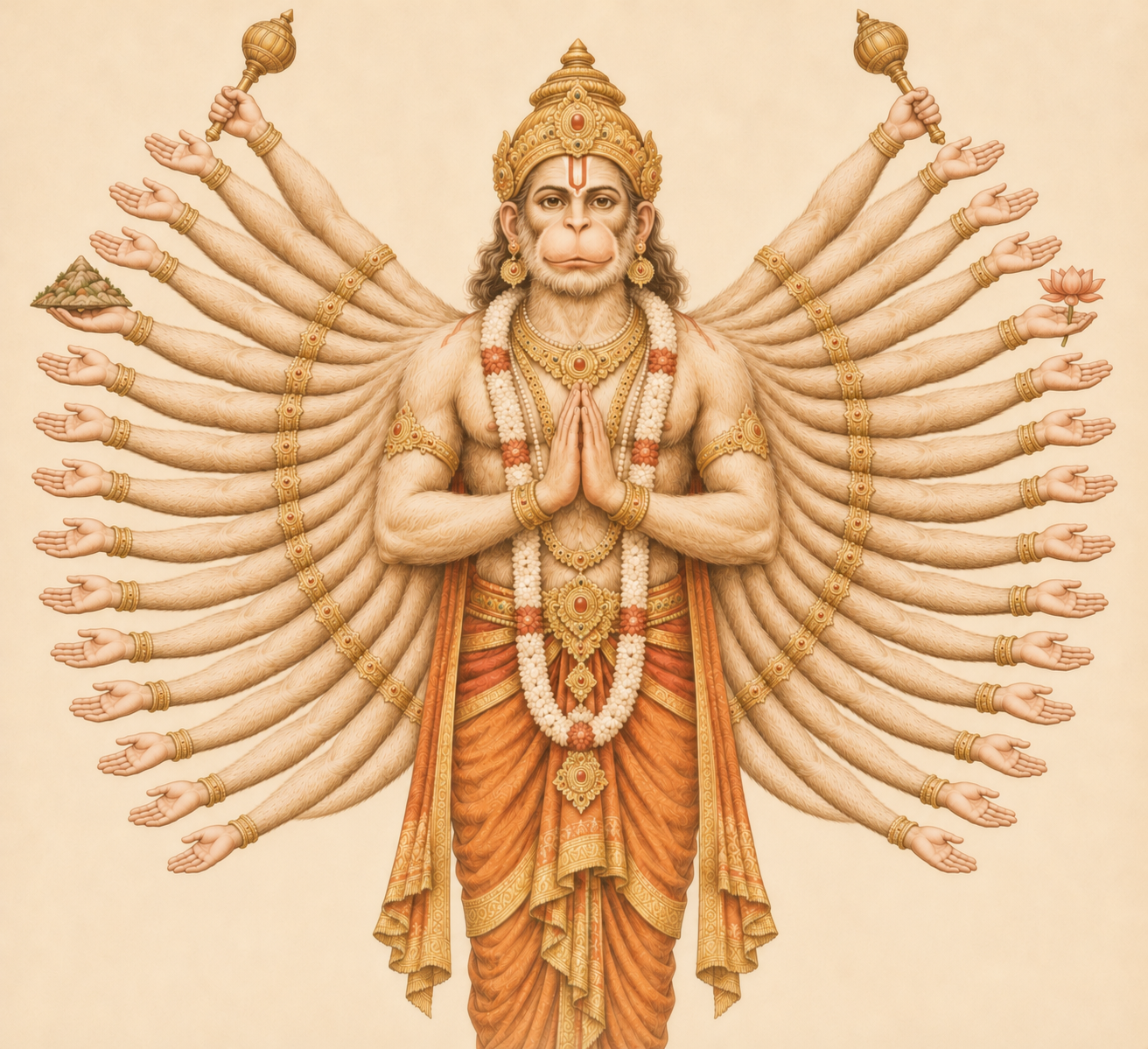
The number of arms alone is not enough. A crowded composition, damaged sculpture, partial photograph, or modern devotional print can make counting difficult. Start with the face because that is the clearest distinction between Dvatrimshatbhuja Hanuman and the more familiar Panchamukhi, or five-faced, Hanuman.
Use this sequence when examining the image:
- Count the visible faces. Dvatrimshatbhuja Hanuman retains a single face; a genuinely five-faced figure belongs to a different iconographic form.
- Count hands rather than objects. An empty hand, a blessing gesture, or a hand partly hidden behind another arm still belongs in the total.
- Look for Hanuman’s identifying characteristics, especially the simian face and, where visible, the tail. Thirty-two arms do not identify the deity by themselves.
- Check whether arms disappear behind the body, halo, ornaments, or neighbouring arms. A flat photograph may conceal parts that are clear on the original murti.
- Record the temple’s or custodian’s name for the form. A local inscription, ritual name, or informed explanation is better evidence than a caption copied across social media.
If you can see only thirty or thirty-one hands, do not silently invent the missing ones. Say that the image appears consistent with the form but cannot be confirmed from that view. Iconographic care begins with knowing the difference between observation and reconstruction.
Read the single face and thirty-two arms together
Multiple arms are part of the visual language of Hindu sacred art. They allow one divine figure to bear several attributes, enact several gestures, or display several capacities at once. They should not be read as an attempt to portray ordinary anatomy.
In this Hanuman form, multiplicity belongs to the arms while identity remains concentrated in one face. That contrast matters. The thirty-two arms communicate an extraordinary range of action; the single face prevents that action from appearing scattered among several personalities. Many capacities remain governed by one consciousness, one orientation, and one purpose.
This gives you a more disciplined interpretation than simply saying that more arms mean more power. The image presents power as coordinated capacity. Each arm can do something distinct, yet all thirty-two belong to the same Hanuman. The form therefore invites you to notice unity within abundance rather than treating abundance as visual excess.
The exact number also matters. This is not merely “many-armed Hanuman” but Dvatrimshatbhuja Hanuman, the specifically thirty-two-armed form. Count carefully when identification matters, but resist assigning an independent doctrine to the number unless the temple tradition, inscription, or an established textual account supplies one. A precise count is evidence; an unsupported numerical theory is not.
Let Hanuman’s devotion govern the meaning of power
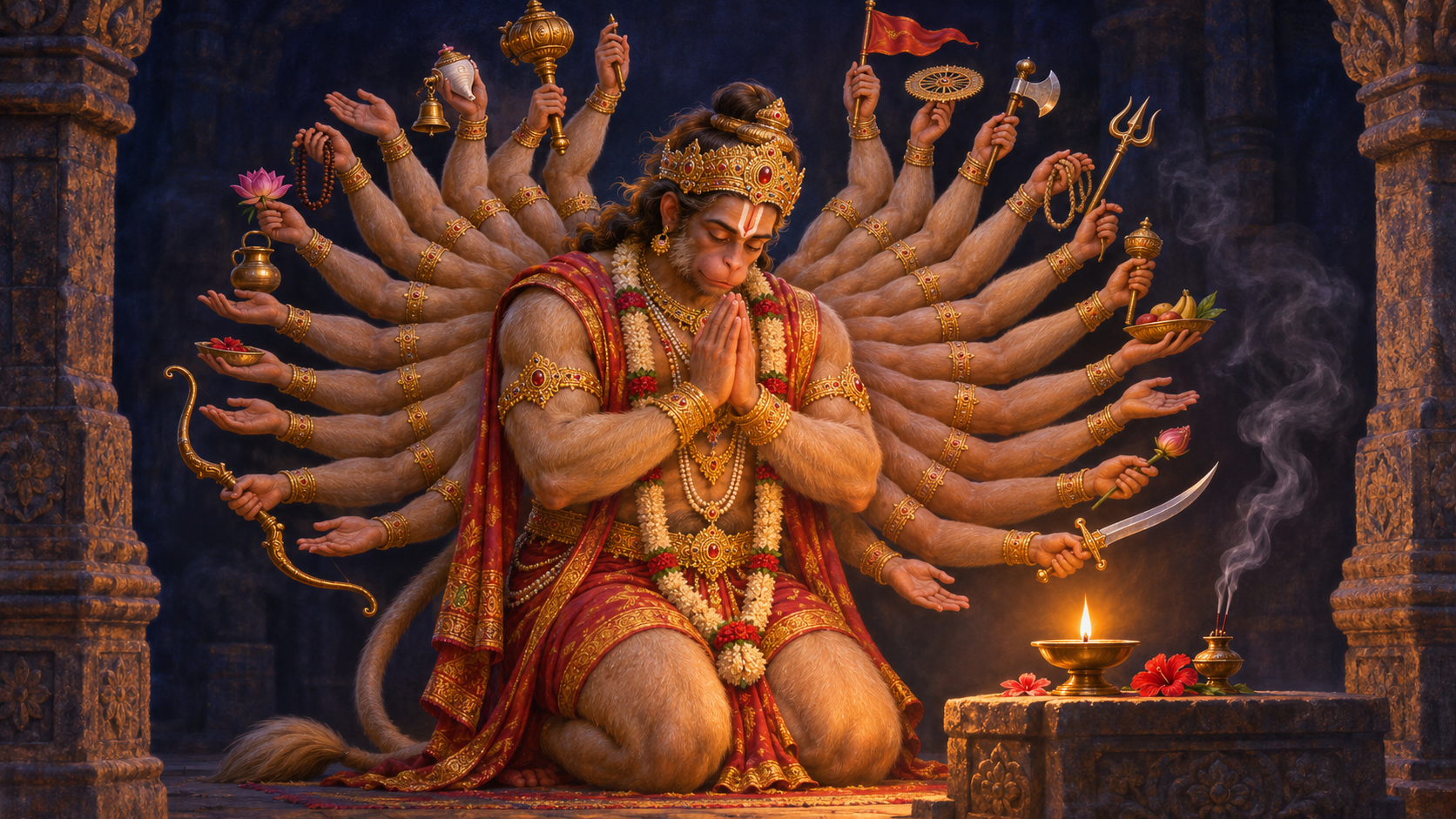
Hanuman cannot be understood through force alone. His enduring sacred identity joins strength, courage, intelligence, discipline, service, and devotion. The thirty-two arms intensify his ability to act, but they do not replace that devotional centre.
This distinction protects the image from a common misreading. A viewer may see numerous arms and weapons and reduce the murti to aggression. Yet the relevant question is not merely, “How much power is present?” It is, “What governs that power?” In Hanuman, capacity is meaningful because it is placed in service rather than displayed as self-glorification.
For a devotee, this makes the form practical rather than remote. You may have many duties, abilities, pressures, and demands competing for attention. The image does not ask you to imitate thirty-two actions at once. It asks whether your many actions answer to one worthy centre. Before beginning a demanding task, identify that centre plainly: dharma, seva, fidelity to a vow, care for family, or responsibility to the community. Activity without orientation becomes agitation; capacity directed by dharma becomes service.
The single face is therefore as spiritually important as the multiplied arms. If you focus only on the arms, you see capability. If you also attend to the face, you see capability held under composure. That is the more complete lesson of the form.
Examine each hand without inventing a catalogue
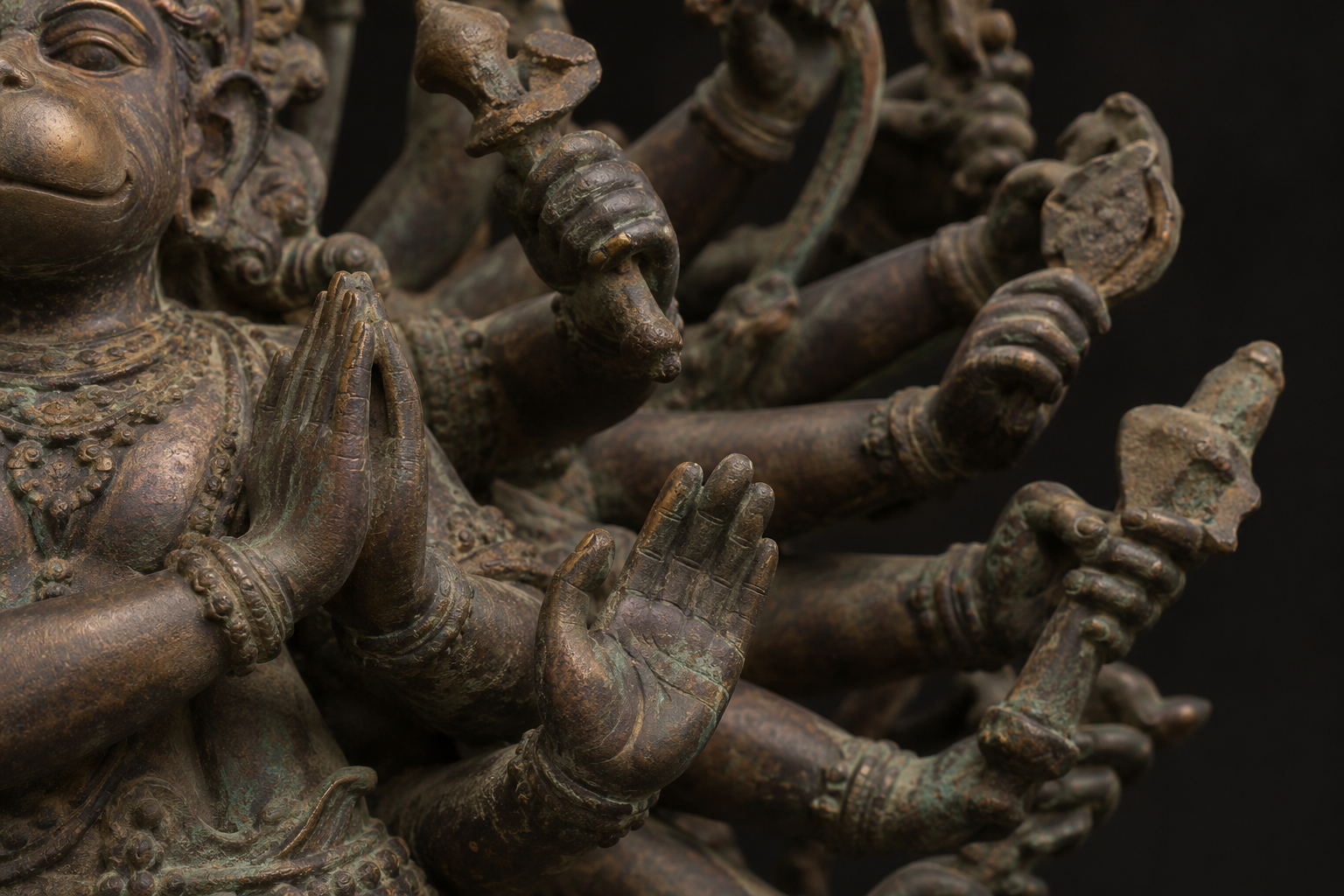
Detailed images tempt viewers to name every object immediately. Slow down. A worn carving can make a fruit resemble a mace, a loop resemble a serpent, or a broken attribute resemble an empty hand. Modern paintings may also sharpen, rearrange, or stylise details that are less obvious in an older murti.
Use a simple observation sheet if you are studying a temple image, museum photograph, or devotional print:
- Identity: Note the name given to the figure and who supplied it.
- Faces: Record the number actually visible, including any profile faces.
- Hands: Number them clockwise from a fixed point so that you do not count the same hand twice.
- Gestures: Separate clearly gesturing hands from hands that hold objects.
- Attributes: Describe uncertain objects by shape before naming them. Write “curved object” or “circular object” when identification is not secure.
- Condition: Mark hands or objects that are hidden, damaged, repainted, or outside the frame.
- Context: Note whether you are viewing the original murti, a reproduction, or a recent artistic rendering.
Only after that inventory should you look for an interpretive explanation. When a priest, temple record, or established tradition names an attribute, preserve that local identification rather than replacing it with a generic list found elsewhere. Iconography is not a guessing game in which every unfamiliar object must be made to fit a preferred theory.
The same restraint applies when sharing the image. Label a confirmed identification as confirmed. Label a probable identification as probable. If the number of arms or the identity of an object cannot be established, leave the uncertainty visible. That small act prevents an attractive but unsupported caption from becoming someone else’s supposed tradition.
Key takeaways
- Dvatrimshatbhuja Hanuman is the rare form of Hanuman with one face and thirty-two arms.
- Do not confuse it with Panchamukhi Hanuman, whose defining visual feature is five faces.
- The arms express an abundance of coordinated capacity; the single face keeps that capacity unified.
- Read the form through Hanuman’s devotion and service, not through force in isolation.
- Count hands, distinguish gestures from objects, and record damage or concealment before naming individual attributes.
- Do not invent a weapon list or a numerical doctrine when the image’s own tradition does not provide one.
The next time you encounter this form, give it more than a quick count. Confirm the single face, trace the thirty-two hands carefully, and then ask what unifies all that capacity. The image becomes most useful when it turns your attention from possessing many powers to placing every ability in the service of dharma.
References

Leave a Reply
You must be logged in to post a comment.