
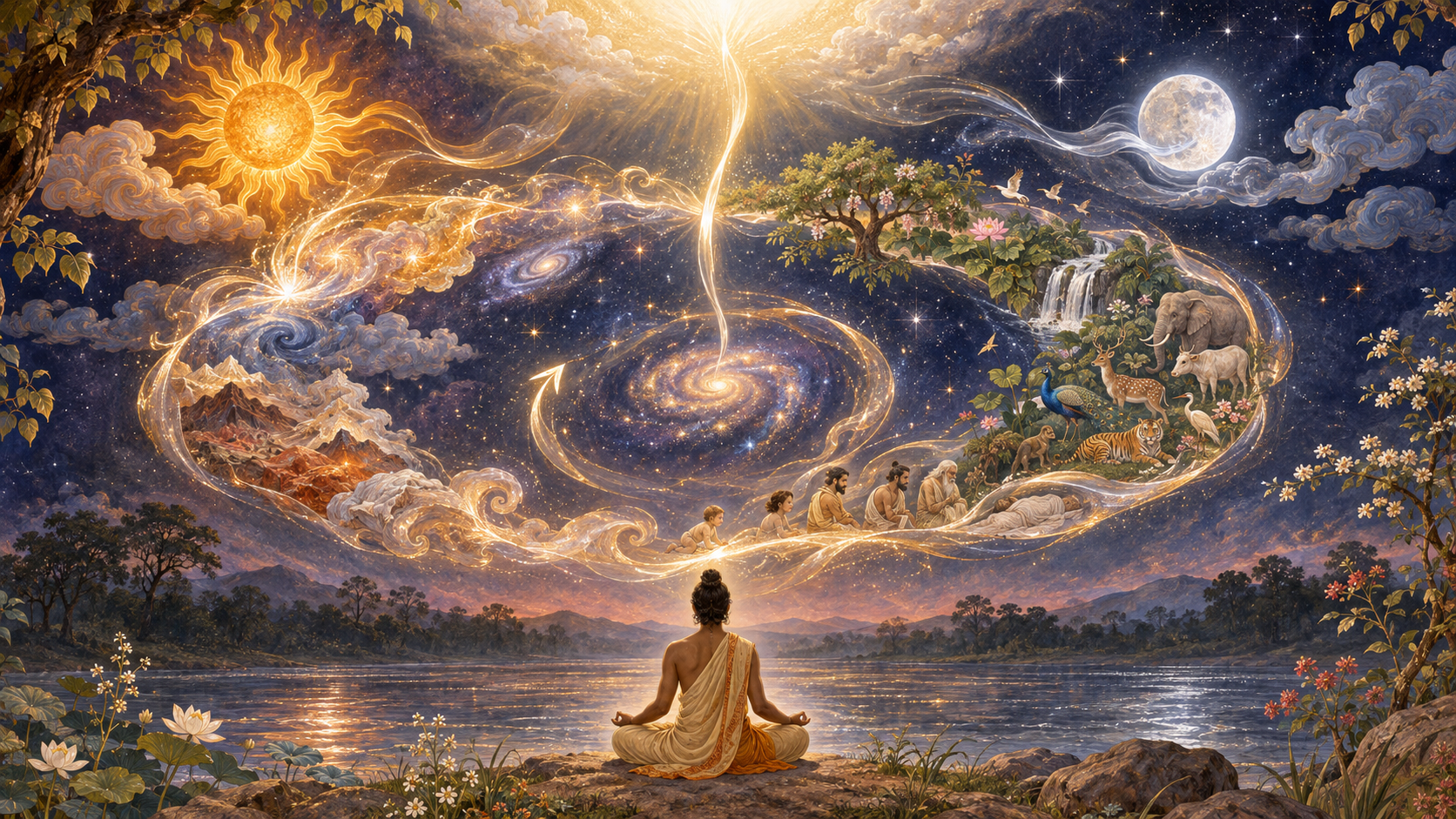
You may have opened the Prashna Upanishad only to find a creation account filled with Prajapati, prana, rayi, the Sun, the Moon and two cosmic paths. Those images can feel remote from the question that probably brought you there: Why do desire, action and temporary satisfaction keep repeating, and what would actually free you from that cycle?
The first prashna becomes practical once you see that creation and liberation are not separate topics. Creation explains how conditioned life arises and renews itself. The teaching on liberation then asks whether you want a better result within that movement or freedom from compulsory return to it.
Creation begins with a question you can turn inward

An earnest seeker asks the sage Pippalada where living beings come from. The answer begins with Prajapati’s desire for progeny, followed by tapas, disciplined concentration or austerity. Prajapati then brings forth a pair: rayi and prana. Through their conjunction, beings arise.
Rayi is commonly rendered through ideas such as matter, form, food and the nourishing lunar principle. Prana is life, vitality and the solar principle that animates and consumes. Neither term fits neatly into one modern English category. Rayi is not merely dead material, and prana is not simply the air moving through your lungs. They name complementary sides of manifested life: that which becomes available as form and sustenance, and that which lives through, activates and uses it.
This is why reading the passage as a primitive laboratory account misses its purpose. The teaching is not asking you to choose between sacred cosmology and biological knowledge. It is showing that embodied existence depends on relationship. Food needs an eater. A body needs life. Form needs an animating principle. Neither member of the pair, considered in isolation, explains a living being.
The order of the teaching also deserves attention: desire, tapas, differentiation and manifestation. That sequence is cosmic in scale, but you can notice a smaller version whenever a desire organizes your attention, effort and circumstances around a result. A career, possession, reputation or even a spiritual identity first appears as an aim; energy and material are then gathered to give it form.
Use that sequence diagnostically. When you feel compelled to create, acquire or become something, ask three questions: What desire began this movement? What forms and resources are feeding it? What life-energy and attention are being spent to sustain it? The point is not to condemn creation. It is to see its causal structure before you mistake a created result for permanent fulfilment.
The Prashna Upanishad belongs to the Atharvaveda and is counted among the principal Upanishads. Adi Shankaracharya distinguishes its explanatory character as Brahmana from the Mundaka Upanishad’s designation as Mantra. That distinction offers a practical reading clue: follow the dialogue’s reasoning step by step instead of detaching the Sun, Moon or breath from the question they are answering.
The two cosmic paths expose the limit of earned results
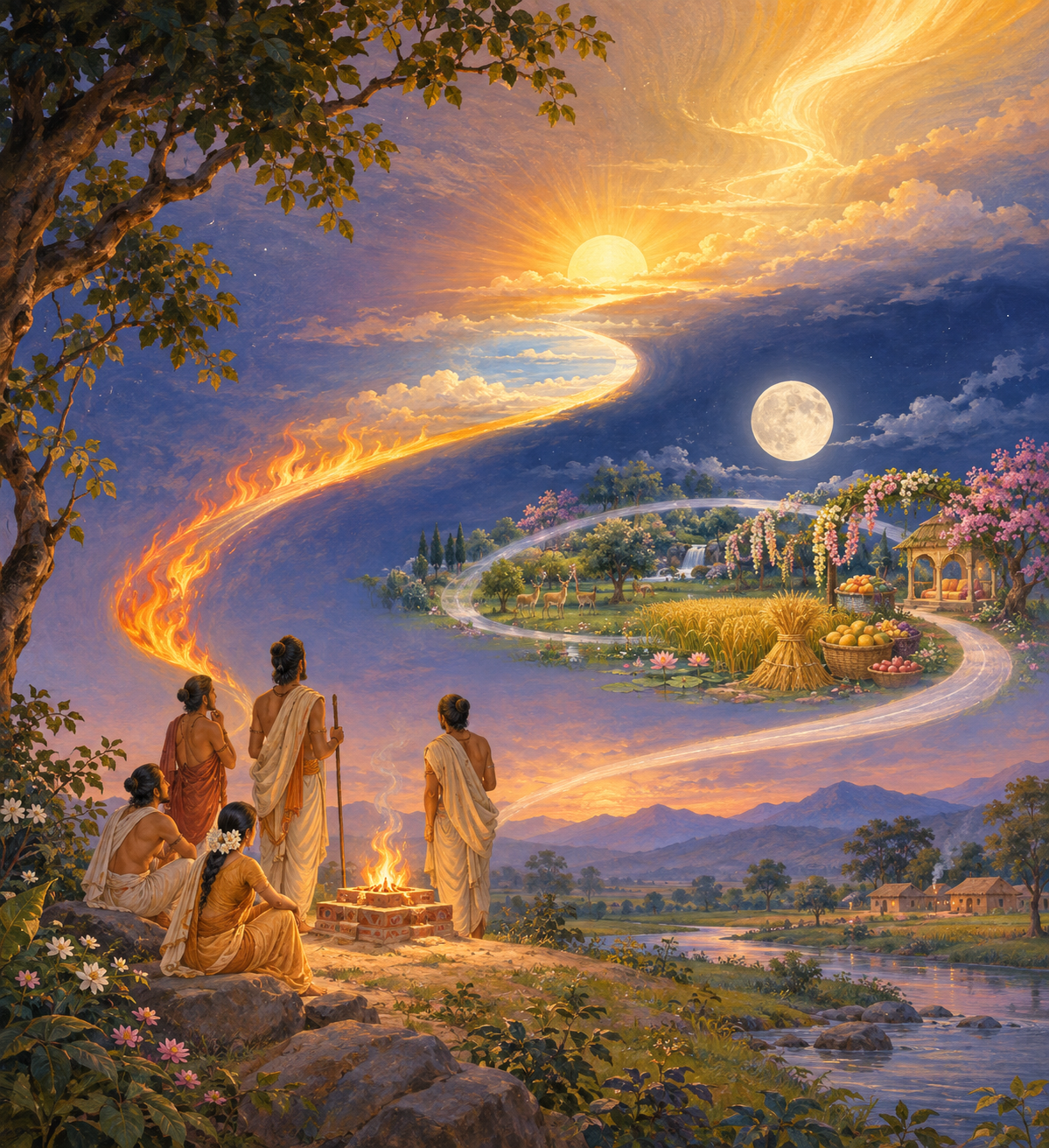
The teaching expands the prana-rayi pair into the structure of time. Prajapati is correlated with the year, whose northern and southern courses become two paths. Solar and lunar imagery now explains more than creation: it distinguishes two orientations of human life and their consequences.
The lunar or southern path is associated with progeny, meritorious action and results that remain within the world of becoming. Such results may be desirable. They can support family, social order, religious duty and elevated experience. But they are finite because they are produced. When the force of the merit that produced an experience is exhausted, return follows.
The solar or northern path is associated with seekers who turn toward the Self through tapas, brahmacharya, faith and knowledge. Its defining movement is non-return. The contrast is not simply between two compass directions, two seasons or two destinations in physical space. It reveals a difference between seeking the fruits of action and seeking release from dependence on all such fruits.
This distinction corrects a common spiritual miscalculation. You cannot obtain the unconditioned merely by accumulating more conditioned rewards. A ritual performed for a result may produce that result. Generosity can generate merit. Discipline can improve attention. Ethical conduct can make life more harmonious. Yet every produced condition remains subject to change. Moksha cannot be just the most pleasant item in the same chain of production.
It would also be careless to turn the two paths into a crude verdict that household life is bad and renunciation is good. The sharper question is one of aim. What do you expect a given action to accomplish? Dharmic duties and beneficial works have their proper place. Confusion begins when you ask a finite action to provide freedom from finitude itself.
You therefore do not need to erase the Upanishad’s cosmology in order to receive its philosophical force, nor must you force its sacred correspondences into modern astrophysics. Read respectfully on both levels. The Sun and Moon belong to a traditional cosmic account, while the paths they govern also disclose two enduring human orientations: outward movement toward experience and inward movement toward knowledge of the Self.
Liberation begins by clarifying what you actually seek
The first prashna does not yet try to compress the whole realization of Brahman into one answer. It first establishes the fork in the road. Do you want fulfilment through creation, continuity and desirable experience, or do you want freedom from the necessity of returning for another experience?
That question is harder than it looks because spiritual practice itself can be absorbed into the cycle of acquisition. Japa can become a bargain for a preferred outcome. Study can become a claim to superiority. Austerity can strengthen the identity of being unusually disciplined. Worship can become another way of asking the world to confirm that everything will go according to personal desire.
None of those distortions makes the underlying practice worthless. They show why motive has to be examined. A practice aimed at a finite result belongs to the field of finite results, even when it uses sacred language. A practice that prepares the mind for truth has a different function: it reduces the hold of craving, self-display and compulsive identification so that knowledge can become more than information.
- Would you continue the practice if it brought no recognition, unusual experience or visible advantage?
- Are you trying to understand the Self, or are you trying to construct a more impressive spiritual personality?
- Does your discipline loosen compulsive desire, or does it merely postpone one desire while feeding another?
- Are you treating temporary calm as liberation, even though the same fear and attachment return when circumstances change?
The cluster of tapas, brahmacharya, faith and knowledge matters here. Austerity without inquiry can turn into pride. Restraint without understanding can become repression. Faith without disciplined examination can remain sentimental. Information without a change in conduct can remain intellectual decoration. The terms support one another because liberation requires the orientation of the whole seeker, not merely the performance of one admired practice.
Whatever precise discipline your lineage assigns to brahmacharya, do not isolate it from that larger purpose. In this setting it belongs to a life directed toward Brahman. The practical test is whether your use of energy, attention and relationship serves clarity or continually scatters the mind among fresh objects of dependence.
Liberation therefore does not require hatred of creation. Rayi and prana are presented as powers within Prajapati’s manifestation, not as evils. Food, embodiment, family and responsible action are not the enemy. The error is expecting something dependent, produced and changing to provide the freedom that cannot depend on a changing condition.
Put the first prashna into practice
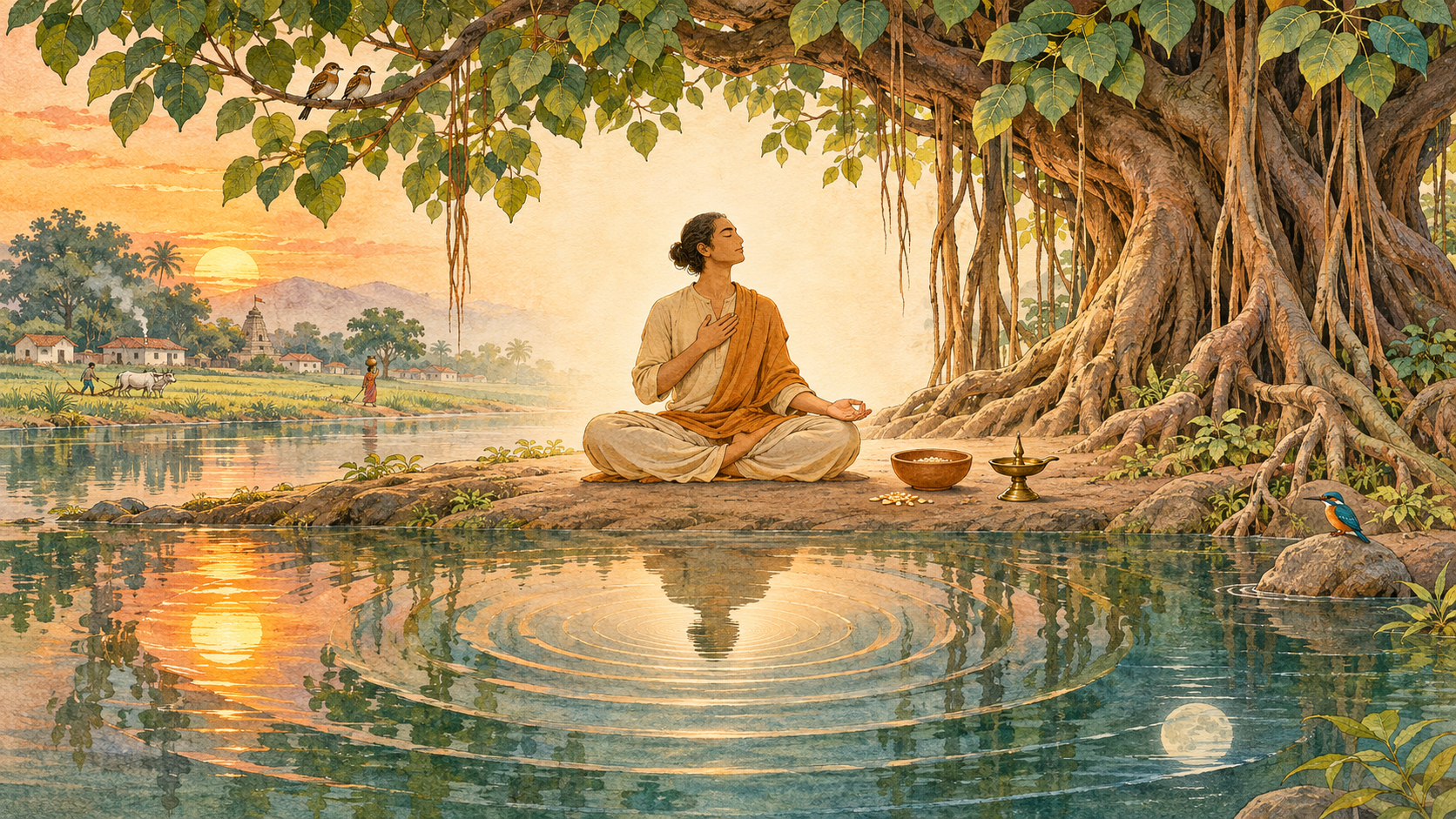
You can turn the chapter into a disciplined contemplation without inventing an elaborate new ritual. Work through the following sequence with one real desire rather than an abstract example.
- Name the result you are pursuing. Write it plainly: security, recognition, pleasure, influence, family continuity, a heavenly reward, a spiritual experience or knowledge of the Self. Do not use elevated language to hide an ordinary desire.
- Identify its rayi and prana. What material, bodily or social forms sustain this pursuit? What attention, breath, time and vitality animate it? This makes the teaching observable in your own life without reducing its cosmic meaning to psychology.
- Trace the likely cycle. If you obtain the result, what will it depend on? How could it change or end? What new desire is likely to follow? This is not pessimism; it is an examination of whether the object can bear the permanence you are asking of it.
- Apply one form of tapas before acting. Delay the automatic response long enough to observe the desire without immediately obeying it. The purpose is not self-punishment. It is to discover whether the impulse governs you or can be held within a larger commitment to truth.
- Classify the practice honestly. Is this action intended to produce a finite benefit, purify and steady the mind, or disclose the Self? A single act may support more than one aim, but vagueness allows the desire for reward to masquerade as liberation.
- Carry the unresolved question forward. Ask what knows the movements of energy, form, desire and result. Do not force the first prashna to provide every later answer. Let its account of creation establish the problem that deeper inquiry into prana and the Self must address.
This exercise also prevents two opposite errors. One is to treat the chapter as obsolete cosmology and never apply it. The other is to turn every image into a private metaphor and discard the traditional cosmic teaching. Keep the textual meaning and the self-examination together. If you study within a sampradaya, use your teacher’s account of the paths and brahmacharya where interpretations differ in ritual or metaphysical detail.
Key takeaways
- The creation teaching begins with desire and tapas, then presents rayi and prana as complementary principles through which embodied beings arise.
- Rayi and prana should not be flattened into matter and oxygen. They encompass form, nourishment, vitality and the solar-lunar structure of manifested life.
- The southern and northern paths distinguish finite, return-producing results from an orientation toward knowledge and non-return.
- Dharmic action can produce valuable results, but no produced result can become unconditioned liberation.
- Tapas, brahmacharya, faith and knowledge belong together; separating discipline from inquiry easily turns sadhana into another identity project.
- The practical question is not whether creation is good or bad, but whether you are asking a changing part of creation to give you changeless freedom.
When you next read the first prashna, begin with one desire that is actively directing your life. Follow it from intention to effort, form, result and likely return. Then ask whether you want that result more intelligently or whether you are finally ready to investigate the one who keeps returning for results.
References

Leave a Reply
You must be logged in to post a comment.