

If you transit through Doha, earn your living in Qatar, study through a Turkish scholarship or hear another foreign intervention on Kashmir, you may wonder whether warnings about Doha and Ankara are evidence-based or merely guilt by association. That is the right question.
You need a method that separates theology from policy, patronage from proof, and an Islamist network from ordinary Muslim life. When you trace the complete chain—from official doctrine to institutions, money, distribution and local adoption—the genuine risks become clearer and the exaggerated claims become easier to reject.
Trace the influence chain, not an isolated speech
Use the word Islamism narrowly. It describes a political project that seeks to organise public power, law or foreign policy around a particular interpretation of Islam. It is not a synonym for Islam, Muslim identity or personal religious observance. Losing that distinction turns a legitimate examination of political networks into an accusation against millions of people who have no connection to them.
Transnational influence usually moves through four linked stages:
- Doctrine supplies the frame. Clerics, curricula or religious institutions define an issue as a religious duty, civilisational struggle or test of loyalty.
- State-linked institutions confer status. A ministry, university, broadcaster, diplomatic office or publicly supported organisation gives the message reach and legitimacy.
- Money and networks distribute it. Grants, mosques, charities, scholarships, conferences and media platforms carry ideas across borders.
- Local actors convert access into influence. Recipient organisations incorporate the message into teaching, mobilisation, recruitment, political pressure or narratives about Bharat.
Do not leap from the first stage to the fourth. A hostile sermon proves that the sermon exists. A state-hosted sermon establishes an institutional connection. A grant proves a financial relationship if the records are authentic. None of those facts, by itself, proves that a recipient committed a crime or that every citizen of the donor country accepts the ideology.
This distinction also keeps attention on the mechanism that matters. Travel through a Qatari airport, trade with a Turkish company or friendship with a Muslim neighbour tells you nothing useful about an Islamist influence operation. Official sponsorship, traceable finance, sustained organisational ties and observable local output do.
Qatar combines religious authority, platforms and finance

The clearest warning is not a stray remark by an obscure preacher. Qatar’s Ministry of Awqaf and Islamic Affairs established Islamweb, a fatwa platform that treats Hindu Dharma as polytheism and pooja as unforgivable shirk. Its rulings tell Muslims to leave schools or workplaces that require participation in pooja and prohibit greetings for Hindu festivals. The same official platform praises Muhammad bin Qasim, invokes the Ghazwa-e-Hind tradition and presents a future conquest of Bharat as unfulfilled.
That record contains an important qualification. In 2020, scholars at Qatar Foundation’s Hamad Bin Khalifa University examined all 82 Islamweb fatwas concerning Hindu Dharma and concluded that their vision was “not fully aligned with state policy”. The distinction matters, but it does not dissolve the concern. A government can pursue pragmatic diplomacy while a ministry under the same state maintains religious material that portrays Hindu practice as both spiritually illegitimate and historically destined for defeat.
Schooling offers another test of whether an idea is peripheral or institutional. In February 2026, the watchdog IMPACT-se examined 52 Qatari state textbooks. It identified a Grade 9 lesson consigning practitioners of polytheism to eternal punishment and a Grade 6 lesson that glorifies Ali bin Abu Talib’s killing of polytheists and Jews. A watchdog’s assessment is not a Qatari admission, so anyone using the finding publicly should inspect the relevant pages and translations. It nevertheless raises a precise policy question: what conception of non-Muslims is being normalised for pupils under state authority?
Doha’s influence becomes transnational when clerical prestige is joined to global platforms. Qatar sheltered Muslim Brotherhood cleric Yusuf al-Qaradawi after his imprisonment in Egypt, granted him citizenship, placed him at Qatar University, gave him a weekly Al Jazeera programme from 1996 and enabled the Doha-based International Union of Muslim Scholars in 2004. Qaradawi used those positions to defend suicide bombing, offensive jihad and a future Islamic conquest of Europe. He died in 2022, but the institutional network he led continued to intervene in international controversies.
During the June 2022 controversy over a BJP spokesperson’s comments about Prophet Muhammad, the International Union of Muslim Scholars urged demonstrations at Bharatiya embassies and a boycott by Muslim-majority countries. Qatar’s foreign ministry separately summoned Bharat’s ambassador and demanded a public apology. In March 2024, Qatar University hosted Zakir Naik, who is wanted in Bharat under anti-terror and money-laundering laws, for a Ramadan lecture. Wanted status is not the same as a conviction, but hosting him at a state university was an institutional choice, not an accidental social-media endorsement.
Media reach supplies another channel. When The Kashmir Files focused public attention on the 1990 exodus of Kashmiri Hindus, Al Jazeera carried an opinion essay disputing the Pandit death toll and resisting a Hindu-Muslim framing of the violence. Disagreement over a film is legitimate, but you should notice when a state-funded international broadcaster repeatedly supplies narratives that reinforce the same government’s diplomatic position on Bharat.
The financial trail reaches both Europe and Bharat. French journalists Christian Chesnot and Georges Malbrunot used leaked Qatar Charity files to attribute approximately €71 million to 140 European mosques and Islamic centres, many linked to Muslim Brotherhood circles. Separately, Abhinav Pandya and Akshay Kumar attributed about QR 28.5 million, or $7.8 million, from Qatar’s Eid Charity to eight Salafi organisations in India, with most of the reported funding directed toward Kerala. The United States Treasury designated one of the charity’s co-founders as an al-Qaeda financier in 2013. That designation does not automatically attach to every grant or recipient; it is a reason to demand recipient-level scrutiny rather than make a collective accusation.
The practical test is what happened after the transfer. Ask which institution received the money, what facility or programme it paid for, who controlled the curriculum, which speakers appeared, and whether the recipient later participated in coordinated political activity. A foreign grant establishes a relationship. The recipient’s conduct establishes—or fails to establish—its ideological effect.
Turkey adds executive rhetoric and a global religious bureaucracy
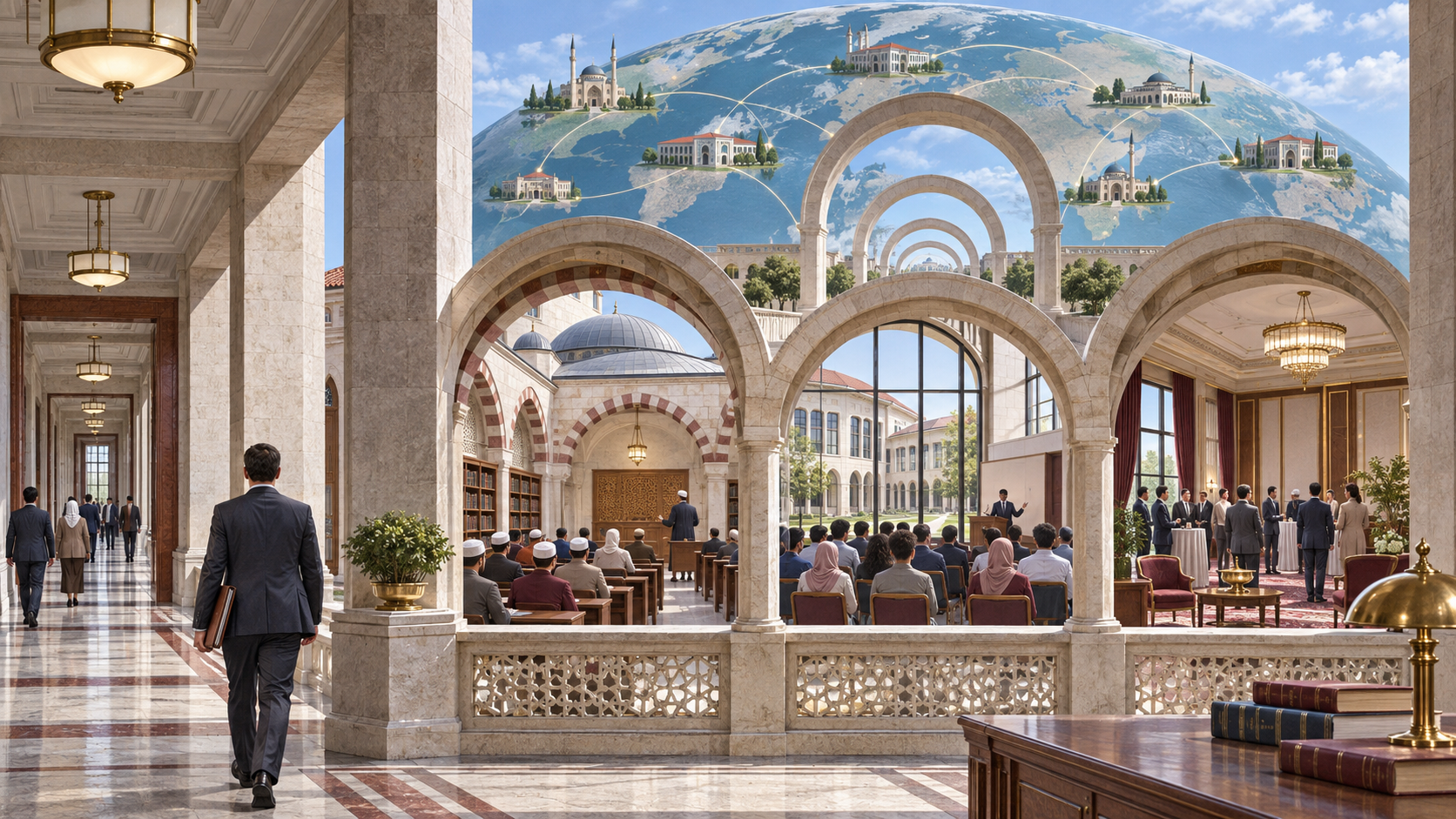
Turkey’s model is more overtly governmental. President Recep Tayyip Erdogan has repeatedly used religious and civilisational language as a description of political power. In a 2015 speech, he recited the lines, “The minarets are the bayonets, the domes are the helmets, the mosques are our barracks, the believers are the soldiers.” In October 2023, he called Hamas a liberation organisation of mujahideen. These statements do not prove every alleged overseas operation, but they clarify the ideological vocabulary used by the country’s highest political authority.
Kashmir brings that vocabulary directly into Bharat’s sovereign affairs. Erdogan raised Kashmir at the United Nations soon after Article 370 was revoked. Addressing Pakistan’s parliament in February 2020, he declared, “It was Canakkale yesterday and it is Kashmir today”, comparing Kashmir with Turkey’s Gallipoli struggle. This was more than generic concern for human rights. The analogy placed a Bharatiya territorial dispute inside Turkey’s own heroic national memory and gave Pakistan a powerful civilisational endorsement.
Ankara can distribute that framing through the Diyanet, Turkey’s state religious directorate. Its overseas mosques and imams operate as a religious network and a form of parallel diplomacy. When an institution controls appointments, training, sermons or funding across borders, you should examine it as state infrastructure even when its public-facing activity is pastoral or educational.
Education and civil-society contact extend the network beyond mosques. Turkey has cultivated clerics and students in Kerala, including about 80 scholarships in one reported year. The Turkish charity IHH, described as close to the ruling AKP and Turkish intelligence, hosted members of the now-banned Popular Front of India in 2018. A scholarship does not prove recruitment, and a meeting does not prove operational control. They do identify relationships worth tracing over time: selection criteria, sponsoring bodies, curricula, repeat visits, post-study employment and the organisations alumni later lead.
The useful comparison is therefore structural. Qatar often amplifies through endowed clerics, universities, charities and international media. Turkey adds a central religious bureaucracy, executive rhetoric, scholarships and politically connected civil-society organisations. Both models can operate through lawful, respectable-looking institutions. That is why labels alone are inadequate; the state nexus and the resulting activity must be documented.
Assess the Bharat-facing risk without misreading people

For Bharat, the documented concern appears at three points where foreign influence can meet a domestic vulnerability:
- Religious delegitimisation: State-linked material does more than disagree with Hindu theology when it discourages ordinary coexistence, celebrates temple destruction or presents conquest as sacred history. Track whether local teachers and organisations reproduce those messages.
- Pressure on sovereignty: Kashmir is internationalised through speeches, diplomatic demands and media narratives. Track whether apparently separate interventions use the same framing, timing and organisational partners.
- Institutional access: Grants, scholarships, conferences and hosted delegations create relationships that can endure after a single payment or event. Track the recipient’s subsequent curriculum, leadership, campaigns and foreign contacts.
Each kind of evidence proves something different. Keeping those limits visible makes an assessment stronger, not weaker.
| Observed signal | What it can establish | What it cannot establish alone |
|---|---|---|
| Official speech or diplomatic demand | The stated position of the speaker or state organ at that time | An operational network or control over foreign actors |
| State-linked fatwa, sermon or curriculum | That specific teaching exists under official institutional authority | Agreement by every Muslim or every citizen of that country |
| Verified financial transfer | A material relationship between donor and recipient | Criminality, extremism or the ideological use of the money |
| Meeting, conference or scholarship | Access and an opportunity to build a network | Recruitment, command or lasting ideological adoption |
| Repeated local messaging or mobilisation | Possible adoption of the foreign framing | Foreign causation without chronology and corroborating links |
This evidence ladder protects two truths at once. Transnational Islamist influence deserves serious scrutiny, especially when a state institution supplies doctrine, resources and diplomatic support. Ordinary Muslims must not be treated as extensions of Qatar, Turkey, the Muslim Brotherhood or any foreign government. The relevant unit of analysis is the identifiable institution and its conduct—not a person’s name, faith, clothing or country of employment.
The same discipline prevents weak claims from obscuring strong ones. Calling every foreign-funded mosque a jihadist project is neither defensible nor useful. Naming the donor, amount, intermediary, recipient, stated purpose and resulting programme gives citizens and authorities something that can actually be checked.
Use a six-step audit before repeating a claim

If you are evaluating a speech, grant, religious centre, scholarship or activist connection, build an evidence ledger before reaching a conclusion.
- Write the narrowest verifiable claim. Prefer “a Qatari ministry portal hosts Fatwa 143847” to “all Qataris want to conquer Bharat.” The first can be checked; the second turns institutional evidence into collective blame.
- Preserve the complete primary item. Record the issuer, title, date, original language, translator, URL and surrounding context. For video, keep the full segment rather than a clipped sentence. For a curriculum, identify the grade, edition and page.
- Resolve the state connection. Determine whether the body is a ministry, state university, publicly funded broadcaster, regulated charity, ruling-party affiliate or independent organisation. Do not compress these materially different relationships into the vague phrase “state-backed.”
- Trace the money to its use. Record the donor, intermediary, recipient, amount, transfer date, stated project and evidence that the project occurred. Then inspect governance, speakers, teaching material and campaigns. A promised grant, a completed transfer and a programme outcome are three different facts.
- Look for local conversion. Ask whether the foreign relationship produced a new institution, repeated talking points, leadership training, coordinated protest, recruitment, electoral pressure or a durable media network. Influence becomes consequential when access changes local behaviour.
- Label confidence and test alternatives. Mark each entry as established, attributed, alleged or inferred. Seek evidence that could weaken the claim: an independent funding stream, a different chronology, a recipient’s rejection of donor ideology or a mundane educational purpose. If the conclusion survives those tests, it will also survive public scrutiny more effectively.
Before publicly describing a person or organisation as extremist, terrorist-controlled or criminal, obtain primary records and appropriate legal review. A meeting, scholarship or grant is not proof of an offence. Overclaiming can expose you to legal risk, harm innocent people and make well-supported concerns easier to dismiss.
Key takeaways
- Islamism is a political project; it is not a synonym for Islam or for Muslims.
- Qatar’s influence architecture joins ministry-linked religious content to clerical platforms, universities, international media and overseas finance.
- Turkey joins presidential rhetoric and Kashmir diplomacy to the Diyanet, scholarships and politically connected organisations.
- The strongest Bharat-facing case combines a demonstrable state nexus, a traceable channel of support and observable local adoption.
- Financial or institutional contact warrants investigation, not an automatic verdict of criminality.
The next time a claim about Doha or Ankara reaches you, put it into a one-page ledger: actor, date, exact statement, state connection, money or network path, local result and confidence label. That small discipline turns justified concern into defensible public knowledge—and keeps scrutiny fixed on the institutions that actually exercise influence.
References

Leave a Reply
You must be logged in to post a comment.