

If Tataka Vadha leaves you uneasy, that unease is worth examining. Why would Rama, whose conduct embodies restraint and righteousness, use lethal force against a woman? Does loyalty to dharma require compassion to be suspended?
The episode gives a more demanding answer. Compassion remains essential, but compassion for an aggressor cannot become indifference toward those exposed to aggression. When hesitation permits destructive conduct to continue, protecting dharma may require a hard and carefully bounded act.
Begin with the duty being neglected, not the identity of the aggressor
Rama does not approach Tataka as someone searching for an excuse to fight. His reluctance matters because it shows that force is not morally trivial. Yet Vishwamitra asks him to look beyond the discomfort of acting and consider the consequences of refusing to act.
The central question is not whether Tataka belongs to a protected social category or whether Rama can preserve his personal sense of purity by withdrawing. It is whether destructive conduct should be allowed to continue when he has both the capacity and the duty to stop it. In Balakanda, Vishwamitra answers Rama’s doubt by recalling Bhagavan Vishnu’s hard decision concerning Bhrigu’s wife, who was also the mother of Shukracharya.
This reasoning depends on distinctions that are easy to blur:
- Compassion is not indulgence. You may recognise the humanity, history or suffering of a wrongdoer without allowing that person to keep harming others.
- Restraint is not abandonment. Refusing to intervene can look peaceful from the actor’s point of view while leaving the threatened to bear the full cost.
- Identity does not erase conduct. Sex, family, learning, lineage or spiritual association cannot convert a destructive act into a harmless one.
- Personal reluctance does not cancel entrusted duty. A person responsible for protecting others cannot always treat withdrawal as a morally neutral choice.
That last distinction is crucial. Rama’s hesitation concerns what he will do. Vishwamitra redirects his attention toward what will happen to others if he does nothing. Dharma asks you to count both sets of consequences.
Why Vishwamitra invokes the fate of Bhrigu’s wife
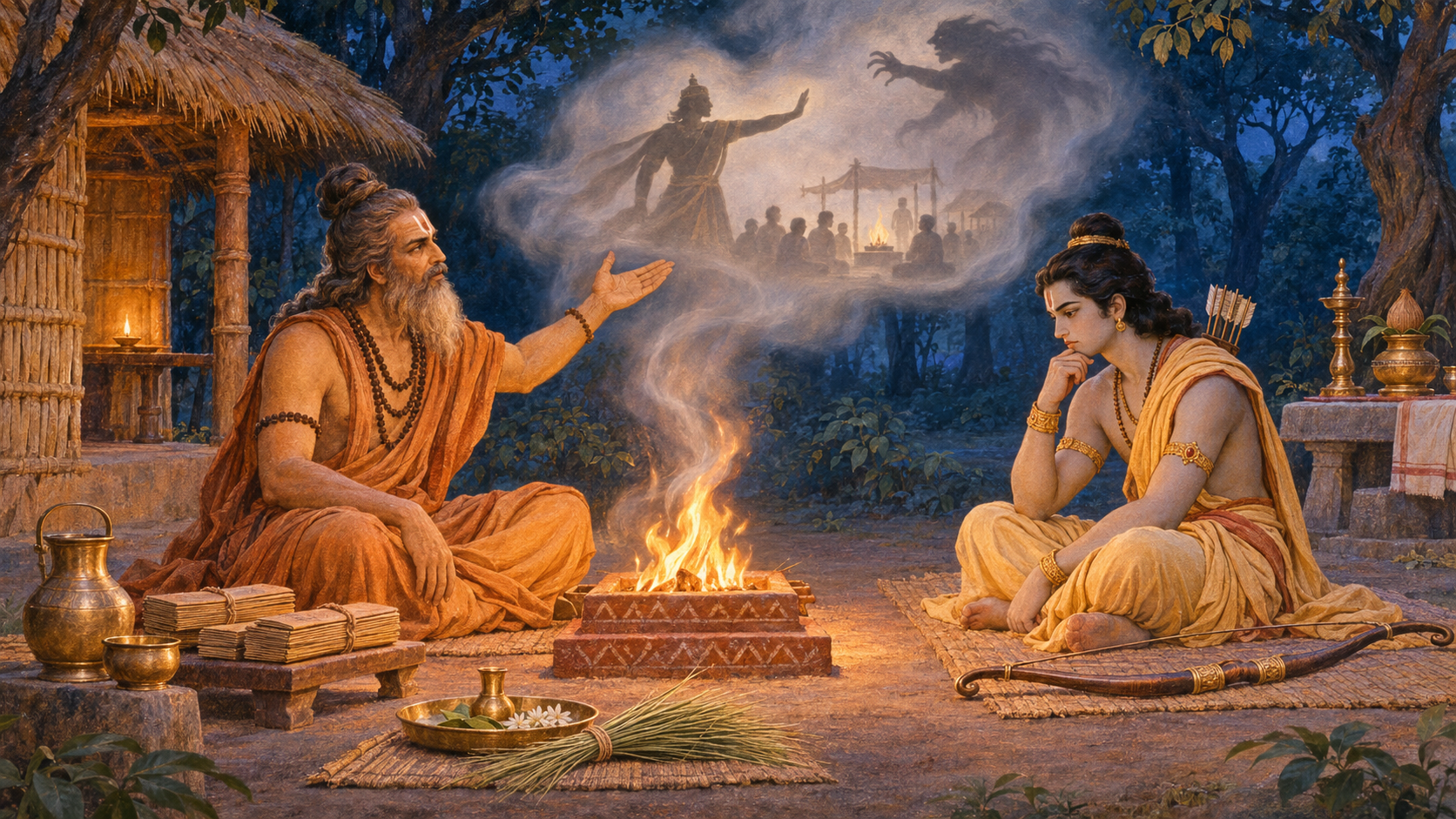
Vishwamitra’s precedent is deliberately difficult. Bhrigu’s wife possesses identities that ordinarily command honour: she is a woman, the wife of a sage and the mother of Shukracharya. Bhagavan Vishnu’s act demonstrates that an honoured identity cannot provide unconditional immunity when conduct threatens dharma.
The point is not that revered people deserve less protection. It is that reverence must not disable moral judgement. Otherwise, status becomes a shield behind which injury can continue. The higher a person’s standing, the more tempting it can be for a family, institution or community to protect the name rather than protect those affected by the conduct.
Vishwamitra is also educating Rama’s compassion. Unexamined compassion follows the person immediately in front of us, especially when that person appears vulnerable or carries a respected identity. Mature compassion widens the field. It notices the unseen people who will suffer if a continuing threat is excused.
But the precedent must be kept within its boundaries. It does not mean that any person may claim to defend dharma and punish anyone they dislike. It does not make suspicion equivalent to guilt, disagreement equivalent to aggression or anger equivalent to courage. Nor does it teach that the end automatically justifies every means. The analogy turns on destructive conduct, a genuine protective duty and the necessity of stopping the harm.
Four tests prevent dharma from becoming a slogan

Protecting dharma is a serious claim. Because it can be misused to sanctify pride, revenge or factional loyalty, apply four tests before invoking Tataka Vadha as a precedent. These are interpretive guardrails drawn from the moral structure of the episode, not a substitute for the full teachings of the Ramayana.
- Identify the concrete harm. Ask who or what is actually endangered. Name the conduct in observable terms. A useful answer describes an act and its consequences; an answer such as they are against us merely declares a side. If no definite harm can be stated, the appeal to dharma is probably concealing fear, rivalry or wounded pride.
- Establish your duty and standing. Rama is not acting as a private avenger. The episode concerns an entrusted responsibility under Vishwamitra’s guidance. In ordinary life, a parent, teacher, trustee, manager or community leader may have a duty to intervene within a defined sphere. That responsibility does not grant unlimited authority outside it. If you have neither responsibility nor reliable knowledge, your first duty may be to report, document or seek competent help rather than impose a punishment yourself.
- Choose the least harmful measure that will actually protect. A mild response that leaves people exposed is not compassionate. An excessive response that goes beyond protection is not dharmic merely because the original cause was just. Depending on the setting, an effective measure may be a clear boundary, removal from a role, suspension of access, a fair investigation, restitution or referral to the appropriate authority. Tataka Vadha reaches a lethal endpoint within its narrative setting; copying that endpoint while ignoring its exceptional context reverses the lesson.
- Examine motive and accept accountability. Ask whether the aim is protection or humiliation, restoration or revenge. A dharmic decision should be explainable in terms of duty, evidence and proportion. The decision-maker should also accept scrutiny. Dharma is not a private certificate that a person writes for his or her own anger.
These tests work together. A real harm does not justify action by an unqualified person. Legitimate authority does not justify an unnecessary method. A proportionate method can still be corrupted by deceit or vengeance. The invocation of dharma becomes credible only when the protected good, the actor’s responsibility, the chosen means and the motive align.
Carry the lesson into ordinary conflicts without imitating a battlefield
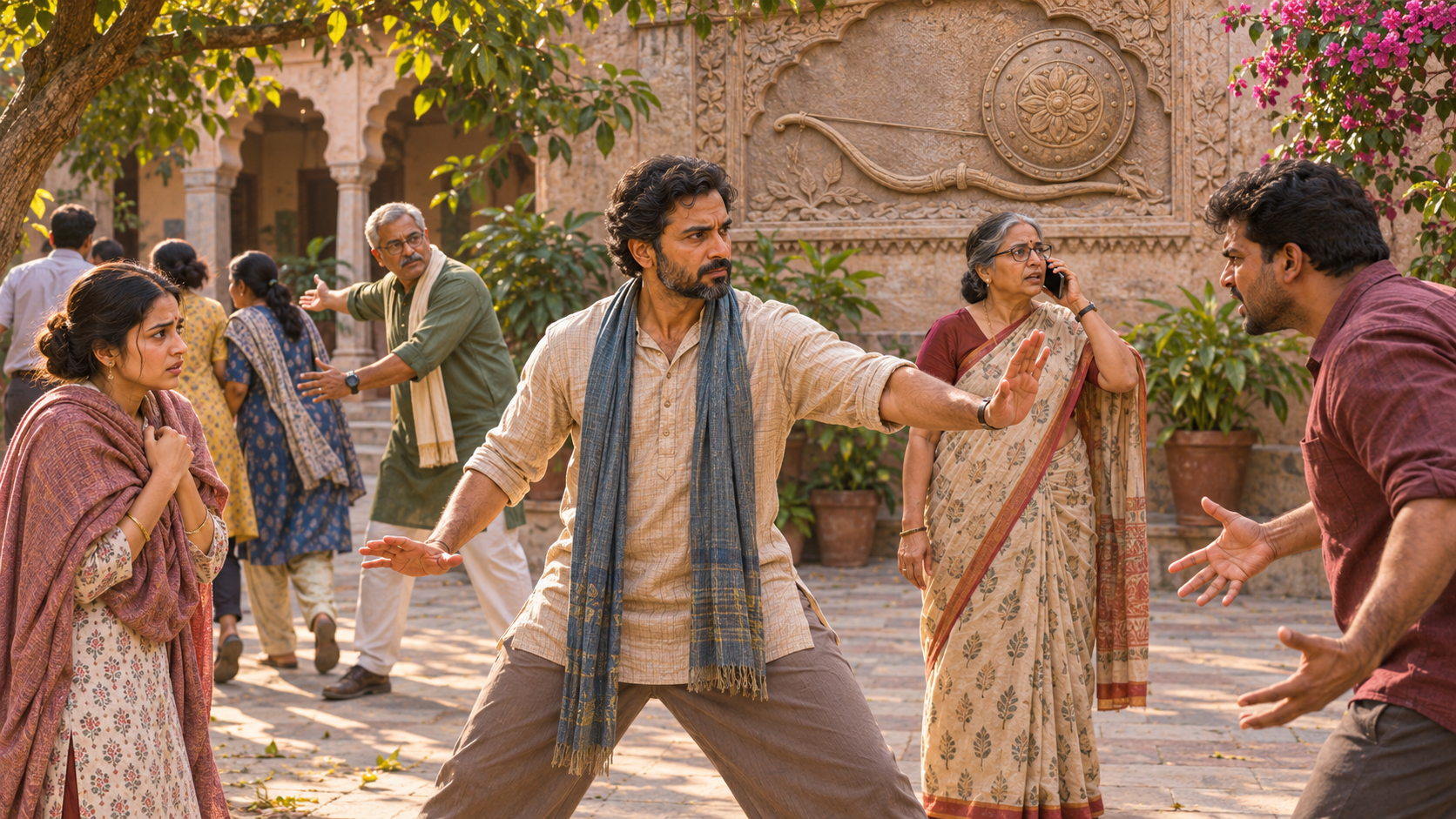
Most readers will never face Rama’s exact situation. You will face smaller but morally related decisions: whether to confront abuse, remove someone from a position of trust, refuse repeated manipulation, defend a sacred institution or speak when silence would preserve your comfort. The usable lesson lies in the pattern of judgement, not in reproducing the story’s degree of force.
When you must decide whether firmness is dharmic, work through this sequence:
- Write one sentence naming what needs protection. Be specific: a person’s safety, the integrity of worship, entrusted funds, a child’s welfare, a fair process or the community’s ability to function.
- Describe conduct without labels. Replace this person is evil with what the person did, what evidence exists and what harm followed. This keeps the response tied to reality rather than hostility.
- Separate dignity from permission. You can refuse humiliation, cruelty and collective blame while still withdrawing access, authority or trust from the person responsible.
- Select a measure capable of stopping the harm. Do not choose a symbolic response merely because it feels gentle. Do not choose a punitive response merely because it feels decisive. Choose what protects, and no more than protection requires.
- Define the path after intervention. Decide whether review, restitution, changed safeguards or restoration of trust is possible. Protection should re-establish order; it should not create a permanent appetite for punishment.
This approach is especially important inside temples, spiritual organisations and cultural institutions. Communities sometimes mistake reputation management for the defence of dharma. They are not the same. Concealing credible harm to protect a respected name sacrifices the people and principles the institution exists to serve. At the opposite extreme, public accusation without evidence or process can destroy innocent people and the possibility of truth. Immediate protection, preservation of evidence, fair examination and proportionate consequences belong together.
The same care applies to family life. Affection may make you postpone a necessary boundary because firmness feels like betrayal. Tataka Vadha asks you to notice who pays for that postponement. If the cost falls repeatedly on a child, dependent, spouse, elder or other vulnerable person, inaction is already a decision. The dharmic response is not the angriest response; it is the response that reliably ends the exposure while retaining as much fairness and humanity as the situation allows.
You can also read Tataka symbolically, as the removal of tendencies that obstruct disciplined life. That inward reading is useful only if it does not spiritualise away external duties. Conquering anger within yourself does not excuse you from stopping preventable harm around you. Inner mastery should make intervention clearer and more proportionate, not make you passive.
Key takeaways
- Rama’s reluctance gives the act moral weight; it shows that force must never become casual.
- Vishwamitra redirects attention from the discomfort of acting to the suffering that inaction would permit.
- The precedent of Bhrigu’s wife makes conduct and consequences morally relevant even when the person involved possesses an honoured identity.
- Protecting dharma requires a concrete threat, a genuine duty, an effective and proportionate response, and a motive open to scrutiny.
- The episode cannot justify vigilantism, collective hatred, punishment based on suspicion or violence in ordinary disagreement.
- In daily life, the right application is usually a firm boundary, protective removal, fair process or accountable intervention rather than physical force.
The next time compassion and protection appear to pull in opposite directions, do not ask only how to avoid becoming the cause of discomfort. Ask who will remain exposed if you decline your duty. Then name the harm, verify your responsibility and take the least destructive action that will truly protect. That is how firmness serves dharma without becoming an excuse for excess.
References

Leave a Reply
You must be logged in to post a comment.