
If money is entering your life but bringing anxiety, conflict, vanity, or secrecy with it, the Dharmic question is not simply how to keep more of it. The sharper question is: what must govern wealth so it can support life without beginning to rule it?
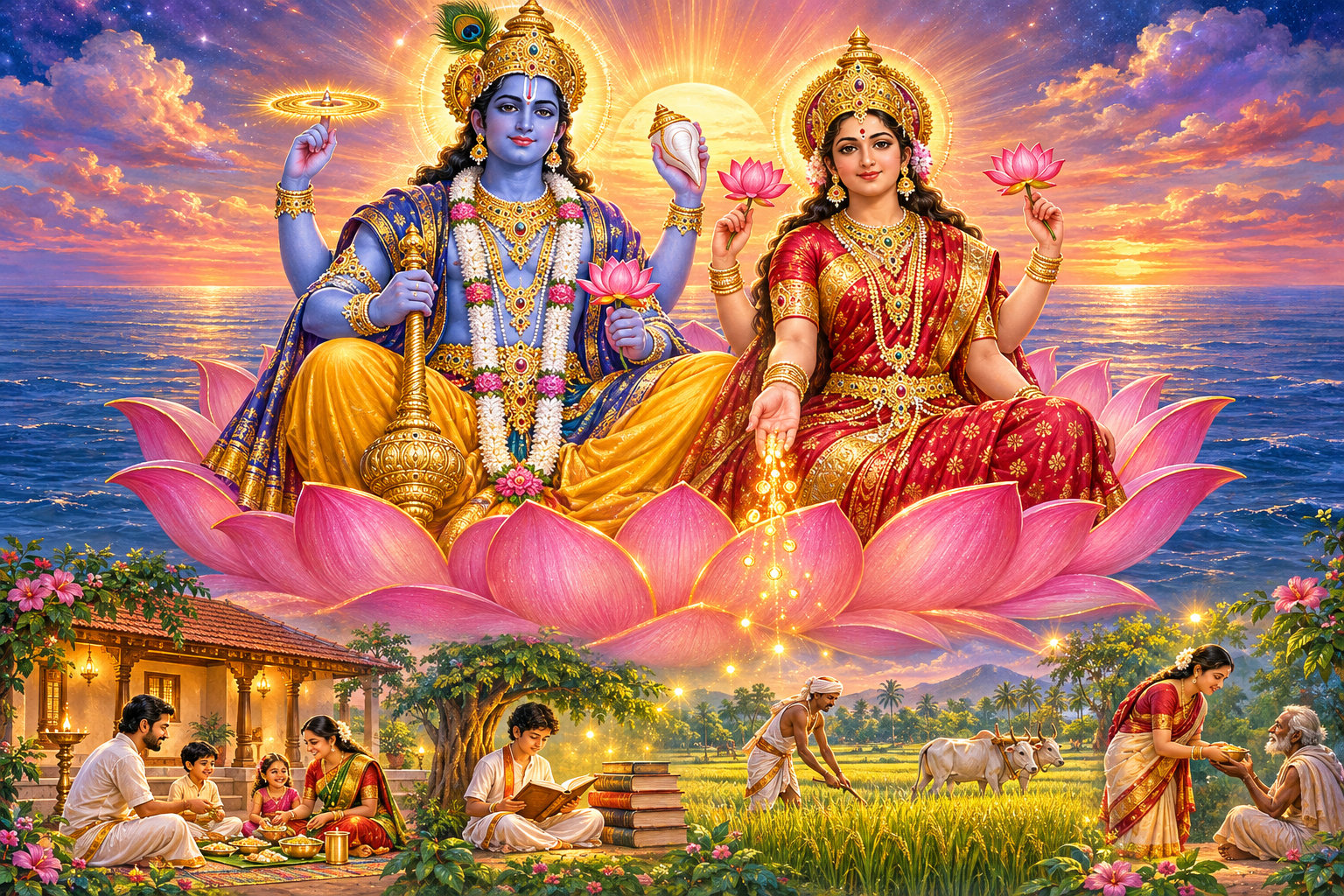
This is where the image of Lakshmi beside Vishnu becomes practical. Their relationship offers a way to judge an income opportunity, purchase, business choice, family budget, or charitable gift. Wealth is neither dirty nor self-justifying. It becomes auspicious when it serves dharma.
Lakshmi is greater than a bank balance
Lakshmi encompasses wealth, prosperity, good fortune, and auspiciousness. Reducing her to cash misses most of the teaching. Money may be one expression of prosperity, but so are the trust that allows a family to cooperate, the competence that makes useful work possible, the health of an institution, and the order that protects resources from waste.
This broader meaning changes how you assess success. A household can have a high income and still be impoverished by mistrust. A business can report a profit while consuming the relationships on which its future depends. A person can display abundance yet remain unable to enjoy, share, or use it without fear. The amount may be impressive while the underlying prosperity is thin.
The opposite mistake is to treat material competence as spiritually suspect. Neglecting dependants, refusing useful work, or leaving avoidable disorder for others to carry does not become Dharmic merely because little money is involved. Wealth is capacity. It can maintain a home, support learning, preserve a temple, assist someone in distress, fund honest enterprise, and give a person room to fulfil duties well.
Begin, then, by noticing the role money occupies in your mind:
- As an instrument, it helps you fulfil duties and support worthwhile aims.
- As an identity, it determines whether you think you deserve respect.
- As a master, it makes you defend conduct you would otherwise recognise as wrong.
The first role is compatible with dharma. The other two warn that possession has begun to possess the possessor.
Chanchala explains why prosperity can be difficult to hold

Lakshmi is traditionally described as chanchala: moving, unsettled, and not easily confined to one place. Anyone who has watched a flourishing household, career, or enterprise deteriorate through arrogance and disorder can recognise the moral insight. Acquiring resources and remaining fit to hold them are different achievements.
This teaching is not a formula for interpreting every financial outcome. Virtuous people can suffer losses, and wealthy people are not thereby certified as righteous. Poverty is not proof of moral failure. Illness, disaster, exploitation, economic disruption, and other forces can injure people who have done nothing to deserve the injury. Do not turn Lakshmi into a weapon for blaming those who struggle.
Chanchala is more useful as a warning about the effects of ungoverned prosperity. Wealth may remain on a balance sheet while its blessings depart. If it produces constant suspicion, estrangement, addiction to status, or fear of every loss, the holder has retained the asset but lost much of its auspicious character.
Bhagavan Vishnu supplies the missing centre. Vishnu is associated with preservation, order, and the maintenance of life. Lakshmi’s lasting bond with Vishnu therefore places wealth beside that which sustains rather than beside appetite without limit. Prosperity finds a worthy home when it is governed by truth, duty, restraint, and care for what must endure.
This relationship corrects two errors at once. It rejects the worship of wealth without dharma, and it rejects a spirituality that speaks grandly about dharma while ignoring the material work required to preserve families, communities, institutions, and sacred places.
Put every money decision through a dharma filter

Dharma is not a decorative blessing added after a profitable decision has already been made. It belongs at the beginning, while the means and consequences can still be changed. Before you earn, accept, spend, invest, or give a meaningful sum, ask these questions in order:
- Are the means truthful? Look for deception, coercion, concealed terms, exploitation, or a breach of trust. A desirable result does not purify a dishonest method.
- Which duties are involved? Identify the people and institutions to whom you already owe care, payment, work, or candour. Generosity elsewhere cannot excuse abandoning a clear responsibility at home or at work.
- Who carries the hidden cost? A gain may depend on another person’s ignorance, desperation, unpaid labour, or inability to object. If the benefit looks clean only because the burden has been kept out of sight, look again.
- What will this wealth preserve? Security, education, worship, useful enterprise, rest, beauty, and enjoyment can all have a place. The question is whether the spending supports a good life or merely performs status for an audience.
- Can you refuse it? If you cannot walk away when an opportunity violates a principle, money is no longer functioning as your instrument.
- Can you explain the decision truthfully to those affected? Privacy can be legitimate. Secrecy required to conceal harm, broken promises, or conflicting stories is a warning.
The questions will not make every difficult choice easy. Duties can conflict, and consequences may be uncertain. Their value is that they expose the real disagreement. You may discover that a debate presented as being about price is actually about fairness, or that a supposed necessity is a desire to avoid embarrassment.
Where a decision affects debt, inheritance, tax, contracts, employees, or the security of dependants, use qualified financial or legal advice as well. A spiritual framework can clarify purpose and limits; it cannot replace accurate calculations, lawful documents, or professional knowledge of your circumstances.
Give Lakshmi a home through household discipline

The symbolism becomes useful only when it changes repeated conduct. You do not need to wait for a dramatic moral test. Ordinary habits reveal whether prosperity is being placed beside Vishnu’s principle of preservation.
- Name the duty attached to each inflow. Salary brings duties to the work and household it supports. Business revenue brings duties to customers, workers, partners, and legitimate obligations. A gift calls for gratitude and responsible use. Do not mentally convert every receipt into immediately disposable money.
- Separate maintenance from display. Before a status purchase, check whether something already entrusted to you needs repair, payment, or care. Preservation usually appears less glamorous than acquisition, which is precisely why it is easy to neglect.
- Practise dana without creating fresh harm. Choose a form of giving you can sustain after meeting genuine obligations. Do not borrow, hide the gift from an affected spouse, or neglect dependants merely to appear generous. Giving governed by vanity reproduces the disorder it claims to cure.
- Keep accounts truthful. Reconcile what you say you value with where money actually goes. If records are vague, shared expectations are unspoken, or bills are being hidden, restore clarity before adding a new spiritual observance.
- Pair worship with conduct. If you offer a prayer or lamp to Lakshmi, let the observance prompt a concrete review: Was the income honest? Was anyone unfairly denied what was due? Did spending preserve what matters? What should be corrected?
- Discuss purpose before amount. Family arguments about money often harden around competing numbers. Ask what each person is trying to protect: security, dignity, freedom, care for elders, education, or social appearance. Shared purpose makes the actual trade-off easier to see.
These practices also prevent a transactional misunderstanding of devotion. Lakshmi worship is not a mechanism for purchasing divine approval while leaving dishonest conduct untouched. The lamp, mantra, or offering should refine the worshipper’s relationship with prosperity. Ritual and ethics belong together.
Nor does stability mean hoarding. Resources preserved without purpose can harden into fear. Resources scattered to prove abundance can become waste. The middle discipline is stewardship: retain what responsible care requires, use what serves legitimate life, share without performance, and remain willing to correct course.
Key takeaways
- Lakshmi signifies prosperity and auspiciousness, not cash alone. Judge wealth by the life and relationships it helps sustain.
- Chanchala warns that acquiring abundance does not make a person fit to hold it. Wealth can remain numerically present while losing its beneficial character.
- Vishnu gives prosperity its centre: preservation, order, duty, and restraint.
- Test financial choices at the level of means, duties, hidden costs, purpose, attachment, and truthful disclosure.
- Do not interpret poverty as guilt or riches as proof of virtue. This teaching guides the use of wealth; it does not explain every person’s material circumstances.
- Let worship produce a visible correction in conduct. Honest accounts, fulfilled obligations, sustainable giving, and careful maintenance are forms of practical reverence.
Before your next consequential money decision, do not ask only whether you can afford it or profit from it. Ask what it will preserve, whom it will affect, and whether you could still defend the means if the reward disappeared. That is how wealth is placed in the service of dharma, where Lakshmi’s presence can become a blessing rather than another appetite to feed.
References

Leave a Reply
You must be logged in to post a comment.