
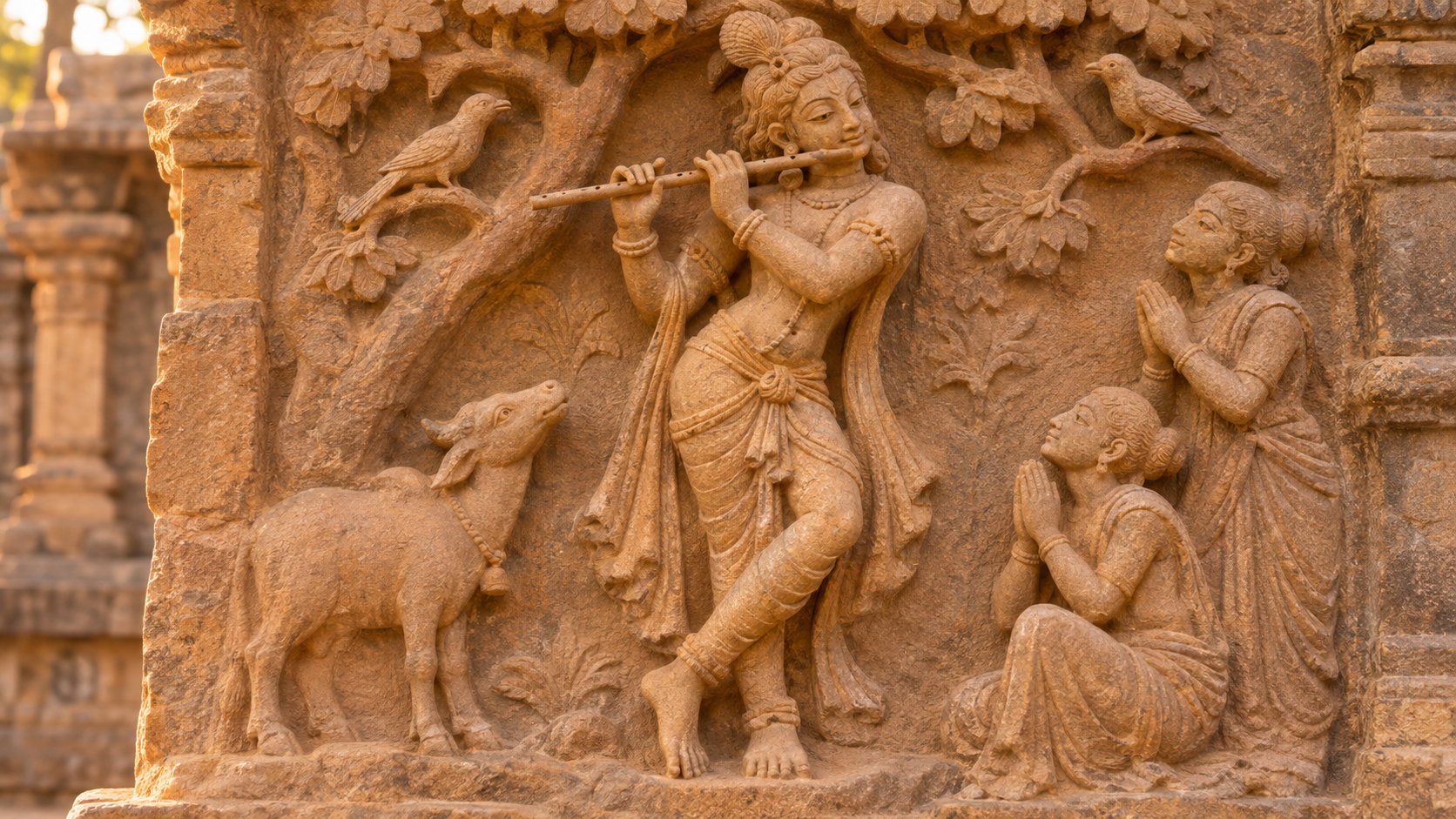
You stop before a sacred image. The figure’s hands rise toward the mouth, a slender flute crosses the body, and nearby beings appear drawn into the moment. What should you notice before deciding that this is simply another image of Krishna?
The flute is certainly an identifying attribute, but it is also a key to the sculpture’s theology. If you learn to read the hands, posture, setting, and implied listeners together, a silent stone image begins to disclose how Hindu art imagines divine presence.
Begin with the action carved into the body
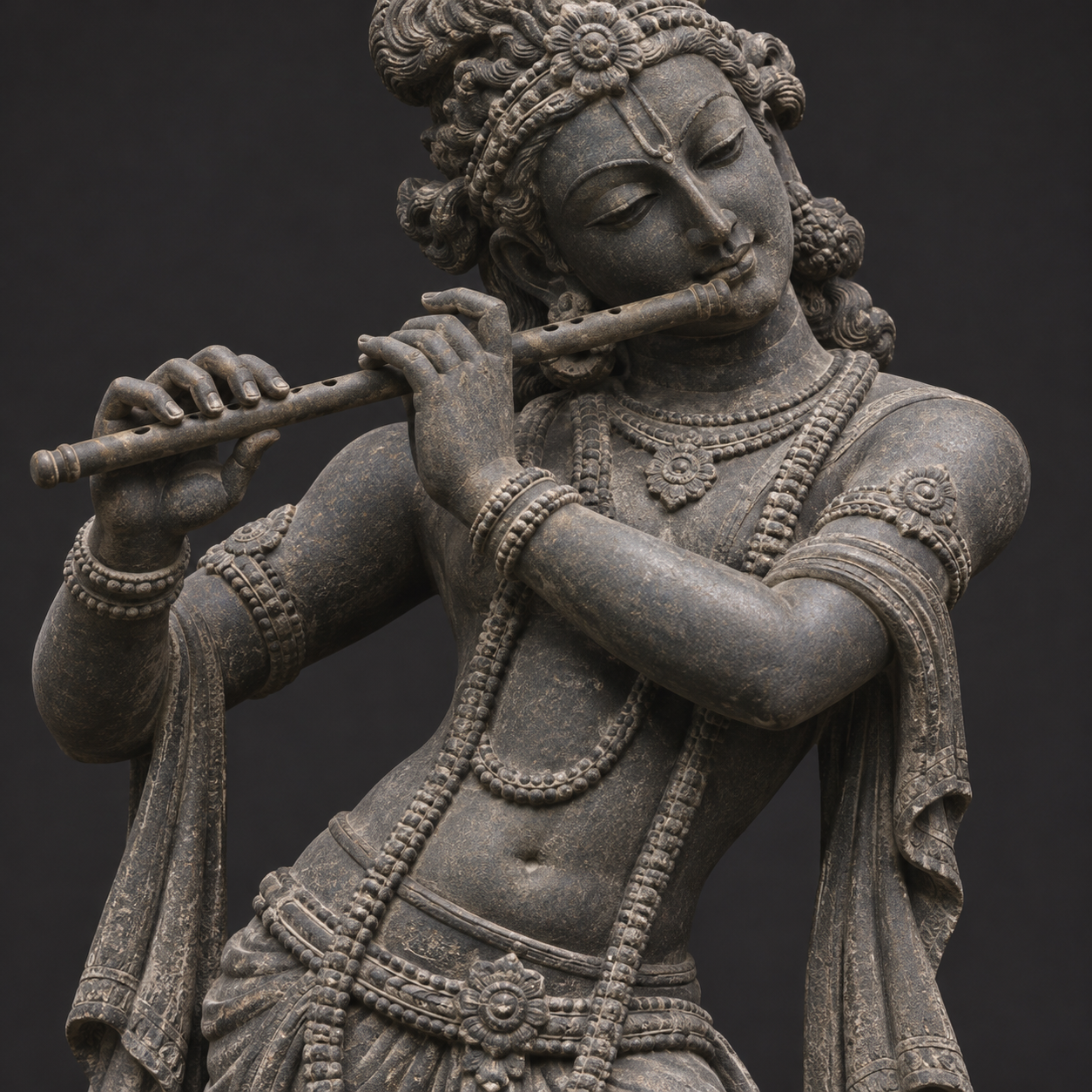
The Sanskrit term venu names a flute. In sacred sculpture, however, recognizing the object is only the first step. You also need to recognize the act of playing. The sculptor must communicate music without audible sound and, sometimes, without a fully surviving instrument.
Use a three-pass method when you encounter a possible flute-playing figure:
- Inventory what is physically present. Look for a narrow instrument, hands gathered around it, fingers arranged as if covering openings, and one end approaching the lips. Note broken surfaces rather than mentally repairing them at once.
- Reconstruct the action cautiously. Ask whether the shoulders, elbows, hands, and head form a believable playing posture. A missing slender attribute may have been damaged, but empty hands alone do not prove that a flute was once there.
- Look for a response. Examine surrounding figures, animals, attendants, and the direction of their faces. A musical action becomes clearer when the rest of the composition appears to listen, turn, gather, or become still.
This order matters. If you begin with the assumption that every familiar-looking youthful deity must be Krishna, you may force the surviving details into your expectation. Begin with the carved evidence; then let the iconographic identity emerge from the whole ensemble.
Damage requires special restraint. A thin projecting flute is more vulnerable than the torso or head of a stone figure. When the instrument is lost, aligned hands near the face can make a flute plausible, but the identification remains an inference unless other features support it. A museum label, temple tradition, inscription, companion figure, or better-preserved parallel may settle what posture alone cannot.
The venu speaks a different language of divine power
Attributes such as the chakra, gada, and trishula readily evoke divine capacities to defend, overcome, or destroy. The musical and pastoral character of the venu places power in another register. It does not strike an adversary or mark royal command. It acts through sound.
That difference gives you a reliable interpretive question: How does this image imagine divine action? A weapon-bearing form may confront disorder. A flute-playing form attracts attention, creates relation, and gathers a world around a centre that does not need to coerce it. The contrast is not between a powerful deity and a powerless one. It is between distinct ways in which sacred power becomes present.
Notice what playing demands from the divine body. The hands are occupied with music. The arms do not threaten. The face is commonly read in relation to concentration, ease, or inward composure rather than combat. The attribute therefore changes the meaning of the posture around it: the entire body participates in an act of ordered expression.
You can test this reading against the rest of the image. If the surrounding beings orient themselves toward the player, the composition presents influence as attraction. If the figure remains serenely self-contained, the implied music may still organize the scene by establishing an unseen centre. Either way, do not isolate the flute as an accessory. Ask what kind of power the whole sculpture allows it to exercise.
Stone makes unseen breath and unheard sound legible
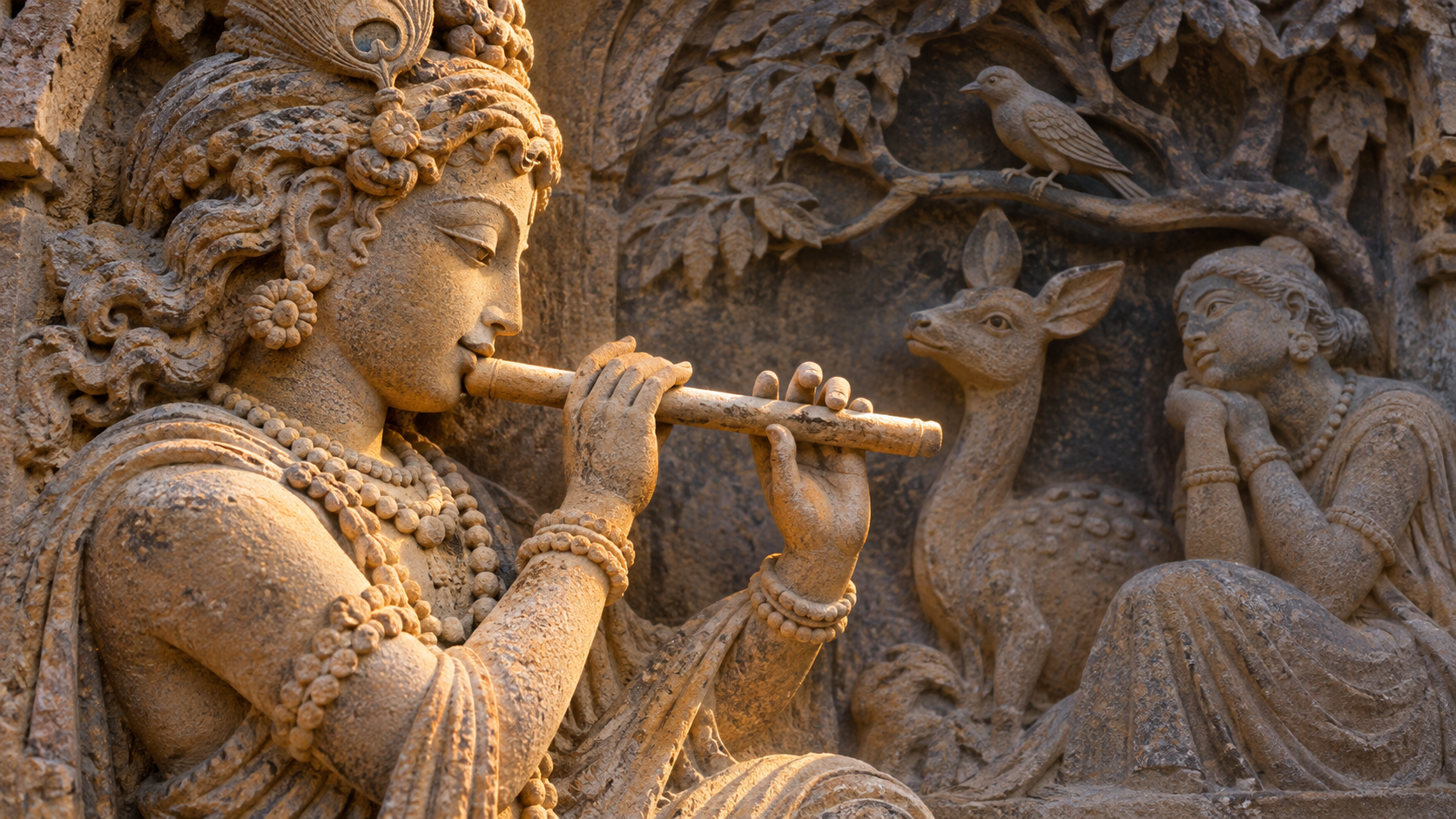
A flute depends on breath moving through a hollow passage. Neither the breath nor the resulting melody can be carved as a solid object. Sacred sculpture therefore gives you the causes and effects of music indirectly: lips approach the instrument, fingers regulate it, the body settles into playing, and listeners respond.
Trace the implied sequence whenever you examine a venu image:
- Breath begins within the player. The visible instrument receives an invisible movement.
- The hollow flute gives that movement form. Breath becomes ordered sound rather than remaining undirected air.
- Gesture makes the sound intelligible. Fingers and posture suggest measure, variation, and intentionality.
- The surrounding world completes the event. Music becomes relational when another being attends to it.
This sequence explains why the venu can bear spiritual meaning without any written explanation beside it. Interior life passes through disciplined form and reaches beyond the individual player. The instrument joins what cannot be seen to what can be embodied.
The flute’s hollowness can also support a contemplative reading: what is open can receive breath, and what receives breath can become an instrument of ordered expression. Treat that as an interpretation, not as a mechanical code imposed on every image. The carving may invite reflection on receptivity, but its exact meaning still depends on the deity, setting, accompanying figures, and larger temple programme.
This distinction protects you from two opposite errors. The first is to see only a charming musical prop. The second is to attach an elaborate doctrine to the flute while ignoring what is actually carved. Begin with the physical relationship among breath, instrument, gesture, and listener; let the spiritual reading grow from that relationship.
The pastoral setting carries theological weight
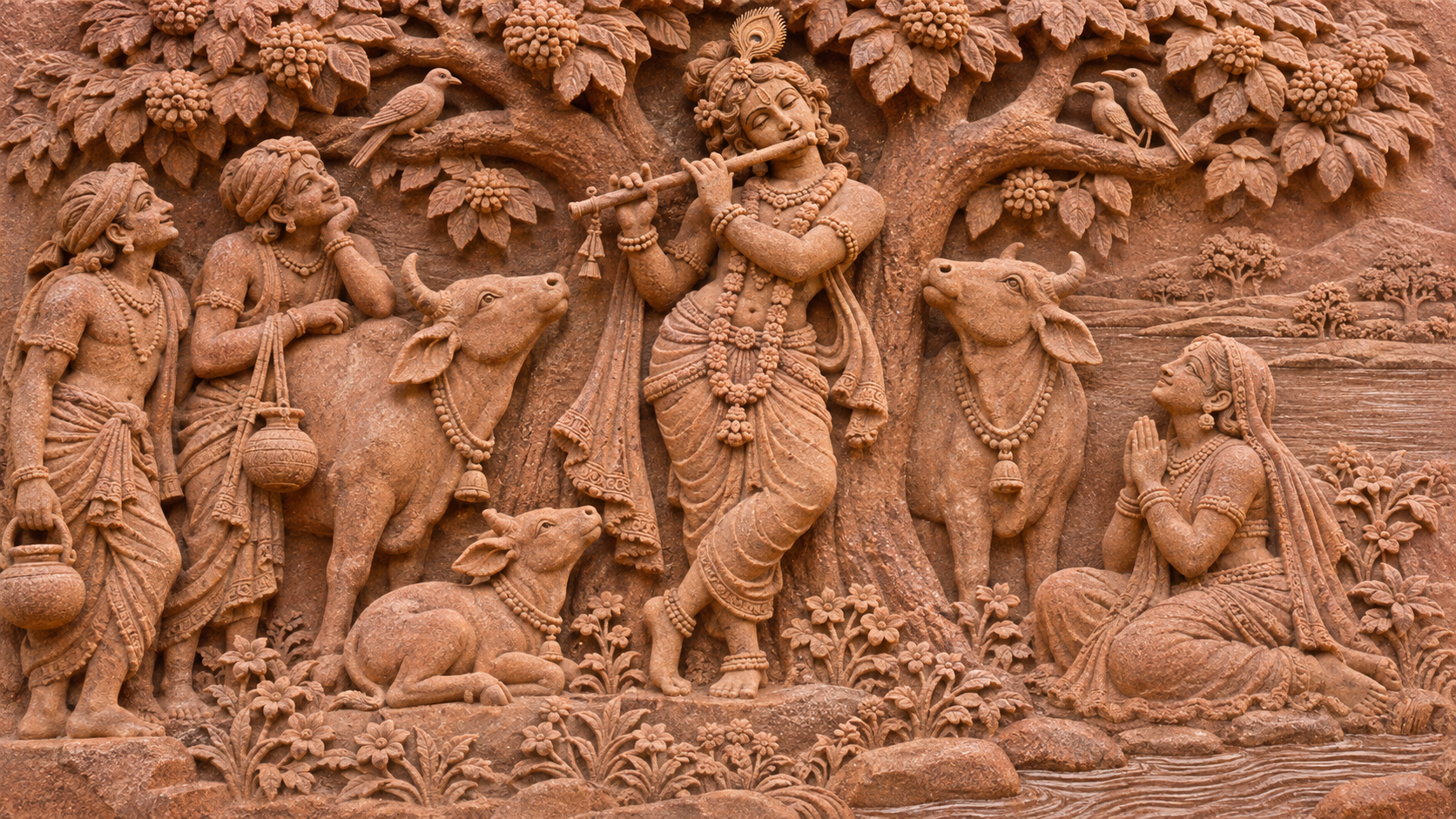
The venu belongs to a pastoral and musical world rather than to the visual vocabulary of battlefield force or courtly command. That setting does not make the image less sacred. It brings divine presence into a register of nearness: music can be encountered, heard, followed, and shared.
When the sculpture preserves its surroundings, take an inventory before concentrating exclusively on the central figure. Are animals present? Do companions turn toward the player? Do trees or other environmental forms make the scene feel inhabited rather than ceremonial? Does the composition gather many beings around one musical act? Such details tell you whether the pastoral world is mere background or an active participant in the sacred event.
This changes how you should read apparent simplicity. A flute, an unarmed posture, and a non-palatial setting can express intimacy without reducing divinity to ordinary life. The scene allows the sacred to be recognized through relationship rather than distance. Grandeur is not abolished; it is translated into presence.
Do not identify the deity by the flute alone
Krishna is the most familiar divine flute player, so he is the natural first possibility when you see the venu. He should not become an automatic answer detached from the rest of the image. Iconographic identification is cumulative.
Check the instrument against the figure’s bodily attitude, ornaments, headdress, companions, setting, and any surviving narrative context. Ask whether these elements reinforce one another. When they do, the flute helps establish identity while also clarifying the form in which the deity is present. When they do not, keep the identification provisional.
This is especially important when looking at fragments, weathered temple reliefs, or objects removed from their original architectural setting. A catalogue title can help, but the sculpture itself should still be read as a coordinated visual statement. One attribute may open the inquiry; the complete arrangement should finish it.
Key takeaways for your next encounter
- Begin with the hands, lips, and surviving instrument before assigning an identity.
- Treat the venu as an action-bearing attribute, not a decorative object: the deity is playing, and the rest of the composition may be responding.
- Contrast the flute’s mode of power with that of weapons. Its visual logic is attraction, relation, and ordered sound rather than impact.
- Follow the implied movement from invisible breath to formed music and then to the listener.
- Use pastoral details as evidence. Animals, companions, vegetation, and attentive faces can carry part of the sculpture’s theological meaning.
- Keep symbolic interpretations accountable to the carving. Hollowness and receptivity may deepen the image, but they should not replace close observation.
At the next temple, shrine, or museum gallery you visit, give a flute-playing image an extra minute. Follow the line from the player’s breath to the instrument, from the instrument to the surrounding bodies, and from those bodies back to the divine centre. That simple act of looking turns a silent attribute into the organizing voice of the sculpture.
References
- Hindu Blog — Flute in Hindu Sculpture – The Venu: Breath, Sound and Divinity in Hindu Sculptural Art

Leave a Reply
You must be logged in to post a comment.