
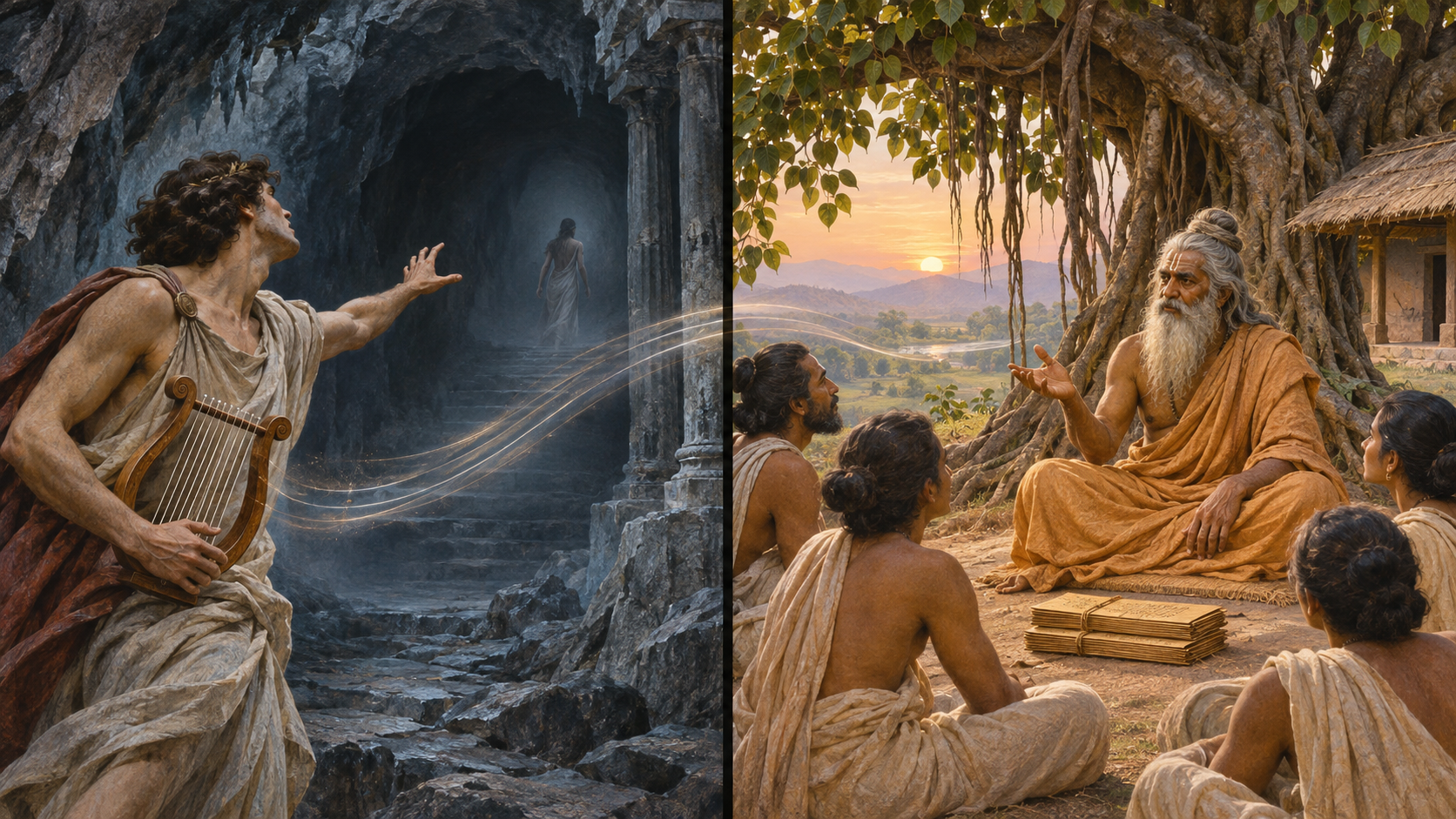
If you have seen Orpheus described as a Greek counterpart to Vyasa, pause before either accepting the pairing or dismissing it. The comparison becomes useful only when you ask what each figure does with suffering, language, and the limits of human power.
They are not equivalents wearing different cultural clothing. Orpheus turns sorrow into a song that seeks reversal. Vyasa turns catastrophe into a body of wisdom through which human beings can examine dharma. Reading them together can help you distinguish the power to move the heart from the wisdom required to guide action.
Comparison is analogy, not a claim of common origin
A resemblance between figures from two traditions can mean several different things. They may share a social role, confront a similar human problem, or use comparable forms of expression. None of those similarities, by themselves, proves borrowing, migration, or a common historical source.
That distinction matters here. The productive question is not, “Was Orpheus really a Greek Vyasa?” It is, “What happens when two traditions entrust extraordinary power to sound and language, but direct that power toward different ends?” The first question encourages speculation about identity. The second makes the traditions more intelligible on their own terms.
Keep three levels separate whenever you make such a comparison. A thematic parallel identifies a recurring human concern. A functional parallel asks whether two figures perform similar cultural work. A historical connection requires evidence of transmission. Orpheus and Vyasa offer a strong thematic contrast and a limited functional parallel; the pairing alone supplies no basis for a historical claim.
This discipline also prevents comparative religion from becoming a contest. You do not have to diminish Orpheus to appreciate Vyasa, or flatten Vyasa into a poet-magician to make the pairing work. A sound comparison preserves difference before drawing meaning from it.
Sound is shared, but its purpose is not
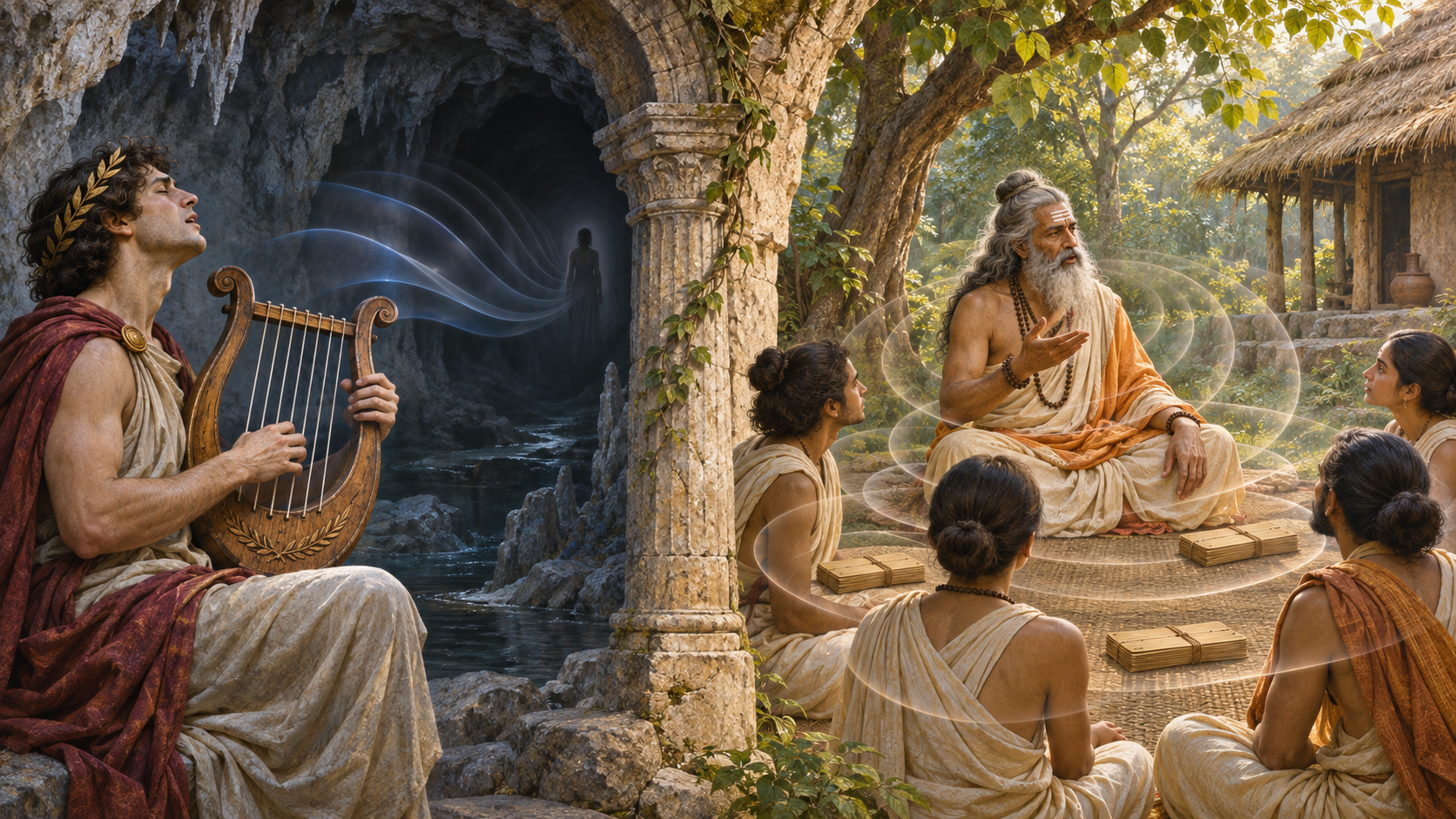
Orpheus is remembered above all as a master musician, while Vyasa is traditionally remembered as the compiler of the Vedas and the author of the Mahabharata. Both stand in relation to potent expression. Yet “powerful words” means something quite different in each case.
Orphic music acts directly upon those who hear it. It charms, persuades, softens, and gains passage where ordinary speech or force would fail. Its power is concentrated in performance and in the response of the listener. The familiar myth therefore asks how far beauty can carry a person when the object of song is not admiration but the recovery of someone lost to death.
Vyasa’s authority has another shape. A compiler does not simply overwhelm an audience with a moment of enchantment. Compilation orders, preserves, and transmits knowledge. The Mahabharata likewise does not make pain disappear through verbal beauty. It gives conflict, kinship, ambition, vows, violence, responsibility, and grief a narrative form in which dharma can be examined.
The common element, then, is not merely sound. It is disciplined expression made consequential. Orpheus reveals expression as an affecting force: song can open a path that appears closed. Vyasa reveals expression as a conserving and interpretive force: words can carry memory beyond the crisis that produced it and help later generations reason about conduct.
Orpheus: sorrow seeking reversal
In the familiar telling, Orpheus descends to the realm of the dead to recover Eurydice. His music wins a conditional opportunity to lead her back, but he must not look behind him before the appointed moment. He looks back too soon and loses her again.
It is tempting to turn this into a simple lesson about obeying instructions. That reading is too thin. The backward glance arises at the point where love must proceed without confirmation. Orpheus can move the powers around him, but he cannot make uncertainty cease to be uncertainty. His artistic mastery does not give him mastery over his own need to know.
The result is not proof that art is useless. His song carries him farther than ordinary power could have carried him. The myth instead places a boundary around artistic potency. Beauty can express grief, make others attend to it, and carry the grieving person toward what seems impossible. It cannot guarantee that mortality will submit to desire.
When you read Orpheus, notice the exact point at which his gift stops being sufficient. The decisive limit is not a lack of feeling or skill. It is the difference between moving reality and controlling it.
Vyasa: catastrophe seeking discernment
Vyasa’s relation to suffering begins from a different premise. The Mahabharata does not organize itself around the recovery of an untouched past. Its moral world contains consequences that cannot simply be sung away. The task is to understand how human beings should act when obligations conflict, motives are mixed, and even a defensible choice may carry a terrible cost.
This is why dharma should not be reduced to a rule book. A rule can tell you what normally applies. A dharmic inquiry must also ask who is acting, what responsibilities that person bears, which goods are in conflict, what harm is foreseeable, and whether attachment is disguising itself as principle. The epic form can hold these tensions without pretending that every dilemma has a painless solution.
Vyasa’s words therefore do not seek the same result as Orpheus’s music. They do not recover one beloved person from death. They make a field of human action available for sustained reflection. The achievement is not reversal but intelligibility: catastrophe becomes something that can be remembered, judged, and learned from without being falsely made harmless.
Use five questions to avoid a shallow comparison
You can test any proposed parallel between Orpheus and Vyasa – or between figures from any two traditions – with five questions. The answers reveal whether the comparison clarifies the traditions or merely collects surface similarities.
- What is the medium? Orpheus is identified with performed music and song. Vyasa is identified with the ordering of sacred knowledge and the composition or transmission of epic narrative. Calling both simply “poets” erases the difference between immediate enchantment and enduring instruction.
- What crisis calls the medium into action? Orpheus responds to personal bereavement and separation. Vyasa’s epic vision addresses a wider moral catastrophe involving families, rulers, vows, power, and war. Both include suffering, but the scale and ethical structure differ.
- What outcome is sought? Orpheus wants a particular loss undone. Vyasa’s work enables people to examine dharma amid consequences that cannot be undone. One seeks restoration; the other cultivates discernment.
- Where does the power meet its limit? Orpheus can gain passage but cannot secure the desired return. Vyasa’s wisdom does not prevent every destructive decision or remove the cost of action. In both cases, expressive power is real without being absolute.
- What remains for the listener? Orpheus leaves the memory of love, beauty, doubt, and irreversible loss. Vyasa leaves an inherited framework for questioning conduct. The lasting gift of one is a tragic recognition; the lasting gift of the other is a discipline of moral attention.
This method guards against two common errors. The first is parallel hunting: finding a shared motif and declaring two figures identical. The second is civilizational scoring: using comparison only to prove that one culture is deeper than another. Neither approach helps you understand what a tradition is actually asking of its hearers.
What a dharmic reader can do with the contrast
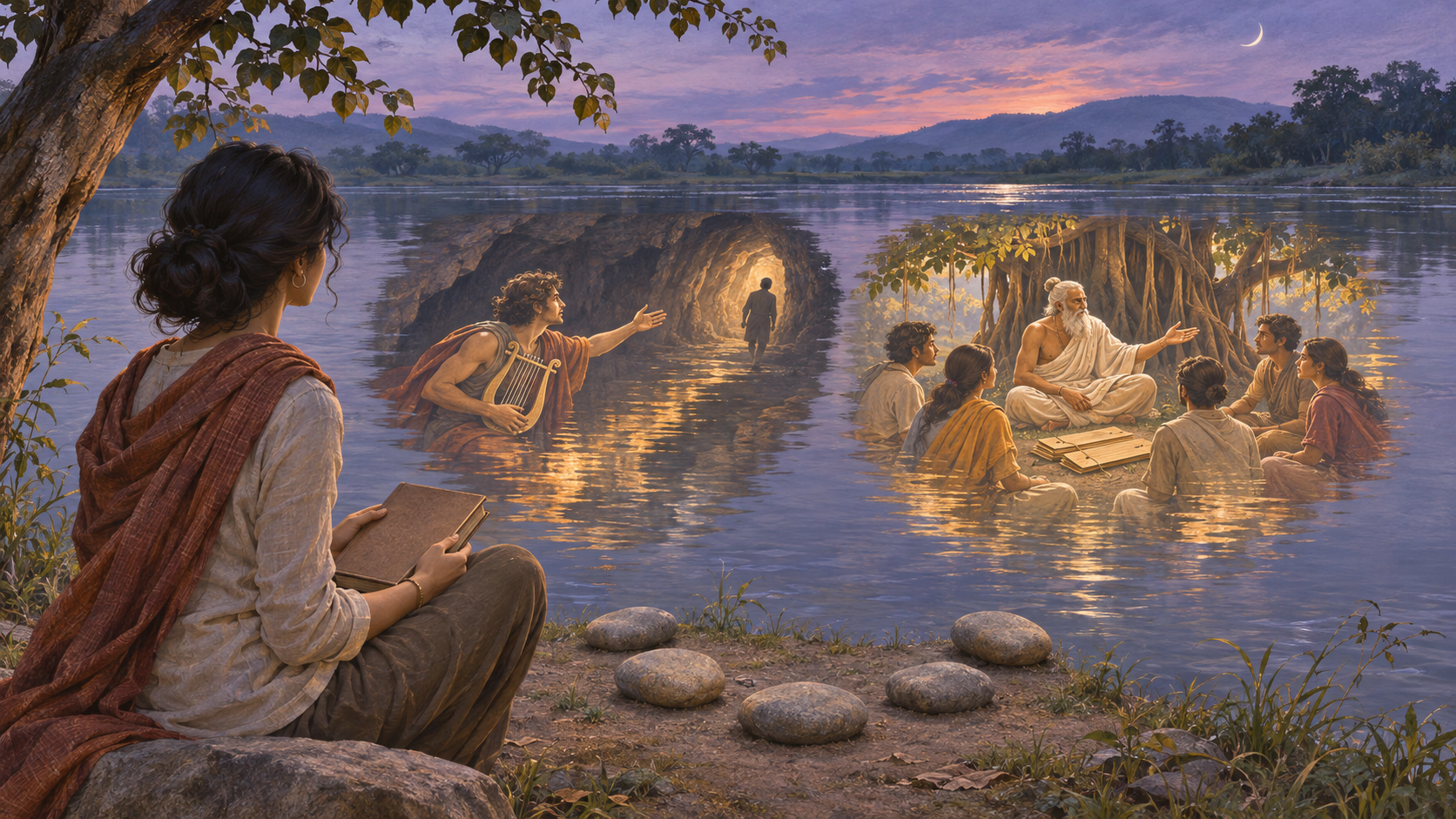
The pairing becomes personally useful when you recognize two different responses to suffering. One response longs to reverse what has happened. The other asks how to act truthfully after reality has changed.
The Orphic response is not foolish. Grief naturally reaches backward. Music, poetry, ritual, and remembrance can give that longing a form rather than allowing it to remain mute. But the Orpheus myth warns you not to confuse the ability to express a loss with the ability to cancel it. Art can bear witness without becoming a bargain by which reality must return what you love.
The Vyasian response begins when reversal is no longer the central question. You then ask: What responsibility remains? Which duty is truly mine rather than one I have claimed from pride, fear, or attachment? Who will bear the foreseeable cost of my decision? What part of the situation am I refusing to see because it complicates the story I prefer?
These questions do not promise certainty. Their purpose is to stop intense feeling from appointing itself as the sole judge of right action. Orpheus shows how deep feeling can empower expression and still fail to command an outcome. Vyasa shows why moral attention must continue after desire, loyalty, courage, and grief have all spoken.
This also clarifies the special contribution of a dharmic perspective. Dharma does not require you to become indifferent to sorrow. It asks that sorrow be placed within a larger field of relationship, consequence, and obligation. Feeling remains morally relevant, but it does not stand alone.
Questions readers often bring to the comparison
Are Orpheus and Vyasa equivalent figures?
No. Both are associated with extraordinary expressive power, but their remembered roles, aims, and results differ. Orpheus is primarily the musician whose song confronts death through personal sorrow. Vyasa is the sage traditionally associated with organizing sacred knowledge and transmitting an epic inquiry into dharma.
Does the resemblance prove contact between Greek and Indian traditions?
No. A thematic resemblance is not historical evidence. A claim of borrowing or shared origin would need independent evidence of transmission, chronology, and identifiable correspondence. This comparison works as an interpretation of two cultural figures, not as proof of a historical relationship.
Is Orpheus about emotion while Vyasa is about reason?
That division is also too simple. Orpheus’s action involves a condition, a decision, and the strain of uncertainty, not emotion alone. The Mahabharata’s inquiry into dharma is saturated with grief, loyalty, anger, love, and attachment, not detached reasoning alone. The sharper distinction is between expression directed toward reversing loss and wisdom directed toward acting within irreversible consequences.
Why compare them if the differences are so large?
Because the difference reveals two genuine capacities of sacred and poetic language. Language can move the heart toward what it has lost, and it can preserve the discernment needed for what comes next. The comparison succeeds when neither capacity is mistaken for the other.
When you next place figures from different traditions side by side, begin with purpose rather than resemblance. Ask what their words are trying to accomplish, where their power ends, and what kind of responsibility they leave with you. With Orpheus and Vyasa, that approach turns an attractive parallel into a serious reflection on grief, limits, and dharma.
References

Leave a Reply
You must be logged in to post a comment.