
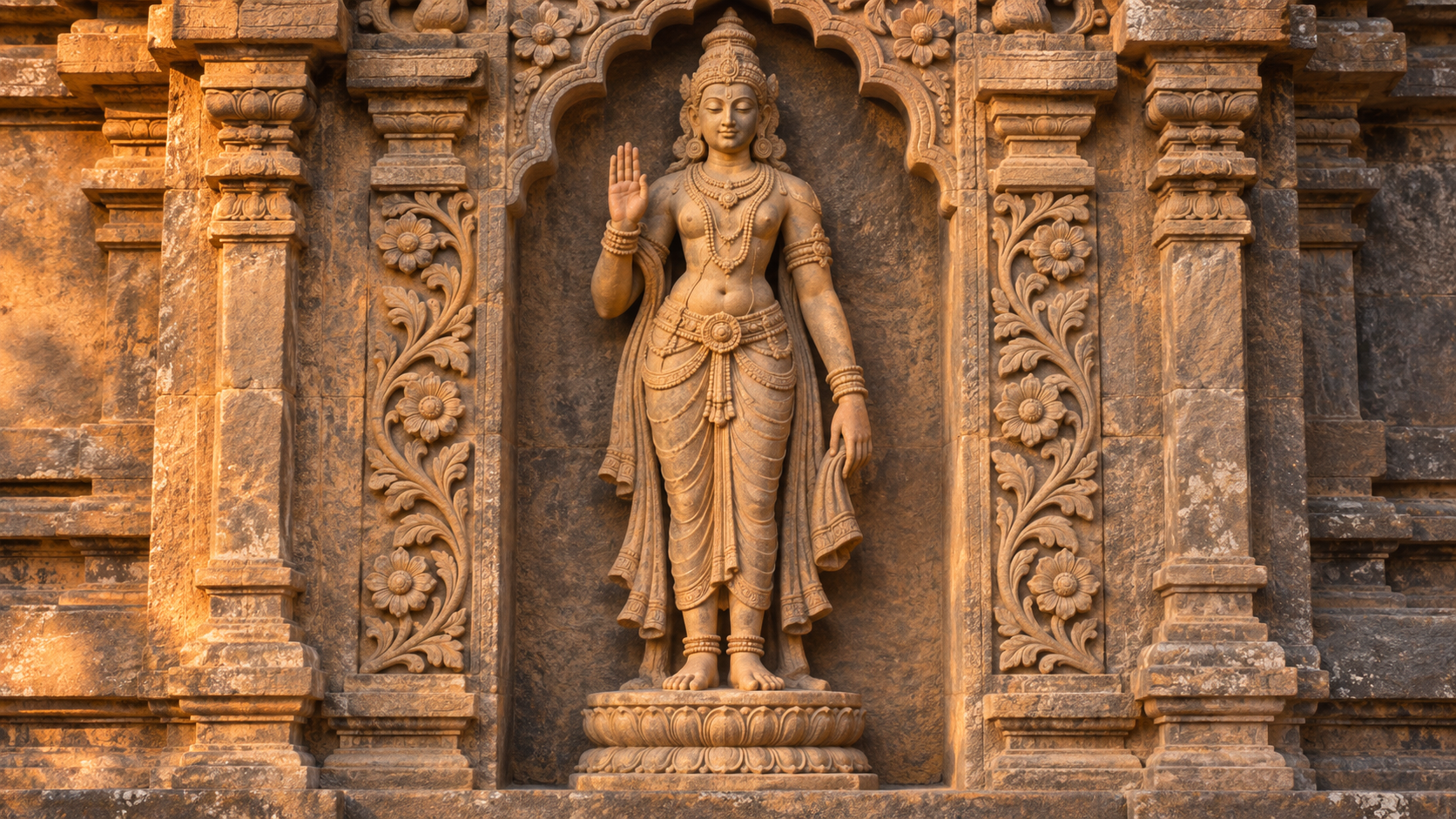
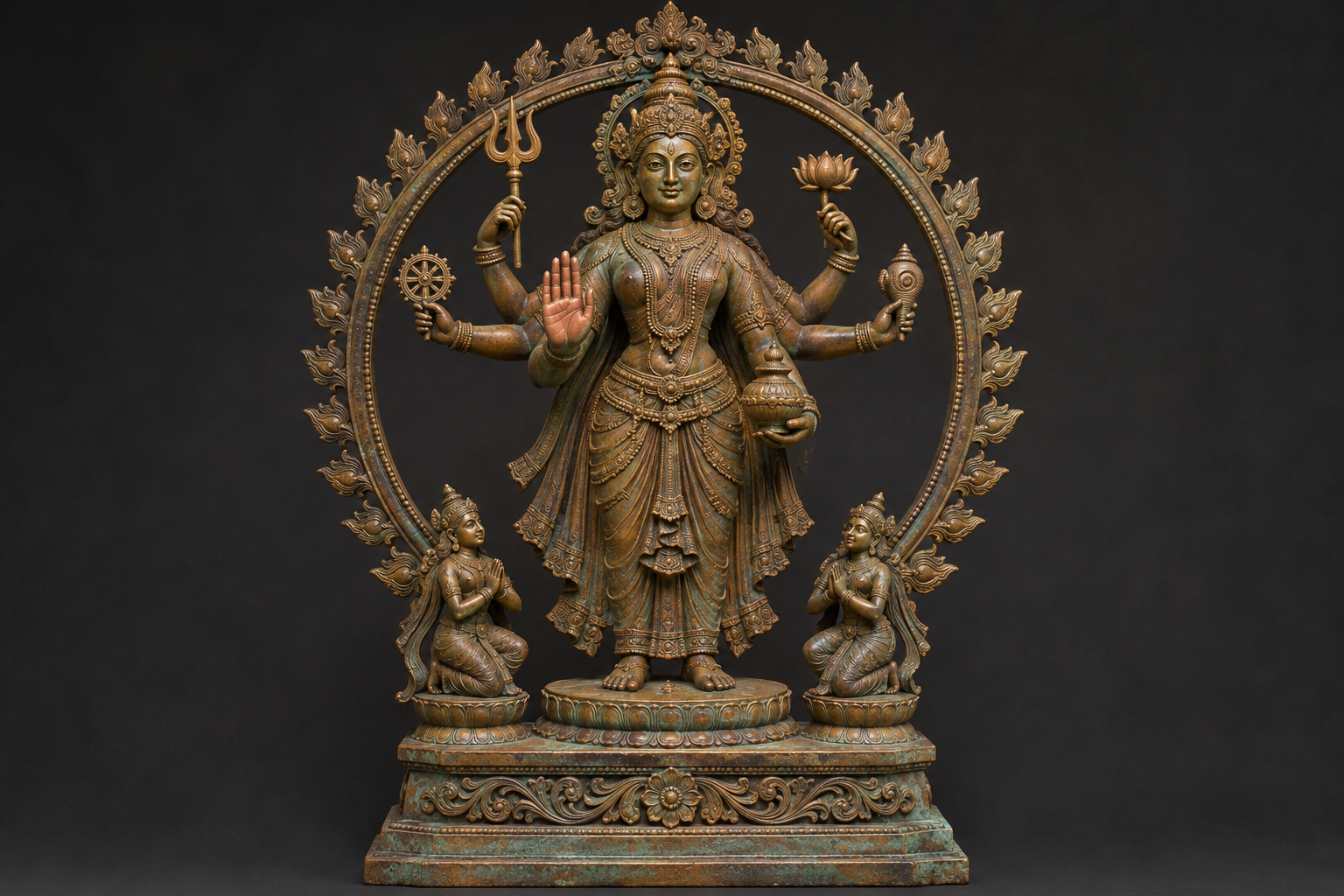
You are standing before a temple sculpture and one hand looks unusually clear: the palm is open, the fingers rise together, and the pose seems to carry both authority and calm. Is it Pataka, Abhaya, a literal signal, or simply a sculptor’s conventional way of showing an open hand?
Pataka gives you a reliable way into that question, but only if you separate the hand’s form from its meaning. Once you know what to inspect – fingers, thumb, palm, arm, posture, and surrounding figures – you can read the gesture without forcing one interpretation onto every murti.
Identify the hand shape before naming its message
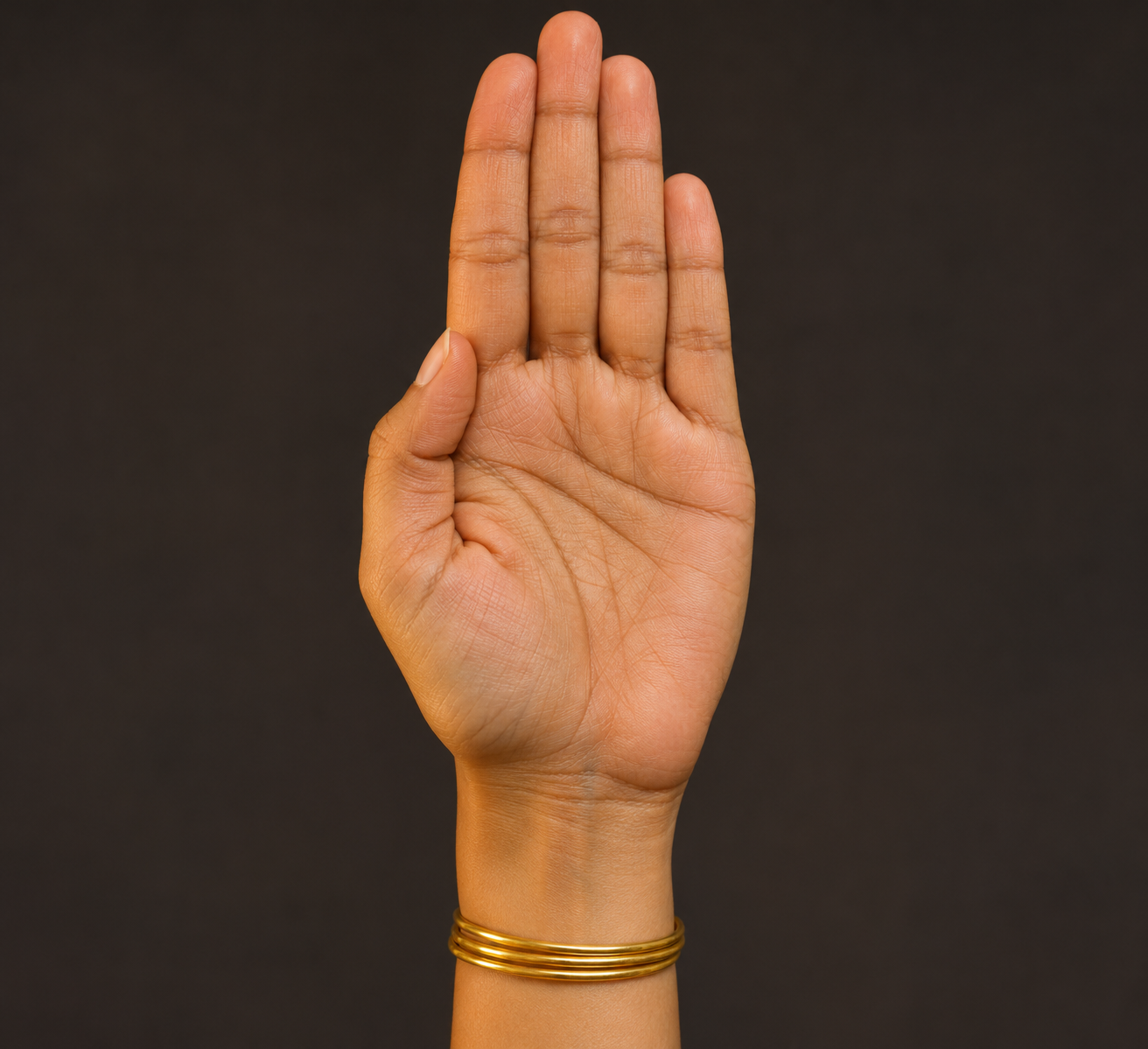
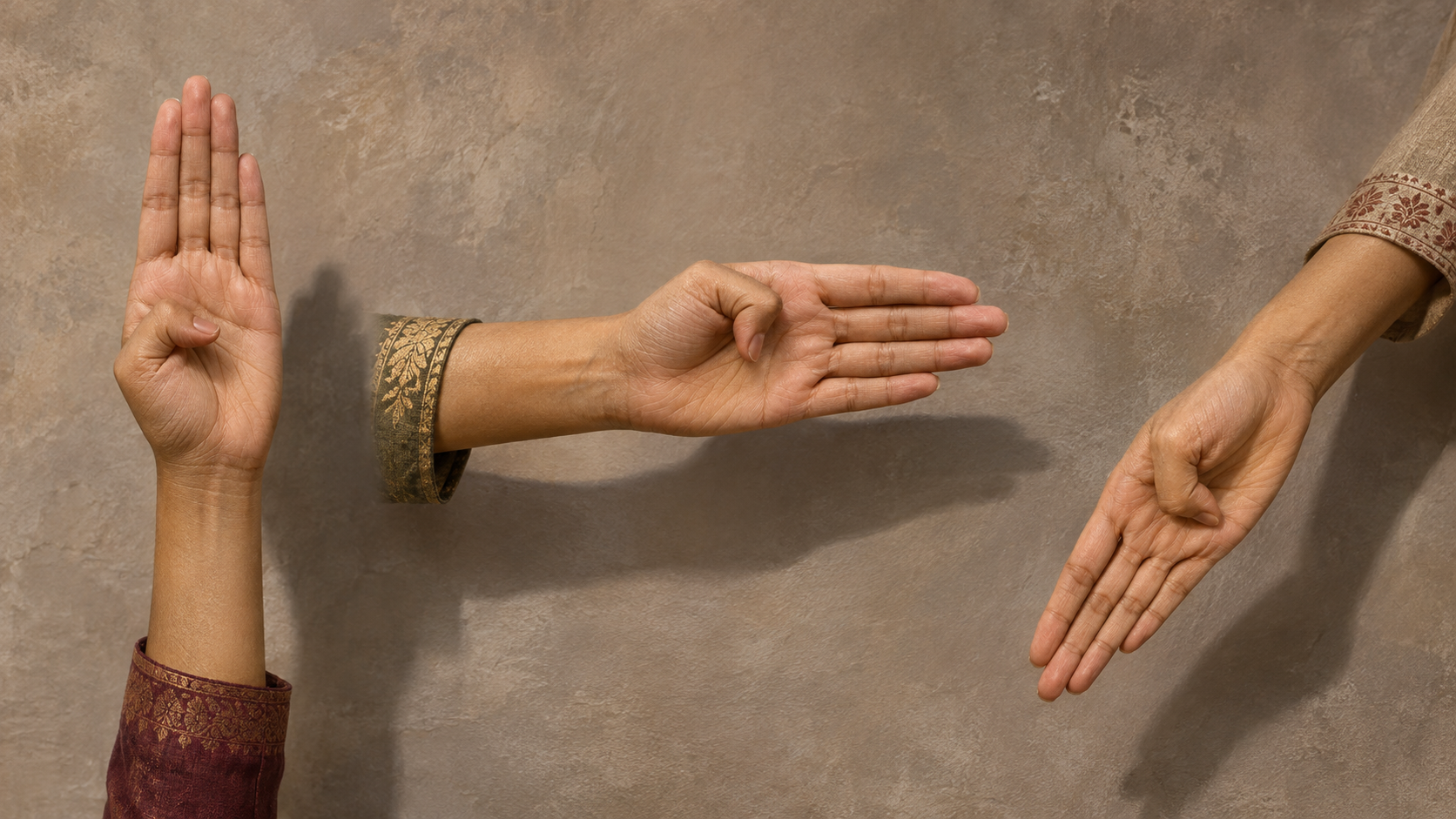
Pataka literally means flag and names a foundational asamyukta hasta, or single-hand gesture. In its familiar classical form, the palm is open, the four fingers are extended and held together, and the thumb bends inward toward the palm. The hand should read as a deliberate plane rather than a relaxed or grasping hand.
- Check the four fingers: They should appear extended and grouped, not individually curled around an object.
- Find the thumb: A thumb drawn inward helps distinguish the formal gesture from an ordinary spread hand.
- Look at the palm: Decide whether it faces outward, sideways, upward, or downward. Orientation changes how the gesture participates in the image.
- Follow the wrist and forearm: A hand cannot be interpreted responsibly after being visually detached from the arm that presents it.
The term asamyukta describes how the gesture is formed, not how many hands the deity possesses. A hand on a multi-armed murti can still make an asamyukta hasta because that particular configuration is executed by one hand independently.
Stone complicates identification. Broken thumbs, worn fingertips, restoration, heavy ornament, and an oblique photograph can make an open hand look more precise than it is. If the defining features are not visible, call it an open-palm gesture or Pataka-like hand rather than presenting a doubtful identification as certain.
The name flag does not make every Pataka a literal flag
A named hasta is part of a visual language, not a one-word rebus. Pataka may mean flag at the level of its Sanskrit name, but that does not require every appearance of the hand to depict a physical banner. Treat the name as the identity of the form; determine the function from the complete composition.
This distinction matters because Pataka can convey qualities such as command and grace without becoming two different hand shapes. Command emerges when the raised hand reinforces an authoritative frontal presence. Grace emerges through measured placement, an unbroken line from arm to wrist, and the controlled stillness of the figure. The hand contributes to those effects, but the body completes them.
The Natya Shastra and Abhinaya Darpana place such gestures within codified systems of movement and expression. That connection helps explain why Pataka appears across dance, sculpture, and temple art. It does not mean that every sculpted hand is a frozen dance step. Performance can unfold a gesture through time; sculpture must concentrate action, relationship, and sacred presence into a still form.
Read a sculpted Pataka in five passes
When you encounter a possible Pataka, resist the urge to interpret it from the palm alone. Use the following sequence at the temple, in a museum, or while examining a photograph.
- Verify the configuration. Look for extended, joined fingers and an inward-bent thumb. Inspect another photograph or viewing angle if the thumb is hidden.
- Record the orientation. An outward-facing palm addresses the viewer differently from a sideways or downward-facing palm. Describe the direction before assigning a meaning.
- Trace the whole limb. Notice whether the arm is raised, lowered, extended, or held close to the torso. The same hand form can feel declarative, restrained, or transitional depending on its placement.
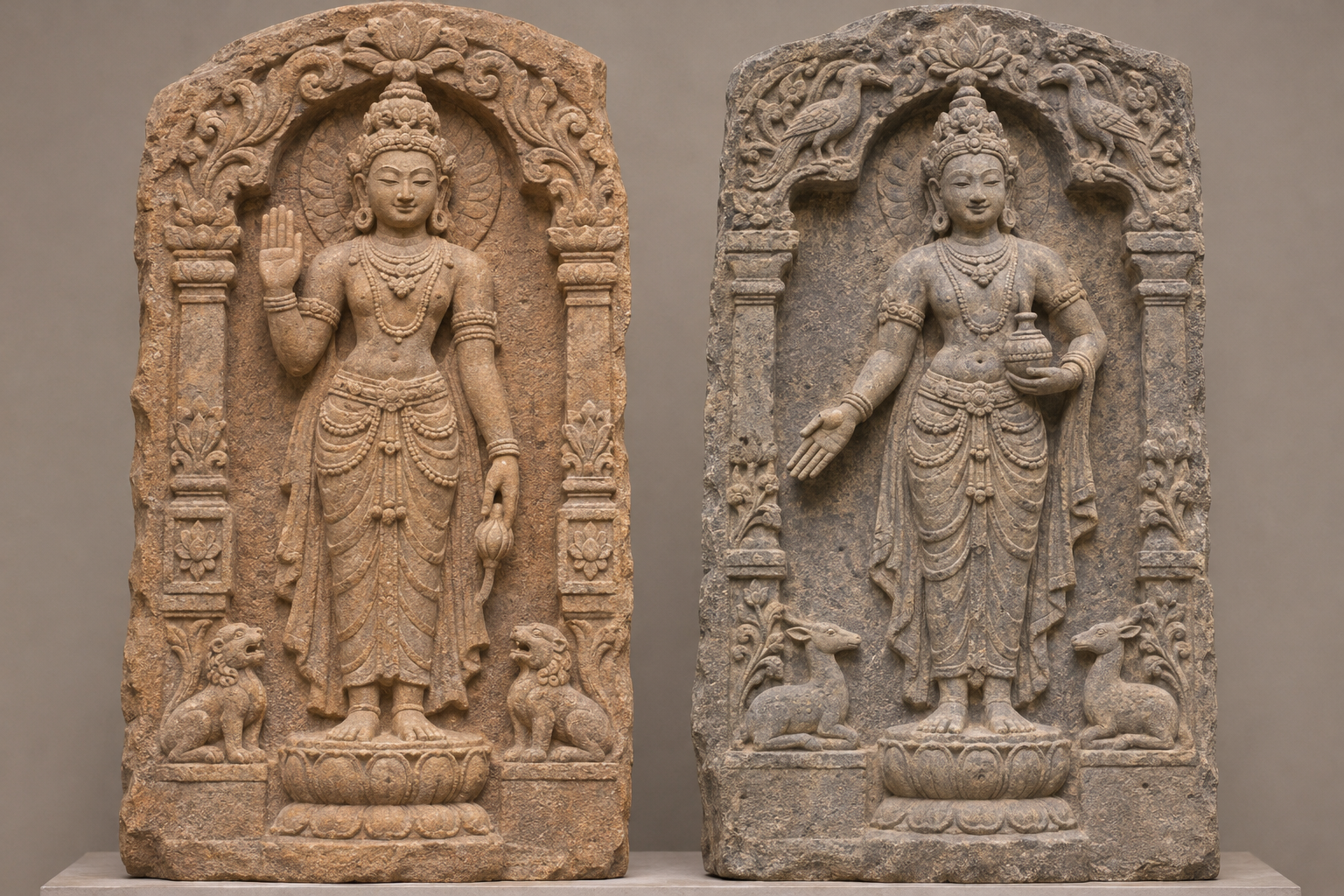
- Examine the other hands and attributes. In a multi-armed image, another hand may hold the object or emblem that establishes identity, while the open hand communicates the deity’s relationship with the devotee or with another figure.
- Read the scene. Attend to gaze, stance, attendants, opponents, worshippers, and repeated gestures. A hand directed toward another figure may belong to a narrative action; one presented frontally may address the viewer more directly.
This method produces a better description because it separates observation from inference. A careful note might read: The right hand has a Pataka-like configuration, with the palm presented outward; its raised position strengthens the figure’s authoritative frontal presence. That sentence tells another reader what you actually saw and where interpretation begins.
If you are cataloguing an image, keep those layers visible. Record the hand shape first, its orientation second, and its probable communicative role third. Future readers can then reassess the interpretation without losing the physical evidence behind it.
Pataka and Abhaya are not always competing labels
The most common reading error is to assume that Pataka and Abhaya must be mutually exclusive. They can answer different questions. Pataka can identify the formal configuration of the hand; Abhaya can identify what an outward-facing raised palm communicates – fearlessness, reassurance, or protection.
Ask which level you are trying to describe:
- What shape is the hand making? Pataka may be the appropriate formal term.
- What is the deity communicating? Abhaya may be the appropriate iconographic term when the gesture offers assurance or dispels fear.
- What does the complete image establish? Context may justify describing the hand as Pataka in form and Abhaya in function.
This layered vocabulary is more precise than choosing a label solely from the silhouette. It also prevents a dance classification from erasing theological meaning, or a theological label from obscuring the carefully constructed hand form.
Do not make the opposite mistake and call every outward palm Abhaya. A hand may participate in command, narrative address, formal presentation, or another action established by the scene. The surrounding iconography has to earn the functional label.
Key takeaways for your next temple visit
- Recognize Pataka first as a formal single-hand configuration: open palm, extended joined fingers, and an inward-bent thumb.
- Do not translate the Sanskrit name flag into a literal flag every time the hasta appears.
- Read the palm together with its orientation, arm position, body posture, other hands, attributes, and surrounding figures.
- Use Pataka for form and Abhaya for function when the image supports both descriptions.
- Downgrade your certainty when damage, restoration, ornament, or the viewing angle hides a defining feature.
The next time an open hand catches your attention, pause before reaching for a single symbolic translation. Identify the construction, follow the arm, and then read the image as a whole. That small discipline turns a familiar-looking palm into a meaningful part of Hindu visual language.
References

Leave a Reply
You must be logged in to post a comment.