
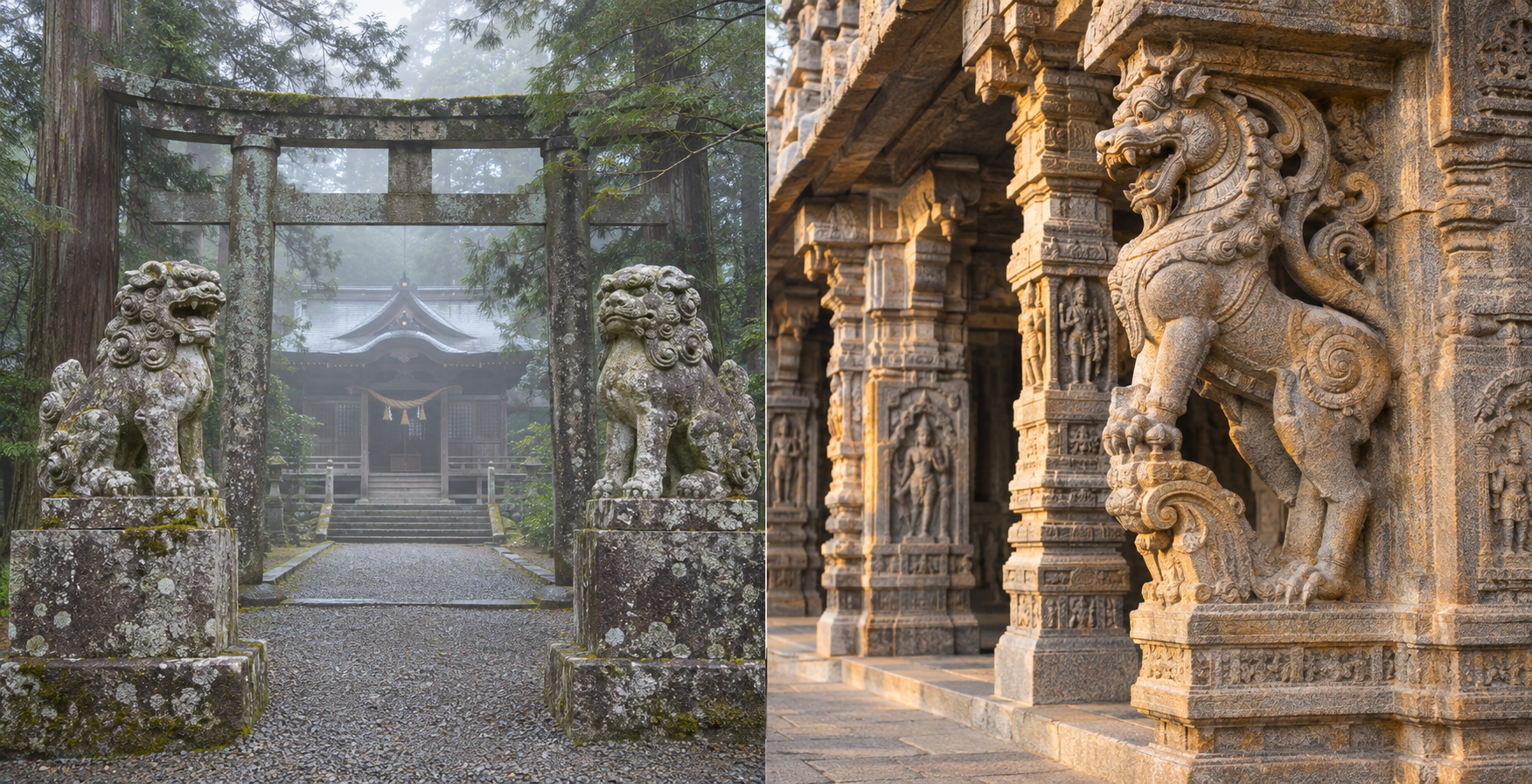
You have probably seen the resemblance before: a formidable creature watches the approach to a Japanese shrine, while a leonine being projects from the entrance or pillars of a Hindu temple. Calling both of them “lion guardians” is an understandable first step. It is not a sufficient reading.
To understand Komainu and Yali, you need to look beyond the animal’s face. Placement, posture, pairing and architectural setting tell you what each guardian is doing. They also help you appreciate a shared sacred language without turning resemblance into an unsupported claim of common origin.
Read the threshold before identifying the creature
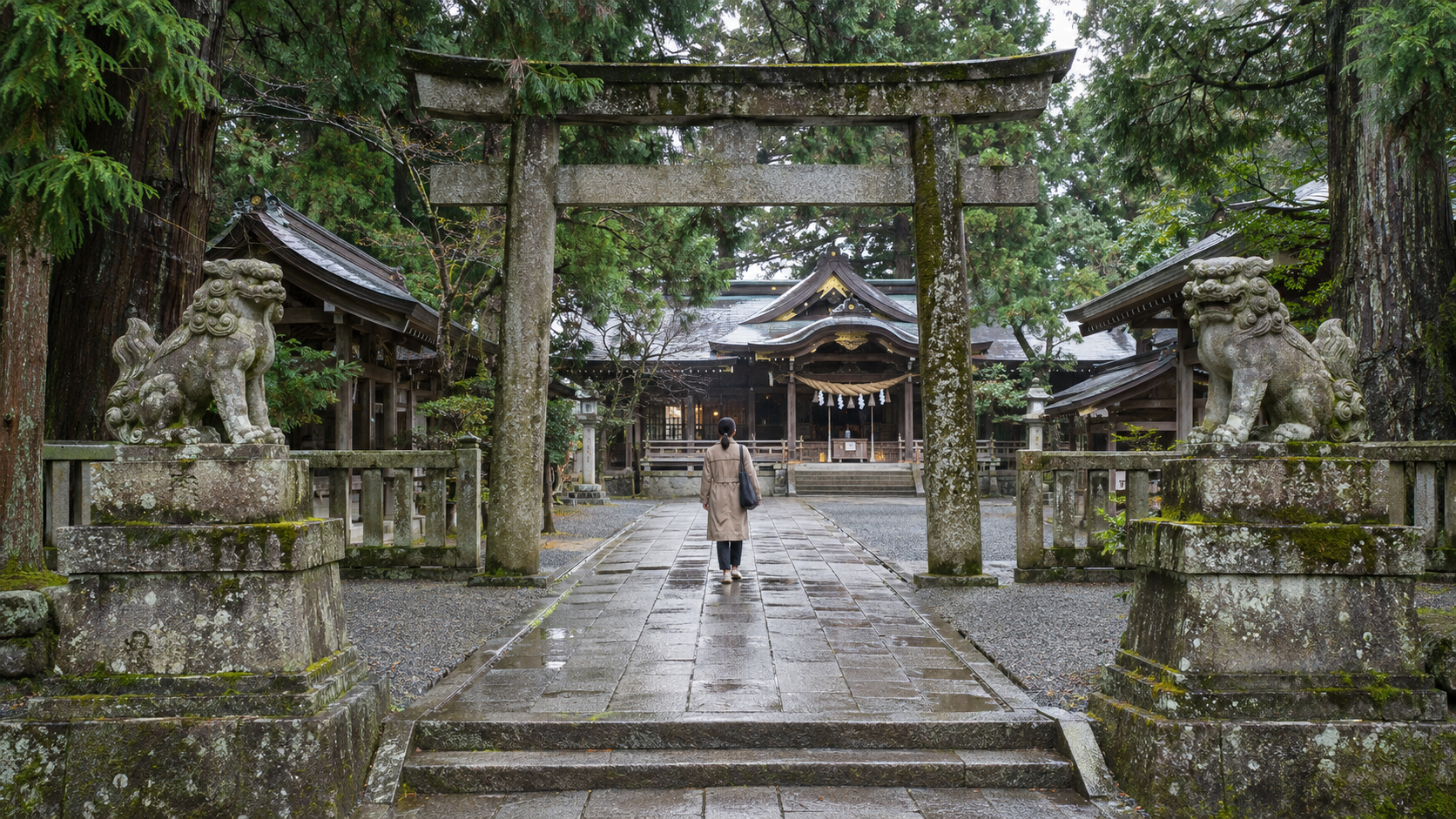
A guardian figure makes the most sense when you begin with the boundary it guards. Ask where you are standing. Are you outside the sacred precinct, approaching an entrance, passing between two figures or looking up at a creature embedded in a pillar? The answer reveals more than a close-up photograph of its head.
Sacred architecture does not merely enclose a ritual area. It prepares the visitor to enter it. A guardian contributes to that preparation by making the threshold visible and morally charged. Its controlled ferocity tells you that the space beyond is not ordinary. Entry requires attention, restraint and a change in conduct.
This is the strongest point of contact between Komainu and Yali. Both participate in an Asian sacred vocabulary of protection, purity, courage and the triumph of sacred order over chaos. The creature is fearsome, but its power is disciplined. It does not threaten sacred order; it serves it.
When examining either form, record four things before assigning a symbolic meaning:
- Position: Is the figure outside, at the threshold or within the sacred structure?
- Orientation: Does it face you, the path, another guardian or the interior?
- Relationship: Is it freestanding, paired or physically joined to the architecture?
- Energy: Does it sit in watchful stillness, rear upward or appear to surge out of stone?
This method prevents a common mistake: treating sacred sculpture as an isolated museum object. A guardian’s location is part of its meaning.
Komainu must be read as a relationship
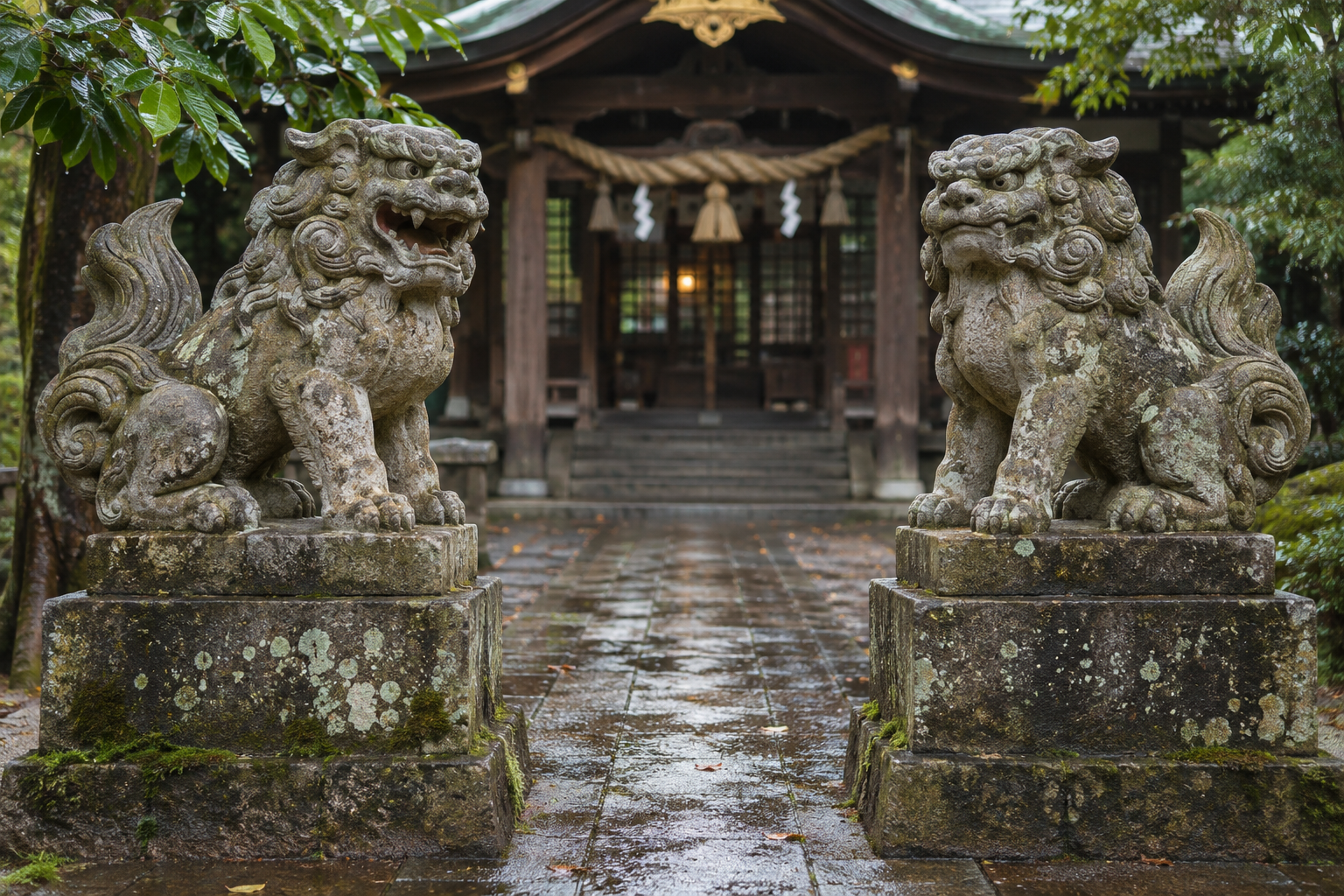
Komainu are associated with Japanese Shinto shrines and are commonly encountered as paired guardians along the approach or near an entrance. They are often described in English as lion-dogs, but that convenient label can mislead you into searching for a natural animal. Their stylised form belongs to sacred representation, not zoological illustration.
The pair is the basic unit. Each figure occupies one side of an approach, so the visitor passes through a field of reciprocal watchfulness. One guardian does not simply duplicate the other. Their positions create balance across the path and give the entrance a visible structure.
In many pairs, one mouth is open and the other is closed. You should note this difference without forcing it onto every example. Damage, restoration, regional variation and viewing angle may make the feature unclear. Where it is present, the contrast reinforces complementarity: expression and restraint, sound and silence, beginning and completion. The larger point is not a single decoded formula. It is that protection is represented through paired differences held in equilibrium.
Posture matters as much as the mouth. A seated Komainu may look calm at first, yet the frontal body, raised head and fixed gaze communicate readiness. Stillness is not passivity. It is vigilance without disorder. The shrine does not need an image of uncontrolled violence at its boundary; it needs force that has accepted a sacred purpose.
If you encounter Komainu during a visit, do not photograph only the more dramatic face. Stand far enough back to include both guardians and the route between them. That wider view preserves the relationship the sculptural arrangement was designed to create.
Yali turns animal power into architectural energy
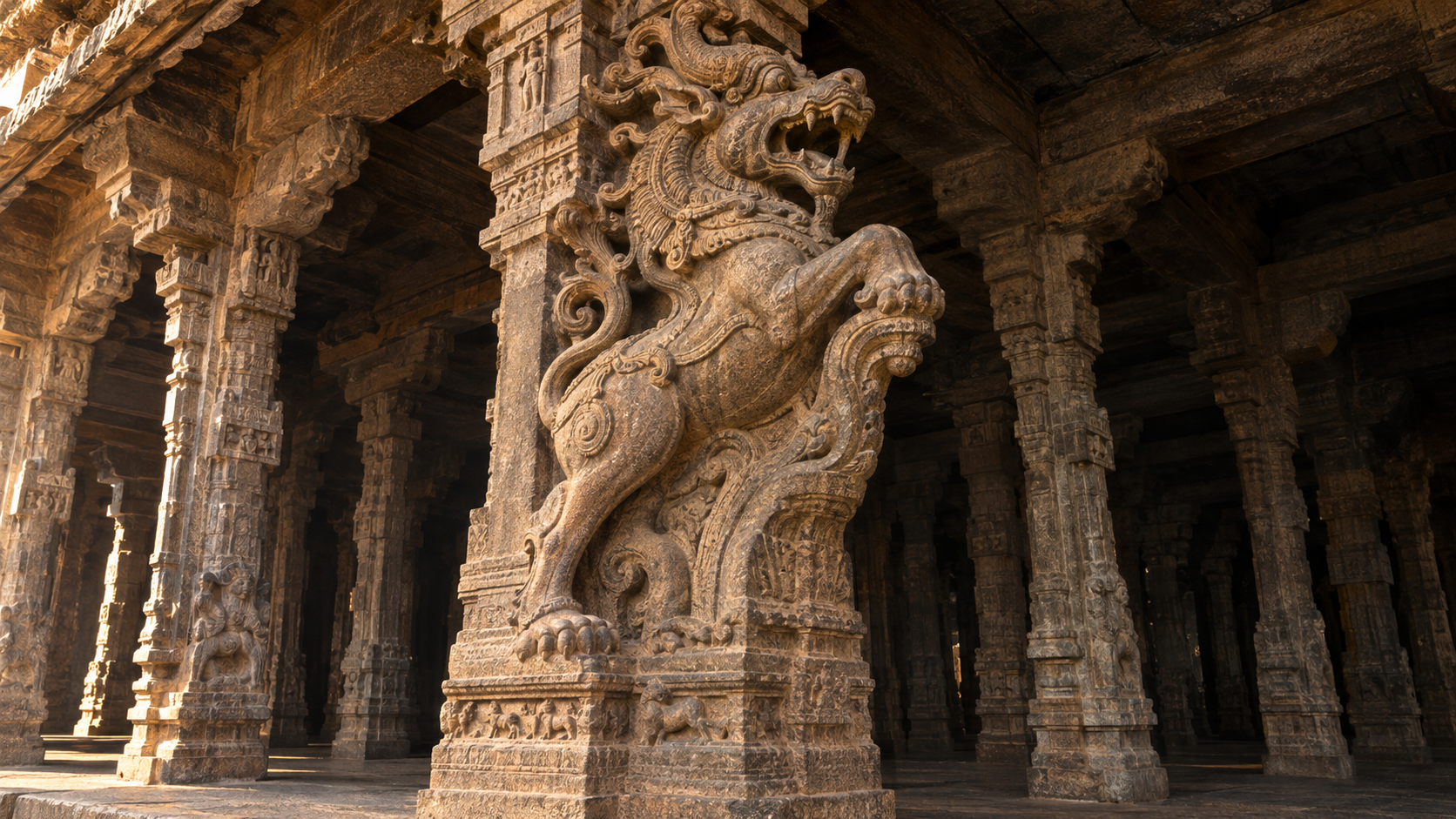
Yali belongs to the visual world of the Hindu temple. It is leonine, but it should not be reduced to an ordinary lion. Its stylisation and composite character allow it to embody a degree of power that a literal animal portrait could not contain.
A Yali may be integrated into a pillar, entrance or other architectural element rather than stationed as one member of a symmetrical freestanding pair. That difference changes how you should read it. With Komainu, your attention often moves horizontally from one guardian to the other across a path. With Yali, your eye may travel vertically through the creature and the structure that contains it.
Look at the line of the body. Jaws, limbs, mane and rearing movement can make stone appear tense and animate. The resulting force is not separate from the temple. It enters the pillar, frames the passage and adds protective intensity to the architecture itself.
This is why identifying every anatomical component is less important than understanding the transformation. A composite sacred creature declares that the sculptor is not trying to copy nature. Recognisable features are being reorganised into a form suited to guarding a divine environment.
For a Dharmic reader, there is also a practical lesson here. Temple ornament is not necessarily an optional layer applied after the “real” architecture was completed. A Yali can help the building communicate how the devotee should experience a particular route: as protected, potent and set apart from ordinary movement.
Compare sacred functions without claiming a shared origin
Komainu and Yali can be compared responsibly because they address a similar architectural problem. A sacred community needs to mark the passage from ordinary space into a protected precinct. A powerful guardian makes that transition visible. The comparison becomes weaker when every resemblance is treated as evidence that one tradition copied the other.
| Question | Komainu | Yali |
|---|---|---|
| What is the immediate setting? | A Japanese Shinto shrine approach or entrance | Hindu temple architecture |
| What is the dominant visual logic? | Paired guardianship across a route | Leonic or composite power integrated with the structure |
| What should you inspect first? | The relationship between the two figures | The relationship between the creature and the pillar or entrance |
| How is controlled power expressed? | Watchful stillness, balance and complementary differences | Concentrated movement, tension and architectural force |
| What is the common misreading? | Studying one figure while ignoring the pair | Treating the form as a literal animal portrait or detachable ornament |
Visual similarity establishes a question, not an answer. A historical claim about transmission would require more than two comparable silhouettes. It would need chronology, plausible routes of contact and evidence that can distinguish direct influence from independent responses to the same sacred need.
This distinction matters when discussing Bharat’s influence abroad. India’s cultural reach across Asia is a serious historical subject, so it deserves serious standards of evidence. Overstatement does not strengthen that history. It gives critics an easy way to dismiss valid connections along with speculative ones.
The careful conclusion is already meaningful: Shinto and Hindu sacred architecture both employ disciplined animal power to protect boundaries and prepare human beings for entry into consecrated space. They do so through different sculptural arrangements and within different religious worlds.
Use this five-minute method at a shrine, temple or museum
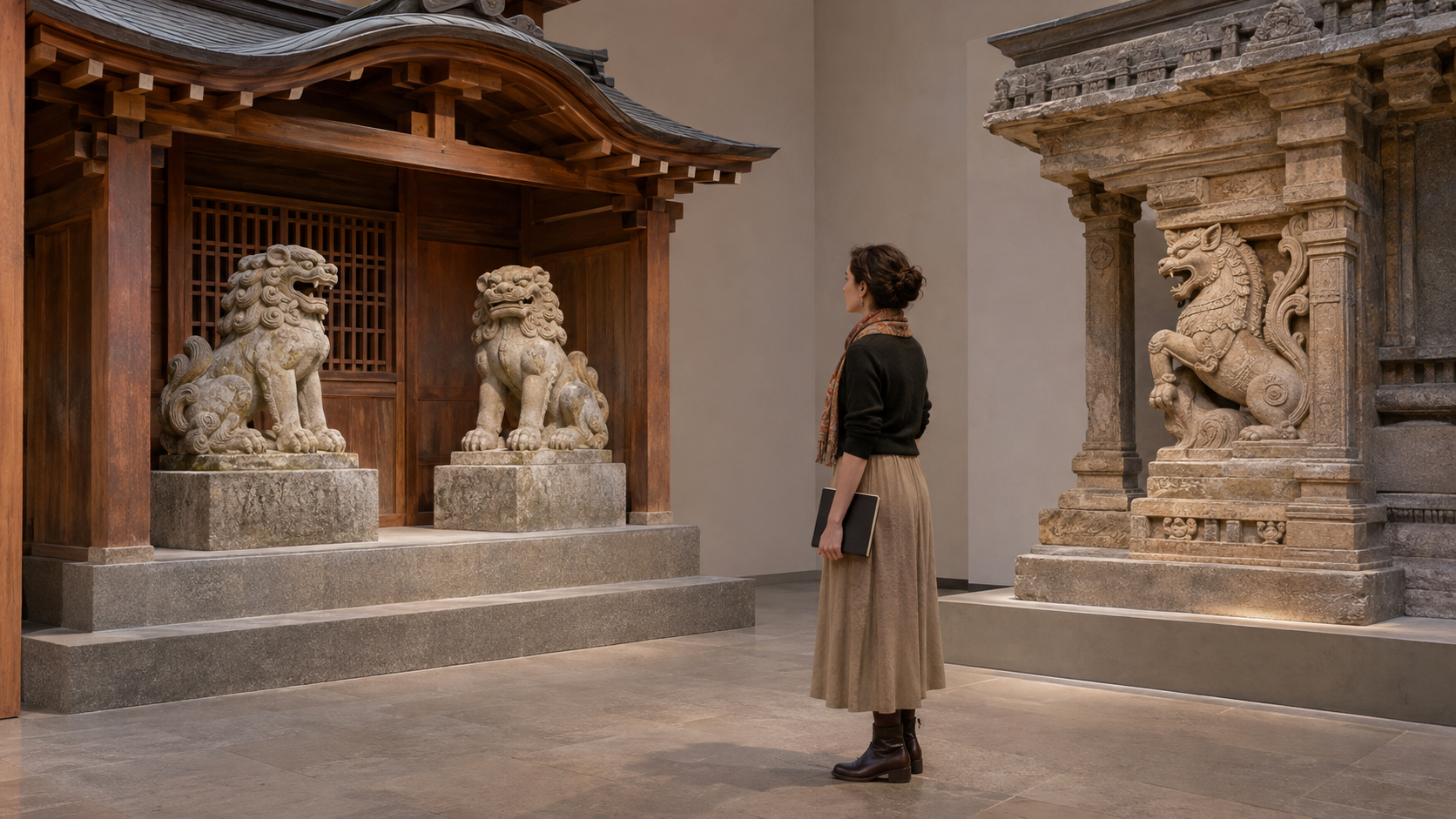
You do not need specialist equipment to make a better reading. Use this sequence when you encounter either guardian in person or in a well-framed photograph:
- Locate the threshold. Identify the path, doorway, pillar or sacred zone associated with the figure.
- Count the guardians. Determine whether you are seeing a pair, one surviving member of a pair or a creature integrated into the building.
- Trace the gaze and body. Note where the head faces, whether the body is seated or dynamic and how the pose directs your own movement.
- Compare differences before similarities. For Komainu, inspect the two mouths, postures and positions. For Yali, inspect how animal features and architectural lines combine.
- Name the function in a complete sentence. Try: “This figure marks the boundary by expressing controlled vigilance.” A sentence forces you to connect form, location and purpose.
- Separate observation from hypothesis. “These guardians flank an entrance” is an observation. “One tradition directly produced the other” is a historical hypothesis requiring additional evidence.
Key takeaways
- Begin with placement and architectural context, not the creature’s species.
- Read Komainu as a pair whose balance and differences structure the shrine approach.
- Read Yali as concentrated sacred power working through Hindu temple architecture.
- Treat protection as disciplined force: the guardian serves sacred order rather than displaying chaos.
- Use resemblance to begin a comparison, never to prove a historical lineage by itself.
The next time you encounter one of these guardians, take one photograph of the whole threshold before taking a close-up. That single change will help you see what the sculpture was made to do, not merely what animal it appears to resemble.
References

Leave a Reply
You must be logged in to post a comment.