
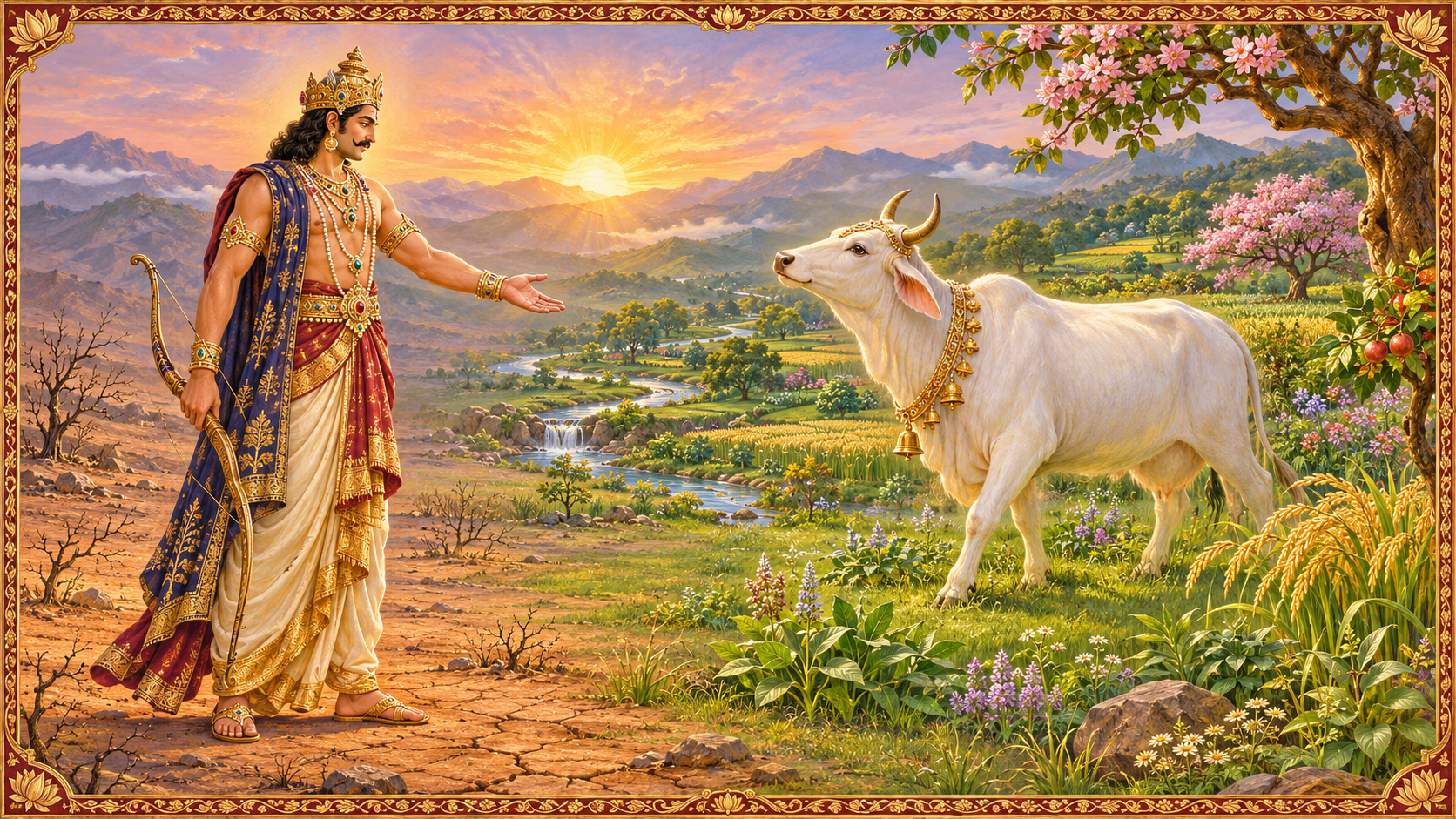
If you have heard that Earth was named Prithvi after King Prithu, you may be wondering how literally to take the claim and how to explain it without reducing a sacred narrative to a slogan. The useful answer is neither a flat dismissal nor an assertion that asks history, language and scripture to be the same kind of evidence.
Hindu tradition preserves a clear association: the name Prithvi is linked with the mighty King Prithu, remembered as a Chakravarthi. You can affirm that tradition while remaining precise about what it establishes.
What the traditional naming claim actually says
The concise answer is this: in a Hindu sacred account, Earth bears the name Prithvi in association with King Prithu. Prithu is the king; Prithvi is the name used for Earth. Keeping those two names distinct is the first step toward explaining the tradition clearly.
The phrase “named after” should be heard in the register of sacred memory. It does not describe a modern naming ceremony, an administrative decree or a date that can be entered on a historical timeline. It tells you that the tradition binds the identity of a renowned ruler to the identity of the Earth itself.
Context determines how much qualification you need. In a devotional conversation, it is sufficient to say that Prithvi is named after King Prithu in Hindu tradition. In a classroom, interfaith discussion or historical essay, say that a Hindu sacred naming tradition connects Prithvi with King Prithu. The second wording does not weaken the tradition. It identifies the kind of claim being made.
Why Bhishma, Pulastya and the genealogy matter
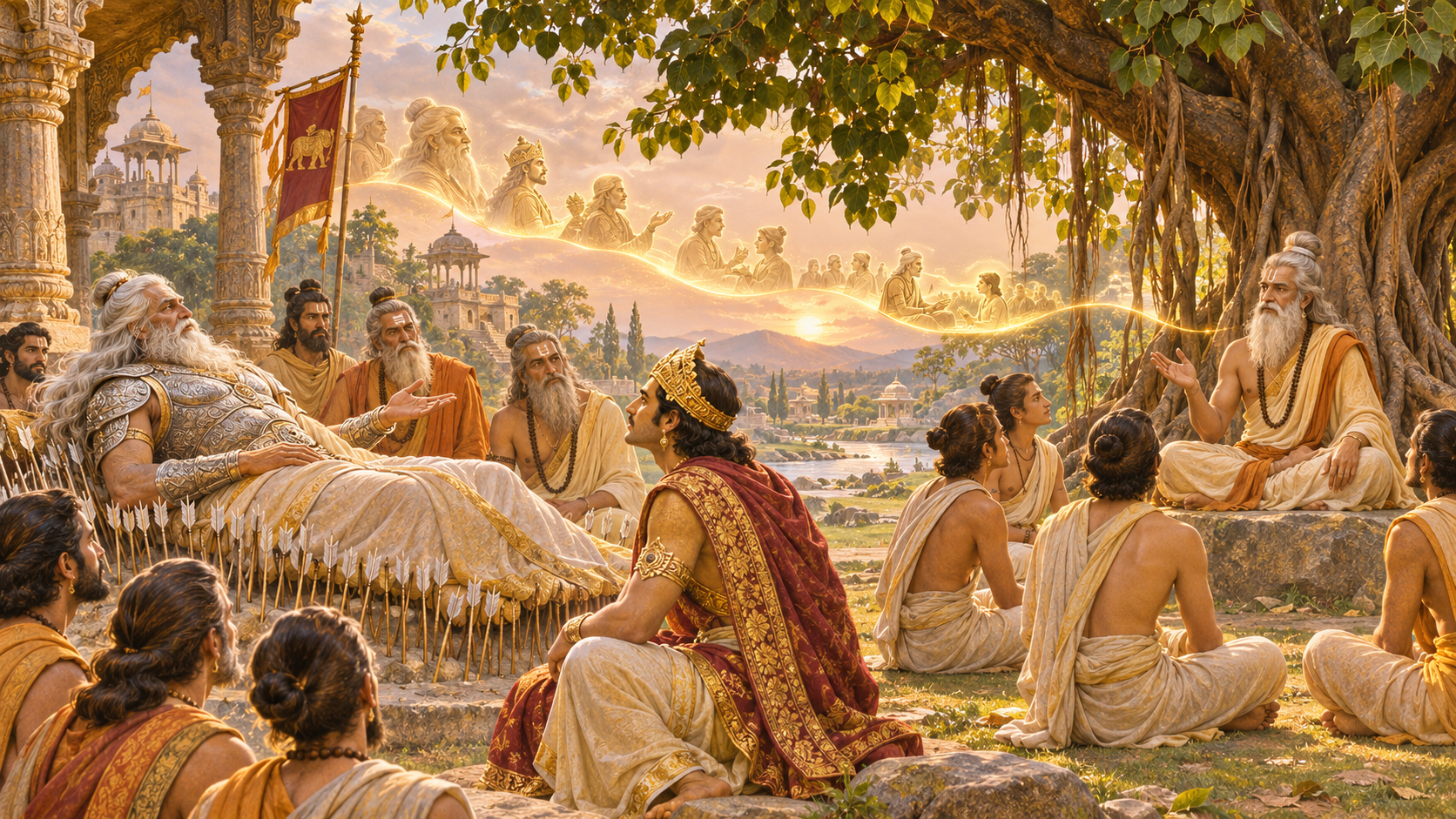
The naming is not presented as an isolated piece of vocabulary. Bhishma asks Sage Pulastya about the mighty King Prithu and the reason Earth bears the name Prithvi. Pulastya’s answer begins by locating the royal account within a lineage: Anga-Prajapati is identified as a descendant of Swayambhuva Manu, and Sunitha as Anga’s wife. The narration then moves to the next generation.
This frame gives you three details worth preserving when you retell the account. Bhishma is the questioner, Pulastya is the sage who answers, and Prithu is understood through a genealogy rather than as an unattached legendary name. The lineage places royal identity inside an inherited moral and cosmic order.
It also prevents a common mistake. Anga-Prajapati, Sunitha and Swayambhuva Manu are part of the setting; they are not alternative names or titles for Prithu. If you do not remember the entire succession, do not improvise it. State only the relationship you can verify: Anga descends from Swayambhuva Manu, Sunitha is Anga’s wife, and their family history opens the account that leads toward Prithu.
The dialogue form matters as well. Bhishma’s question is about a king whose memory has become inseparable from the name of Earth. Pulastya answers by placing that king within sacred lineage. Read in that order, the genealogy is not decorative background. It teaches you to approach Prithu as a bearer of inherited responsibility, not merely as a powerful individual.
Sacred etiology is not the same as modern etymology

Much confusion disappears once you separate three questions that are often collapsed into one:
- What does the tradition say? It associates the name Prithvi with King Prithu.
- How did the word develop as a matter of language history? That requires philological evidence about forms, usage and textual chronology.
- What does the association mean within Dharma? It preserves Prithu’s memory at the scale of Earth and invites reflection on why a ruler would be remembered in that way.
The first is a sacred etiology: a narrative that explains the origin or significance of something familiar, in this case a name for Earth. The second is etymology in the technical sense: the historical development of a word. One question can enrich the other, but answering one does not automatically settle the other.
This distinction protects the narrative from two opposite errors. The first is to treat a sacred association as though it were a modern linguistic report complete with a date and documentary chain. The second is to assume that, unless it functions as modern philology, it has nothing meaningful to communicate. Both approaches force the tradition into a category it did not claim for itself.
Do not attach a verse number, manuscript history, date or linguistic derivation unless you can document it separately. None of those details follows from the naming claim alone. Precision here is a form of respect: it keeps a genuine Hindu tradition from being burdened with evidence it was not presented to supply.
How to explain King Prithu and Prithvi responsibly
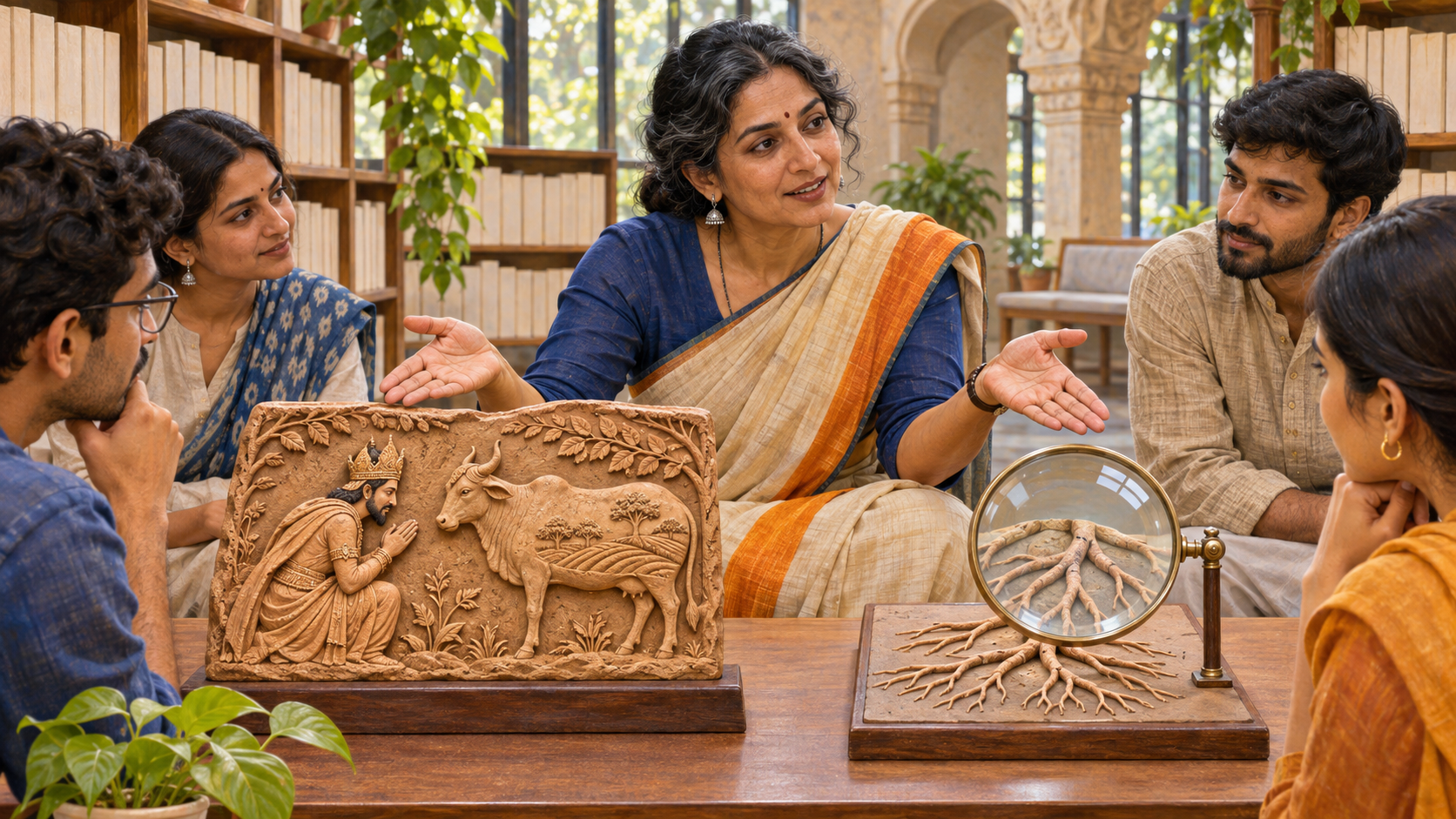
If you are teaching a child, answering a question online or introducing the account in a community discussion, use this sequence:
- Begin with the direct answer: Hindu tradition connects Earth’s name Prithvi with King Prithu.
- Identify Prithu as the Chakravarthi remembered in the account, without adding achievements that you have not verified.
- Mention the narrative frame when more context is needed: Bhishma asks Sage Pulastya about Prithu and the naming of Earth.
- Add the verified genealogy carefully: Anga-Prajapati descends from Swayambhuva Manu, and Sunitha is Anga’s wife.
- Distinguish sacred naming tradition from a complete philological argument if the discussion turns to historical linguistics.
- Return to the interpretive question: what kind of kingship is worthy of being remembered through the very name of Earth?
A dependable one-sentence version is: Hindu sacred tradition remembers Earth as Prithvi in association with King Prithu, whose account is introduced through a dialogue between Bhishma and Sage Pulastya.
That sentence does useful work. It answers the question, identifies the claim as traditional, preserves the named participants and avoids inventing a linguistic proof. If your listener wants the fuller narrative, that is the moment to consult a complete telling rather than filling gaps from memory.
The name also gives you a disciplined way to reflect on sacred kingship. Prithu’s remembrance is not confined to a palace, dynasty or victory. It is joined to Prithvi. At minimum, that association asks you to judge rulership in relation to the world entrusted to it. Treat this as an interpretive invitation, not as permission to add events or teachings absent from the account in front of you.
Key takeaways
- Hindu tradition associates the name Prithvi with King Prithu, remembered as a Chakravarthi.
- The account is framed as Bhishma’s question to Sage Pulastya, not as a modern linguistic report.
- Anga-Prajapati, Sunitha and Swayambhuva Manu establish the genealogical setting and should not be confused with Prithu.
- A sacred explanation of a name and a technical history of a word answer different questions.
- The most responsible retelling states the traditional claim clearly, preserves its frame and leaves undocumented details out.
When you next encounter the word Prithvi in prayer, teaching or conversation, let it do more than label the ground beneath you. Remember the association with Prithu, ask what responsibility toward Earth should mean for a ruler, and seek the fuller sacred narrative before making claims beyond the tradition you can verify.
References

Leave a Reply
You must be logged in to post a comment.