
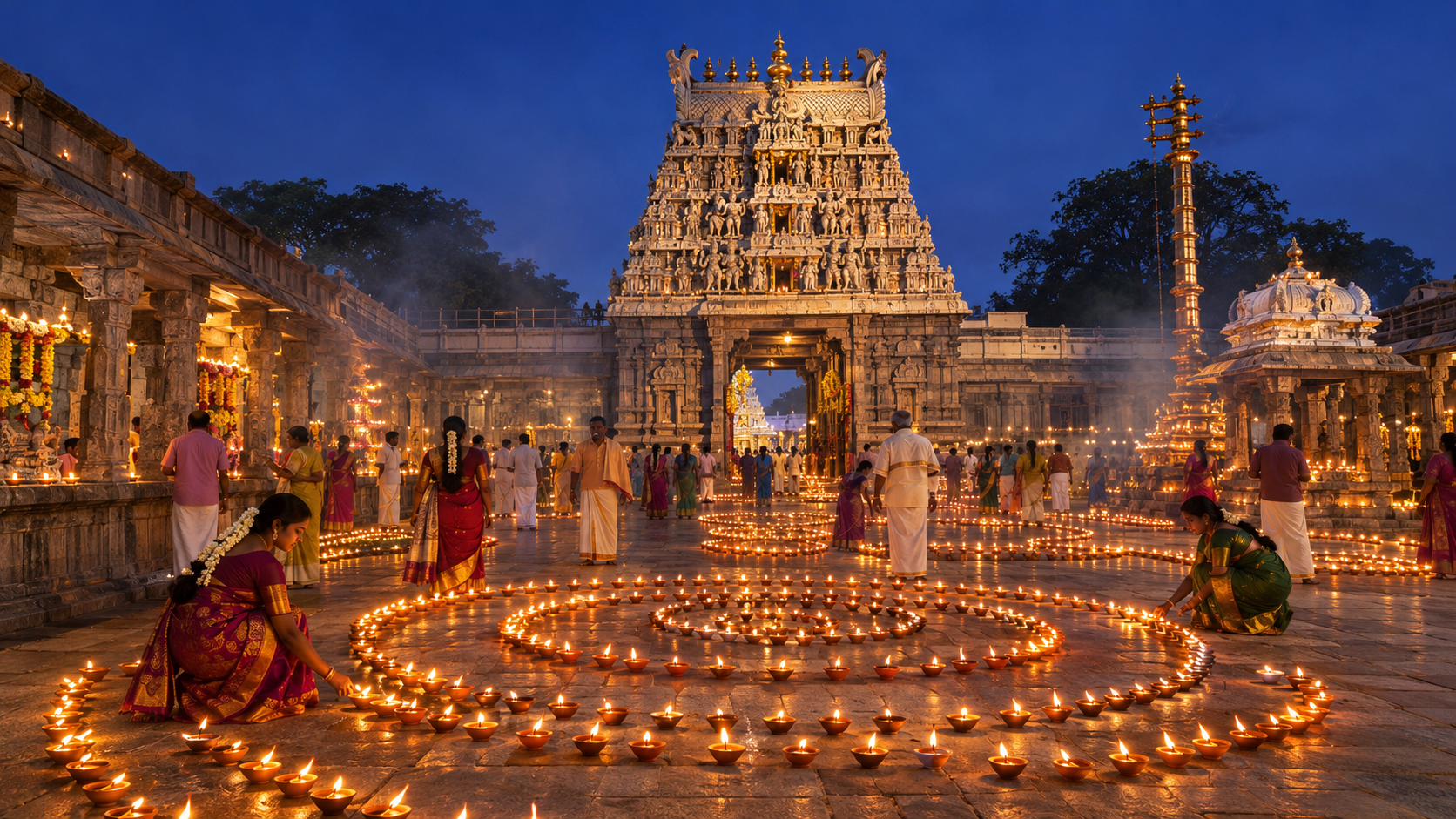
If you are trying to decide whether November 24 or November 29 is the relevant date for Karthika Deepotsavam in 2026, keep two separate entries in your calendar. November 24 is the announced festival date at two Tirupati temples. November 29 is a daily Panchang date on which Krishna Paksha Panchami changes to Sashti.
Those dates serve different purposes. Use November 24 to plan a temple visit or follow the Tirupati observance. Use the November 29 tithi timing only when a vrata, puja, sankalpa, or family custom specifically requires that lunar day.
November 24 is the Tirupati Deepotsavam date
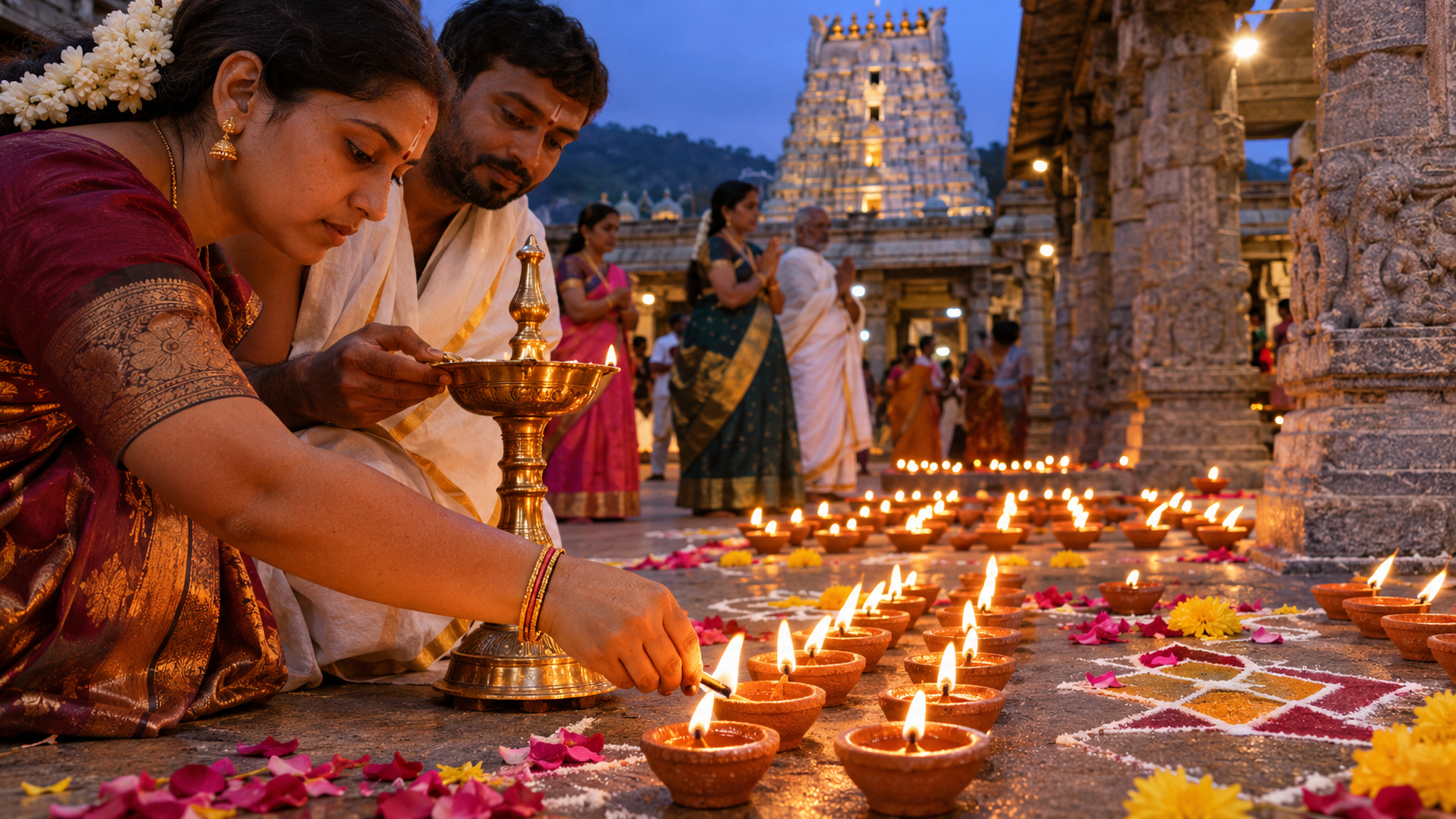
Karthika Deepotsavam is scheduled at Sri Govindaraja Swamy Temple and Sri Kodandarama Swamy Temple in Tirupati on November 24, 2026. If your decision is whether to travel for the temple celebration, this is the date to reserve.
At Sri Govindaraja Swamy Temple, the Karthika lamp and clothes are to be taken in procession from Sri Pundarikavalli Ammavari Temple at 6:30 PM and offered to the deity. Lamps will then be lit. The 6:30 PM detail belongs specifically to the Govindaraja Swamy Temple sequence; do not automatically apply it to the programme at Sri Kodandarama Swamy Temple.
Choose your temple before arranging transport. A calendar entry that merely says “Deepotsavam, Tirupati” is too vague when two temples are involved and only one procession time has been specified. Closer to the date, verify the current temple arrangements before setting out, because access, queues, and operational timings can change even when the festival date remains fixed.
November 29 changes from Panchami to Sashti
Sunday, November 29, 2026 begins under Krishna Paksha Panchami in most regions. Panchami continues until 9:46 AM, after which Krishna Paksha Sashti begins.
This is an intra-day tithi change, not a second Deepotsavam date. Before 9:46 AM, the listed tithi is Panchami; after the transition, it is Sashti. Write the cutover into your calendar rather than labelling the entire civil date with only one tithi.
A tithi is a lunar-calendar division and does not have to begin or end at midnight. That is why two tithis can occupy different portions of the same civil date. It is also why the date printed on a wall calendar cannot by itself answer every ritual-timing question.
The phrase “in most regions” matters. Panchang timings depend on place, and a time listed for an Indian calendar should not be copied unchanged into a calendar for another country or time zone. If you will observe Panchami or Sashti outside the locality for which the timing was prepared, check a Panchang calculated for your city.
Build a calendar that does not mix the observance and the tithi
A simple two-entry plan prevents the most common confusion:
- Create a November 24 temple entry. Name the chosen venue: Sri Govindaraja Swamy Temple or Sri Kodandarama Swamy Temple. If you choose Govindaraja Swamy Temple, record the 6:30 PM procession detail.
- Create a separate November 29 Panchang entry. Record “Krishna Paksha Panchami until 9:46 AM; Sashti thereafter,” together with the city for which the timing applies.
- Identify what your observance actually requires. Temple attendance follows the announced temple programme. A tithi-based vrata follows the rules of that vrata and your sampradaya. One should not be substituted for the other without a traditional reason.
- Check the local sunrise and tithi if a rule depends on sunrise. Some observances care about the tithi prevailing at sunrise, while others use a different rule. Ask your family priest or follow the established procedure of your lineage rather than inventing a universal rule from one transition time.
- Confirm the programme before travelling. Retain November 24 as the planned date, but check the latest temple information for entry arrangements and the final sequence.
If you are lighting deepas at home, let your household tradition determine the number of lamps, placement, mantra, and offering. The public temple programme establishes a venue and schedule; it does not establish one compulsory domestic ritual for every Hindu family. Place every flame on a stable, heat-resistant surface, keep it away from cloth and other combustible material, and do not leave it unattended.
What the November 29 timing can and cannot decide
The 9:46 AM transition answers one narrow question: when Panchami gives way to Sashti in the calendar being used. It does not, by itself, establish a complete muhurta for a wedding, house entry, major purchase, or another consequential ceremony.
A full Panchang decision may also require the local nakshatra, weekday, yoga, karana, lagna, prohibited intervals, and the rules of the intended samskara or vrata. The relevant factors differ by purpose. Do not treat “Sashti after 9:46 AM” as a general declaration that every later hour is auspicious.
This distinction is especially useful when relatives in different cities compare calendars. A disagreement about the displayed time may result from location, time zone, or the rule used for assigning an observance to a civil date. Compare the city and method before assuming that one calendar is wrong.
Key takeaways
- Karthika Deepotsavam at Sri Govindaraja Swamy Temple and Sri Kodandarama Swamy Temple in Tirupati is scheduled for November 24, 2026.
- The 6:30 PM procession detail applies to the Govindaraja Swamy Temple programme.
- On November 29, Krishna Paksha Panchami lasts until 9:46 AM in most regions; Krishna Paksha Sashti follows.
- November 29 is a Panchang transition date, not an alternative date for the announced Tirupati Deepotsavam.
- Use a city-specific Panchang before applying the tithi time outside the locality for which it was calculated.
Put November 24 and November 29 into your calendar as two different kinds of information now. Then verify the temple programme and your city-specific Panchang closer to the observance. That small distinction will keep your travel plan, family practice, and tithi-based worship aligned.
References
- Hindu Blog – November 29 2026 Tithi – Panchang – Hindu Calendar – Good Time – Nakshatra – Rashi
- HinduPad – Karthika Deepotsavam in Tirumala Temple, 24 November 2026

Leave a Reply
You must be logged in to post a comment.