
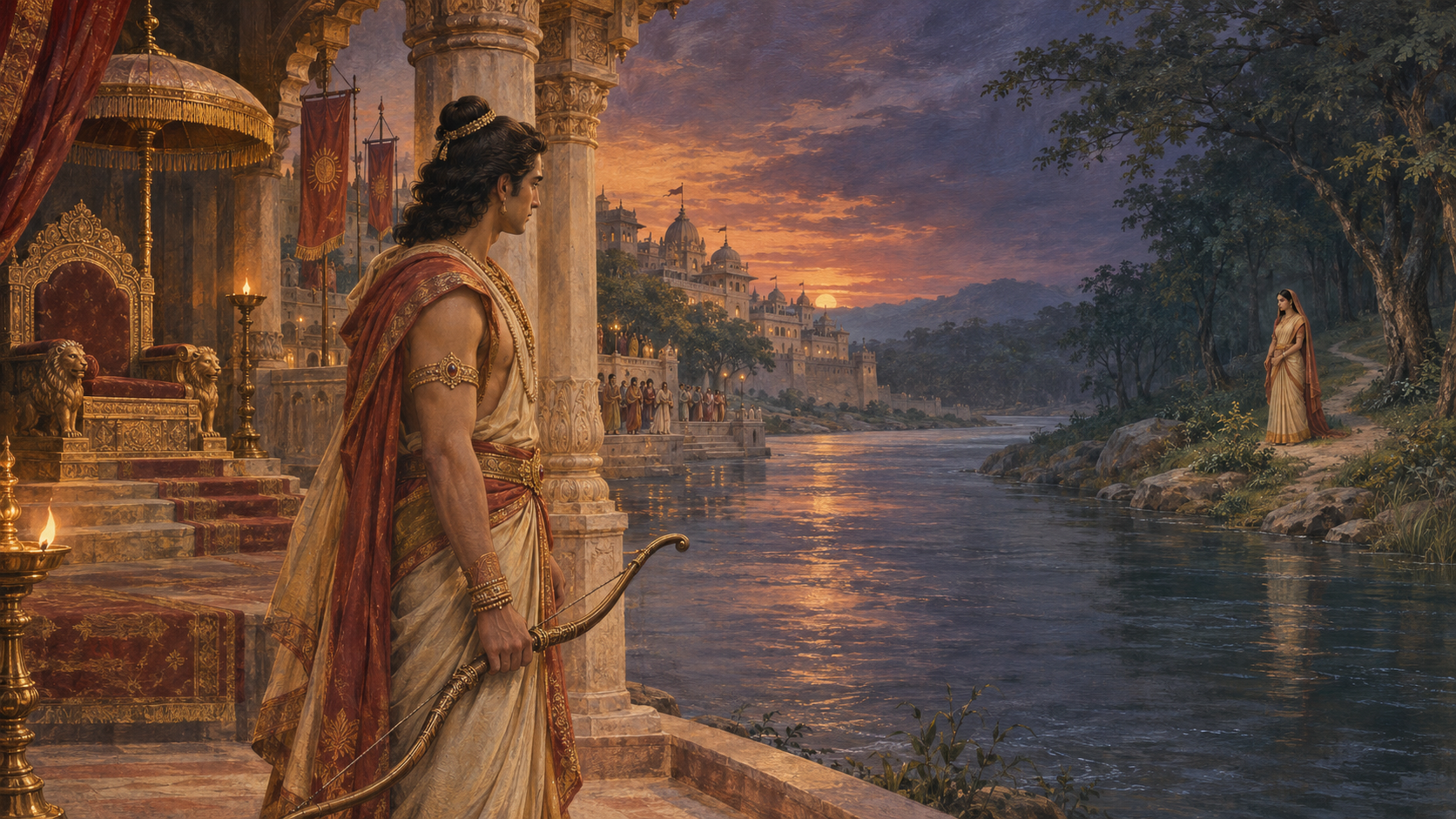
If Rama’s separation from Sita has ever made you hesitate before calling him Maryada Purushottama, do not suppress the question. That discomfort is where a serious reading begins. Devotion does not require you to pretend that the conflict was painless, or that Sita’s suffering was morally insignificant.
The useful question is not whether Rama was simply a good husband or a good king. It is what happens when the obligations of marriage and the obligations of public office demand different actions from the same person. Reading the episode as a conflict between dharmas can explain Rama’s choice without turning explanation into an excuse.
The conflict is duty against duty, not duty against love
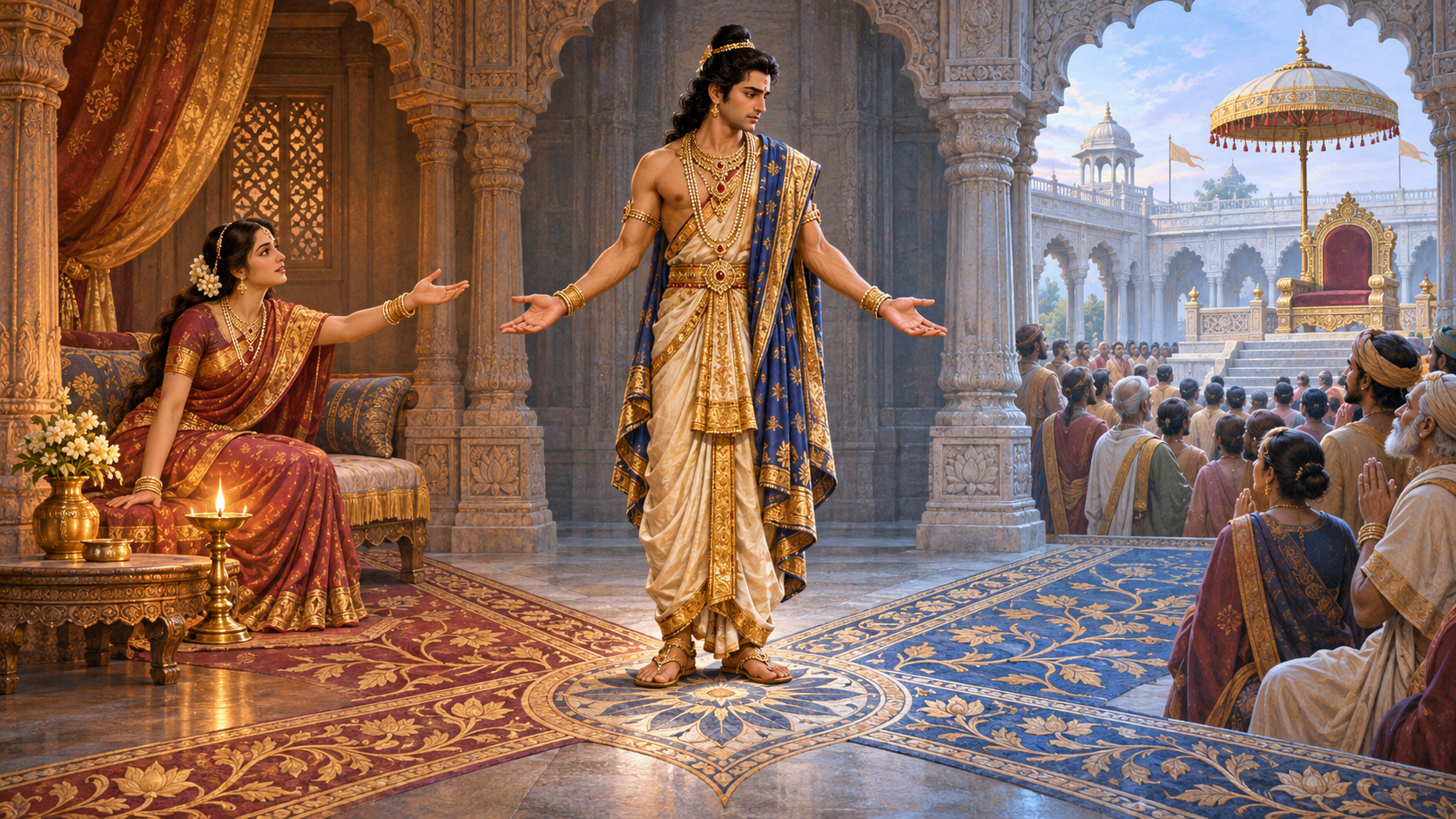
Rama’s dilemma is often reduced to a crude choice: Sita or the throne. That framing misses the moral pressure. A husband owes his wife trust, companionship, protection and loyalty. A king owes his subjects impartiality, stability and confidence that the royal household is not exempt from the standards associated with the kingdom.
Public suspicion of Sita therefore creates two different problems. Its claim about her can be false, while its effect on royal legitimacy can still be real. Rama does not have to believe the suspicion for him to recognize its political force. Yet responding to that force means allowing an innocent person to bear consequences created by other people’s doubt.
This distinction matters. If you treat public opinion as proof, you erase the difference between truth and reputation. If you dismiss public confidence as irrelevant, you erase the distinctive burden of kingship. Rama’s crisis exists because neither responsibility can be discarded without injuring something he is bound to protect.
That makes the decision tragic, but it does not make every possible decision equally righteous. A conflict of duties explains why a person faces a hard choice; it does not automatically vindicate the choice made. Dharma is not a word that ends moral examination. It is the reason the examination must go deeper.
Rama’s humanity makes the choice morally serious
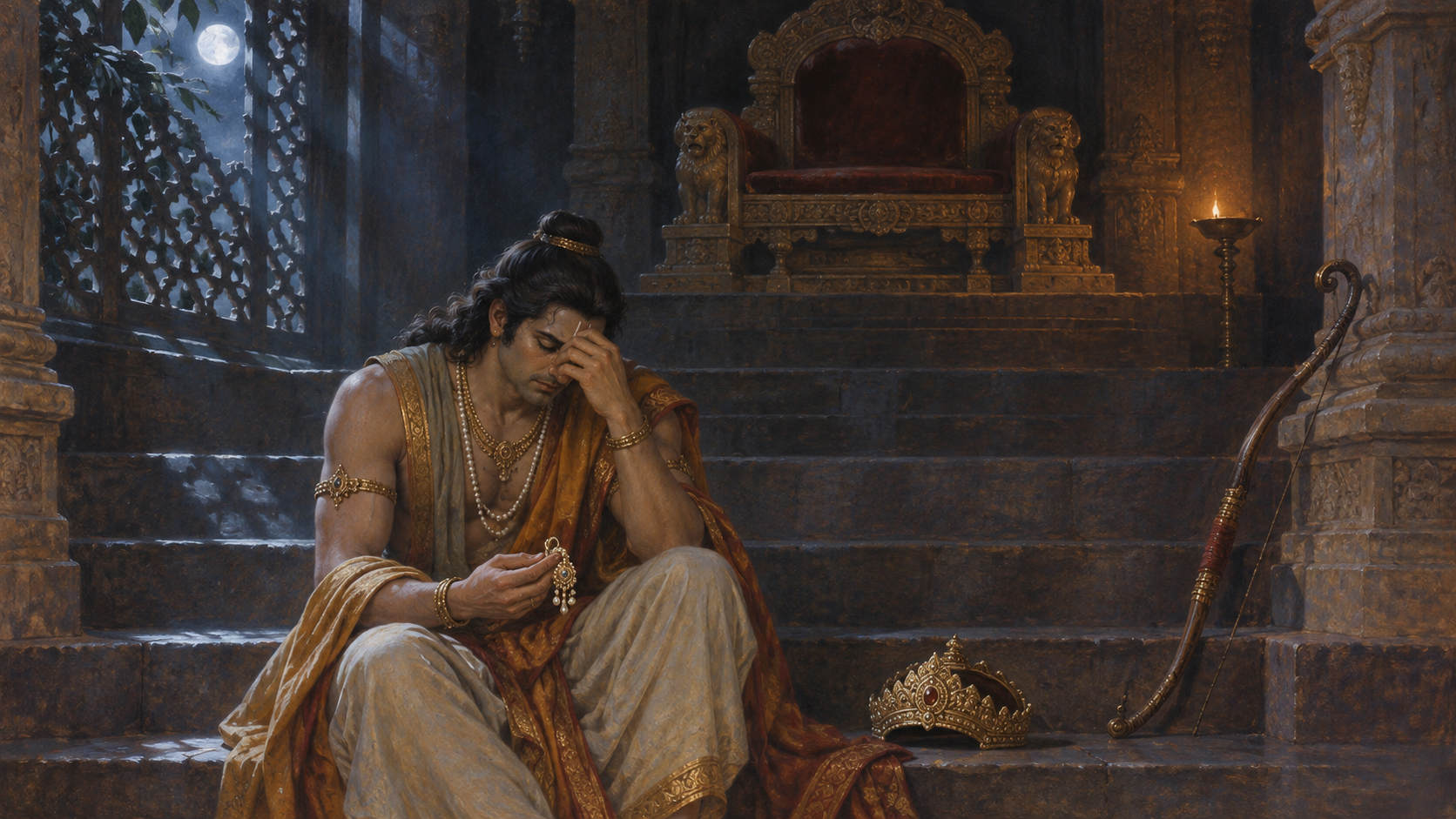
The episode loses much of its force if Rama is imagined as merely acting out a result already guaranteed by omniscience. The interpretive key is that Rama lives within the human condition rather than relying on conscious certainty of his divine power. He must decide under the pressure of role, uncertainty, attachment and consequence.
This is why Maryada Purushottama should not be understood as a claim that Rama always receives a painless option. Maryada concerns bounds, order and the disciplines attached to a role. The ideal person within those bounds is not someone who escapes every collision of duties. He is someone who does not quietly give himself an exemption when the collision reaches his own home.
But restraint is only one part of the moral picture. You need three lenses to read the decision honestly:
- The duty lens: What obligation attached to Rama’s office, and why could he not treat public confidence as a purely private concern?
- The consequence lens: Who suffered because of the chosen response, and was that burden proportionate or fairly placed?
- The character lens: Did Rama use power for personal comfort, or accept a loss that his position could otherwise have helped him avoid?
Using only the duty lens turns kingship into an all-purpose justification. Using only the consequence lens can hide the fact that rulers sometimes must act against personal attachment. Using only the character lens romanticizes sacrifice without asking whether someone less powerful was made to sacrifice more. The conflict becomes intelligible only when all three remain visible.
Sita’s suffering belongs at the centre of the judgment
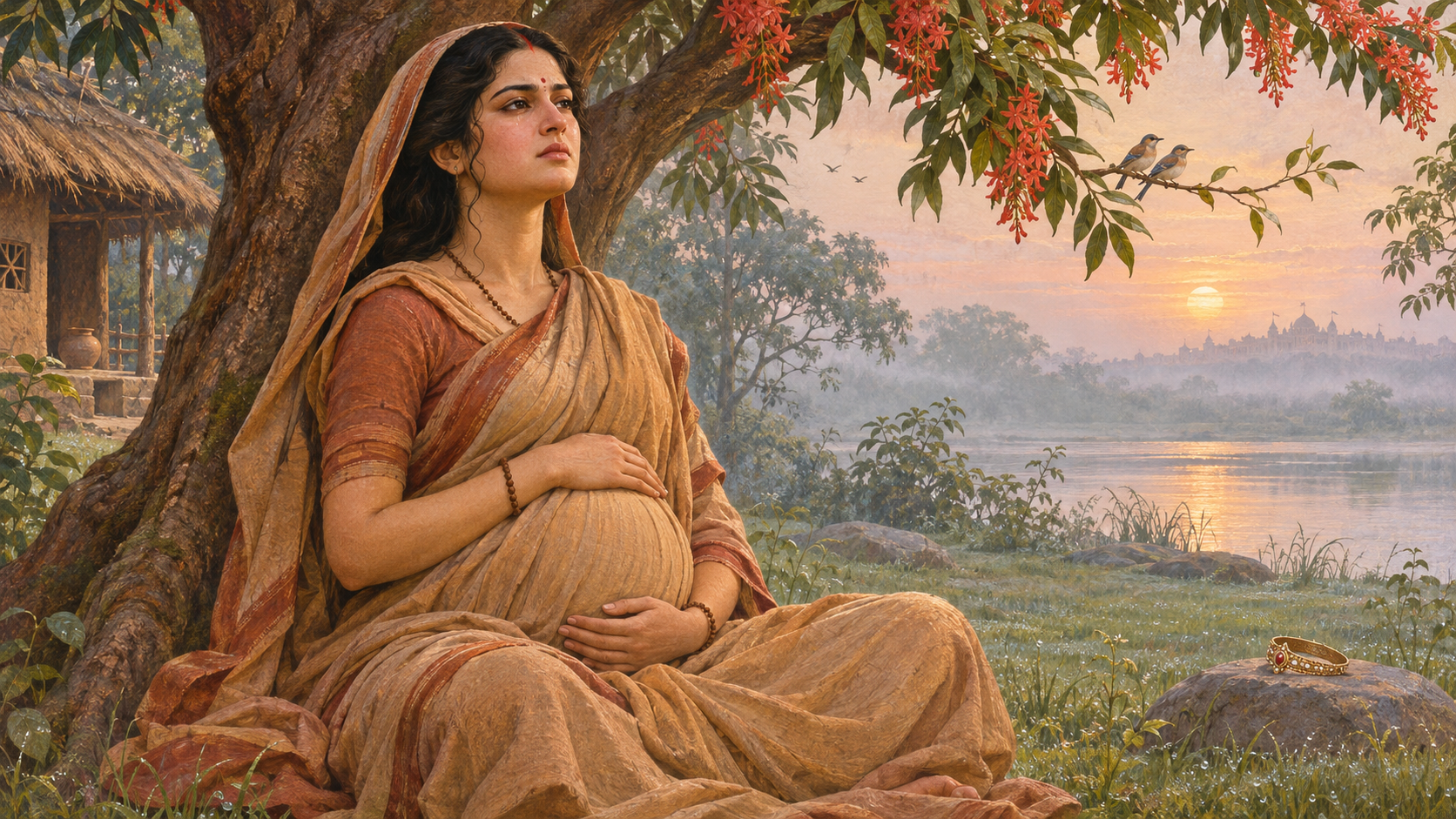
A defence of Rama that requires you to minimize Sita weakens the very moral seriousness it is trying to preserve. If her loss did not matter, Rama’s loss would not carry much meaning either. The cost of the choice is real precisely because the marriage, the wife and the obligations owed to her are real.
Sita must therefore be read as a moral subject, not as an object used to demonstrate Rama’s renunciation. She is the innocent person around whom public suspicion gathers. Rama relinquishes domestic happiness, but Sita bears a different kind of burden: doubt directed at her character and separation imposed in response to other people’s judgment. Those costs are connected, but they are not interchangeable.
Four questions help you resist an easy verdict:
- What was Rama trying to protect? Distinguish the authority of the throne from personal pride. A ruler defending his vanity is not practising rajadharma merely because he invokes the kingdom.
- What did the public actually know? Suspicion can damage confidence, but repetition does not transform suspicion into truth. Political effect and moral truth must be evaluated separately.
- Was separation the only response compatible with kingship? Do not assume that identifying a duty proves that one particular means of serving it was unavoidable. The means remain open to scrutiny.
- Who carried the heaviest burden? Rama accepted personal grief, but Sita bore the direct force of a judgment rooted in public doubt. Any assessment that counts his sacrifice must also count her vulnerability.
This allows a pro-Rama reading to remain fully attentive to Sita. You do not honour him by making her pain disappear. You honour the scale of his dilemma by refusing to shrink either side of it.
Do not turn a royal tragedy into a household rule
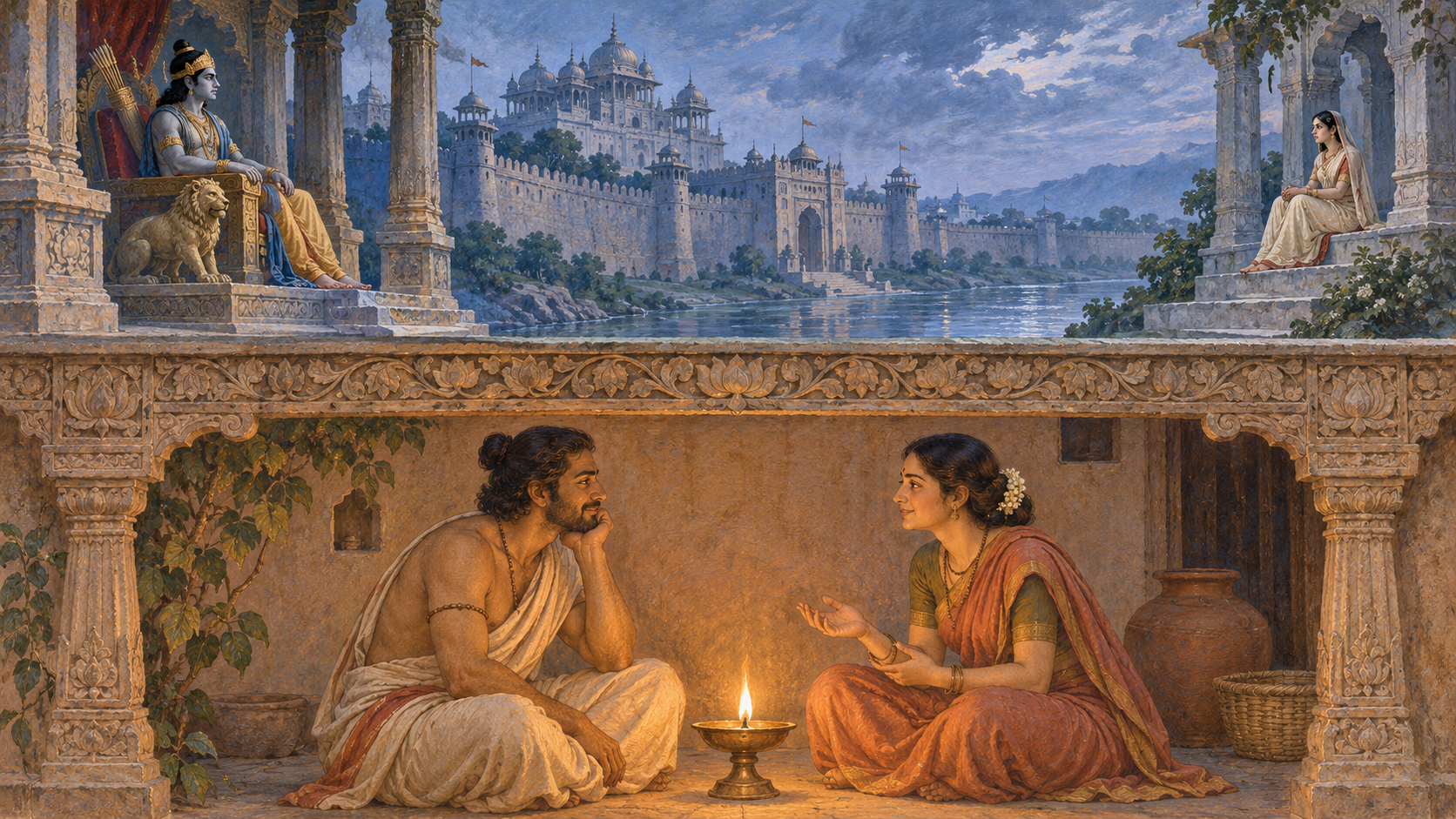
The most dangerous modern use of this episode is to treat it as permission to abandon a spouse whenever family, community or social reputation becomes uncomfortable. Ordinary reputational anxiety is not rajadharma. A person does not become Rama merely by placing public approval above the dignity of a partner.
Even in public life, leadership does not mean making the nearest innocent person absorb the institution’s difficulty. A leader can investigate claims, establish evidence, hear the affected person, state a consistent rule, disclose a conflict of interest or step back from a decision. The higher the office, the stronger the obligation to search for a response that does not transfer its entire burden to someone with less power.
When you face your own conflict of duties, use this five-part test before invoking dharma:
- Name both duties. Write them as concrete obligations, such as protecting a promise, applying a fair rule or preserving another person’s dignity. If you can name only one duty, you have not yet described the conflict.
- Separate evidence from opinion. Ask what is known, what is alleged and what is feared. Social pressure can be consequential without being truthful.
- Identify the involuntary sacrifice. Your willingness to suffer does not authorize you to impose a larger cost on someone else.
- Test the means, not only the motive. A worthy purpose can still be pursued through an unjust or needlessly harmful method. Look for an option that serves both duties before declaring them irreconcilable.
- Accept accountability for the remainder. When every option causes injury, do not rename the injury as righteousness. State what was protected, what was wounded and why you believe the decision was still necessary.
This is the enduring value of Rama’s conflict. It does not supply a convenient command for every marriage or public controversy. It teaches you to notice when roles collide, when reputation is being confused with truth, and when the cost of preserving an institution is being placed on an innocent person.
Key takeaways
- Rama’s crisis is a collision between his duty as king and his duty as husband, not a simple contest between duty and affection.
- Understanding the political logic of his choice does not require declaring every consequence morally harmless.
- Rama’s human limitation is essential: the decision matters because he acts under uncertainty and accepts personal loss.
- Sita’s innocence and suffering are central to the moral problem, not obstacles to a devotional reading.
- Rajadharma cannot be copied into ordinary domestic life as permission to privilege gossip or reputation over a spouse.
- A dharmic decision must examine motive, evidence, means, unequal power and the person compelled to bear the cost.
The next time a difficult choice is presented as duty, complete one sentence before accepting it: I am protecting this obligation by asking this person to bear this cost. If the person is innocent, the burden is unequal or the action cannot be undone, look again for another path. That pause is not a retreat from dharma. It is part of taking dharma seriously.
References

Leave a Reply
You must be logged in to post a comment.