
You know the moment when your mind refuses to stay where you place it. You understand what should be done, yet attention wanders, desire pulls, anger accelerates, or anxiety keeps rehearsing a future that has not arrived. Trying to overpower every thought usually adds another conflict: now the mind is restless, and you are angry that it is restless.
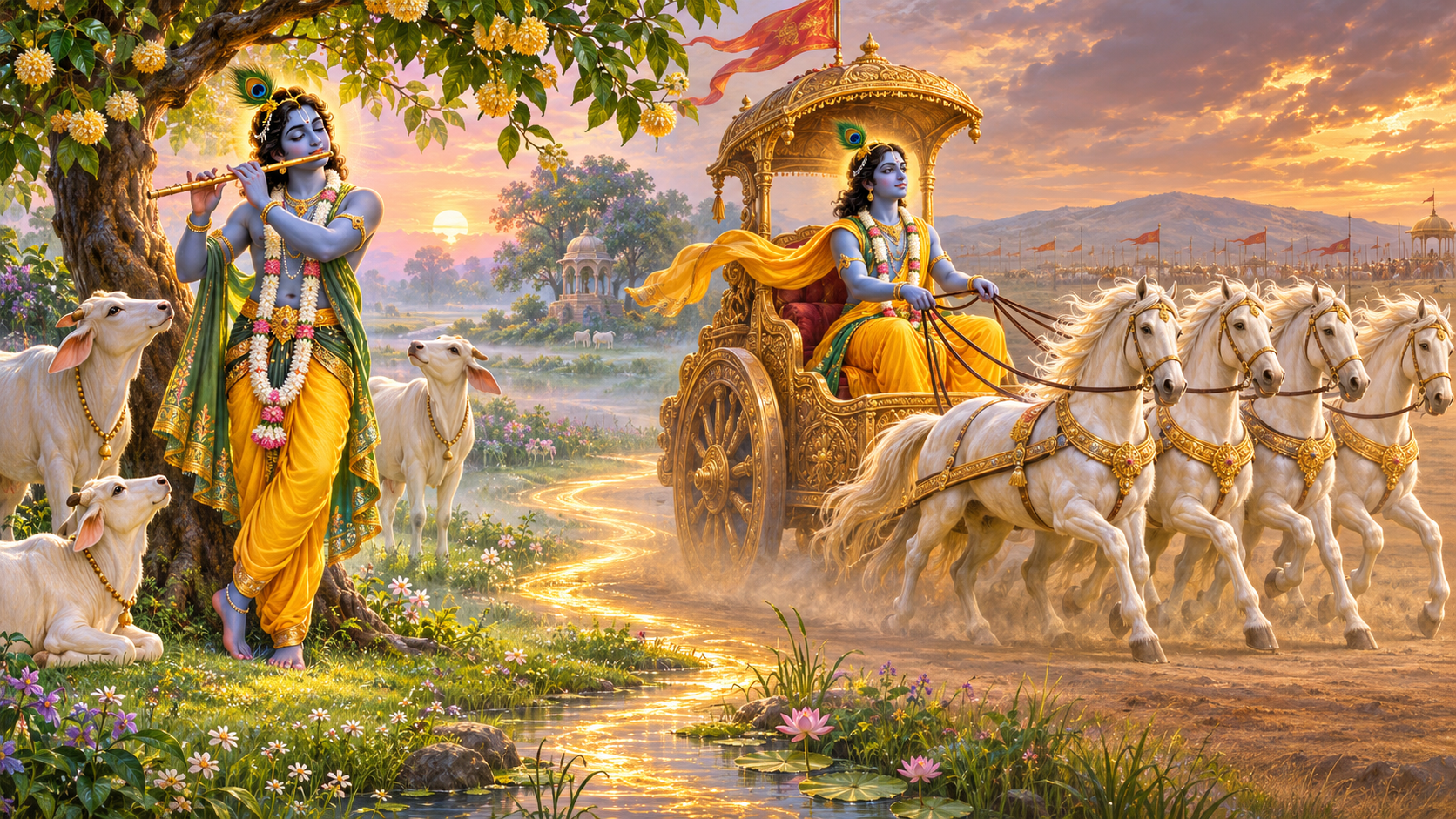
Krishna offers a more complete model. In Vrindavan, he draws the cows with his flute. At Kurukshetra, he guides horses with reins. One image teaches attraction; the other teaches direction. Read together, they show you how to govern the mind without either indulging it or waging war against it.
Two images reveal two kinds of inner discipline
Krishna appears as the flute-playing cowherd in the Bhagavata Purana and as Arjuna’s rein-holding charioteer in the Mahabharata. These are not interchangeable scenes. Vrindavan is pastoral and musical; Kurukshetra demands alertness and decisive action. Krishna is serene in both, but his way of guiding changes with the situation.
The flute does not drag the cows toward Krishna. Its music gives their attention a compelling center. This suggests an important principle for your own practice: a wandering mind may not need harsher force. It may need something worth returning to. If the mind is offered only prohibition – do not think, do not feel, do not desire – distraction remains more interesting than discipline.
The reins meet a different condition. Horses possess power, speed, and momentum. That energy is useful when it serves the journey, but dangerous when every movement is allowed to determine its own direction. Reins do not destroy the horses’ strength. They coordinate it.
This is a better meaning of mind mastery than emotional numbness or constant self-denial. Your mental energy does not have to disappear. Desire can become commitment. Anger can disclose that a boundary has been crossed. Imagination can serve creation instead of worry. The work is to place these energies under wise direction.
First decide whether your mind needs a flute or reins
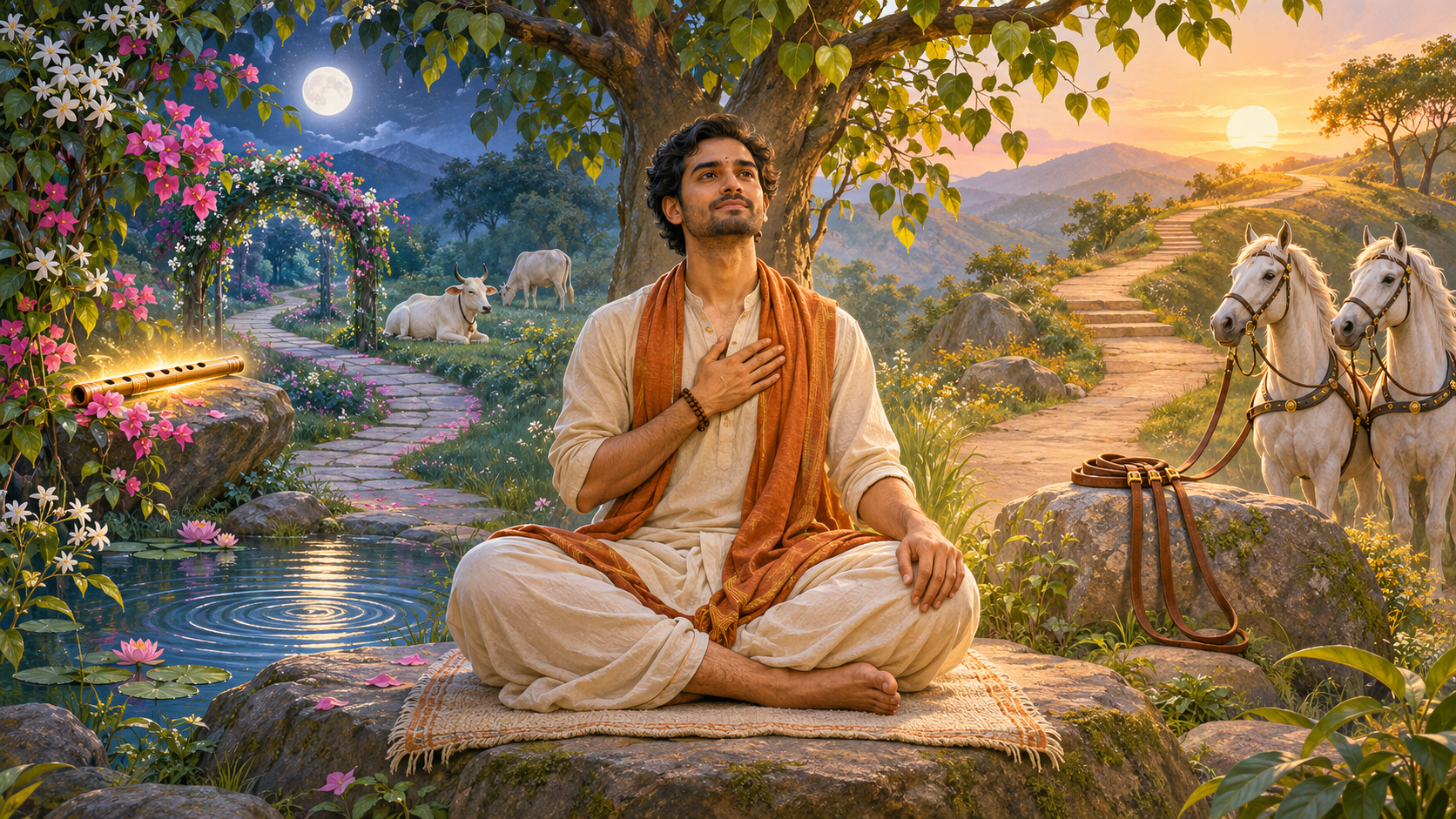
Many attempts at self-control fail because they apply the same remedy to every disturbance. Before correcting the mind, notice what it is doing.
- Use the flute when attention is scattered. You keep changing tasks, reaching for stimulation, or drifting into thoughts that carry no urgent message. Give attention one wholesome center: Krishna’s name, a mantra, a verse, the work directly in front of you, or an act of service that needs care.
- Use the reins when an impulse is already moving toward action. You are about to send the angry reply, repeat the harmful habit, abandon a duty, or say something merely because saying it will bring immediate relief. Insert a boundary before the impulse becomes conduct.
- Use both when you know what to stop but not what to do instead. Restraint creates space; a worthy center tells you how to use that space. Put down the distraction, then return immediately to remembrance or duty.
This distinction keeps discipline from becoming indiscriminate pressure. If your attention has no meaningful center, pulling harder on the reins can produce resentment. If a strong impulse is approaching harmful action, waiting for inspiration can become an excuse. Attraction and restraint are complementary, not competing, methods.
A practical question helps: Is my attention merely wandering, or is an impulse carrying me somewhere I should not go? The answer tells you which image of Krishna to remember.
A Krishna-inspired practice for the difficult moment
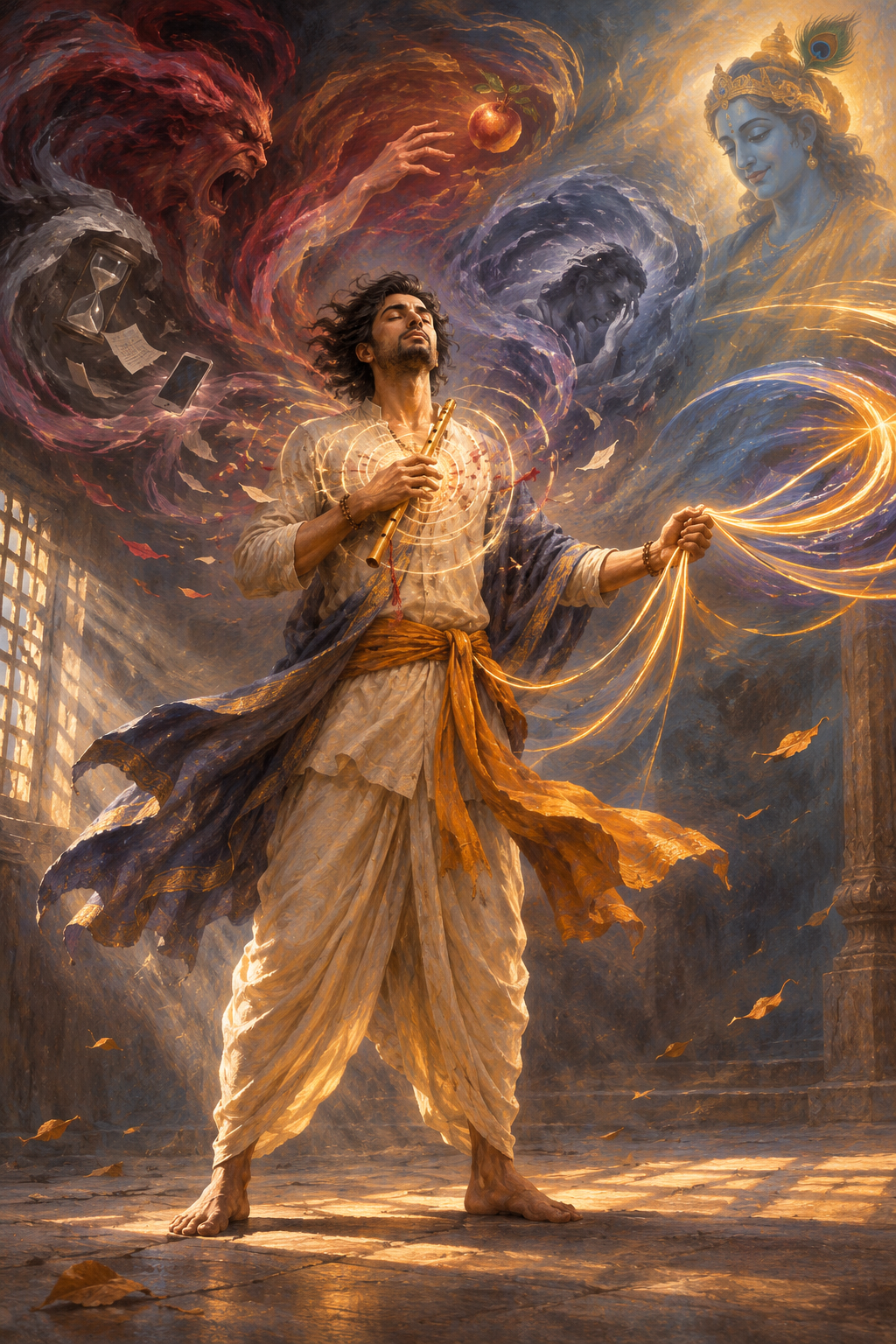
You do not need to wait for perfect stillness before practising. Use the disturbance itself as the place of sadhana. When attention or emotion begins to take command, move through the following sequence.
- Notice the movement before judging it. State plainly what is happening: attention is scattering, anger is accelerating, approval is being sought, or discomfort is being avoided. Naming the movement separates observation from automatic obedience.
- Identify the direction. Ask where this state will carry you if it governs the next action. The question is not whether the feeling is pleasant or unpleasant. The question is whether following it serves dharma.
- Choose flute, reins, or both. For distraction, establish a compelling center. For a forceful impulse, establish a boundary. When both conditions are present, restrain the unwise action and redirect attention at once.
- Make the next action small and visible. Resume the sentence you were writing. Complete the neglected household duty. Repeat the chosen name of Krishna with attention. Speak only the necessary words. Mind mastery becomes real through conduct, not through an impressive inner declaration.
- Review without self-dramatisation. After the moment passes, notice what helped and where control was lost. The purpose is to recognize the pattern earlier next time, not to build a new identity around failure or success.
Suppose you are preparing for an important task and repeatedly reach for distraction. The flute approach is to make the task meaningful again: connect it to the person served, the promise made, or the dharmic responsibility being fulfilled. Remove unnecessary stimulation, then keep that meaning in view.
Now suppose an argument has activated the urge to retaliate. Meaning alone may not slow the impulse. Use the reins: do not send the message while anger is choosing the language. Step away from the act, not from responsibility. Return when you can say what is true and necessary without surrendering the reins to the desire to wound.
The same method applies to craving. A boundary stops immediate obedience; redirection prevents the empty space from being filled by the same craving in another form. Restraint without redirection often becomes a contest of endurance. Redirection without restraint leaves the door open to rationalisation.
Mind mastery is neither suppression nor indulgence
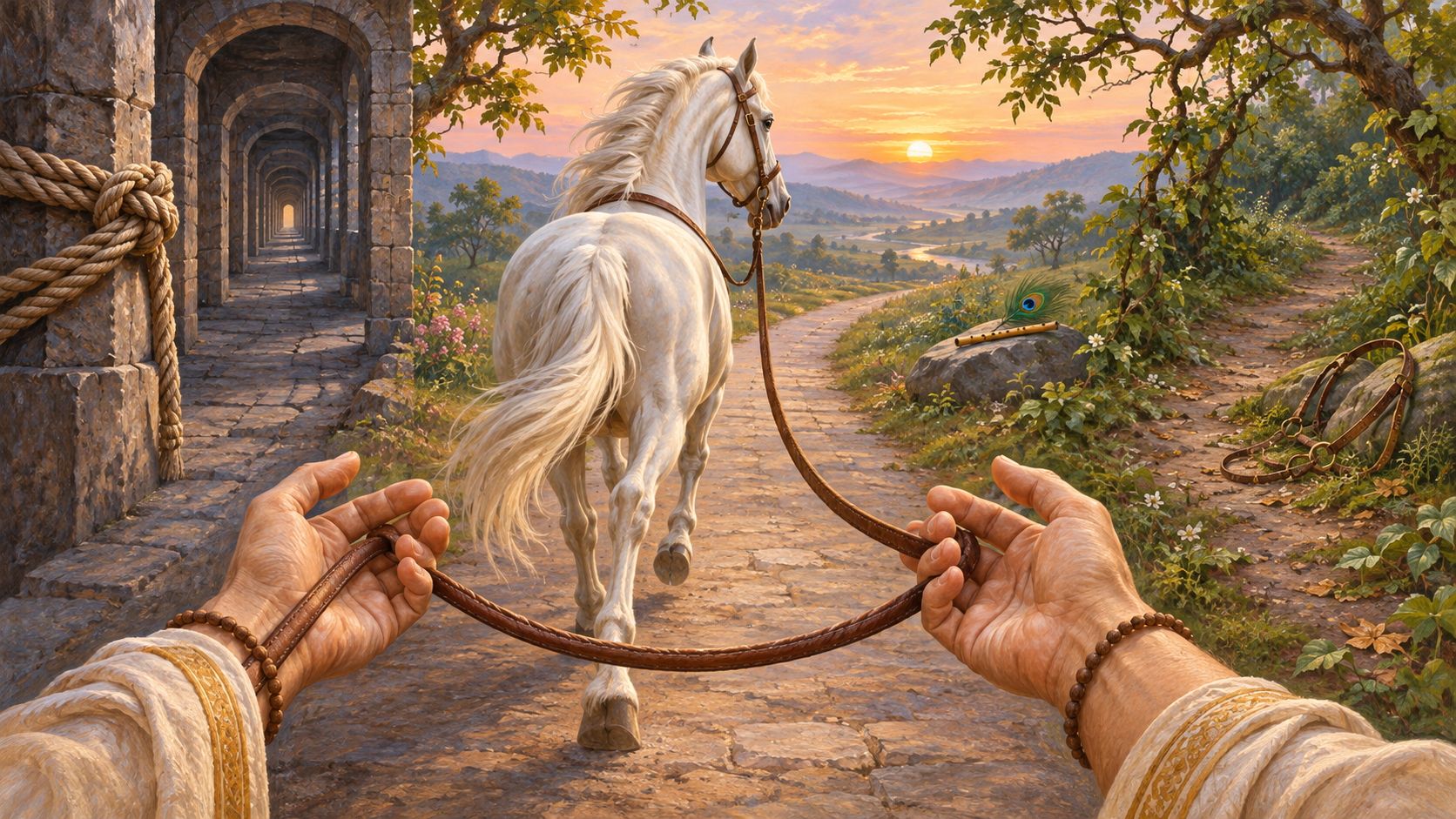
The flute and reins correct two common misunderstandings.
The first is that spirituality requires the destruction of thought, feeling, and desire. But a charioteer needs living horses, not lifeless ones. Mental power is not the enemy. The problem begins when a passing mental state assumes the authority to choose your direction.
The second misunderstanding is that whatever feels natural must be followed. The pastoral sweetness of Krishna’s flute is not permission for aimlessness. Attraction becomes spiritually useful when it gathers the being around a worthy center. Devotion is not merely an emotion you enjoy; it changes what receives your attention and therefore what governs your action.
There is also a subtler mistake: turning self-control into pride. You may restrain an impulse outwardly while continuing to rehearse it inwardly, congratulating yourself for being more disciplined than others. Krishna’s symbolism directs attention away from the performance of control and toward right relationship. The mind becomes an instrument rather than a ruler, while the person remains responsible for the direction taken.
This is why mastery should make you more available to dharma, not merely more efficient at getting what the ego wants. Better concentration can serve ambition, resentment, or vanity as easily as service. The decisive test is not simply whether you can control attention. It is what you place at its center and where you direct its power.
Key takeaways
- Krishna’s flute represents guidance through a worthy attraction; his reins represent guidance through clear direction and restraint.
- A scattered mind usually needs a center to return to. A forceful impulse nearing action usually needs a boundary.
- Restraint works better when you immediately redirect attention toward remembrance, duty, service, or the next right action.
- Mind mastery does not erase mental energy. It places desire, emotion, imagination, and attention in the service of dharma.
- The practical test is conduct: after the thought or feeling arose, who chose the next action?
The next time your mind becomes difficult, do not begin by condemning it. Ask which Krishna the moment calls for: the cowherd who gathers attention with the flute, the charioteer who directs power with the reins, or both. Then make the next dharmic action before the old momentum chooses for you.
References

Leave a Reply
You must be logged in to post a comment.