

If you remember Tataka only as a fearsome figure, you miss the larger warning carried by Malada and Karusha. The important question is not simply who Tataka was. It is how two prosperous cities could lose the conditions that made prosperity possible.
That question matters whenever you are trying to protect a community, temple, cultural institution, neighbourhood, or inherited practice. The episode teaches you to notice decline before abandonment makes it look irreversible.
The real measure of Tataka’s destruction is civic loss
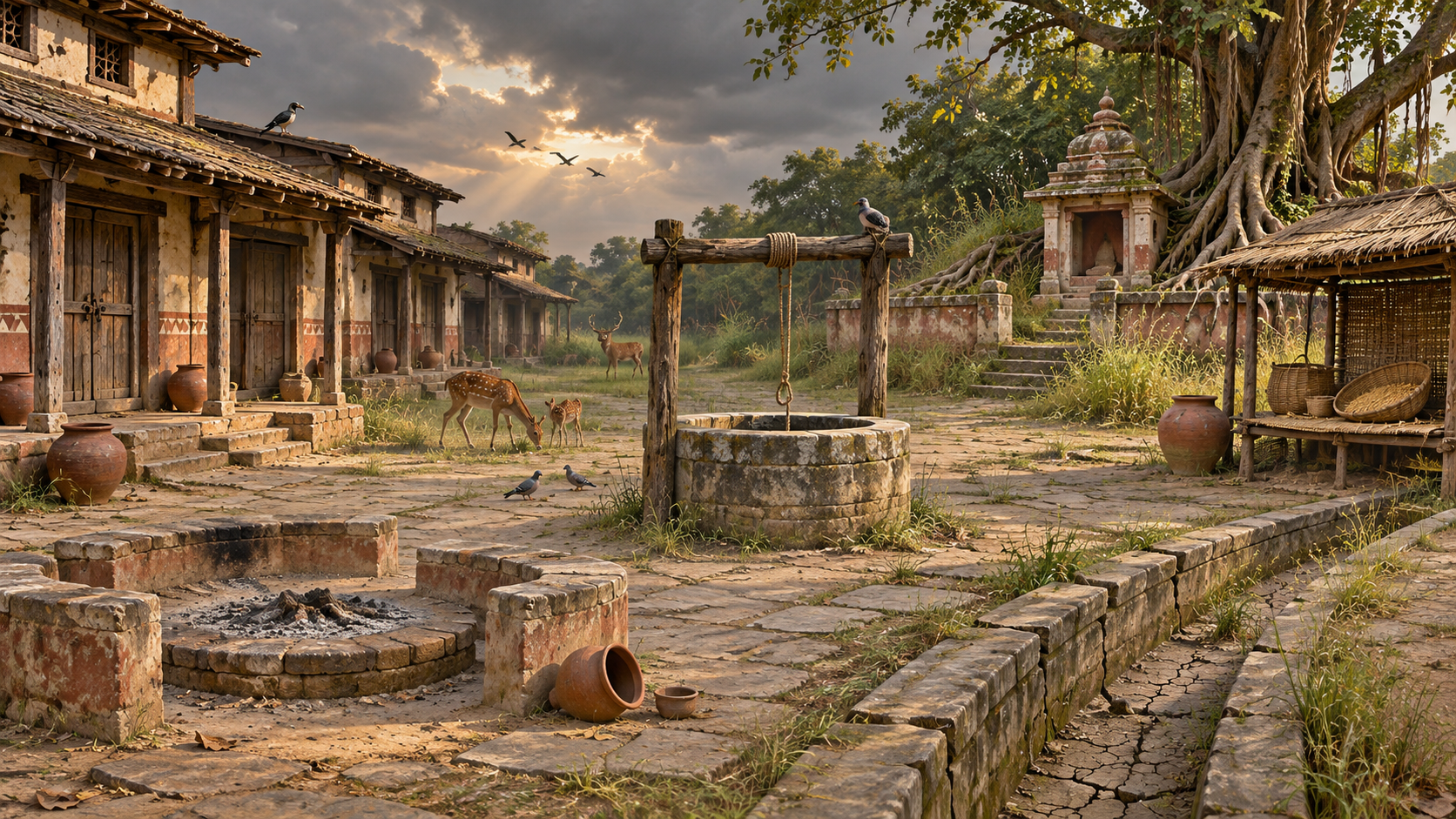
In the twenty-third chapter of the Bala Kanda of the Valmiki Ramayana, Sage Vishwamitra tells Rama and Lakshmana about Malada and Karusha. The two cities had once been wealthy and full of life. Tataka’s devastation left the region as a terrible forest.
The contrast is deliberately severe: living cities on one side, frightening desolation on the other. Tataka’s significance therefore cannot be reduced to the danger posed by one hostile being. Her power is measured by what disappears around her. Prosperity, human presence, movement, confidence, and ordinary social life no longer define the land.
This distinction changes how you read the episode. A threat becomes civilisational when it makes a place unliveable, interrupts continuity, and drives away the people who would otherwise maintain it. The deepest harm is not a single frightening encounter. It is the conversion of a functioning human world into an abandoned one.
The forest itself should not be mistaken for the villain. A forest can be sacred, sustaining, and rich with life. Here, the frightening forest is the visible aftermath of civic destruction. Nature has occupied space from which organised human life has been driven. Tataka is the agent of devastation; the changed landscape reveals its extent.
Malada and Karusha reveal the sequence of collapse
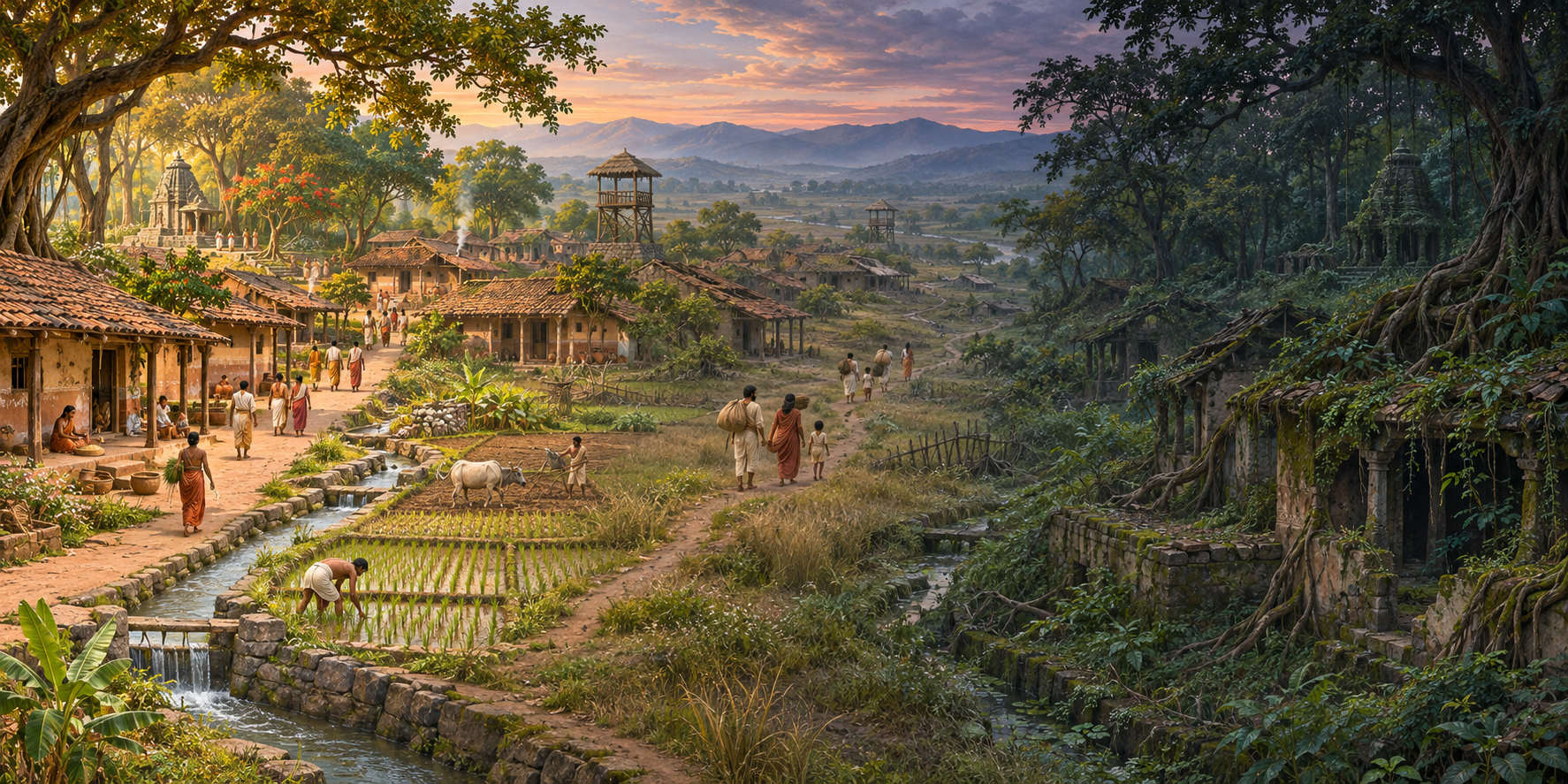
The episode gives us two memorable conditions: former prosperity and later desolation. Between them lies a pattern you can use to examine decline in your own surroundings.
Prosperity comes first, but prosperity is not self-protecting. A wealthy or culturally important place may appear secure precisely because previous generations built strong institutions around it. That accumulated strength can conceal weakening participation, neglected maintenance, or growing fear. The appearance of continuity may survive for a while after the habits supporting it have begun to fail.
Withdrawal comes next. People stop attending, maintaining, teaching, trading, visiting, or investing because participation has become difficult or unsafe. Buildings may remain standing while the community that gives them meaning thins out. This is the stage most worth noticing, because recovery is still easier while people retain memory, relationships, and a reason to return.
Abandonment is the final visible condition. By then, decline can look natural: an empty place simply appears to have always been empty. Malada and Karusha resist that illusion. Their names preserve the knowledge that desolation had a history. The ruined landscape was not the original condition of the land.
You can apply this sequence without forcing a literal analogy. When a cultural institution begins to weaken, look beyond its remaining walls or funds. Check whether participation is becoming harder, whether capable people are quietly leaving, whether knowledge is still being transmitted, and whether recurring disruption is being treated as normal. Those signals tell you more about future survival than ceremonial claims that everything is fine.
Tataka is not a label for every opponent
The Ramayana gives the destruction a named agent. That preserves moral clarity: Malada and Karusha did not simply fade for no reason. Yet this clarity imposes a discipline on anyone who wants to use the story in present-day debate.
Calling a person or community a modern Tataka proves nothing. Before making such an analogy, identify the conduct at issue, show how it damages the conditions of common life, and distinguish deliberate aggression from ordinary disagreement, incompetence, or neglect. If you cannot explain the causal path from conduct to harm, you have a slogan rather than an argument.
This is especially important in cultural and political discussion. Anger encourages us to treat every critic as an existential enemy. The story demands a more exact judgement. A threat comparable to Tataka’s devastation would not merely offend, challenge, or compete. It would systematically make sustained life in a place impossible.
The individuality of Tataka also blocks lazy generalisation. A named character is not a verdict on an entire sex, class, ethnicity, or community. Responsibility belongs to the agent and actions presented in the narrative. Extending blame to people who did not perform those actions would abandon the moral precision that gives the episode its force.
The opposite mistake is to erase agency altogether. Some losses do result from deliberate intimidation or destruction. Others come from apathy, weak administration, or the gradual failure to transmit knowledge. Name these causes separately. Neglect calls for renewed participation and competent stewardship; active predation may require protection and firm restraint. Confusing the two produces the wrong response.
A dharmic response aims to restore the conditions of life

Vishwamitra does not present Rama and Lakshmana with a nameless obstruction detached from its surroundings. He gives them the memory of a place: what Malada and Karusha had been and what had happened to them. The setting therefore carries a moral history.
That detail offers a practical discipline. Before deciding how to answer a threat, understand what good is being protected. Name the people, practices, relationships, and forms of continuity that make the place worth defending. Protection without such an account can decay into anger for its own sake. Memory supplies the purpose: the goal is not merely to oppose something harmful but to make flourishing possible again.
On this reading, dharma is not exhausted by private virtue. It includes stewardship of the conditions in which ordinary life, learning, worship, exchange, and community can continue. A prosperous society that cannot protect those conditions possesses wealth without resilience.
Use that principle when you assess a threatened institution. Begin with the living good at stake. Then identify the evidence of decline, separate the immediate trigger from the deeper weakness, and choose a response that protects participants while rebuilding continuity. Success should be measured by renewed presence and confidence, not merely by the defeat of an opponent.
This also prevents a common strategic error. Removing a disruptive force does not automatically restore what has been lost. People may still be afraid to return. Knowledge may no longer have teachers. Maintenance may have stopped. Trust may need to be rebuilt. Defence and restoration are connected duties, but they are not the same task.
Key takeaways for reading the episode responsibly
- Measure the harm at the right scale. Tataka’s devastation matters because prosperous human life disappears from Malada and Karusha, not merely because she is frightening.
- Keep cause and aftermath distinct. Tataka is the destructive agent; the terrible forest is the condition that reveals how completely civic life has been displaced.
- Watch for withdrawal before abandonment. Falling participation, broken transmission, neglected maintenance, and fear of returning are earlier warnings than visible ruin.
- Use modern analogies with evidence. Name the damaging conduct and its effects instead of turning Tataka into a label for anyone you dislike.
- Define protection through restoration. A dharmic response should preserve or rebuild the conditions in which people can live, gather, learn, worship, and sustain continuity.
When you next encounter a weakening cultural space, do not ask only whether its name, structure, or formal leadership survives. Ask whether people can still inhabit it with confidence and pass it forward. That is where the distance between a living Malada and an abandoned one first appears.
References

Leave a Reply
You must be logged in to post a comment.