
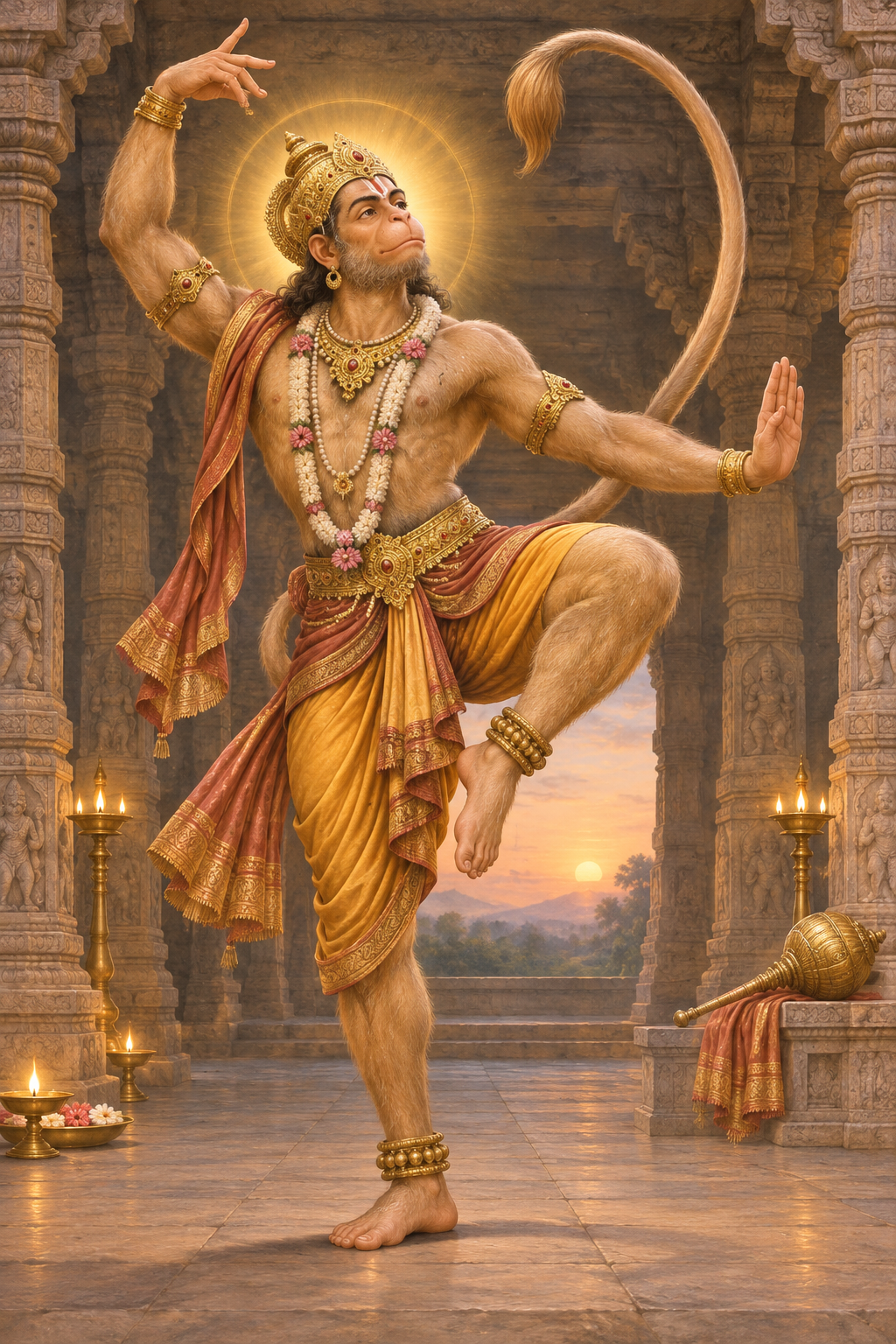
You may have encountered an image of Hanuman poised in dance and wondered whether the movement is merely an artistic flourish or identifies a distinct sacred form. The difference matters. If you read a dancing Hanuman as though he were seated in meditation or kneeling in service, you miss the central work of the composition.
Nartana Hanuman presents devotion as movement. To understand the image, you need to look beyond a single hand gesture or attribute and examine how the entire figure creates rhythm, balance, energy and joy.
Begin with the movement of the whole figure
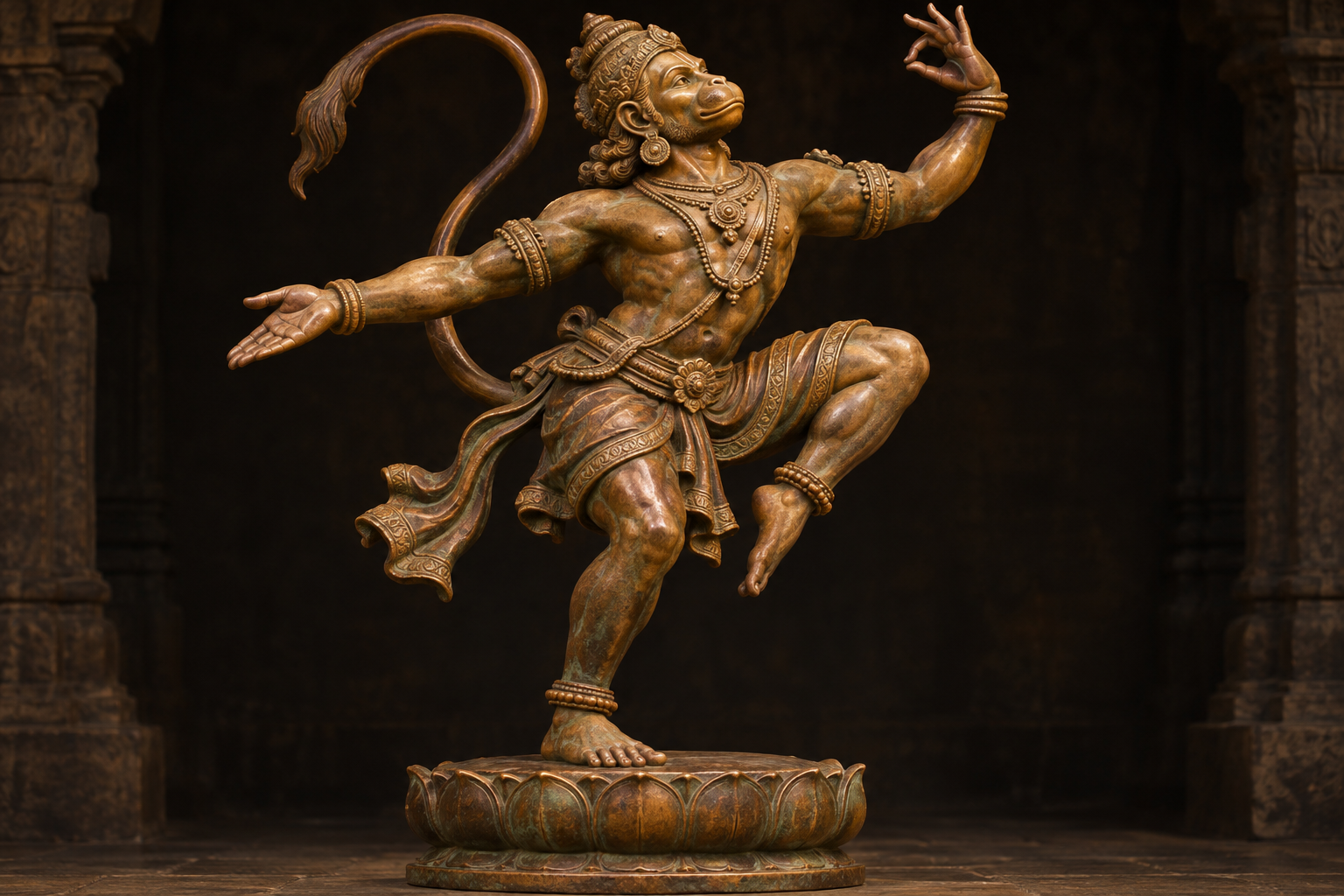
Nartana means dancing. The defining clue is therefore not an ornament, weapon or isolated gesture but the action of the body. Nartana Hanuman is distinguished from more familiar depictions of stillness, meditation and service by an unusual concentration of motion, joy and sacred energy.
Read the image from its largest forms to its smallest details:
- Find the balance of the feet. Look for the point that appears to bear the figure’s weight. Then notice whether the other leg continues, counters or redirects that movement. A raised foot can indicate dance, but it is not sufficient by itself.
- Trace the axis of the torso. Ask whether the body rises vertically, turns, bends or shifts away from its point of support. This line usually tells you more about the intended action than a small object held in one hand.
- Follow the arms as one composition. Do not inspect each hand in isolation. See whether the arms balance one another, open the figure outward or carry its rhythm in a particular direction.
- Notice the secondary lines. The tail, clothing and ornaments may reinforce the body’s direction. They are supporting evidence: they help you see the movement already established by the main pose.
- Return to the face. The expression tells you how the physical energy should be understood. In Nartana Hanuman, movement and joy belong together; the face should not be treated as an unrelated decorative detail.
The useful question is not simply, “Is one leg lifted?” Ask instead, “Has the whole composition been organised as dance?” This prevents an energetic standing image from being labelled Nartana Hanuman merely because one limb is bent.
The dance expresses bhakti rather than performance for its own sake
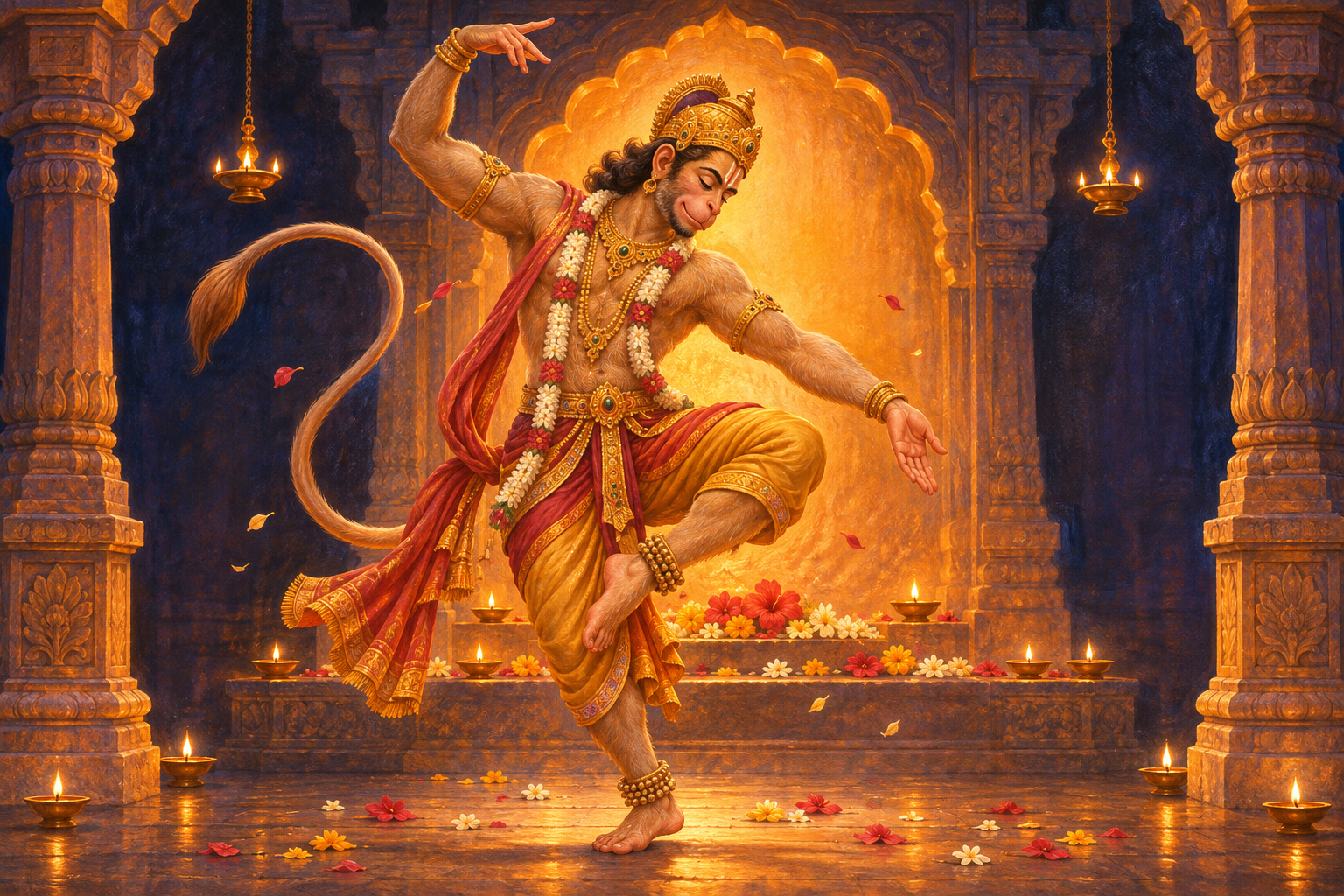
Hanuman’s identity does not change when he dances. His strength, discipline and devotion remain present, but Nartana gives them a different visual emphasis. The form asks you to see bhakti not only as reverent stillness but also as an energy capable of filling the body.
- Devotion becomes embodied. The figure does not merely possess devotion as an inward feeling. Posture, balance and gesture make it visible.
- Power receives direction. Hanuman’s energy is not shown as restless force or self-display. A sound devotional reading understands that energy as governed by purpose and offered through service.
- Joy acquires sacred seriousness. Dance need not make the image comic or frivolous. Here joy can be disciplined, concentrated and inseparable from devotion.
This gives you a simple test for any interpretation. It should explain both parts of the name. If it treats the sculpture as a generic dancer, it loses Hanuman’s devotional identity. If it discusses only loyalty, strength or service while ignoring the rhythm of the body, it loses the meaning of Nartana.
Separate identity, form and secondary attributes
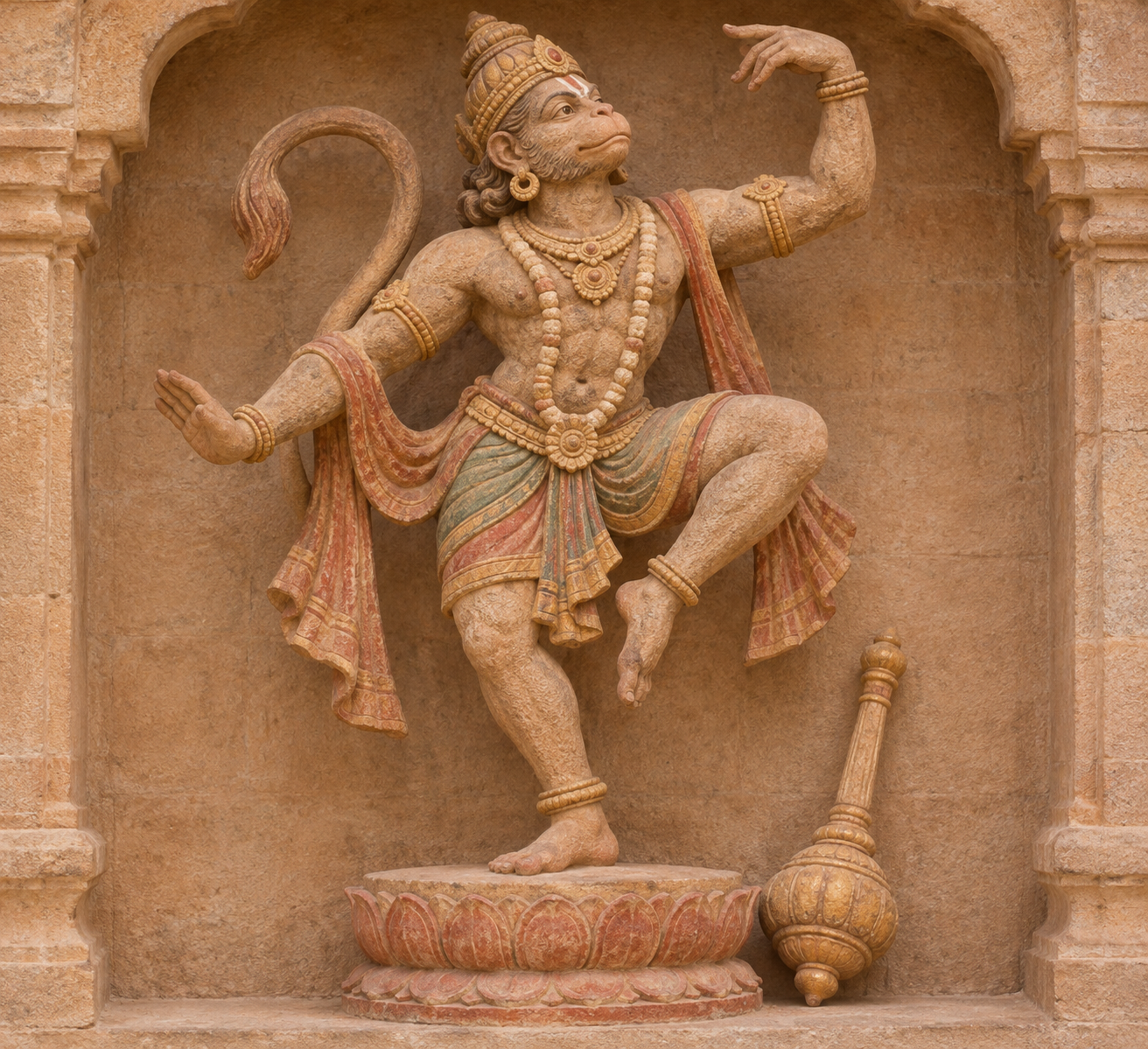
Iconography is often misread as a hunt for one decisive object. That method is especially unreliable here. A gada may help identify Hanuman, for example, but it does not by itself identify a dancing form. Keep four layers of evidence separate:
- Identity: Vanara features, the tail and other recognisable characteristics establish that the figure is Hanuman.
- Form: The body’s organised movement establishes the Nartana aspect.
- Secondary details: Hand gestures, attributes, clothing, ornaments and facial treatment refine the reading but should not replace the primary evidence.
- Context: A pedestal, accompanying figures, an inscription, a temple tradition or a reliable collection label may clarify what the image alone leaves uncertain.
Secondary features can vary with medium, region, period and local convention. That variation is not a reason to abandon careful identification. It is a reason to avoid declaring one specimen the universal template for every Nartana Hanuman image.
Damage introduces another problem. A broken hand may once have held an attribute, while a missing foot or tail can obscure the direction of the pose. Do not reconstruct absent details from expectation alone. Record what is visible, what has been inferred and why you think the inference is reasonable.
The same restraint applies to mudras. Name a hand gesture only when the fingers are sufficiently clear. A blurred photograph, worn relief or later repair may not preserve enough information for a confident identification.
Use a disciplined method when identifying or commissioning an image
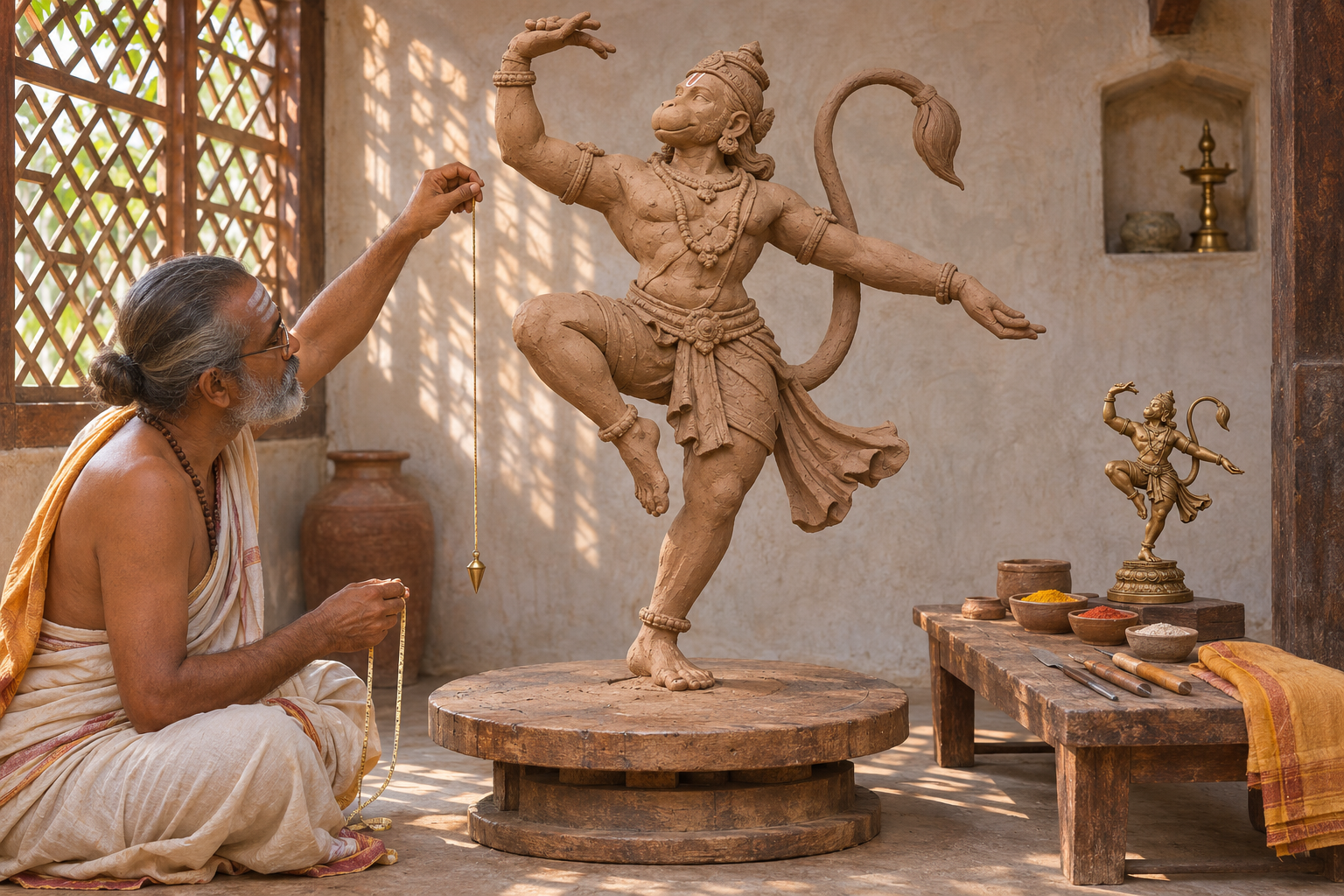
If you are studying a temple sculpture, museum object or photograph, describe it before interpreting it. This small change makes your conclusion much easier to check.
- Record the setting. Note where the image is located or where the photograph originated. Temple placement and collection history may matter to the identification.
- Describe only what you can see. Write down the stance, direction of the torso, arm positions, tail, expression and surviving attributes without assigning meaning yet.
- Identify the primary action. Decide whether the figure is dancing, advancing, standing, kneeling or performing another action. Keep the conclusion provisional when the evidence is incomplete.
- Check contextual information. Read the inscription or label carefully, and ask a priest, curator or knowledgeable tradition-holder when local usage is available.
- State your confidence honestly. “Nartana Hanuman” and “possibly Nartana Hanuman” are not equivalent conclusions. Uncertainty is more useful than a precise but unsupported label.
If you are commissioning a new murti or sculpture, begin with the silhouette rather than surface decoration. Ask the sthapati or sculptor which iconographic or regional convention informs the design. Examine how the weight is supported, how the movement will read from the intended viewing position, and whether the hands, attributes and expression serve the same devotional idea.
For an image intended for worship, visual appeal is not the only consideration. Confirm the requirements of your temple, lineage or household tradition with the appropriate priest or tradition-holder. A lively sculpture marketed as “dancing Hanuman” should not automatically be assumed to follow the conventions expected in a particular ritual setting.
Key takeaways
- Nartana Hanuman is recognised primarily through the coordinated movement of the whole body, not through one bent leg or one attribute.
- The dance makes devotion, sacred energy and joy visible without displacing Hanuman’s identity as the disciplined servant of dharma.
- Identity, action, secondary attributes and setting are different layers of evidence; keep them separate while examining the image.
- A gada, ornament or hand gesture can refine an identification, but none of these details alone proves that the form is Nartana Hanuman.
- When damage, a poor photograph or missing context prevents certainty, preserve the identification as provisional.
At your next encounter with a dancing Hanuman, resist the urge to read the label first. Give the figure one quiet moment of attention. Find its balance, follow its direction and see how the expression transforms physical movement into bhakti. Then consult the contextual evidence. That order lets the murti teach you how it was meant to be seen while keeping your interpretation disciplined.
References

Leave a Reply
You must be logged in to post a comment.