
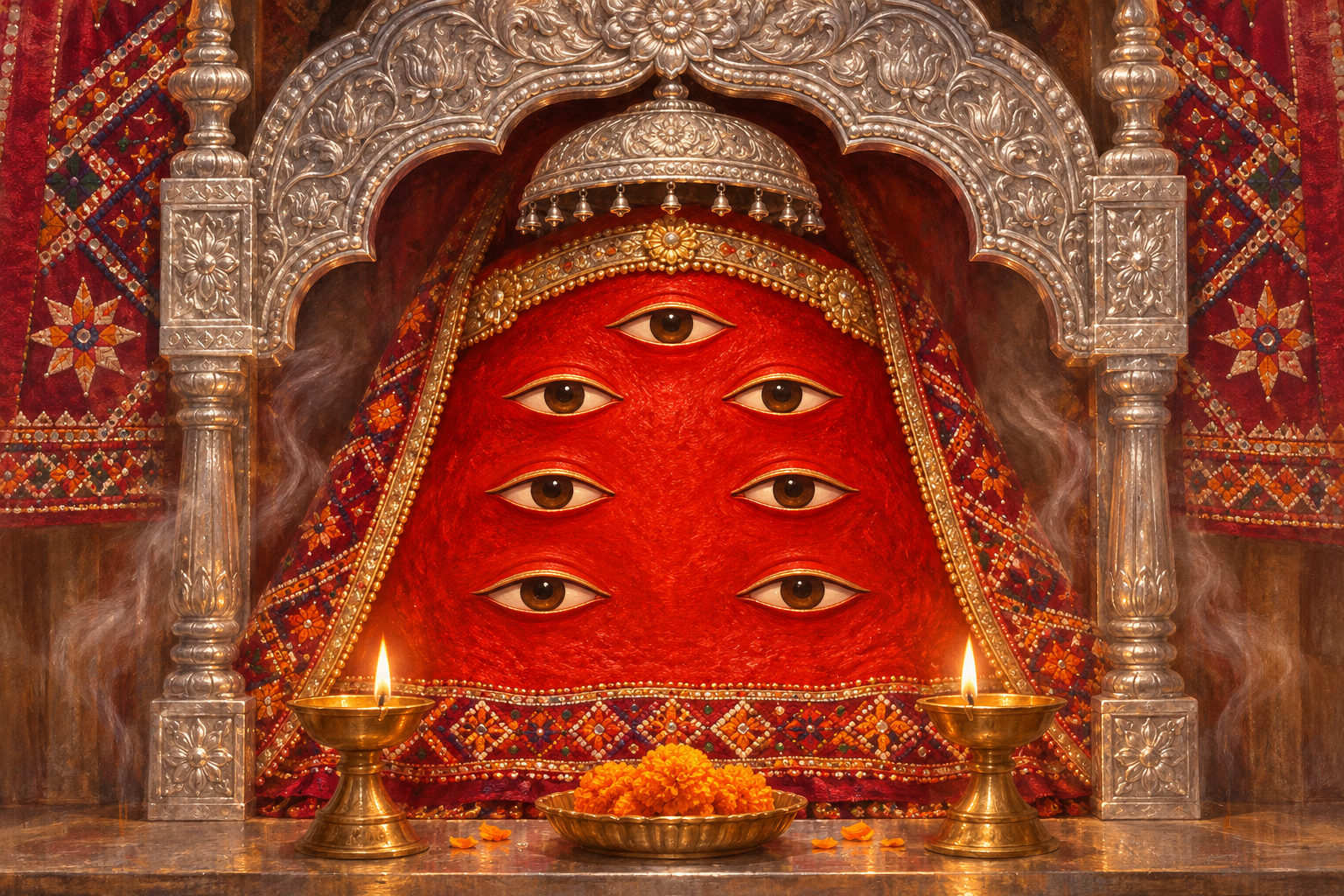
You may know Ashapura Mata as the Devi who fulfils hopes, yet still wonder how to read her unusual seven eyes and vivid red form. Are these details a fixed code, a regional convention, or an invitation to contemplate the Goddess more deeply?
Begin with the features that the form itself emphasizes. Her name establishes the devotee’s relationship with her. The eyes widen the meaning of sight. Red presents divine power as active and present. Her identity as Desh Devi roots that power among a particular land and people. Reading the form in this order gives you a grounded way to approach darshan without forcing unsupported meanings onto it.
Her name places hope within a sacred relationship
Ashapura Mata’s name is devotionally understood through asha, meaning hope or wish, and puran, meaning fulfilment. The name tells you why devotees turn toward her: human longing is brought into the presence of the Devi rather than carried in isolation.
That meaning should not be reduced to the idea that every impulse must produce the result you demand. A sacred name describes a relationship, not a mechanical transaction. Hope can be fulfilled through the desired outcome, but devotion can also expose a confused desire, reveal a neglected duty, or give you the steadiness to accept what cannot be controlled. The important movement is from anxious wanting to conscious prayer.
You can make this distinction practical before darshan. State the hope plainly to yourself. Then ask what part of it depends on your own action, whom its fulfilment would affect, and whether it accords with your dharma. This does not weaken the prayer. It removes vagueness and turns wishfulness into a responsible sankalpa, or intention.
The seven eyes make expanded awareness impossible to miss
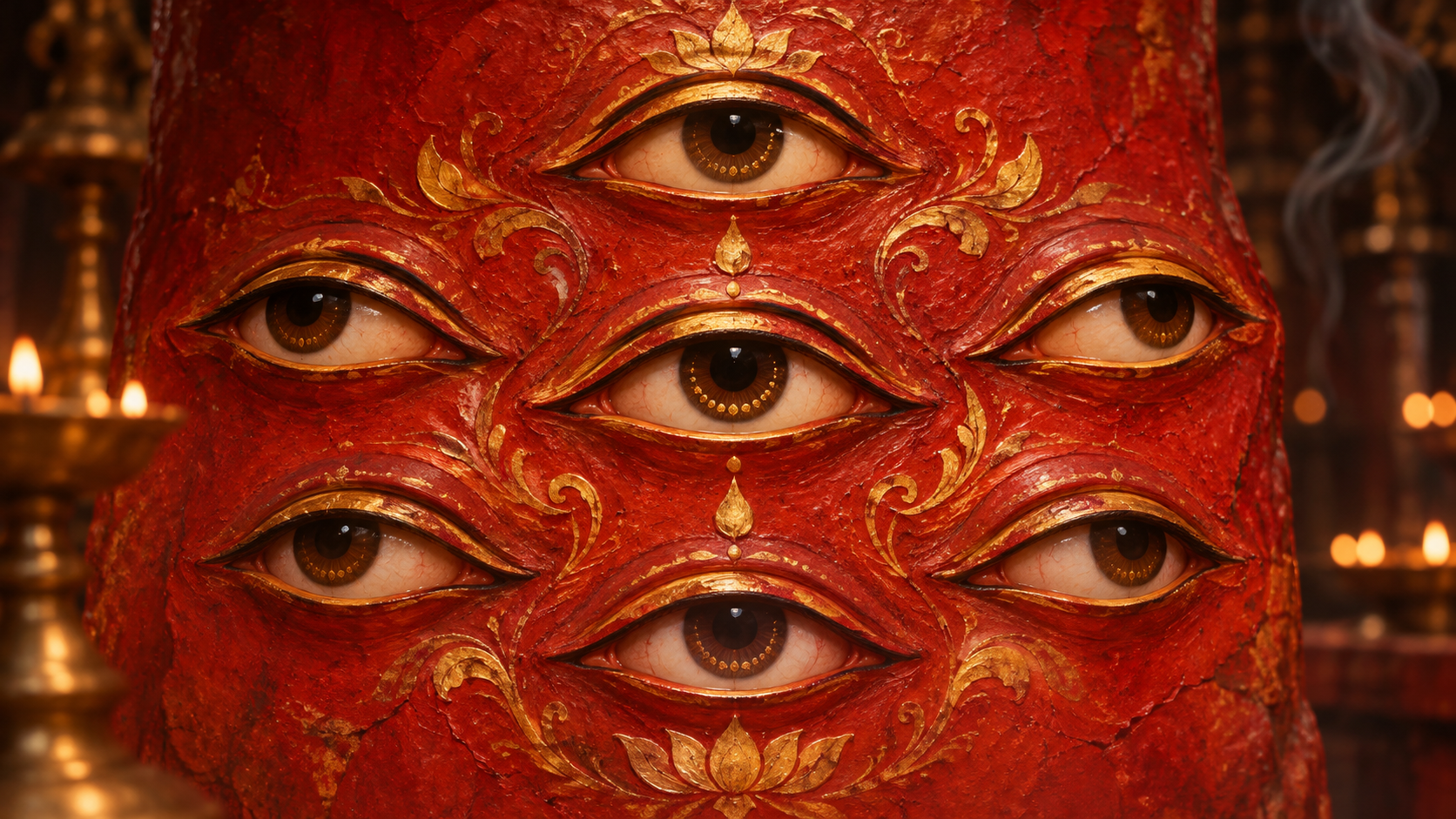
A human face normally has two eyes, so the multiplication of eyes immediately moves the image beyond ordinary anatomy. The most careful symbolic reading begins there: Ashapura Mata does not see from one narrow position. Her seven-eyed form presents awareness as abundant, penetrating, and greater than the partial vision available to an individual person.
This matters because hope can narrow your sight. When you want a particular result, you naturally focus on the outcome nearest to you. You may overlook a consequence for your family, a responsibility that accompanies success, or the difference between fear and genuine discernment. The Devi’s many eyes confront that tunnel vision. Before asking to be seen by her, you are invited to see more honestly yourself.
It is tempting to match the number seven automatically with another familiar set of seven: chakras, days, worlds, rivers, or some other scheme. Do not make that leap unless the lineage, temple tradition, or teaching you follow explicitly makes it. A repeated number can carry several associations in Hindu traditions, and visual resemblance alone does not prove a precise correspondence. The defensible meaning here is the one displayed directly by the form: ordinary sight has been intensified.
You can use the seven eyes as a contemplative discipline without pretending that your exercise is the icon’s sole traditional meaning. Examine your hope from several sides: intention, duty, effect on others, practical cost, hidden fear, possible consequence, and your response if the answer differs from your preference. This turns the symbol into a mirror for discernment rather than a puzzle to be solved.
Red reveals active Shakti, not anger alone

Red carries a strong field of associations in Hindu sacred culture. It can evoke Shakti, vitality, auspiciousness, protection, fertility, and the intensity of embodied life. In Ashapura Mata’s form, the color therefore complements the eyes: this is not passive observation. The Devi who sees also possesses the power to act.
A common misreading treats red as if it must signify anger. Fierceness can belong to Devi imagery, but color never works in isolation. Here it must be read beside the compassionate promise expressed by the name Ashapura and the encompassing awareness expressed by the eyes. The result is a fuller image of protective power: alert, energetic, and responsive to the hopes placed before her.
Notice what the color does to your own response. If red makes the form seem frightening, return to the name and ask whether you are confusing intensity with hostility. If it makes the form seem merely decorative, return to the eyes and consider what active awareness asks of you. Sacred color is doing its work when it changes the quality of your attention.
Do not infer a prescribed offering, garment, or household ritual from the color alone. Iconographic meaning and ritual instruction are different things. For worship, follow the custom of your family, community, or temple; where you do not know the custom, ask rather than inventing a rule from the image.
Desh Devi joins personal longing to Kutch and its people
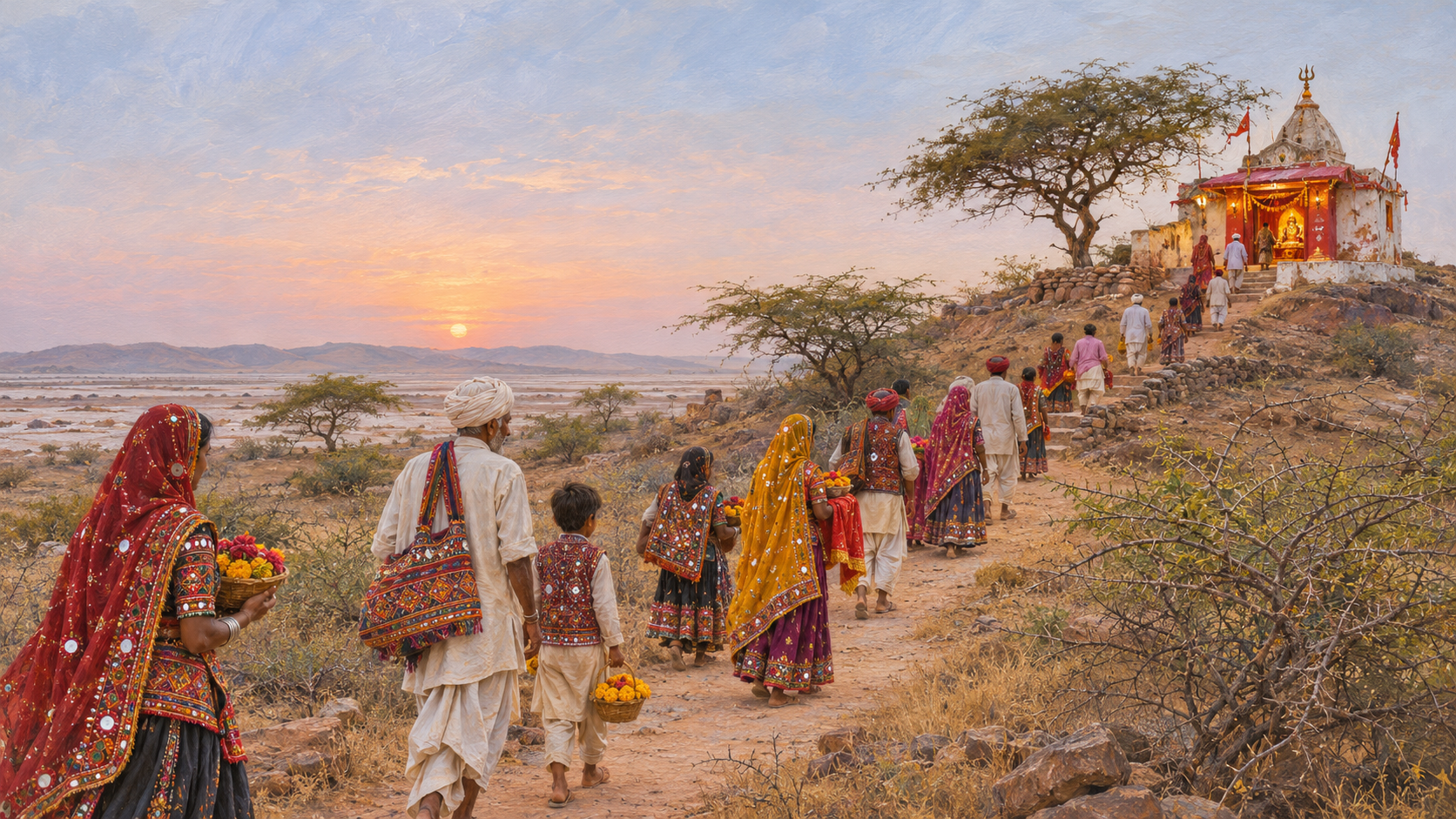
Ashapura Mata is lovingly known as Desh Devi Maa, the Goddess of the people, and her worship is deeply rooted in Kutch, Gujarat. This regional identity is not a minor biographical detail. It shows how Hindu sacred life binds divinity, community, memory, and land without treating the divine as confined to one location.
The title Desh Devi also changes how you hear the promise of fulfilled hope. A hope is personal, but its consequences rarely remain private. A marriage, livelihood, recovery, journey, or family decision alters a web of relationships. When the fulfiller of hope is also understood as the Goddess of a people, devotion acquires a communal horizon. You should ask not only, “Will this happen for me?” but also, “What will I owe others if it does?”
For devotees living far from Kutch, the regional root need not be treated as a barrier. It is a reason to approach the tradition with greater care. Learn the name by which the Goddess is addressed, distinguish inherited custom from internet speculation, and respect the community that has preserved her worship. A locally rooted Devi can be approached beyond that locality without erasing where her living tradition is anchored.
Key takeaways for your next darshan
- Begin with the name. Ashapura expresses the movement from hope or wish toward fulfilment, placing desire within a relationship of devotion.
- Let the eyes widen the question. The seven-eyed form most securely signifies sight intensified beyond ordinary human limitation. Do not attach it to a particular set of seven without support from a relevant tradition.
- Read red through the whole image. It points toward active Shakti, vitality, auspiciousness, and protection; it should not automatically be reduced to anger.
- Hold place and universality together. Honour Ashapura Mata’s roots in Kutch while recognizing that a regionally grounded sacred presence need not be spiritually restricted by geography.
- Keep symbolism distinct from ritual rules. Use the form for contemplation, but follow an established family or temple tradition for specific mantras, offerings, and observances.
- Make hope accountable to dharma. Ask what action your prayer requires from you and how its fulfilment would affect the people around you.
When you next stand before Ashapura Mata, spend a quiet moment looking before you ask. Bring a clearly named hope, allow the seven eyes to broaden your view, and let the red form remind you that divine blessing does not excuse human responsibility. Then take the next dharmic action that is genuinely yours to take.
References

Leave a Reply
You must be logged in to post a comment.