
You may have reached Svarupa Parinama through a seeming contradiction. Samkhya describes primal nature as balanced before the universe becomes manifest, yet it also calls that condition a transformation. If everything is in equilibrium, what is changing?
The answer depends on a distinction that is easy to miss: a system can change within its existing order without producing a new, differentiated state. Once you see that distinction, Samkhya’s account of cosmic manifestation, the three gunas, and the unchanging character of Purusha becomes much easier to follow.
The shortest accurate definition
Svarupa means one’s own form or inherent character, while parinama means transformation. Svarupa Parinama is therefore transformation in which something continues to change according to its own character without becoming a differently configured effect.
In Samkhya, the transforming reality is Prakriti, also called Pradhana when emphasis falls on primordial, unmanifest nature. It is the causal matrix of both the material world and the mental apparatus through which that world is experienced. In this framework, Pradhana contains the potential from which the differentiated universe can emerge; it is not an empty space waiting to be filled from outside.
Prakriti consists of three inseparable gunas: sattva, associated with illumination and clarity; rajas, associated with activity and movement; and tamas, associated with weight, restraint, and obscuration. Before manifestation, none of the three gains effective predominance over the others. Each nevertheless continues in its own mode. That change-within-balance is Svarupa Parinama.
The definition becomes sharper when you mark its boundaries. Svarupa Parinama is not the production of the manifest cosmos, not a change in Purusha, and not the cessation of every kind of activity. It is the transformation of the gunas while their mutually balanced condition remains unbroken.
Why equilibrium does not mean frozen stillness
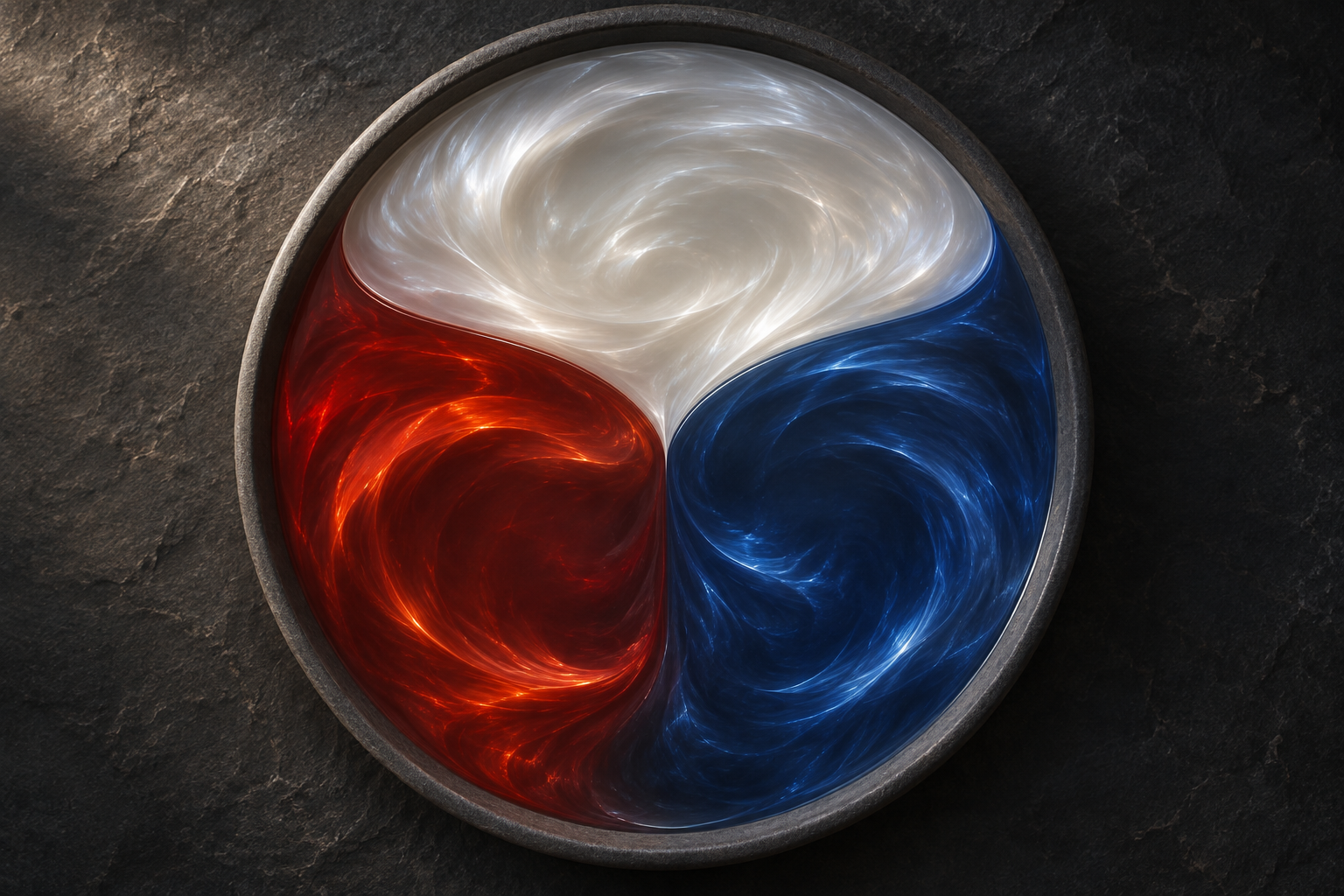
The word equilibrium often makes readers imagine three perfectly still objects. That picture creates the problem. Samkhya’s equilibrium is relational: no guna overpowers the others in a way that generates a distinct effect. It need not mean that the gunas have become featureless or that transformation has stopped.
Think of musicians sustaining a stable chord. Every tone remains active, but the relation among the tones preserves the chord’s identity. If one tone becomes dominant or shifts its relation to the others, a different musical configuration appears. The analogy is limited, but it isolates the important distinction: activity within a stable relation is not the same as a change of relation.
You should not turn this balance into an imagined numerical formula. Samkhya is not claiming that sattva, rajas, and tamas occupy three measurable, equal portions. Equilibrium means the absence of the predominance and subordination that would produce a differentiated tattva. It is a functional balance, not a percentage calculation.
This also clarifies what unmanifest means. The unmanifest is not absolute nonbeing. Causes, capacities, and the gunas remain present, but they are not arranged into the distinct forms through which a cosmos can be experienced. Svarupa Parinama gives Samkhya a way to describe that condition without treating it as either a created world or a blank nothing.
Svarupa and manifest transformation must not be confused

The contrasting mode is commonly described as Virupa Parinama: transformation into a different or differentiated configuration. Here the gunas no longer maintain the same mutual balance. Their predominance and subordination make the evolution of distinct principles possible, beginning with Mahat or Buddhi and proceeding through the other tattvas of manifest nature.
| Question | Svarupa Parinama | Manifesting or Virupa Parinama |
|---|---|---|
| What happens among the gunas? | Their balanced relation is preserved. | Predominance and subordination appear. |
| Does a distinct tattva arise? | No differentiated effect is produced. | Distinct evolutes of Prakriti become manifest. |
| What cosmic condition does it describe? | Unmanifest Pradhana or the equilibrium associated with cosmic quiescence. | The unfolding of the experienced mental and material cosmos. |
| Does transformation cease? | No. Change continues within the gunas’ own modes. | No. Change now also produces differentiated configurations. |
| What should you not infer? | That equilibrium is absolute nonexistence or total immobility. | That the universe has been produced from nothing. |
These are not two kinds of primordial substance. They are two conditions of the same Prakriti. In one, transformation preserves the balanced relation of the gunas. In the other, an altered relation yields determinate effects.
You can use a simple reading test. If a passage says that the gunas remain mutually balanced and no distinct principle emerges, read it as Svarupa Parinama. If their unequal relation results in Mahat, Ahamkara, mind, the senses, or the elements, the passage is discussing manifest evolution.
This distinction protects another central Samkhya claim: manifestation is not creation from absolute nothing. The effect becomes manifest from a cause that already possesses the relevant capacity. The world is a real transformation of Prakriti, not an inexplicable addition to an originally empty reality.
Keep Purusha out of the changing column

Svarupa Parinama belongs to Prakriti and its gunas. It does not belong to Purusha. This is the most important safeguard when you connect the doctrine to spiritual life.
Purusha is consciousness, the witness. Prakriti includes not only bodies and physical elements but also Buddhi, Ahamkara, Manas, the senses, and the changing contents of experience. Thoughts become clear or confused. Attention moves. Identity forms around an experience. Samkhya assigns all of those changes to the evolutes of Prakriti, even though they appear in the light of consciousness.
A peaceful or predominantly sattvic mind is therefore not identical with Purusha. It remains guna-constituted and capable of transformation. The same principle applies at the primordial level: even perfectly balanced Prakriti is not pure consciousness, because it is composed of the gunas and participates in Parinama.
This is why the doctrine matters for liberation rather than only for cosmology. Samkhya asks you to discriminate between everything that changes and the consciousness to which change appears. Svarupa Parinama makes that discrimination more exact. Something does not have to look turbulent, productive, or visibly altered in order to belong to changing Prakriti. Subtle balance is still not Purusha.
A five-question test for reading the doctrine correctly
When you encounter Svarupa Parinama in a commentary, lecture, or discussion, work through these questions in order:
- What is said to transform? If the answer is Prakriti or the gunas, you are within the Samkhya framework. If Purusha is said to mutate into mind or matter, either the explanation is imprecise or a different philosophical system is being used.
- What does balance mean in the passage? Read it as the absence of effective predominance, not as an arithmetic division and not automatically as total inactivity.
- Does the change produce a distinct tattva? If not, Svarupa Parinama may be intended. If a new stage of cosmic evolution emerges, the passage has moved into differentiated transformation.
- Is the discussion cosmological or psychological? A person’s mixture of clarity, restlessness, and inertia can illustrate the gunas, but an individual mood is not identical to the primordial equilibrium of Pradhana.
- Is an analogy being mistaken for a mechanism? Images such as seeds, containers, chords, or balanced scales can explain causal potential and equilibrium. None should be treated as a literal physical model of Prakriti.
The fourth question prevents a particularly common misuse. Svarupa Parinama is a technical account of transformation in primordial nature. It is not a diagnosis for emotional numbness, a label for doing nothing, or a promise that personal balance means the gunas have stopped operating. Psychological examples can help you notice the logic, but they should not replace the doctrine.
You can still use the concept as a disciplined contemplative lens. It teaches you not to equate an unseen effect with no causal activity, stillness with nonexistence, or mental clarity with consciousness itself. Keep those insights anchored to the Prakriti-Purusha distinction, and they illuminate practice without turning a precise philosophical term into vague self-help language.
Key takeaways
- Svarupa Parinama is transformation that preserves the gunas’ balanced relation and their respective characters.
- Equilibrium means that no guna gains the predominance required to produce a differentiated effect; it does not mean absolute immobility.
- Manifest cosmic evolution begins when the relation among the gunas becomes unequal and distinct tattvas arise.
- All such transformation belongs to Prakriti. Purusha is the witnessing consciousness, not another changing product of the gunas.
- The doctrine should first be read as metaphysics and cosmology; psychological analogies are useful only when their limits remain clear.
The next time you meet the phrase primordial equilibrium, replace the image of frozen stillness with balanced transformation. Then ask two questions: has the relation among the gunas changed, and has a distinct effect appeared? Those questions turn Svarupa Parinama from an apparent paradox into a precise tool for understanding both manifestation and the path of discrimination.
References

Leave a Reply
You must be logged in to post a comment.