
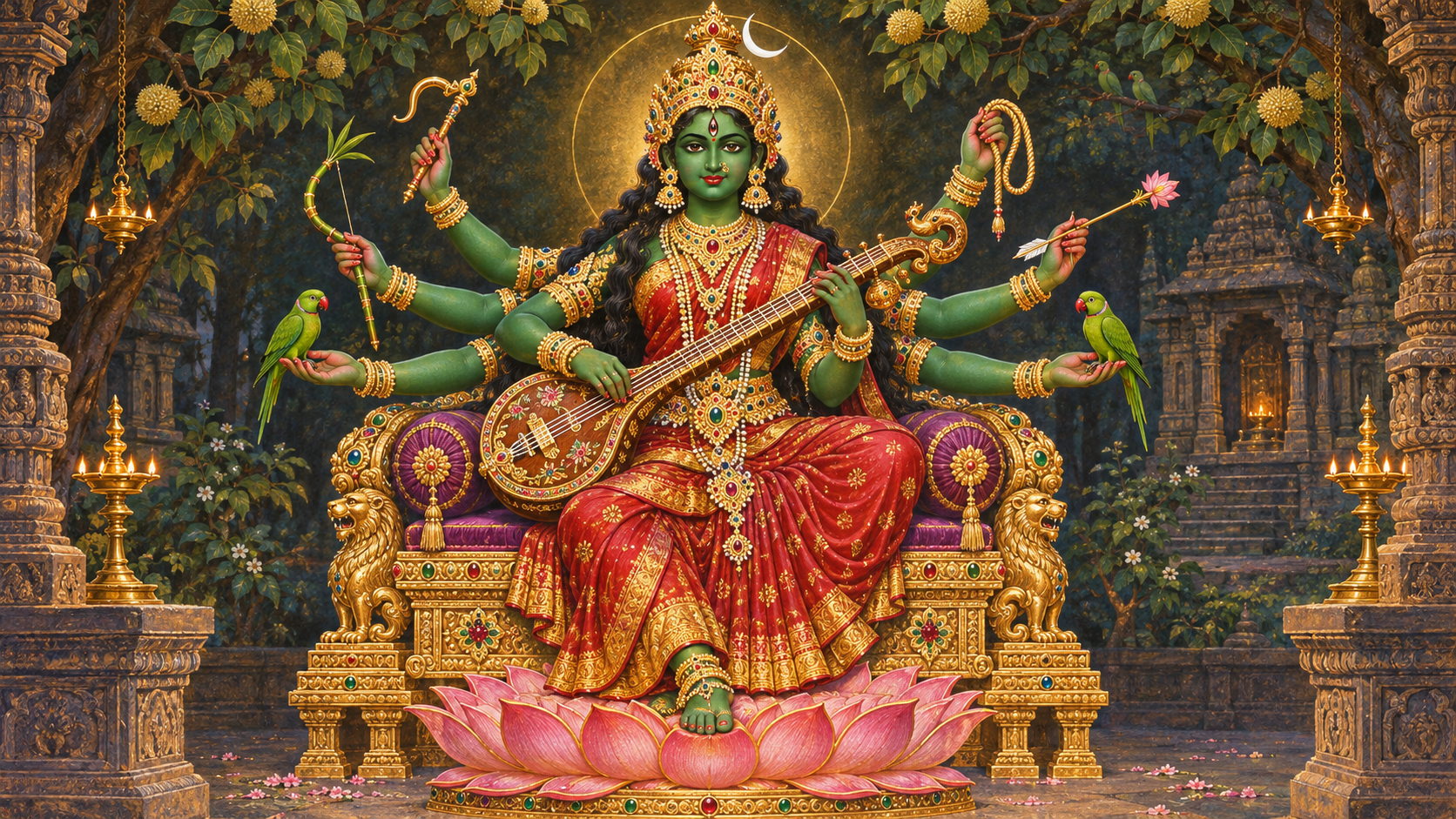
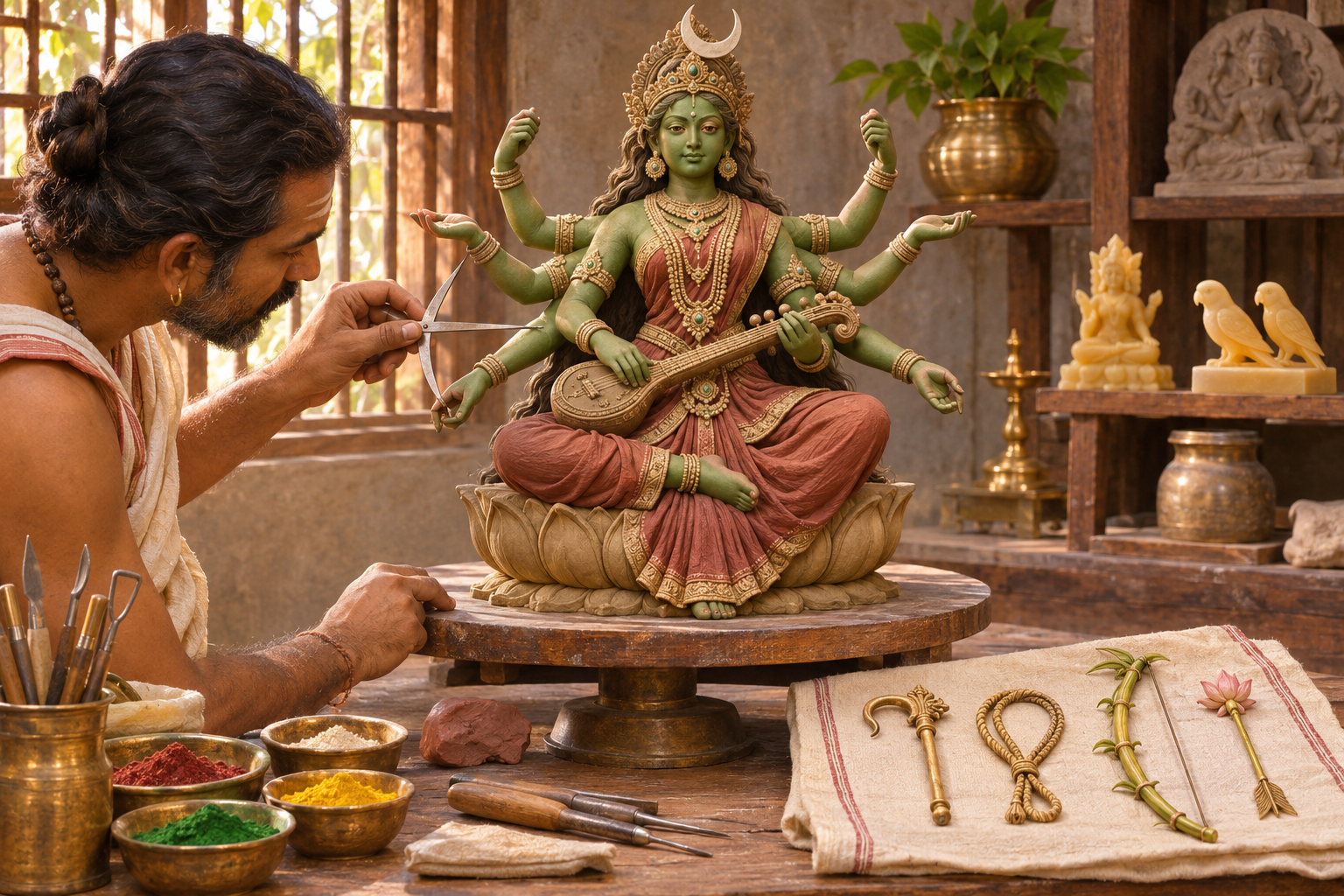
You may be looking at a murti, painting, or digital image labelled “Matangi Devi” and wondering what actually makes the figure Matangi. A musical association may seem decisive, but it is not enough by itself. The reliable approach is to read the deity’s identity, religious setting, and symbolic functions together.
This matters because Matangi stands close to Saraswati in the realms of speech, learning, music, and the arts, yet she belongs to a different theological setting. If you identify her through a single object or a marketplace caption, you can easily miss the meaning that her iconography is meant to carry.
Begin with Matangi’s place among the Mahavidyas
The safest point of entry is Matangi’s identity as the ninth of the ten Mahavidyas. The Mahavidyas are wisdom goddesses revered within Shakta and Tantric traditions. That setting is not a minor biographical detail; it is the frame within which Matangi’s image should be interpreted.
When a depiction appears in a Mahavidya series, shrine, manuscript, or ritual setting, the surrounding figures provide strong identification evidence. An isolated image is harder to read because the context that distinguishes one goddess from another has been removed. Before interpreting ornaments or held objects, therefore, ask where the image came from and whether it belongs to a recognised Mahavidya arrangement.
This first step also prevents a common mistake: treating Hindu iconography as a visual guessing game. A divine image is not simply a collection of detachable clues. Placement, accompanying names, ritual use, and theological family can be as important as anything represented in the deity’s hands.
Do not collapse Matangi into Saraswati
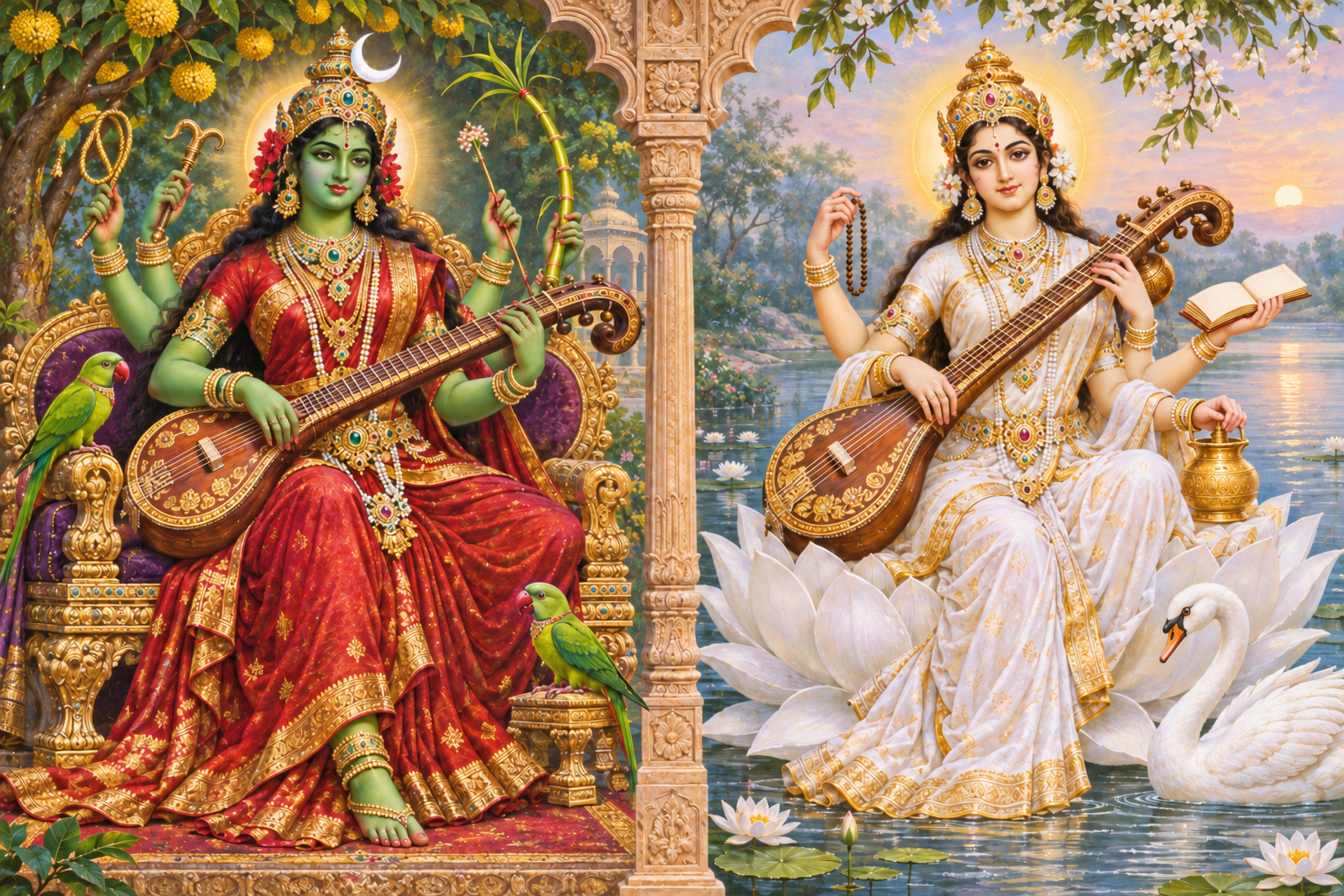
Matangi is associated with speech, music, learning, and the arts. These domains explain why she is often understood as a Tantric counterpart of Saraswati. “Counterpart,” however, does not mean that the two goddesses are interchangeable or that every image associated with learning and music must represent the same deity.
The distinction is easiest to preserve by asking two separate questions. First, what powers does the image evoke? Second, within which tradition is that power being expressed? Speech and learning point toward a shared sacred domain; a Mahavidya and Tantric context points specifically toward Matangi.
If you are cataloguing an image, describing one for publication, or choosing a murti, avoid identifying Matangi solely through resemblance to Saraswati. Record the resemblance, then look for corroboration in the image’s title, inscription, placement, accompanying deities, temple tradition, or documented ritual identity. When that evidence is unavailable, “possibly Matangi” is more accurate than a confident but unsupported label.
Read the image as a complete visual program
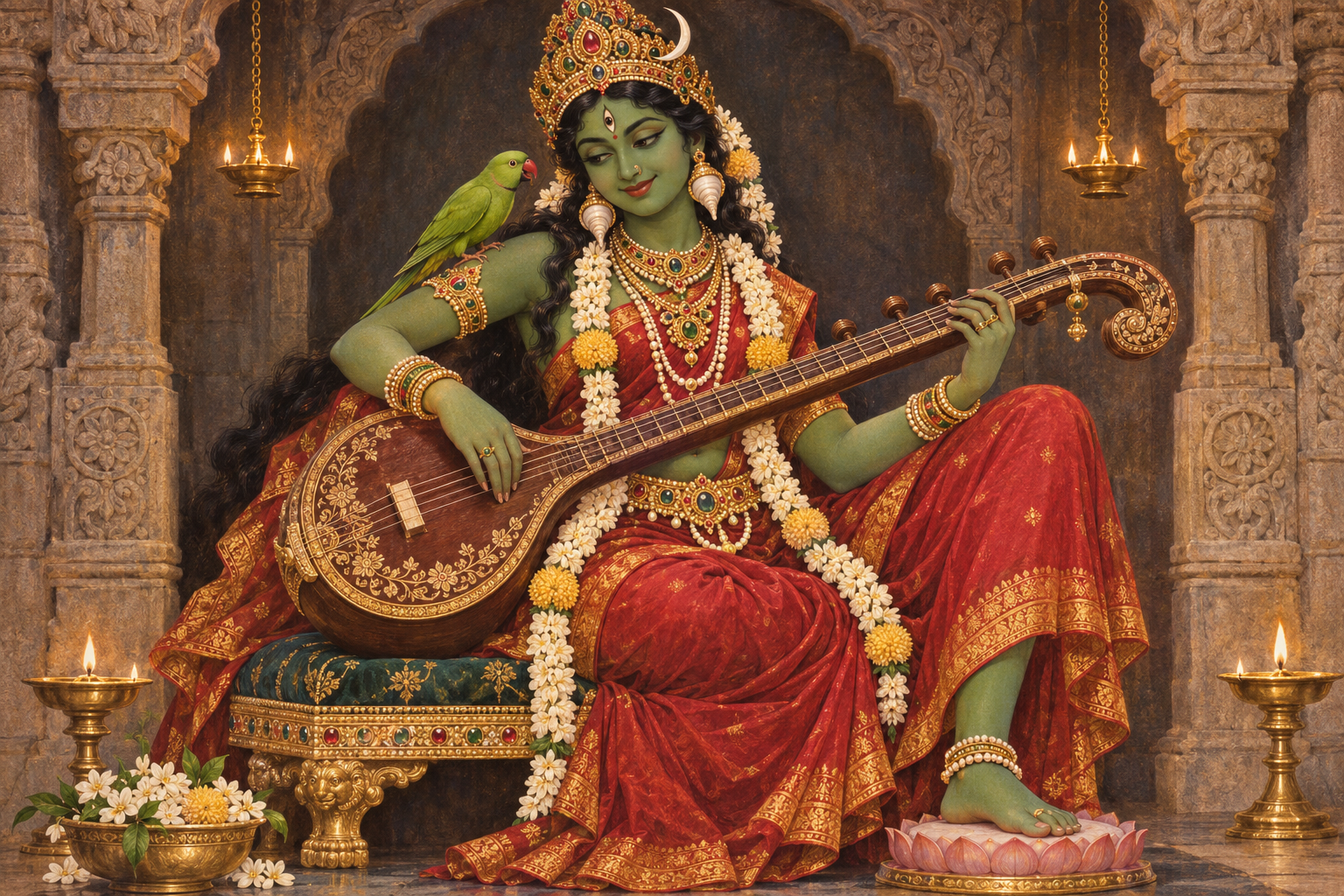
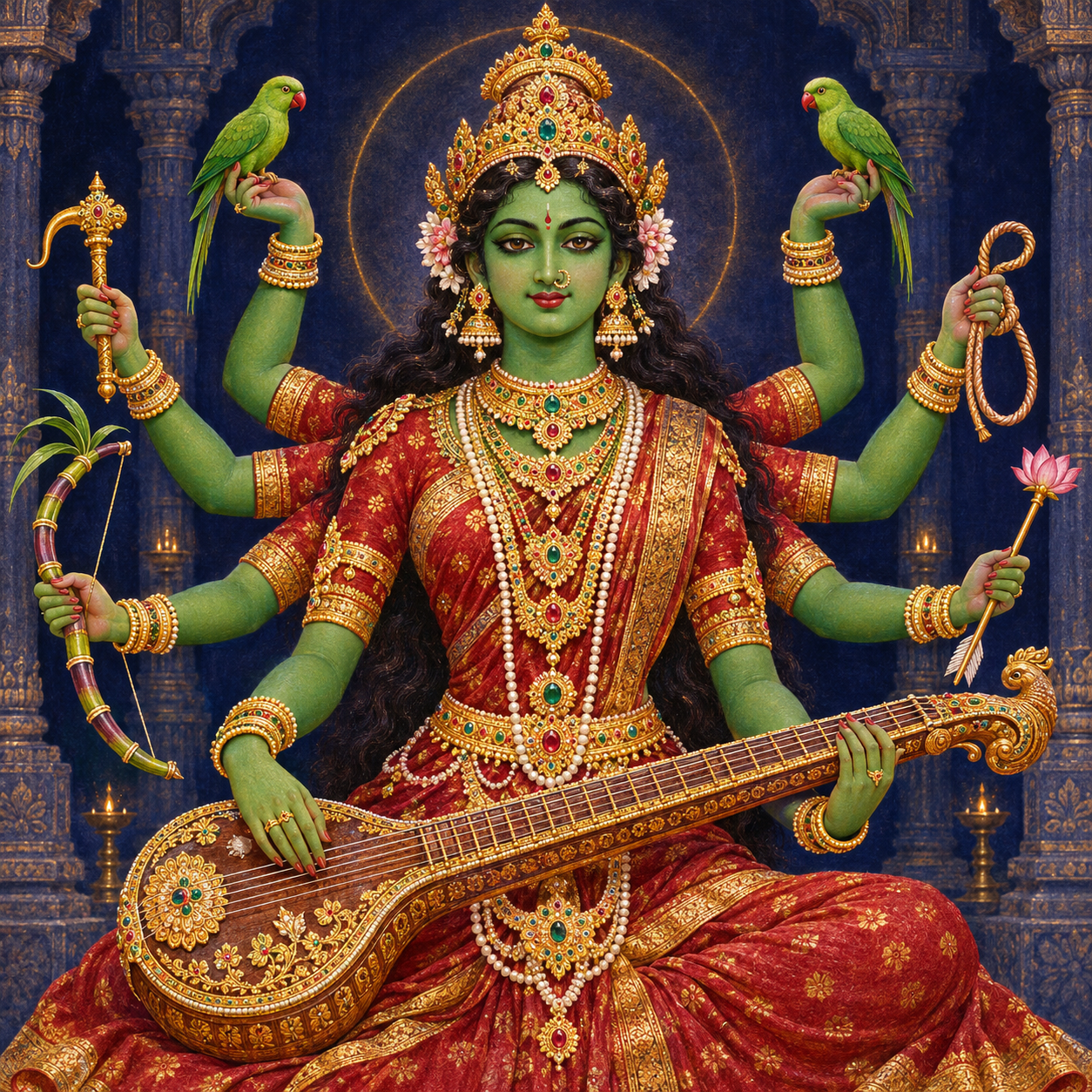
A careful iconographic reading begins by separating observation from interpretation. First write down only what you can actually see: posture, number and position of hands, held objects, ornaments, complexion, seat, attendants, background figures, inscriptions, and placement within a larger group. Do not assign meanings during this first pass.
Next, group the visible elements by the ideas they might support. For Matangi, the central interpretive cluster is speech, music, learning, and artistic expression. A credible identification should make sense across that cluster and within her Mahavidya setting. One suggestive feature may begin the inquiry, but it should not end it.
Then consider inner purity, another important dimension of Matangi’s identity. Her imagery should not be reduced to a celebration of artistic skill or eloquence. It directs attention to the interior condition from which expression arises. The relevant question is not merely whether a person can speak, sing, compose, or learn, but what kind of consciousness animates those abilities.
This is where Matangi’s paradoxical character becomes important. A superficial reading may look for a neat emblem and stop there. A fuller reading notices a tension between outward expression and inward transformation. The icon asks you to examine speech as sacred power: what enters it, what it carries, and what it does to the person who hears it.
Visual forms can vary between temples, artistic workshops, regions, and ritual traditions. Do not assume that every depiction must reproduce one fixed colour, posture, hand count, or set of objects. When those details matter to your purpose, identify the particular form and tradition before assigning a universal meaning to them.
Key takeaways for identifying a Matangi image
- Establish the setting first. A place within a Mahavidya series or Shakta-Tantric context is stronger evidence than a generic resemblance.
- Look for a cluster, not a solitary clue. Speech, music, learning, and the arts belong together in Matangi’s symbolic identity.
- Treat the Saraswati connection as a relationship. Shared domains explain the comparison, but they do not erase the goddesses’ distinct theological settings.
- Separate what you see from what you infer. Record visible features before attaching symbolic meanings to them.
- Preserve uncertainty. If the provenance, inscription, or ritual context is missing, use a qualified identification instead of forcing certainty.
- Verify the particular form. Do not turn the features of one representation into rules for every Matangi image.
Let the iconography change how you use speech
Matangi’s iconography becomes useful when it changes the way you approach the powers she governs. Before speaking in a difficult situation, ask whether your words are accurate, necessary, and shaped by a disciplined interior state. Before performing music or writing, notice whether technique is serving clarity or merely displaying itself. Before pursuing learning, examine what the knowledge is making of you.
This is not an attempt to turn the goddess into a generic lesson in good communication. It is a way of respecting the unity of her domains. Speech, music, knowledge, and art are not separate accomplishments placed side by side; each gives form to something that begins within.
If you are studying a particular Matangi murti now, begin with provenance rather than symbolism. Find its temple, series, inscription, artist’s description, or ritual name. Then return to the visible details and ask how they express Matangi’s Mahavidya identity and her governance of speech, music, learning, the arts, and inner purity. That sequence will give you a more dependable reading than any one-feature checklist.
References

Leave a Reply
You must be logged in to post a comment.