

You may have encountered the phrase prana devatas and wondered what you are being asked to understand: five deities within the body, five kinds of breath, or five names for bodily processes. That confusion matters when you practise mantra, because each interpretation leads to a different way of attending to breath, sound, and awareness.
The most useful starting point is to understand the prana devatas as five coordinated expressions of the vital power that sustains embodied life. This vital power animates the body, supports the senses, influences the mind, and enables the functions necessary for life. The framework is sacred without being vague, and practical without reducing the human being to a machine.
First distinguish prana from the breath alone

Prana is often translated as breath, but the two words are not interchangeable. Breathing is one of the clearest ways in which living vitality becomes perceptible. Prana, in the broader Dharmic sense, is the animating power present through bodily activity, sensory engagement, attention, and mental life. A person who treats prana as nothing more than inhaled air has already made the concept too small.
There is a second source of confusion. The word prana can name the whole field of vital energy, but it can also name one member of the fivefold division. Context decides which meaning is intended. In the expression five prana devatas, prana in the broad sense is differentiated into prana, apana, samana, udana, and vyana. Think of one living power disclosed through five characteristic movements, not five unrelated substances competing inside you.
This also explains why a purely anatomical reading falls short. The fivefold map can direct your attention toward areas and activities of the body, but it is not a medical diagram. Prana is not a substitute name for oxygen, the nervous system, blood circulation, or any other single physiological mechanism. Traditional language is describing embodied life through its patterns of receiving, releasing, integrating, expressing, and distributing.
The reference to man and woman should be read at this basic level of shared embodiment. Both live through the operations gathered under prana. You should not infer a spiritual hierarchy between male and female bodies, or invent separate gendered lists, unless a specific lineage supplies a distinct teaching and its context.
The five prana devatas form one coordinated field

The following table is a reading aid for contemplative practice. Its bodily references identify traditional emphases, not rigid borders. Every act of recitation depends upon the cooperation of the whole living person.
| Prana devata | Traditional emphasis | What it helps you notice in mantra practice |
|---|---|---|
| Prana | Receiving and inward-moving vitality, especially associated with breathing and the chest | The renewal supplied by inhalation and the gathering of attention before utterance |
| Apana | Downward and outward movement, release, and elimination | The capacity to complete an outgoing breath, release unnecessary tension, and let a recitation end cleanly |
| Samana | Gathering, balancing, assimilation, and the central region | The integration of breath, meaning, attention, and an even pace instead of scattered effort |
| Udana | Upward movement, expression, speech, and the throat | The emergence of audible sound, clear articulation, and the lift involved in voiced recitation |
| Vyana | Pervading and distributing movement throughout the body | The whole-body coordination that keeps posture, breathing, hearing, and utterance working together |
The names become clearer when you resist the urge to isolate them. Audible mantra illustrates this well. An incoming breath renews your capacity to recite. Outgoing breath carries the sound. The throat and mouth articulate it. The centre maintains rhythm and composure. The entire body supports posture and continuity. Completion requires release. What appears to be one simple utterance is already a coordinated event.
That coordination is more important than locating each prana with anatomical precision. Traditional descriptions may associate a movement with the chest, throat, middle, lower body, or the whole organism, but these are centres of emphasis. They are not sealed compartments. Trying to feel five sharply separated energies can produce imagined sensations while obscuring the plain fact that life functions as a whole.
Calling them devatas changes how you approach the map
If the five were presented only as mechanisms, you might approach them as controls to manipulate. The word devata interrupts that attitude. It asks you to meet the powers sustaining life with attention, restraint, and reverence. You participate in these powers; you do not manufacture them through technique.
This does not require you to choose between a personal deity and an impersonal bodily process. Dharmic language can recognize divine agency through a function without reducing the divine to that function. In practice, devata keeps two truths together: the five names describe intelligible operations, and those operations are worthy of sacred regard.
That sacred regard has practical consequences:
- Seek cooperation, not domination. Do not try to make one prana overpower the others merely because its role sounds more spiritual or dramatic.
- Notice what is already occurring. Begin with natural breathing, ordinary speech, stable posture, and attentive listening before adding specialized techniques.
- Treat the body as a participant in sadhana. A mantra is not produced by an abstract mind while the body merely waits. Breath, voice, hearing, posture, attention, and intention all take part.
- Preserve humility before lineage. A general map of the pranas does not authorize you to invent nyasa, assign bija mantras, or create correspondences that your tradition has not taught.
This is where the prana-devata language protects mantra practice from two opposite errors. It prevents material reductionism, in which sacred recitation becomes a breathing exercise with religious decoration. It also prevents careless mystification, in which every twitch, warmth, or emotional change is declared a supernatural sign. Reverent observation is quieter and more exact than either extreme.
Use the framework to refine recitation without forcing breath
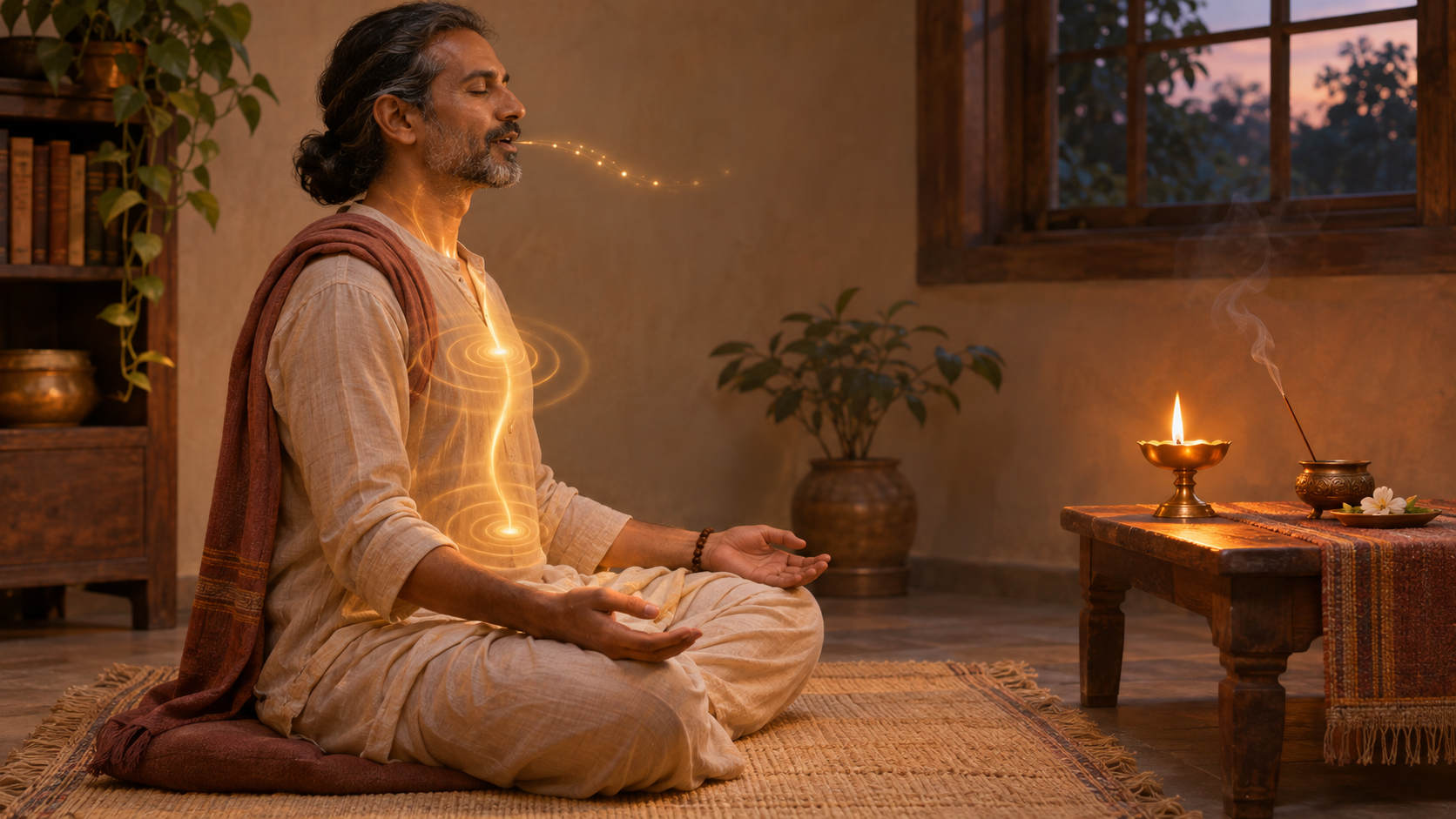
You can apply the fivefold map to a familiar mantra without pretending to perform an advanced ritual. The purpose of this exercise is observation. It is not initiation, pranayama instruction, or a replacement for guidance from your guru or lineage.
- Begin with a mantra you already practise. If your tradition restricts a mantra to initiated practitioners, honour that boundary. Do not use an unfamiliar bija merely because it seems connected with prana.
- Let breathing remain natural. Sit in a position you can maintain without strain. Keep the jaw and throat easy. Do not add breath retention, force a deep inhalation, or prolong an exhalation to prove control.
- Notice reception before expression. Feel how inhalation renews the capacity to speak and how attention gathers before the next utterance. Use prana as the interpretive lens, but do not chase a special sensation.
- Listen to the formation of sound. Observe how outgoing breath supports the mantra and how voice emerges through the throat and mouth. Udana helps you notice expression; it does not mean that louder chanting is better chanting.
- Attend to integration. Samana offers a way to notice whether pace, meaning, breath, and attention are coming together. If recitation becomes hurried or fragmented, simplify it rather than increasing intensity.
- Include the whole body. Through the lens of vyana, notice posture, facial tension, hearing, and general coordination. Correct obvious strain gently. There is no need to scan the body for esoteric signs.
- Allow completion and release. Apana reminds you that practice includes letting the breath and the utterance finish. Do not squeeze out the last sound after comfort has ended.
- Remain briefly with ordinary awareness. After recitation, let the breath settle by itself. Notice the quality of attention without awarding yourself a spiritual grade.
This method turns the map into disciplined attention. It also reveals common technical problems. If articulation is unclear, soften the pace and attend to the formation of sound. If the voice is forceful but the body is rigid, reduce effort. If breathing is comfortable but the mantra has become mechanical, return to meaning, devotion, and listening. The fivefold framework helps you ask a better question: not which prana is powerful, but whether your living faculties are participating coherently.
Stop if you become dizzy, short of breath, or experience pain. Persistent symptoms require appropriate medical assessment, not a spiritual diagnosis about blocked prana. Breath retention and other demanding pranayama methods need competent instruction, particularly if you are pregnant or managing a respiratory or cardiovascular condition. A conceptual explanation of the prana devatas is not enough to make those techniques safe for an individual.
Avoid the shortcuts that distort the teaching
The first shortcut is to turn the five pranas into a chakra chart. Pranas and chakras may appear together in wider subtle-body teachings, but they are not interchangeable categories. Do not assign each prana to a chakra automatically or treat a diagram found elsewhere as though it were part of your mantra lineage.
The second is to attach one prana to every syllable of a mantra. Particular traditions may teach detailed correspondences, but the general fivefold map does not supply them. If you have not received such an assignment, stay with breath, sound, attention, meaning, and reverence. Restraint is more faithful than invention.
The third is to convert ordinary sensations into proof of attainment. Warmth, tingling, changes in breathing, and emotional movement can have many causes. A sensation by itself does not establish that a devata has been awakened, mastered, or pleased. Judge a practice more soberly by whether it supports steadiness, clarity, devotion, ethical conduct, and fidelity to the discipline you have actually received.
The fourth is to treat the model as a self-diagnostic medical system. The language of imbalance can be meaningful within an established traditional discipline, but casual self-labeling is unreliable. Do not explain away chest discomfort, breathing difficulty, digestive trouble, or neurological symptoms as a pranic event. Sacred vocabulary should deepen discernment, not delay necessary care.
Key takeaways
- Prana is the vital power sustaining embodied life; breath is one of its clearest manifestations, not its complete definition.
- The same word prana can mean the whole vital field or the receiving and inward-moving member of the fivefold division.
- Prana, apana, samana, udana, and vyana describe coordinated tendencies within one living system.
- Calling them devatas brings reverence, responsibility, and restraint into what might otherwise become mechanical manipulation.
- In mantra practice, use the map to notice cooperation among breath, voice, attention, posture, listening, integration, and release.
- Do not invent bija assignments, nyasa, chakra correspondences, breath retentions, or gender distinctions without lineage-specific instruction.
- The framework supports contemplation; it does not provide a medical diagnosis or replace professional care.
The next time you recite, begin with something modest: let the breath be natural, listen carefully to the mantra, and notice how completely your embodied life participates in one utterance. If your tradition calls for a more specialized engagement with the prana devatas, seek the instruction that makes that practice precise. Until then, attentive reverence is already a sound beginning.
References

Leave a Reply
You must be logged in to post a comment.