
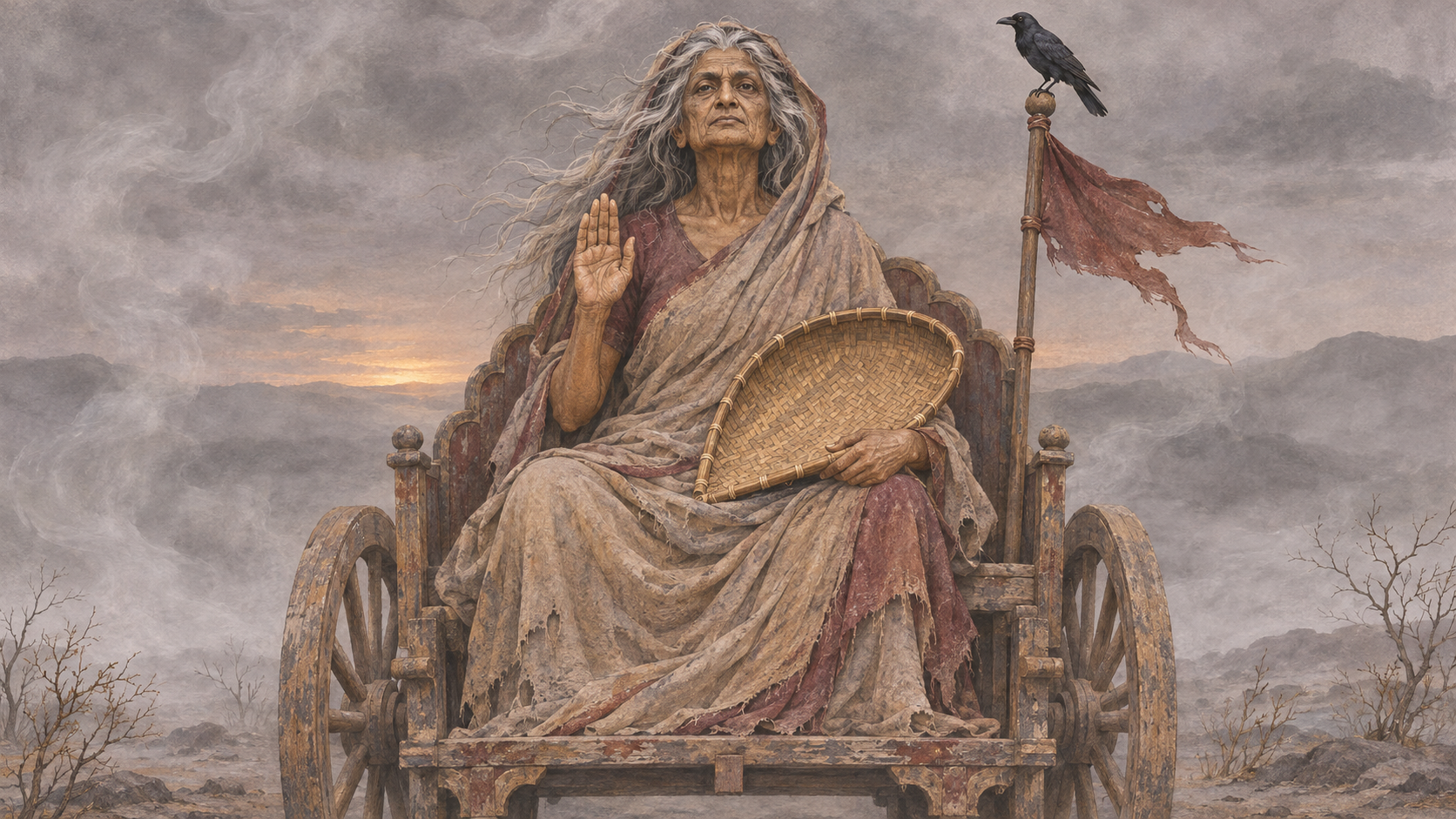
You may have arrived at Dhumavati through an image that feels deliberately uncomfortable: an aged Goddess, without conventional beauty or domestic abundance, accompanied by signs of abandonment and want. If you judge that image by the visual language used for Lakshmi, Saraswati, or a benevolent form of Parvati, you will misread it.
Dhumavati asks you to look at what remains when beauty fades, support disappears, plans fail, and familiar identities no longer protect you. Her iconography does not glorify misery. It makes absence visible so that absence can be faced without being mistaken for the end of sacred reality.
Begin with the iconographic reversal
Dhumavati is one of the ten Mahavidyas, profound forms of Shakti within Shakta and Tantric traditions. The Mahavidyas do not confine the Divine Mother to the pleasant, protective, or socially approved. They disclose divine power through radically different conditions of existence.
Dhumavati’s condition is withdrawal. She is commonly represented as old rather than youthful, widowed rather than accompanied by a consort, plainly or poorly dressed rather than ornamented, and associated with smoke, crows, hunger, and a vehicle that cannot move in the ordinary way. These are not defects that an artist failed to correct. They are the visual teaching.
When reading her image, therefore, do not begin with the question, “Why is this Goddess unattractive?” Ask instead, “What has been deliberately removed?” Youth, adornment, marital status, fertility, comfort, movement, and social approval may all be missing. Yet Shakti is still present. That is the first and most important clue.
This reversal also protects you from a common mistake: treating beauty as proof of divinity and suffering as proof of divine absence. Dhumavati breaks that equation. She appears precisely where ordinary signs of blessing are unavailable.
Read the attributes as a connected visual language
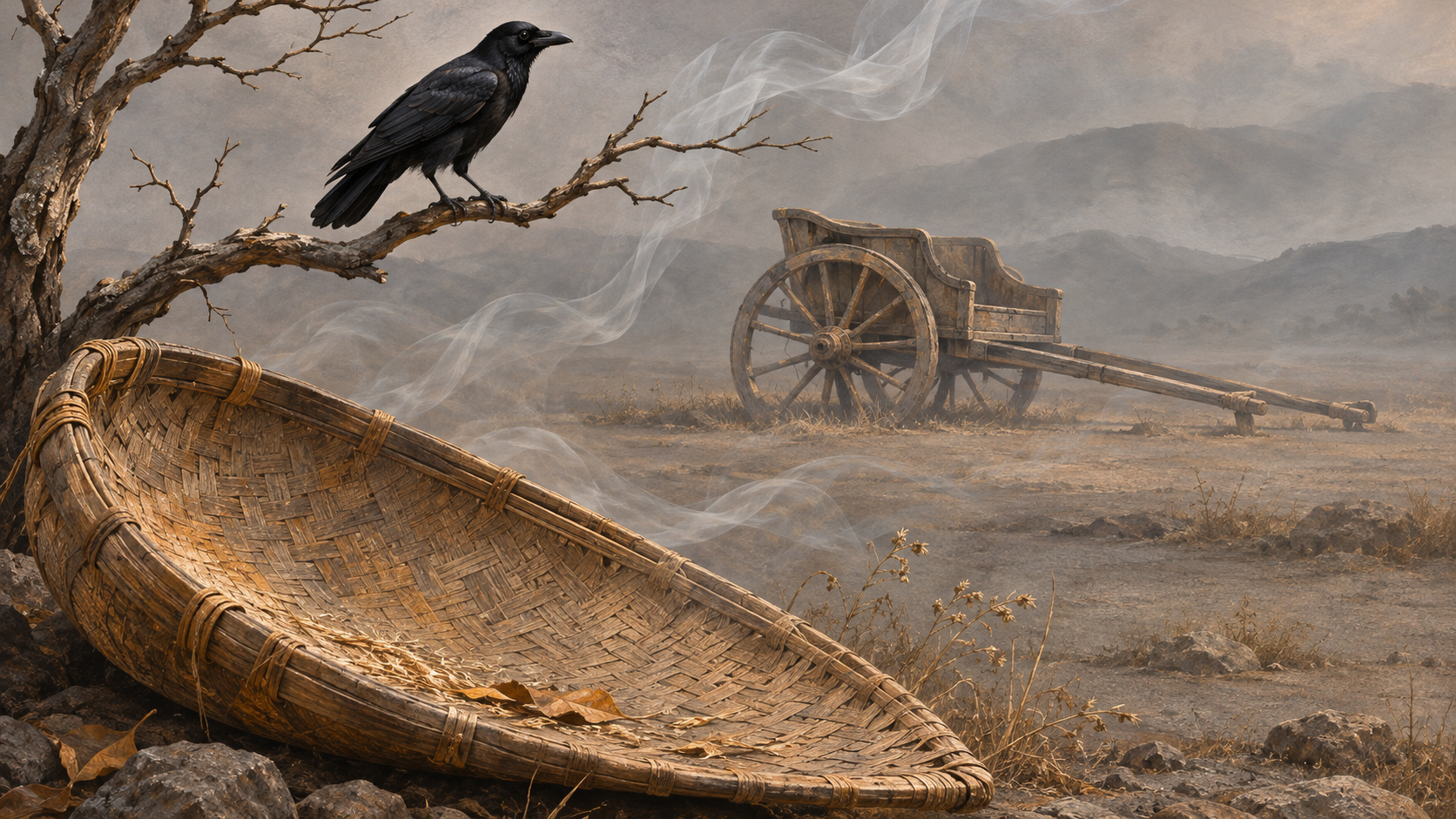
Individual depictions vary, so no single object should be forced into one universal interpretation. Look for the cluster of attributes, confirm the image’s local or lineage context when possible, and then read the elements in relation to one another.
The aged body and worn appearance
Dhumavati’s age removes the reassuring promise that the divine must always appear fresh, fertile, and desirable. Her body belongs to time. It shows change that cannot be reversed by ornament.
This does not make old age itself a punishment, nor does it authorize contempt for elderly women. The image turns a condition society often hides into a form through which Shakti can be encountered. When you see her aged face and worn clothing, notice whether your discomfort comes from the Goddess or from a habit of valuing people according to youth, usefulness, and attractiveness.
Widowhood and the absent consort
Dhumavati is characteristically presented as a widow. Within an iconographic culture in which divine couples often express cosmic complementarity, the missing consort is a powerful absence. She stands without the identity, protection, or auspicious social position conventionally associated with marriage.
Read this carefully. The symbol does not declare living widows impure, spiritually deficient, or deserving of exclusion. It works through an older contrast between auspicious and inauspicious states in order to expose the limits of that contrast. Dhumavati remains Shakti when the socially approved role has fallen away. Her power is not made contingent on a husband.
Smoke and obscured form
Her name evokes smoke. Smoke is difficult to grasp: it has a visible presence, but no stable shape. It can mark what remains after burning, and it can prevent the eye from seeing clearly.
This gives you two related ways to approach the symbol. First, Dhumavati belongs to the residue left after a former condition has been consumed. Second, she represents the interval in which the next form cannot yet be seen. If your old identity has ended but a new one has not formed, smoke is a more accurate image than either total darkness or immediate illumination.
The crow and the horseless chariot
Dhumavati may be shown with a crow emblem and a chariot without horses. The crow survives near what refined society rejects. It directs attention toward remains, margins, and realities people would prefer not to see.
The horseless chariot sharpens the same lesson. A vehicle is present, but its ordinary means of propulsion is absent. There are periods in life when you still possess a position, a plan, or a body capable of action, yet the force that once carried it has gone. The image does not pretend that movement is occurring. It asks you to recognise suspended movement before choosing a new direction.
The winnowing basket
A winnowing basket separates grain from husk. In Dhumavati’s hand, it offers one of the clearest practical interpretations of her iconography: loss can expose a distinction that abundance concealed.
When many supports are available, you can confuse the container with the content, the role with the person, and recognition with worth. Winnowing removes what cannot nourish. The process looks like reduction because it is reduction, but reduction is not always annihilation. Something essential may become discernible only after the lighter covering is blown away.
Sacred emptiness is not nihilism
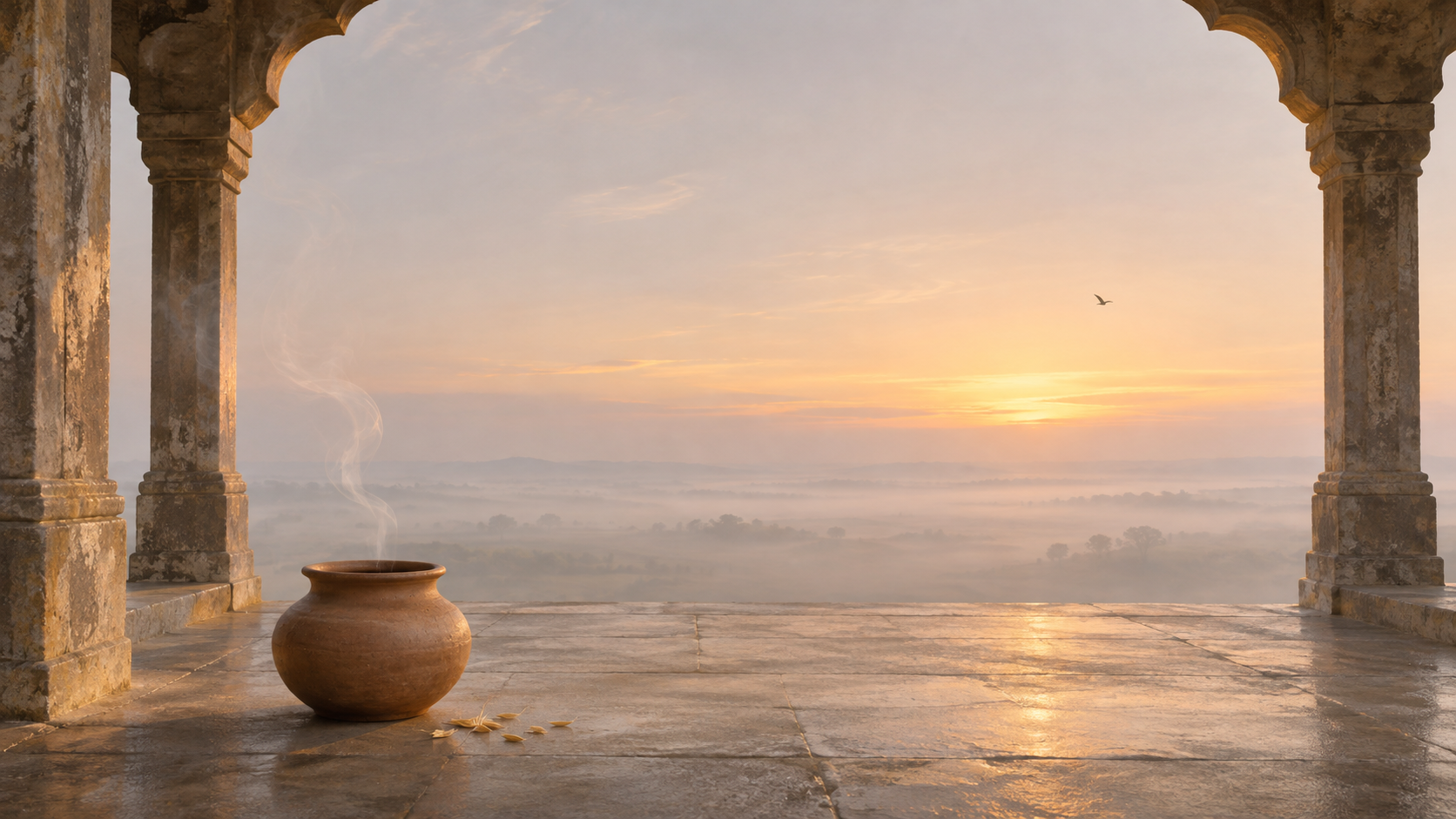
Calling Dhumavati a Goddess of emptiness can create three avoidable misunderstandings. Emptiness here does not mean that nothing exists, that nothing matters, or that despair is a superior spiritual state. It points to the sacred dimension of absence: the reality disclosed when a desired form, relationship, possession, or identity is no longer available.
Her iconography also should not be casually collapsed into Buddhist teachings on shunyata. Hindu and Buddhist traditions may both use the language of emptiness, but they do not automatically mean the same thing by it. Dhumavati’s visual teaching can be understood on its own terms: Shakti is not limited to flourishing forms. The power of reality remains present during deprivation, obscurity, and dissolution.
Nor is Dhumavati an embodiment of moral evil. Fierce or inauspicious imagery does not perform the same function as an evil antagonist. She brings unwanted conditions inside sacred vision. Aging, disappointment, hunger, solitude, and failure are no longer allowed to sit outside the spiritual map.
This is why romanticising her would be another misreading. Actual poverty, bereavement, exclusion, and hunger should not be aestheticised as spiritual gifts. Dhumavati does not require you to call suffering pleasant. Her challenge is more exacting: do not conclude that dignity, awareness, or divine presence has vanished merely because pleasure and social approval have vanished.
A disciplined way to contemplate Dhumavati
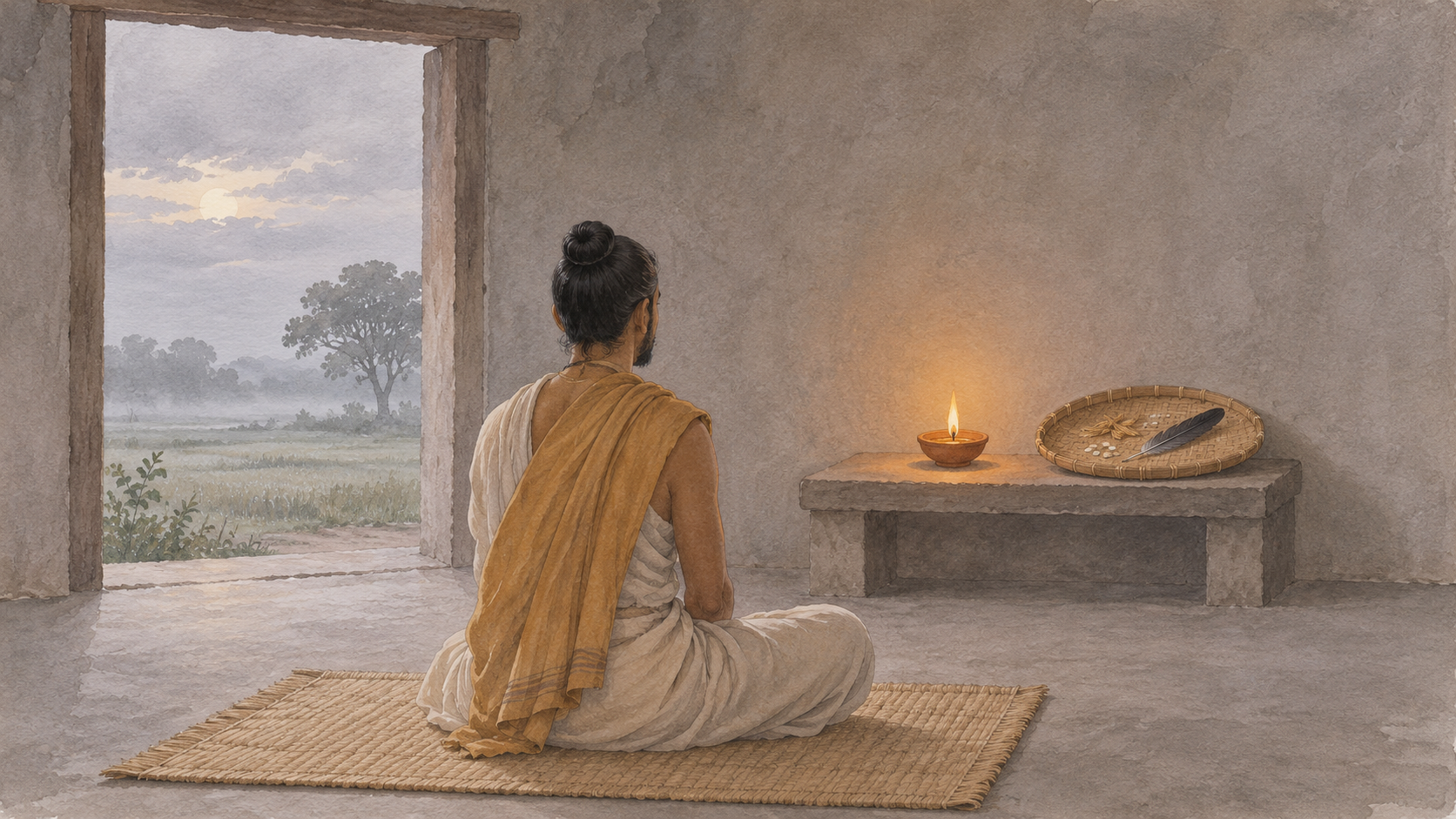
You do not need to invent a ritual in order to learn from the image. Mantra, initiation, and formal Tantric worship belong within the instructions of an appropriate lineage and teacher. For personal reflection, use the iconography as a structured inquiry rather than treating it as a collection of supernatural promises.
- Describe before interpreting. Record only what the image shows: age, clothing, expression, objects, vehicle, animals, gestures, and empty spaces. This prevents an immediate emotional reaction from becoming your entire interpretation.
- Identify the deliberate absences. Ask what you would normally expect in an image of a Goddess but do not find. The missing ornament, consort, youthful body, or active vehicle may carry more meaning than the visible object beside it.
- Name one support you have confused with the self. It might be a role, reputation, plan, possession, or another person’s approval. Do not pretend the support was worthless. Ask the narrower question: if it changes or disappears, what remains true?
- Use the winnowing test. Separate what nourishes from what merely surrounds it. In a lost role, for example, the title may be husk while discipline, knowledge, and responsibility remain grain. The distinction tells you what can be carried forward.
- Allow an unresolved interval. Smoke is an image for obscured vision. You do not have to name the next identity immediately. Refusing a premature answer can be more truthful than replacing one attachment with another.
- Choose one action that respects what remains. Repair a neglected duty, simplify an unnecessary commitment, preserve a useful skill, or sit without seeking external validation. The action should arise from discernment, not from a performance of detachment.
This method is especially useful when an ending has occurred but its meaning is not yet clear. It keeps you from declaring either “everything is ruined” or “everything happens for the best.” Dhumavati permits the more honest middle statement: a former form is gone, the present is obscured, and careful discernment is still possible.
Key takeaways
- Dhumavati reverses conventional divine imagery so that age, want, solitude, and obscurity can be seen within Shakti rather than outside sacred reality.
- Her aged form is not permission to demean elderly women, and her widowhood is not a verdict against living widows.
- Smoke represents an unstable, obscured interval: an old form has ended, while the next form cannot yet be clearly perceived.
- The crow and horseless chariot direct attention toward rejected remains and suspended movement.
- The winnowing basket offers a practical discipline: distinguish what nourishes from the identity, status, or appearance that once surrounded it.
- Sacred emptiness is not nihilism, moral evil, or a demand to romanticise suffering.
- Formal Tantric worship should follow lineage guidance; reflective study can begin by observing what the icon deliberately makes absent.
The next time you encounter Dhumavati, make three simple notes: what is present, what is absent, and what remains. That small discipline changes the image from a frightening curiosity into a demanding form of darshana. It may also show you where your own fear of emptiness has been hiding an unexamined attachment.
Do not rush to fill the space she reveals. First see it accurately. Then winnow what has been lost from what cannot be taken away, and let your next action begin there.
References

Leave a Reply
You must be logged in to post a comment.