
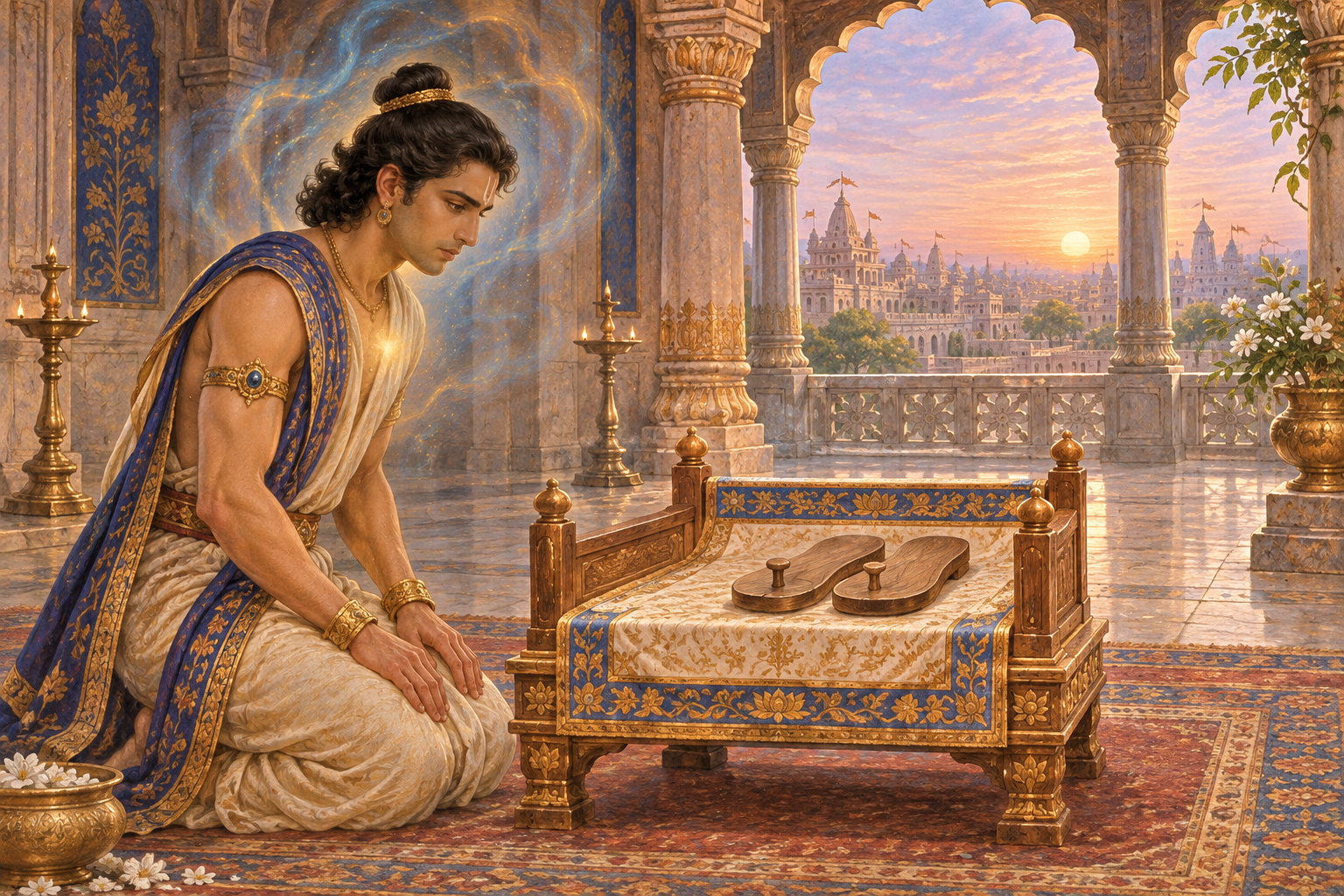
You may know Bharata as the prince who refused to turn Rama’s exile into his own advancement. But if you have encountered the claim that Bharata represents dream consciousness, you may wonder whether it diminishes his loyalty or treats his life as unreal. It does neither.
The key is to understand what Vedanta means by the dream-state subject, taijasa. Bharata shows how an inwardly held reality can govern outward conduct without the mind claiming sovereignty for itself. That makes his example especially useful when your imagination, fear, memory, or ambition begins writing a story ahead of the facts.
Dream consciousness is inward, not meaningless
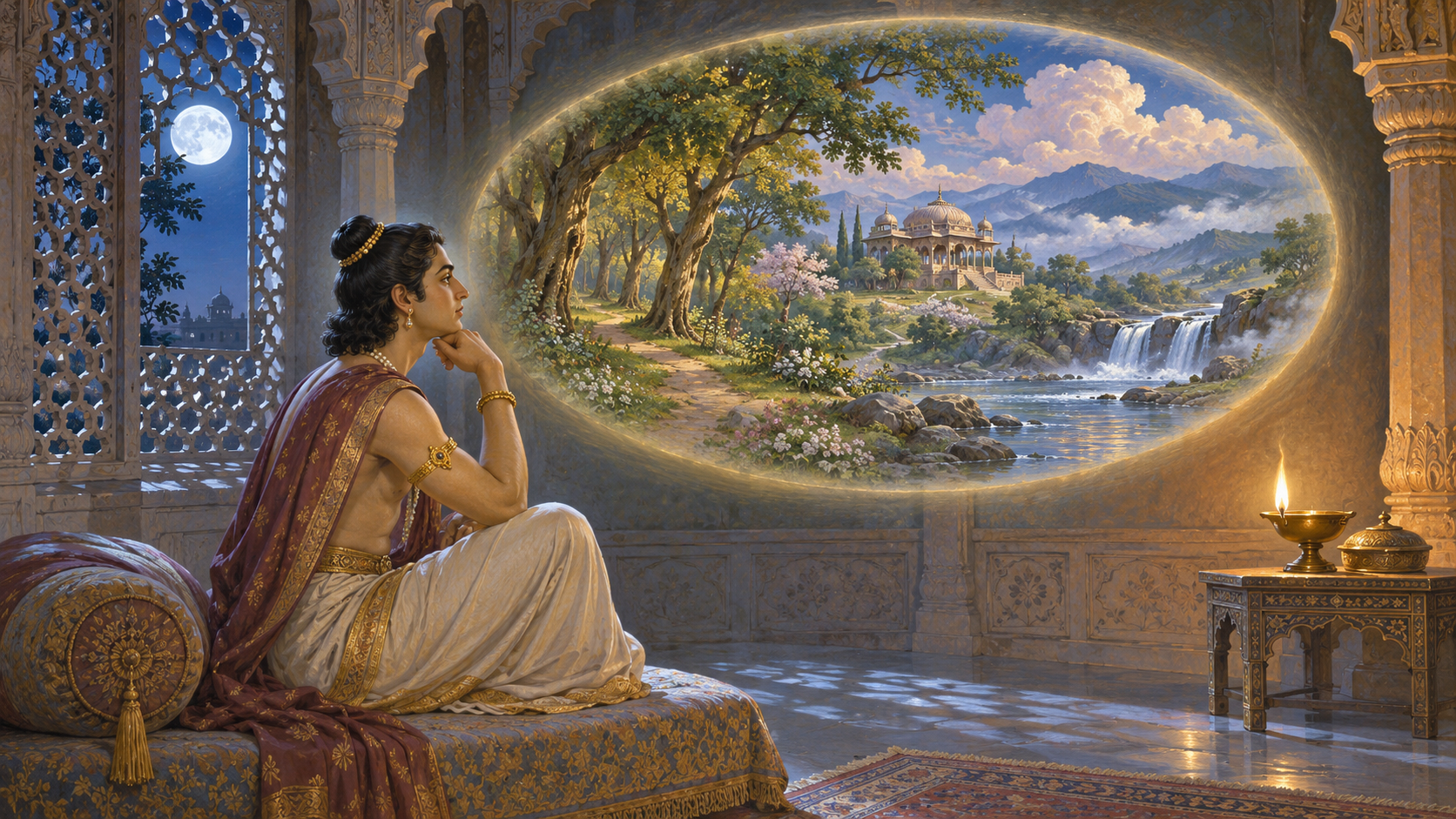
Vedanta distinguishes four states or dimensions of consciousness. Jagrat is waking experience, in which attention is directed toward a world presented through the senses. Svapna is dream experience, in which consciousness encounters an inwardly generated world. Sushupti is deep sleep, where differentiated objects are no longer experienced. Turiya is the awareness that is not confined to any one of the other three states.
Taijasa is the experiencing subject within svapna. In a dream, the mind supplies the setting, objects, relationships, dangers, and desires. The experience is real as an experience, even though its objects do not belong to the shared waking field. This is why taijasa should not be translated casually as a fantasist, an escapist, or someone incapable of seeing reality.
Within the Malayalam Adhyatma Ramayana tradition associated with Thunchaththu Ezhuthachan, the four brothers of Ayodhya are read as a map of the four states of consciousness, with Bharata representing taijasa. This is a contemplative interpretation of the Ramayana, not a claim that every Ramayana tradition must use the same symbolic assignment.
The distinction matters. Calling Bharata taijasa does not mean that his duties are imaginary. It means that the decisive presence in his life is inward. Rama is absent from Bharata’s sensory field, but Rama remains the organizing center of Bharata’s thought, authority, and action.
Key takeaways
- Bharata represents taijasa, the conscious subject of the dream state, rather than idleness or confused fantasy.
- Rama’s physical absence becomes an inward presence that directs Bharata’s outward conduct.
- Bharata accepts responsibility for Ayodhya without treating its sovereignty as his personal possession.
- Rama’s padukas separate the administration of power from the ownership of power.
- The practical lesson is to let thought serve dharma without allowing an inner narrative to crown itself as truth.
Why Bharata is an apt image of taijasa
Bharata’s situation turns on an absence. Rama is not seated in Ayodhya, yet Bharata refuses to behave as if that absence has erased Rama’s sovereignty. He does not permit the visible vacancy to become an inward permission slip for ambition.
Rama remains present within Bharata
Dream consciousness encounters what is inwardly present rather than what is physically available to the senses. Bharata’s life follows a comparable pattern. Rama cannot be seen in the palace, but Bharata’s decisions continue to take their form from Rama. The absent brother is more decisive than the available throne.
This is not ordinary wishful thinking. Wishful thinking changes an inconvenient reality to gratify the thinker. Bharata does the opposite: his inward relation to Rama restrains gratification. It makes his life more demanding. A useful test for your own inner life follows from that contrast: does the image you carry make duty clearer, or does it excuse what you already want?
The padukas prevent an inward coronation
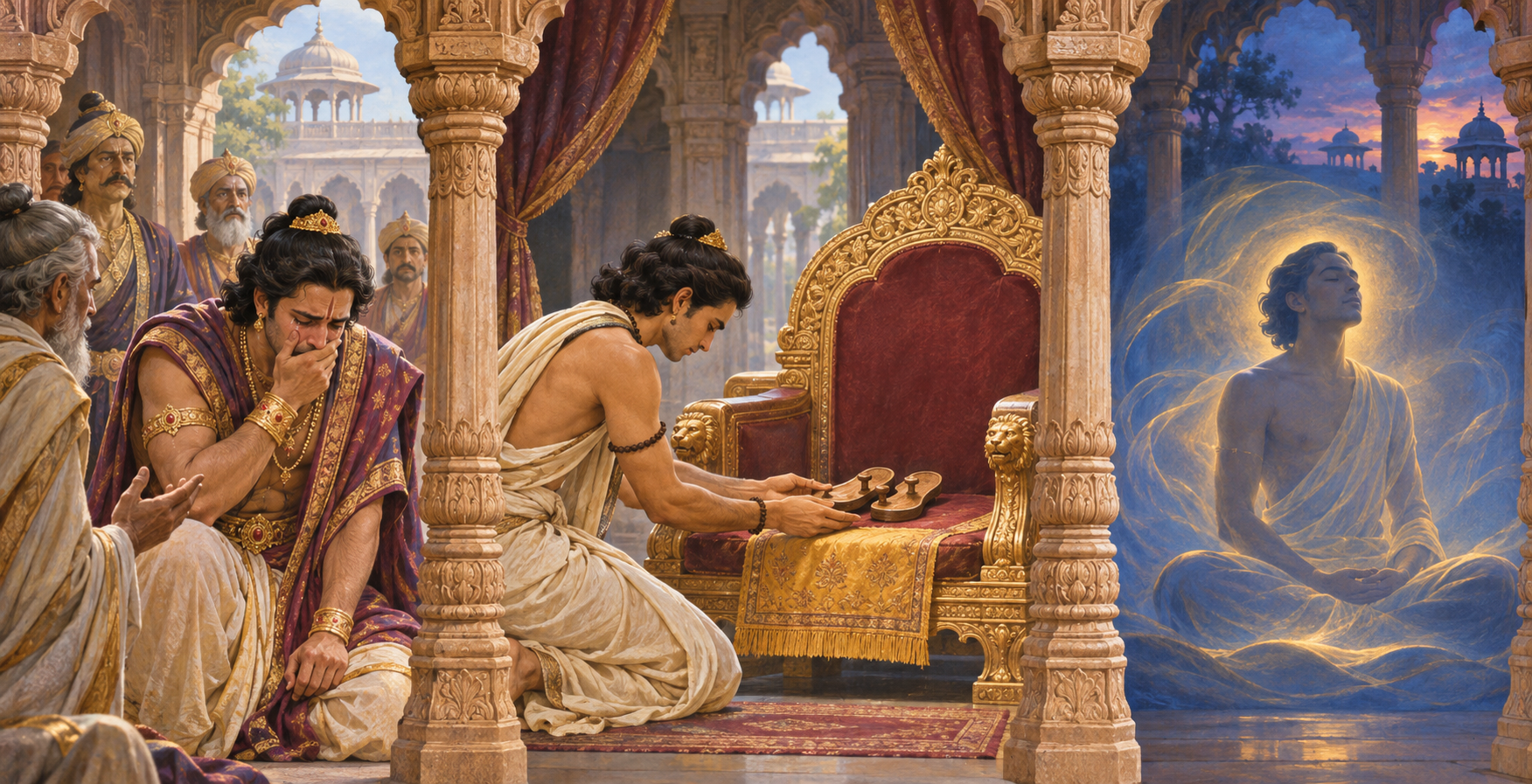
Rama’s padukas on the throne make a subtle principle visible. Bharata can administer the kingdom, but he cannot mistake administration for ultimate ownership. The sign of sovereignty remains outside his ego, even while the work of governance passes through his hands.
The padukas therefore do more than commemorate an absent ruler. Symbolically, they establish a boundary for the mind. Bharata may think, decide, command, and serve, but his thoughts do not become sovereign merely because they arise within him. They remain answerable to a principle he did not invent for his convenience.
You can use the same distinction whenever responsibility and possession become confused. Leading a project does not make its purpose your private property. Caring for a family does not give you ownership of other people. Representing a tradition does not authorize you to bend it around your personality. Bharata’s posture is that of a trustee: fully responsible, but not self-enthroned.
Renunciation does not cancel action
Bharata does not seize Rama’s kingship, but neither does he abandon Ayodhya. He accepts the burden of rule while refusing the identity of the usurping king. This combination is what makes the symbolism useful. Detachment is not neglect. It is action without converting a temporary role into an absolute claim about who you are.
Ask two questions when a role gives you influence: “What must be protected?” and “What am I tempted to appropriate?” The first question reveals duty. The second reveals where the inward dream of status may be taking over.
Keep the story, the psychology, and the Vedanta distinct
A symbolic reading becomes more reliable when you do not force every level into a single claim. Bharata can be understood ethically, psychologically, and metaphysically at the same time. Each level asks a different question.
| Level of reading | What you notice | Question for your own life |
|---|---|---|
| Ethical story | Bharata meets an opportunity for power with loyalty, restraint, and continued service. | What does duty require when I could benefit from another person’s absence? |
| Inner psychology | An inwardly held image of Rama organizes Bharata’s outward choices. | Which memory, fear, ideal, or imagined future is governing me now? |
| Vedantic symbolism | Bharata represents taijasa, the subject moving through an inward world. | Am I mistaking a state of mind for the awareness that knows the state? |
The ethical level prevents the symbolism from becoming vague. Bharata still has a kingdom to protect and obligations to discharge. The psychological level helps you see how an absent person, remembered injury, desired outcome, or feared future can become inwardly present enough to direct behavior. The Vedantic level goes further: even this inward ruler belongs to a state of consciousness and is therefore not the final Self.
That last point prevents a common spiritual mistake. Bharata’s inward fidelity is noble, but taijasa is not identical with Absolute Reality. The contents of a dream change. The dreamer’s standpoint also ends when the state ends. Vedantic inquiry therefore asks you to recognize the awareness to which waking, dream, and deep sleep appear, rather than making any one state supreme.
This reading also blocks three convenient misinterpretations:
- “The world is dreamlike, so obligations do not matter.” Bharata’s response points in the opposite direction: insight deepens responsibility.
- “Renunciation means withdrawing from difficult work.” Bharata relinquishes personal kingship while continuing to govern.
- “A strong inward conviction must be true.” Bharata subjects his inward life to dharma and to Rama’s sovereignty; he does not treat intensity of feeling as proof.
Nor must the allegory displace devotion, literature, or the moral force of the narrative. A symbol becomes fruitful by adding a level of attention, not by declaring every other level invalid.
Use Bharata’s pattern when your mind writes ahead of reality
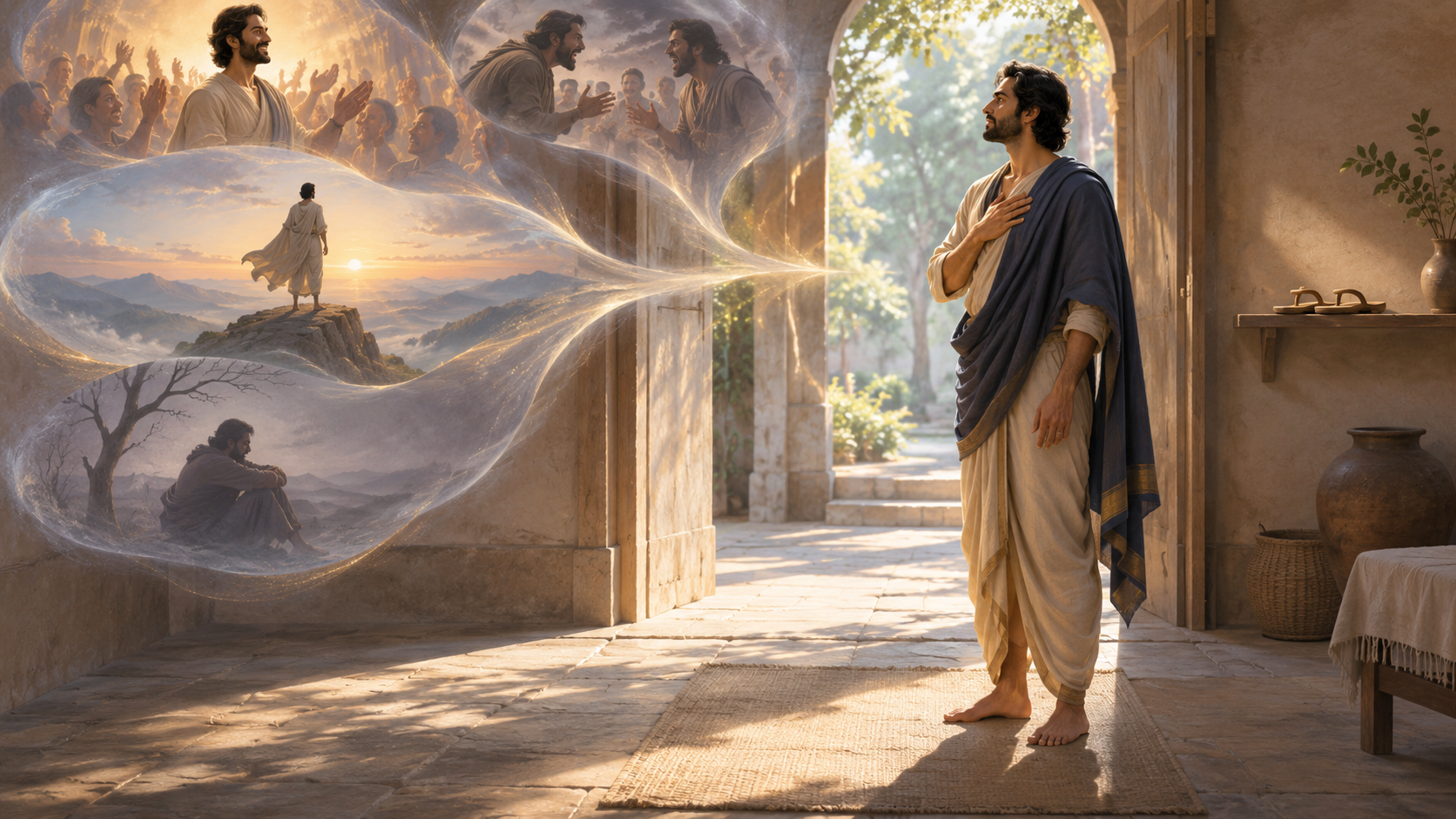
The inward mind is constantly constructing scenes. It replays yesterday, supplies motives to other people, rehearses confrontations, and predicts outcomes. Some of those constructions are useful. Others quietly occupy the throne and begin issuing commands as if imagination were evidence.
You can turn Bharata’s symbolism into a short decision practice. This is an application of the allegory, not a ritual prescribed by scripture.
- Name the waking fact. Write one sentence containing only what was said, done, observed, or formally entrusted to you. Remove assumptions about motives and future outcomes.
- Name the inward scene. Write what your mind is replaying, predicting, fearing, or desiring. Do not condemn it; identify it as mental content rather than established fact.
- Place the padukas. State the dharmic principle, promise, or legitimate responsibility that should remain sovereign. Make it more precise than “do the right thing.” It might be truthful speech, keeping an entrusted confidence, honoring a commitment, or protecting someone dependent on your care.
- Choose the regent’s action. Take the next action that serves the governing principle without pretending to control the whole outcome. Clarify, verify, correct, protect, wait, or speak as the actual duty requires.
- Refuse self-coronation. Do not turn the event into an identity such as “I am the only one who can save this,” “I have been completely dishonored,” or “My fear proves what will happen.” Perform the duty without building a throne for the story.
Suppose a terse message from a relative feels insulting. The waking fact is the exact message. The inward scene may include an imagined intention, an old quarrel, and a future rupture that has not happened. The paduka principle might be truthful speech joined with responsibility for the relationship. The regent’s action could be one direct clarifying question before you accuse, retreat, or recruit others into the conflict. Refusing coronation means not treating “I have been deliberately humiliated” as settled truth before you know it.
The point is not to distrust every thought. Bharata’s inward orientation is powerful precisely because it produces disciplined action. The point is to distinguish an inner representation that serves dharma from an inner drama that serves possession, resentment, or vanity.
Use the same four headings at your next consequential choice: waking fact, inward scene, governing principle, next duty. If the scene changes while the principle remains sound, let the principle rule. Your mind may generate the kingdom it experiences, but it does not have to seize the throne.
References

Leave a Reply
You must be logged in to post a comment.