
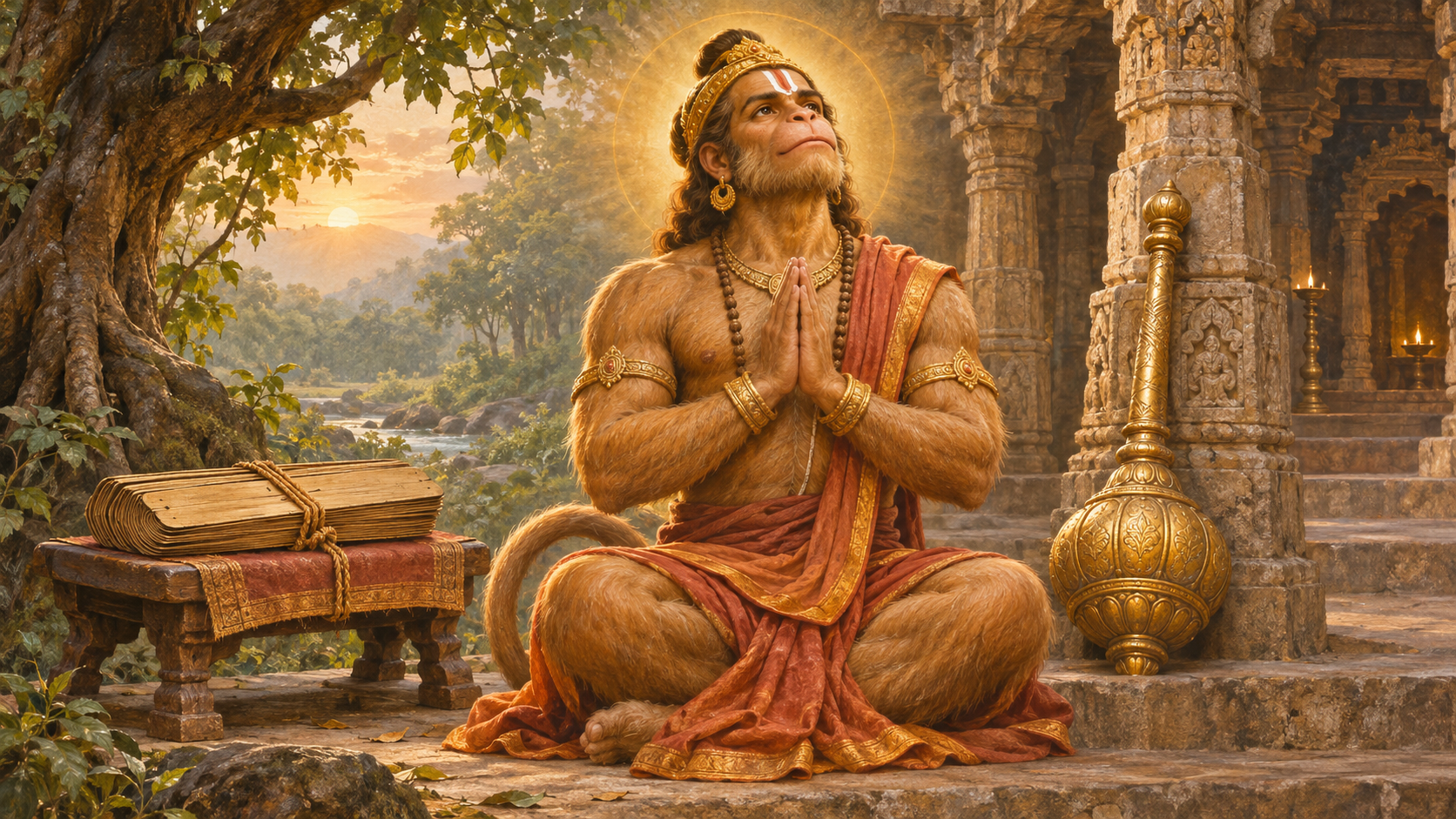
If you have been told that every detail in a familiar murti comes directly from the Valmiki Ramayana, Hanuman’s gada offers a useful test. The answer is not that the image is wrong. Scripture and iconography are making different kinds of statements.
If you are asking whether Valmiki explicitly presents Hanuman as the permanently mace-bearing figure familiar from temple sculpture and calendar art, you should not make that claim. If you are asking whether the gada is a meaningful and legitimate part of Hanuman’s devotional iconography, the answer is yes. You can preserve both textual accuracy and the integrity of the sacred image without forcing one to imitate the other.
The short answer depends on what you are asking
The question “Did Hanuman carry a gada?” sounds simple, but it can mean at least three different things. Separate them before accepting or rejecting an answer:
- Narrative question: Does a named scripture describe Hanuman carrying or using a gada in a particular episode?
- Iconographic question: Is the gada a conventional attribute by which worshippers recognize Hanuman?
- Devotional question: What does the gada communicate about Hanuman’s strength, readiness and service to dharma?
These questions require different evidence. The first calls for a passage in a specified text. The second can be answered by examining established forms of representation. The third involves theological and devotional interpretation.
Confusion begins when popular memory compresses all three into one claim. An image seen repeatedly in temples, books and homes starts to feel like a direct quotation from scripture. Familiarity, however, does not identify where a detail originated. A sacred image can be faithful to Hanuman’s character without functioning as a literal inventory of everything he carries in a particular narrative.
What the Valmiki Ramayana does and does not establish

The Valmiki Ramayana should not be cited as though it consistently introduces Hanuman with the shoulder-borne gada that now identifies him at a glance. The familiar mace-bearing form is deeply embedded in devotional hymns, temple sculpture and popular art, but that prominence does not by itself turn the gada into a constant piece of equipment explicitly assigned to him by Valmiki.
Keep the conclusion narrow. It is reasonable to say that the popular, permanently mace-bearing image should not automatically be projected back into Valmiki’s narrative. It is not reasonable, on that basis alone, to declare that no Ramayana tradition, later text, regional retelling or devotional convention ever associates Hanuman with a mace. A conclusion about one named work is not a conclusion about the whole Dharmic inheritance.
This distinction also prevents a second error. You should not change a claim about a constant iconographic attribute into the much larger claim that Hanuman could never have handled any mace in any account. Words such as always, never and only demand more evidence than recognition of the familiar image can provide.
When teaching or writing about the subject, keep the grammar honest:
- Valmiki narrates should be followed by a verifiable passage or episode.
- Hanuman is conventionally depicted identifies a practice of sacred art.
- The gada can be understood as signals a devotional interpretation rather than a quotation from the narrative.
That small change in wording lets your listener know exactly what kind of claim you are making.
Iconography is visual theology, not a weapons inventory
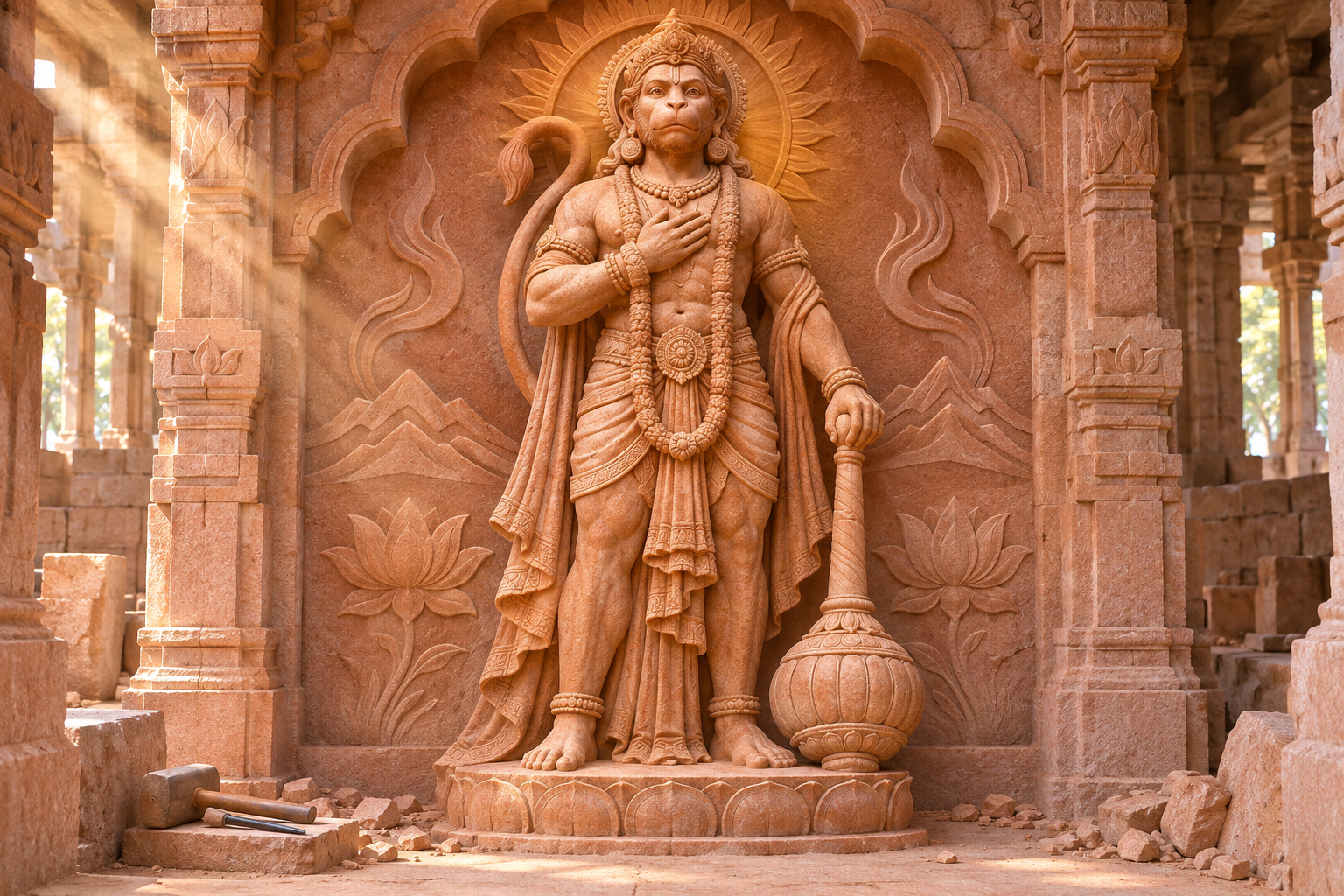
A murti or painted form does not have to reproduce one frozen moment from a story. Sacred iconography condenses identity, virtues and relationships into visible form. An attribute may tell you who stands before you and how that being should be contemplated, even when the image is not illustrating a named episode.
The gada works effectively in this visual language because it immediately communicates formidable strength and readiness for action. In Hanuman’s hand, however, force is not the final message. His power is governed by devotion, directed toward service and placed at the disposal of Rama and dharma. The weapon therefore invites a devotional reading of disciplined strength rather than aggression for its own sake.
That is an interpretation of the image, not a claim that Valmiki supplies a verse defining every part of it. The distinction matters. It allows you to receive the spiritual meaning of the form without manufacturing a scriptural citation for it.
It also helps to distinguish an iconographic attribute from a narrative object. An iconographic attribute belongs to a recognizable representation of a deity or sacred personality. A narrative object is something mentioned or used in a described event. The same object can be both, but it does not have to be. Hanuman’s gada can identify and interpret him in sacred art without every such image claiming to reconstruct a scene from the Valmiki Ramayana.
A four-step test for captions, talks and classroom claims
If you are preparing a temple caption, social-media explanation, school lesson or discussion of Hanuman imagery, use this sequence:
- Name the field of the claim. Are you discussing the Valmiki Ramayana, another retelling, a hymn, a temple image or the symbolic meaning of the gada? Do not let the word tradition hide which one you mean.
- Ask for the textual anchor. If someone says Valmiki describes the gada, ask for the passage and the translation being used. If no passage is available, relabel the statement as iconographic convention or devotional interpretation.
- Read the image as an image. Notice whether Hanuman rests the gada on his shoulder, holds it ready or simply stands beside it. Such choices help communicate strength, availability and composure; they need not depict a specific instant in the epic.
- State only the conclusion your evidence supports. Say that Hanuman is conventionally represented with a gada. Do not silently expand that into a universal statement about every scripture and retelling.
Two corrections are especially useful. Replace the overclaim Valmiki always shows Hanuman carrying a gada with Hanuman is conventionally depicted with a gada, although this familiar constant attribute should not automatically be attributed to Valmiki’s narrative. Replace the overcorrection the gada image is therefore false with an iconographic attribute does not require a matching narrative scene in order to carry devotional meaning.
This method protects your audience from a false choice. They do not have to choose between respecting scripture and respecting living iconography.
Questions devotees commonly ask
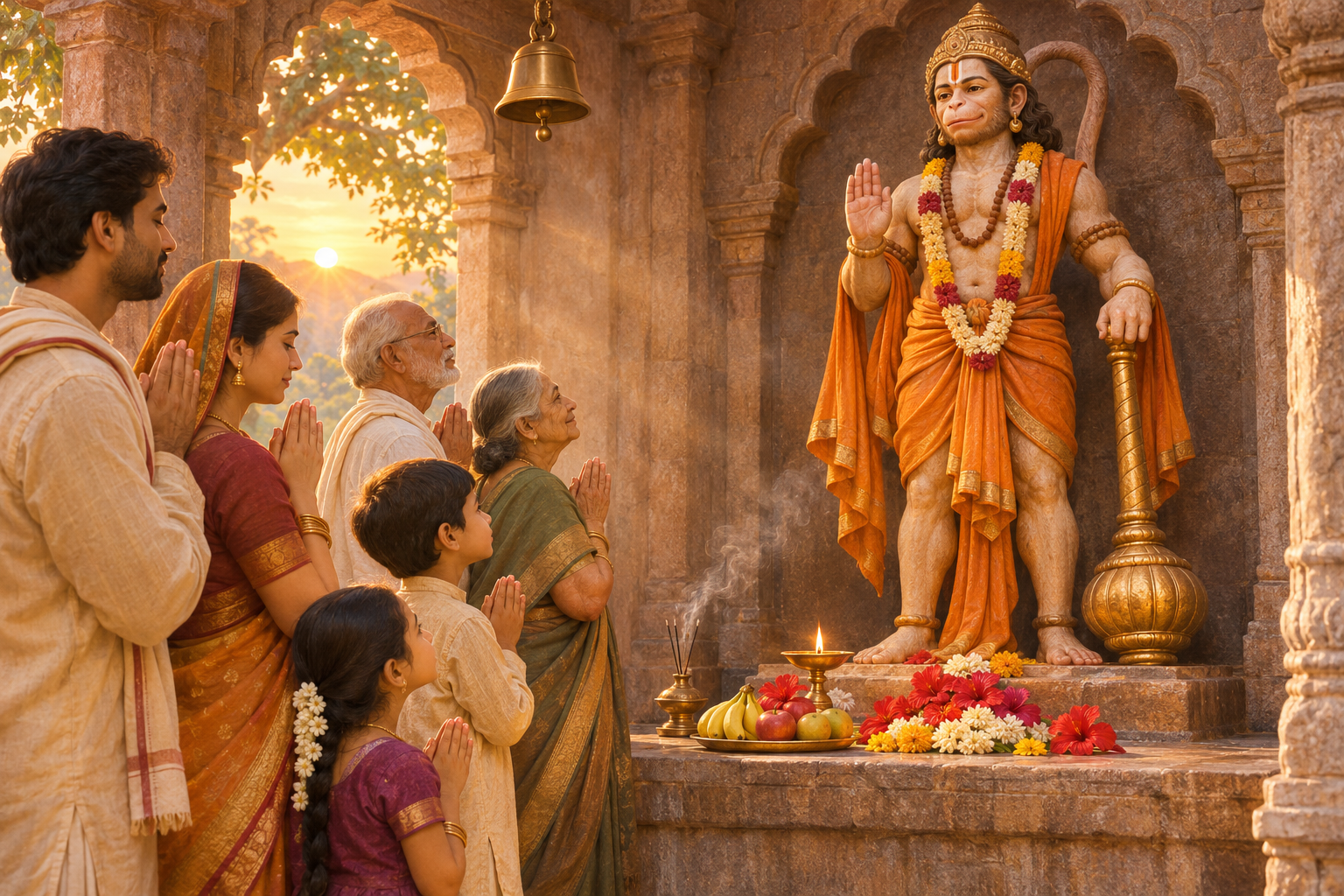
Does the absence of a constant gada in Valmiki make the familiar murti inauthentic?
No. A murti can express Hanuman’s identity and virtues through established visual language without claiming to reproduce one passage word for word. Textual description and sacred representation are related, but they are not identical forms of communication.
Can we say that Hanuman never used a mace?
Not on the strength of this distinction alone. That statement ranges across more texts and traditions than a conclusion about Valmiki’s portrayal can support. Name the work you mean and check the relevant passage before using an absolute term.
What is the safest one-sentence explanation?
Hanuman’s gada is a prominent devotional and iconographic attribute, but it should not be treated automatically as a constant possession explicitly assigned to him in the Valmiki Ramayana.
Does this distinction diminish the gada’s spiritual meaning?
No. It clarifies where that meaning is being expressed. You can contemplate the gada as disciplined strength in service of Rama and dharma while remaining precise about what a named scripture actually narrates.
The next time you encounter Hanuman with his gada, ask what kind of truth the image is communicating before demanding a matching line of narrative. When you discuss it, name the text, the artistic convention or the devotional interpretation you mean. That single habit will make your account both more faithful and more useful.
References

Leave a Reply
You must be logged in to post a comment.