
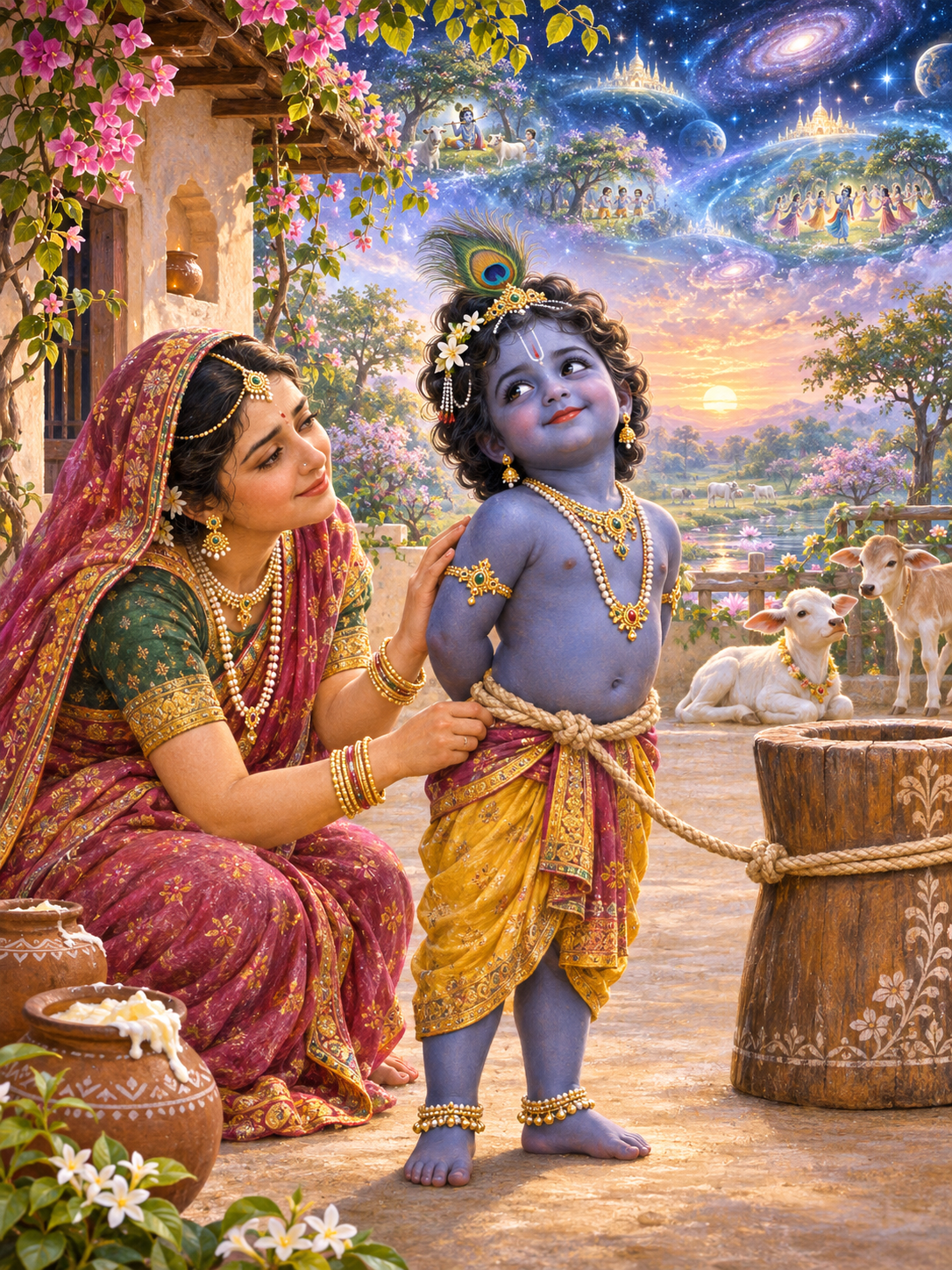
You may know the image of child Krishna bound by Mother Yashoda, yet the final stanza of the Damodarastaka can still feel unexpectedly dense. In four lines, your attention moves from a rope to the universe, from Radhika to the unlimited play of Bhagavan. If you chant the words as a list, that movement is easy to miss.
The practical key is to treat the stanza as a sequence of bows. Each line enlarges what you are seeing without leaving the intimacy of Damodara behind. Once you follow that sequence deliberately, Text 8 becomes a compact lesson in how bhakti holds reverence, affection, relationship and surrender together.
Read the stanza as four movements of surrender
namas te ‘stu dāmne sphurad-dīpti-dhāmne
Śrī Dāmodarāṣṭaka, Text 8
tvadīyodarāyātha viśvasya dhāmne
namo rādhikāyai tvadīya-priyāyai
namo ‘nanta-līlāya devāya tubhyam
The repeated namas and namo tell you what the verse is doing: it is bowing. It does not end by bargaining for a result. Its grammar is the grammar of reverence.
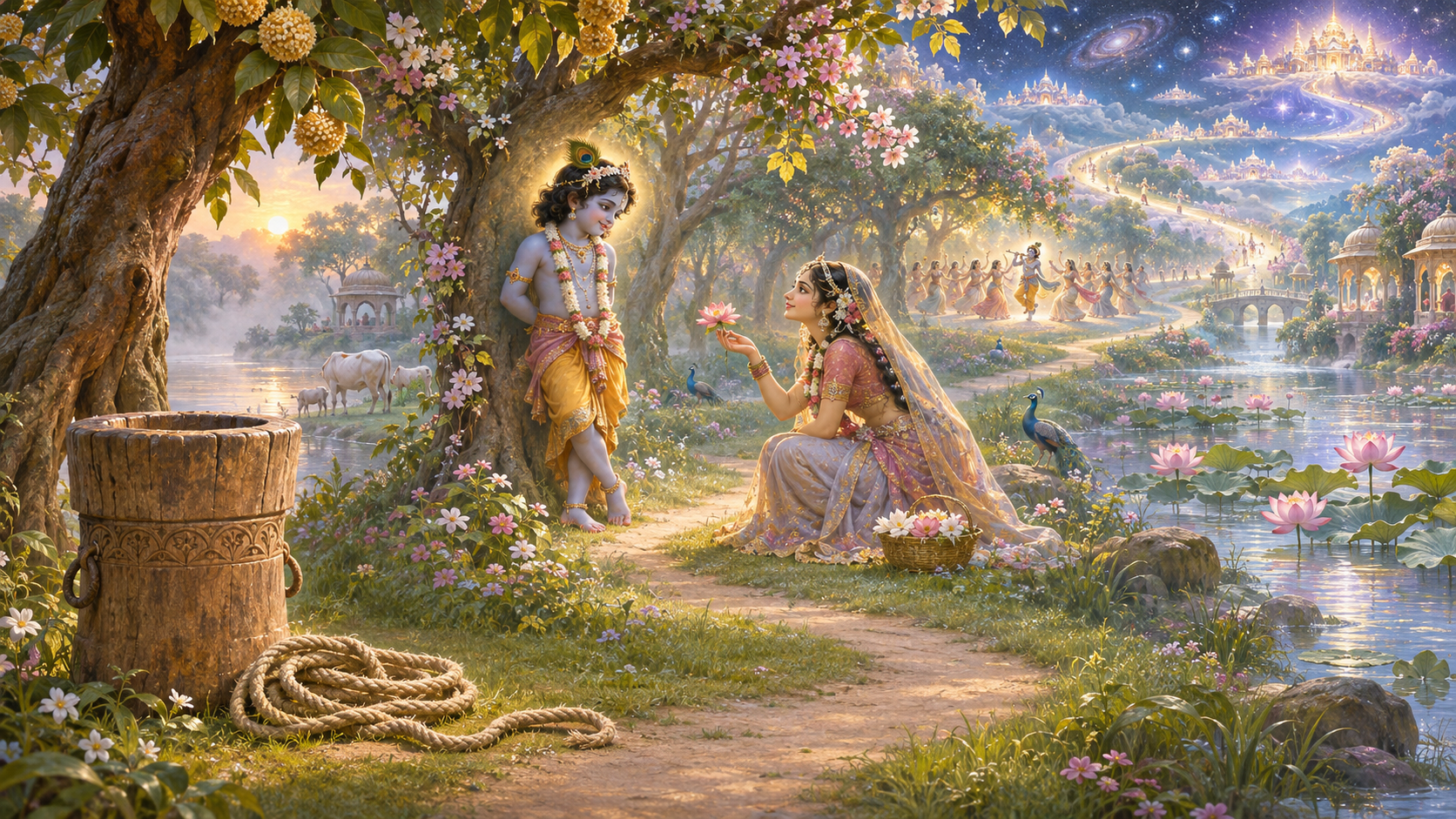
- The shining rope: The first line bows to the rope around Damodara, described in relation to radiant splendor.
- The abdomen that contains the universe: The second line turns from the rope to the apparently impossible reality of whom it binds.
- Radhika, Krishna’s beloved: The third line offers a distinct salutation to the person dearest to him.
- The divine possessor of unlimited lila: The final line bows directly to Bhagavan, whose pastimes cannot be exhausted.
Keep those four movements distinct when you chant. The rope is not merely another name for the abdomen, Radhika is not a decorative reference, and infinite lila is not an abstract afterthought. Each is a new object of attention. The progression carries you from something concrete and visible into a mystery without limit.
The rope is not an embarrassment to explain away
Ordinary reasoning associates divinity with unrestricted power: if someone can be tied, that person must not be supreme. Damodara-lila refuses that equation. Bhagavan’s willingness to be bound within a loving relationship does not cancel his sovereignty. It reveals a kind of sovereignty that is not threatened by intimacy.
This is why the stanza does not hurry past the rope. It bows to it. The rope has become venerable through its place in the lila and its contact with Damodara. You therefore lose something important if you reduce it to a generic symbol of human bondage. The hymn directs attention to this rope, this relationship and this act of loving restraint.
That distinction changes how you look at devotional practice. A lamp, a wick, a flower, a vessel or the voice with which you chant may appear ordinary when considered only as material objects. Their importance lies in how they are offered and whom they serve. The lesson is not that every object is automatically sacred in the same way. It is that bhakti teaches you to notice relationships that material description alone cannot disclose.
When you reach dāmne, do not picture coercion or punishment. Hold the specific devotional paradox before you: the unlimited Lord accepts the position of one who is bound. Let the rope remain a rope. Its force comes from the lila, not from replacing it with a more comfortable abstraction.
Do not choose between majesty and intimacy
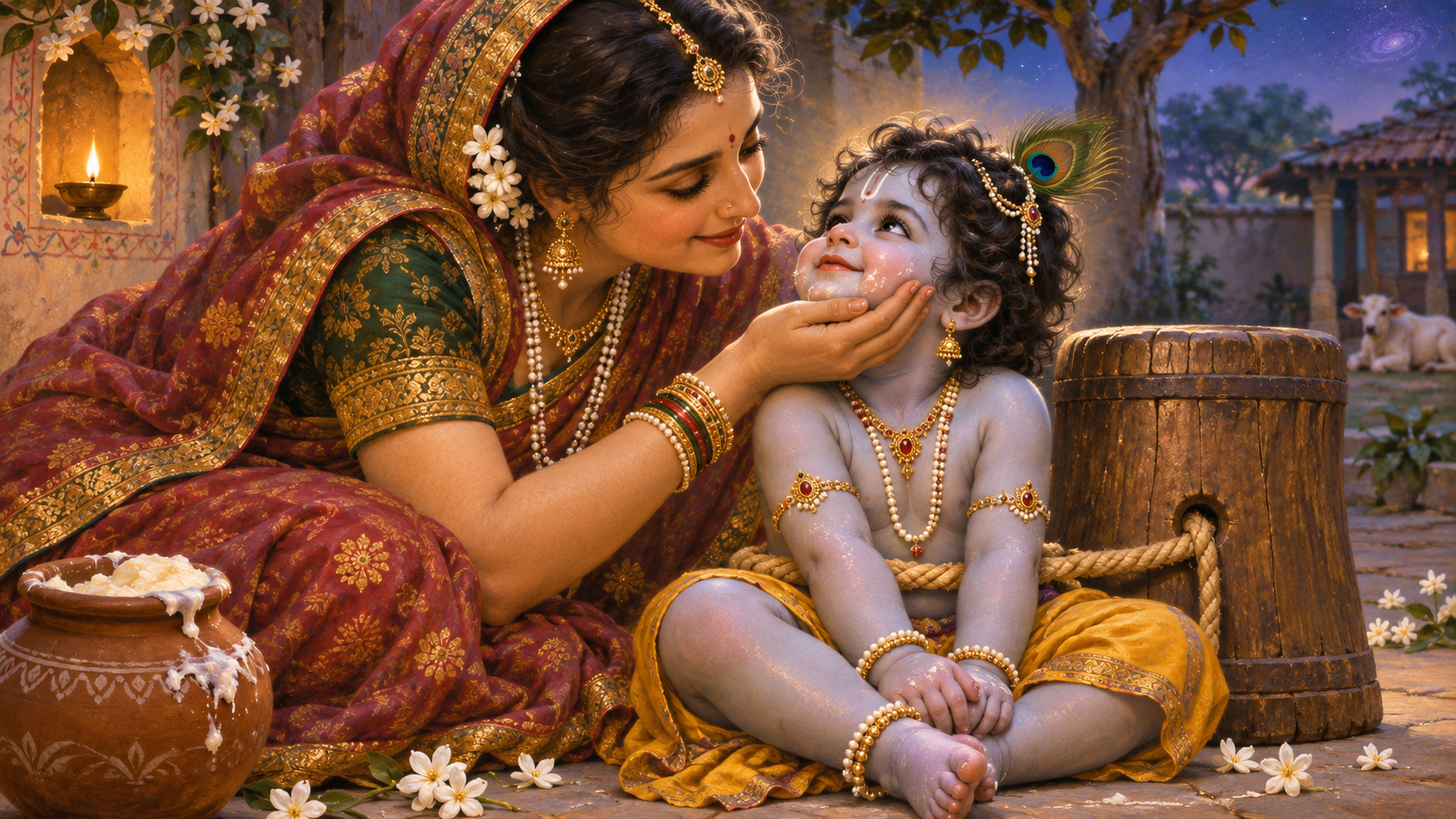
The next line makes the paradox sharper. The abdomen encircled by the rope is addressed as the abode of the universe. The stanza places the small domestic scene and the cosmic vision beside each other, asking you to hold both without allowing either to erase the other.
Vaishnava devotional language often distinguishes aiśvarya, awareness of divine majesty, from mādhurya, the sweetness of intimate relationship. Text 8 gives you both in a single movement. The abode of the universe evokes majesty; the rope around the abdomen preserves intimacy.
If you retain only majesty, Krishna can become remote: an object of formal respect who is never allowed to enter the household of the heart. If you retain only sweetness, the scene can shrink into a charming childhood story whose divine depth no longer commands surrender. The stanza protects you from both reductions.
It also prevents a common misreading. The line is not asking you to imagine that a finite rope physically encloses the universe or to construct a cosmological mechanism around the image. It asks you to contemplate who has accepted the rope. The devotional astonishment lies in the coexistence of realities that our usual categories would keep apart.
Use the words themselves to preserve the tension. At viśvasya dhāmne, allow your attention to widen toward the cosmic. Then remember that this immeasurable reality is still the same Damodara lovingly bound before Yashoda. Do not rush to solve the paradox. Remaining attentive to it is part of the meditation.
Radhika shows that divine love is personal and relational
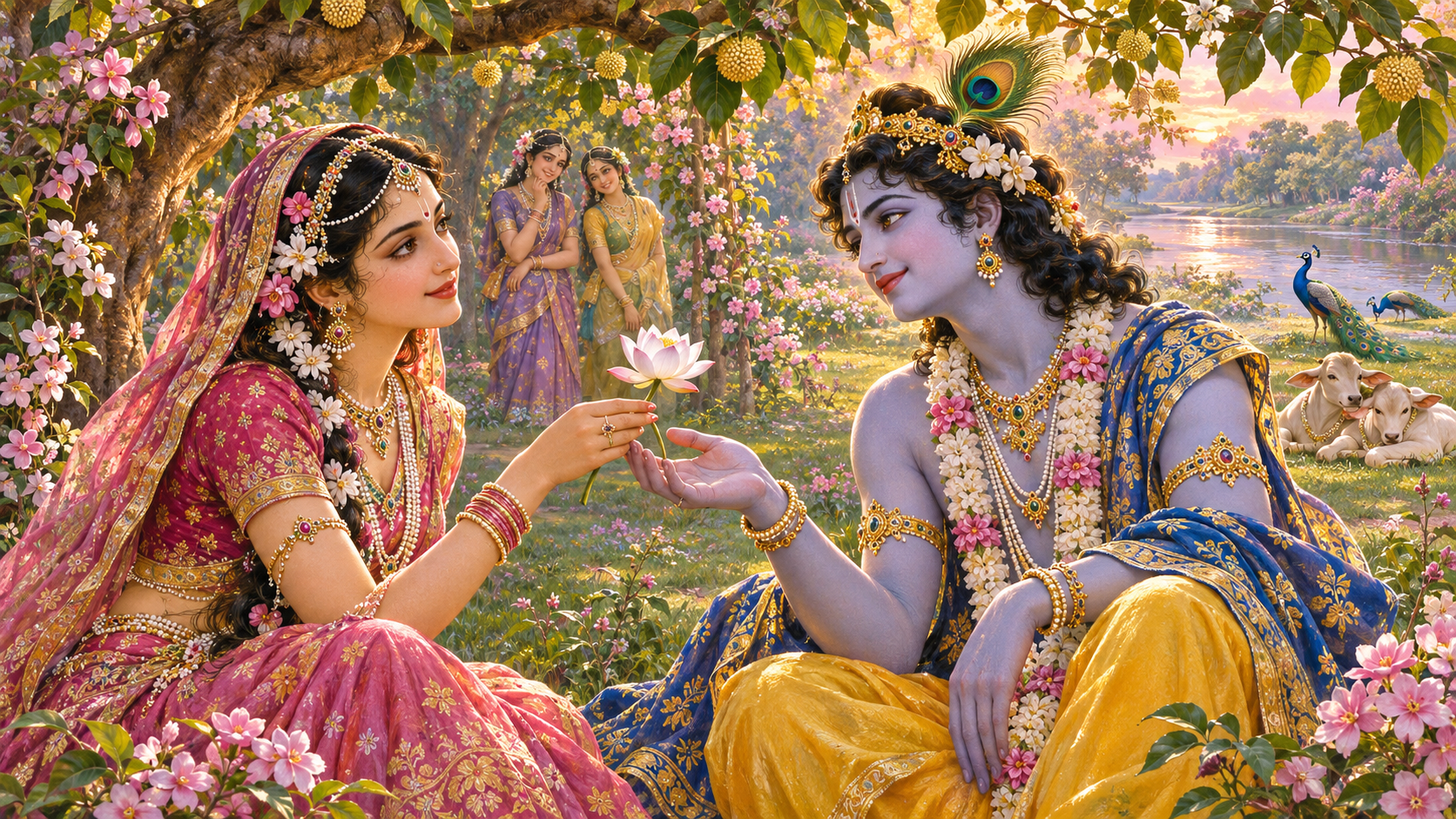
The third line turns explicitly to Radhika and identifies her through her relationship with Krishna: she is his beloved. Her appearance near the close is not an ornamental addition to a prayer otherwise concerned only with Damodara. The separate salutation tells you that the beloved of Bhagavan is herself to be approached with reverence.
Notice the relational language. The stanza does not present divinity as an isolated absolute stripped of names, affection and personal bonds. The rope matters through its relation to Damodara. The abdomen matters because it is his and is the abode of the universe. Radhika is addressed as his beloved. Lila itself is relationship in movement.
This is also why reducing Radhika to a vague symbol of love is inadequate. A symbol can be absorbed into whatever meaning the reader prefers. The verse names and bows to Radhika. It asks you to encounter love as personal, directed and worthy of service, not merely as an emotion occurring inside your own mind.
When chanting in a familiar melody, the third line can easily become a bridge between the cosmic image and the final salutation. Resist that habit. Pronounce rādhikāyai and priyāyai distinctly. Let the salutation reach its intended recipient before moving on.
The final line then bows to the divine Lord of unlimited lila. This is a fitting conclusion because it does not pretend that the hymn has exhausted its subject. Your recitation reaches an ending, but Bhagavan’s lila does not. The proper response to that difference is not frustration. It is renewed willingness to hear, remember and serve.
A deliberate way to chant Text 8
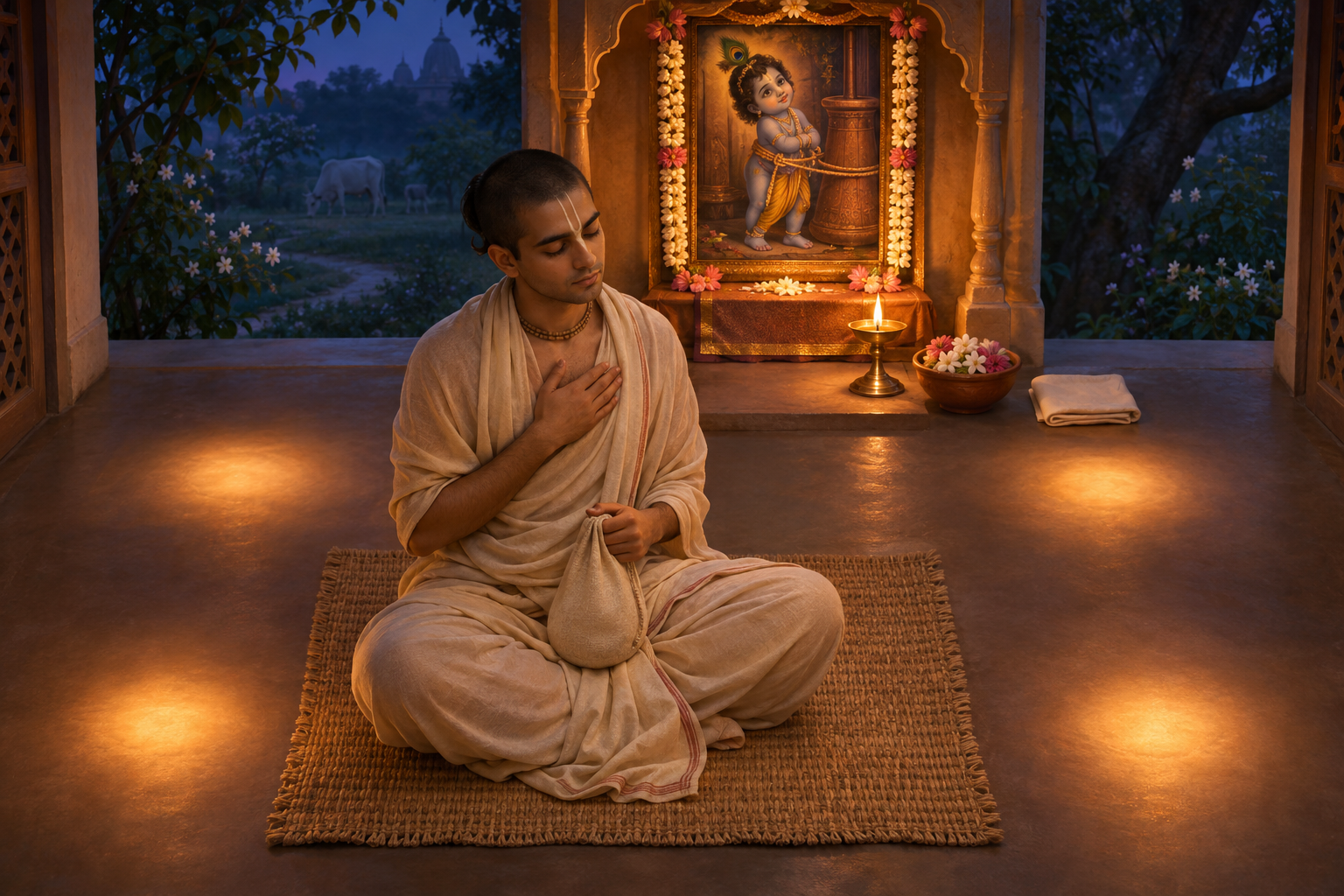
Before singing the whole hymn at your usual pace, recite this stanza once without melody. Melody can sustain devotion, but familiarity can also carry the mouth past words the mind has stopped hearing. A plain reading helps restore the structure.
- Begin with the visible: At dāmne, attend to the rope around Damodara rather than substituting a general idea of bondage.
- Widen the vision: At viśvasya dhāmne, remember that the bound abdomen is addressed as the abode of the universe.
- Make the relational turn: At rādhikāyai, bow inwardly to Radhika instead of treating her name as a transition.
- Release the demand to comprehend everything: At ananta-līlāya, acknowledge that divine lila exceeds the limits of your present understanding.
- Recite the stanza again as direct address: After clarifying the sense, stop analyzing while you chant. Say the words to those being addressed.
If Sanskrit is unfamiliar, slow down enough to keep the four sense-units intact. Speed is not evidence of absorption. In group chanting, listen for where the line ends and avoid swallowing Radhika’s name or the final tubhyam, which directs the bow toward “you.” Clear attention is more useful than forcing an emotional state.
You can test whether the recitation remained attentive without judging the intensity of your feelings. Afterward, ask whether you can recall the movement: rope, cosmic abdomen, Radhika, infinite lila. If one element disappeared, give that line particular attention the next time. This is a practical correction, not a verdict on your devotion.
Key takeaways
- Text 8 moves from the shining rope to the abdomen that is the universe’s abode, then to Radhika and finally to Bhagavan’s unlimited lila.
- The rope reveals loving intimacy; the cosmic abdomen reveals divine majesty. The stanza asks you to hold both together.
- Radhika receives a distinct salutation as Krishna’s beloved, so her line should not be rushed or reduced to symbolism.
- The repeated act of bowing makes the verse an exercise in surrender rather than a request for a reward.
- For your next recitation, pause at each line long enough to know exactly whom or what you are addressing.
The next time you chant Damodarastaka, make one modest change: do not let the melody carry you across Text 8 automatically. Follow its widening vision line by line. Begin with the rope, bow to the mystery it encircles, give Radhika’s name its full attention, and let the final words leave you facing a lila that remains inexhaustible.
References

Leave a Reply
You must be logged in to post a comment.