
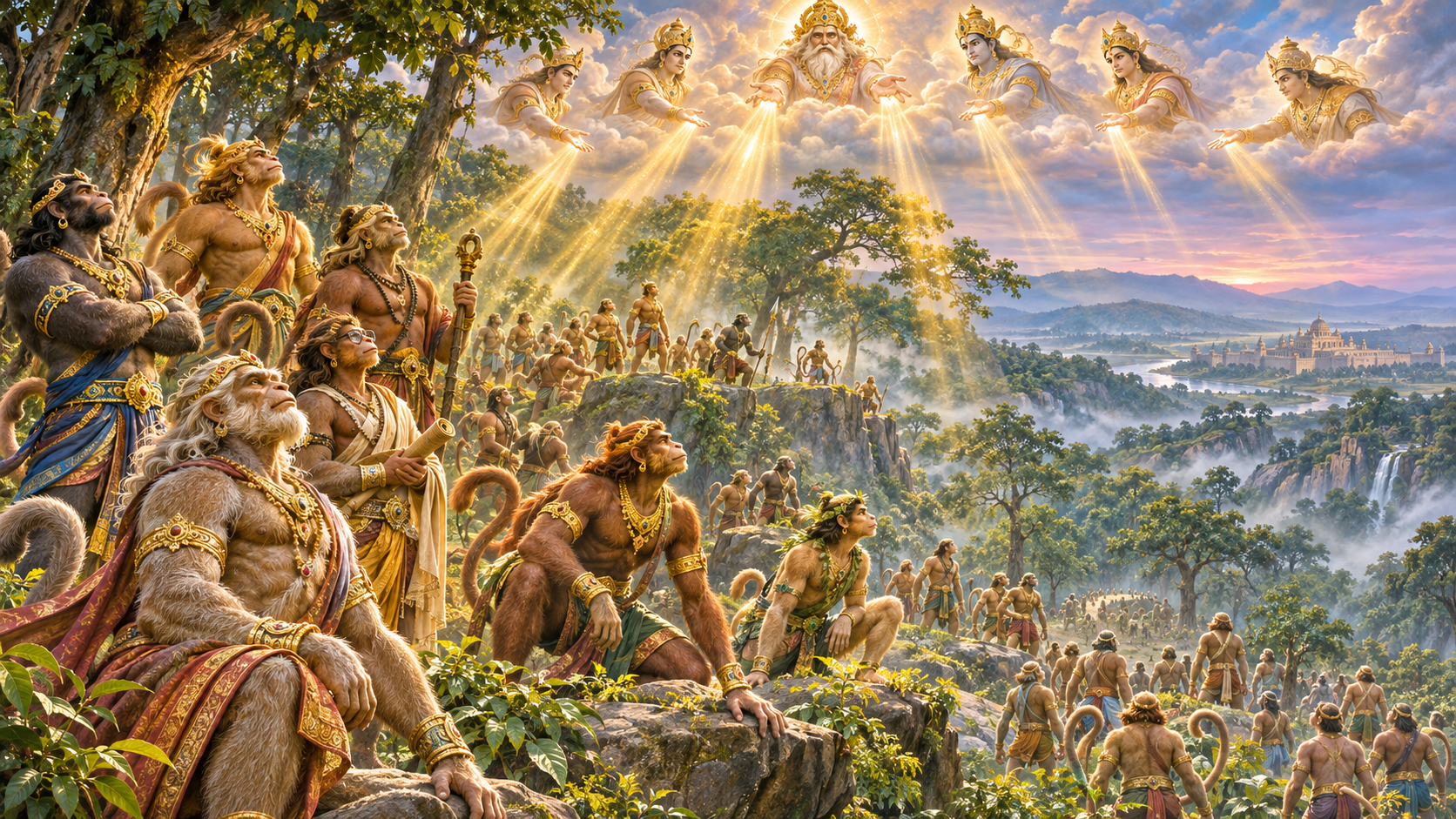
If you are wondering why the Vanaras become so important to Rama’s mission, begin before Rama is born. Bala Kanda places their origin at that earlier moment, and the sequence is the key to understanding them.
The Vanaras do not enter the Ramayana as last-minute reinforcements. They are brought into existence as part of the response to Ravana’s oppression. Once you notice that timing, their later alliance with Rama looks less like a convenient turn in the story and more like the fulfilment of a purpose already set in motion.
The direct answer: the Vanaras were born to assist Rama
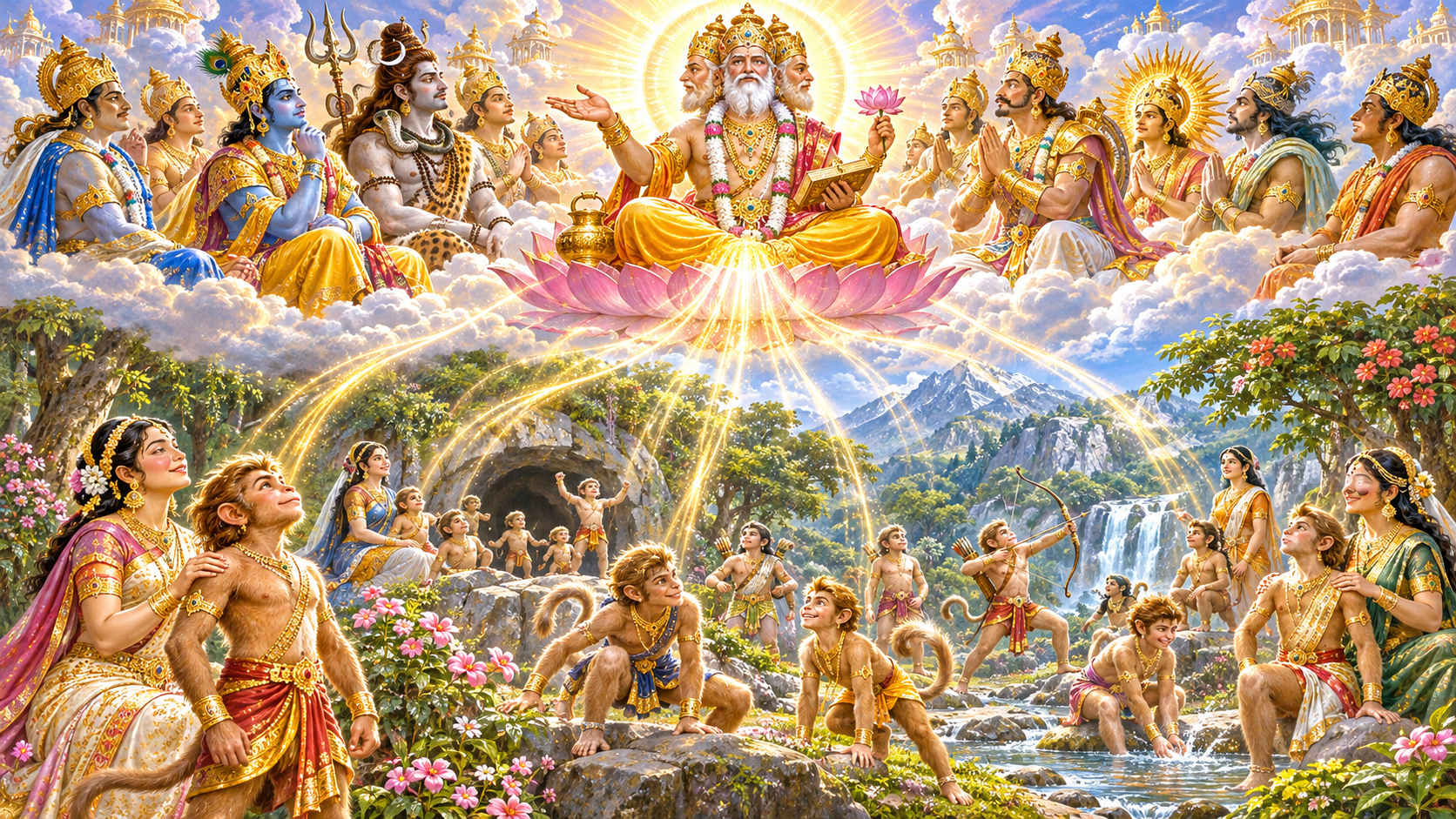
In Chapter 16 of the Bala Kanda, Ravana has become a source of suffering for the Devas, the sages and ordinary people. The Vanaras are therefore brought forth as helpers of Rama in the work of removing Ravana and re-establishing Dharma.
That is the passage’s essential answer to the question of their birth. Their origin is tied to a task. They belong to the same divine preparation that precedes Rama’s arrival, even though they will perform their role within the world and alongside him.
Key takeaways
- The birth of the Vanaras is placed in Bala Kanda, before the birth of Rama.
- Ravana’s persecution of Devas, sages and ordinary people creates the need to which their birth responds.
- The Vanaras are prepared specifically as Rama’s helpers in the restoration of Dharma.
- Their later appearance should be read as the fulfilment of prior preparation, not as an improvised solution.
Why their birth comes before Rama’s birth

The order of events does interpretive work. First, the crisis is established: Ravana is disturbing the moral order and causing suffering. Next, the beings who will assist in confronting that crisis are prepared. Rama’s story can then unfold with those helpers already present in the world.
This chronology corrects a common impression created by remembering only the later, more dramatic portions of the Ramayana. If you begin with Rama’s encounter with the Vanaras, they can seem like allies found by chance. If you begin where Bala Kanda asks you to begin, the encounter is part of a much longer design.
When reading an epic, placement matters as much as action. A short preparatory episode may explain the purpose of characters who become prominent much later. Here, the birth notice tells you how to interpret the alliance before the alliance itself takes shape.
The episode presents Dharma as shared work
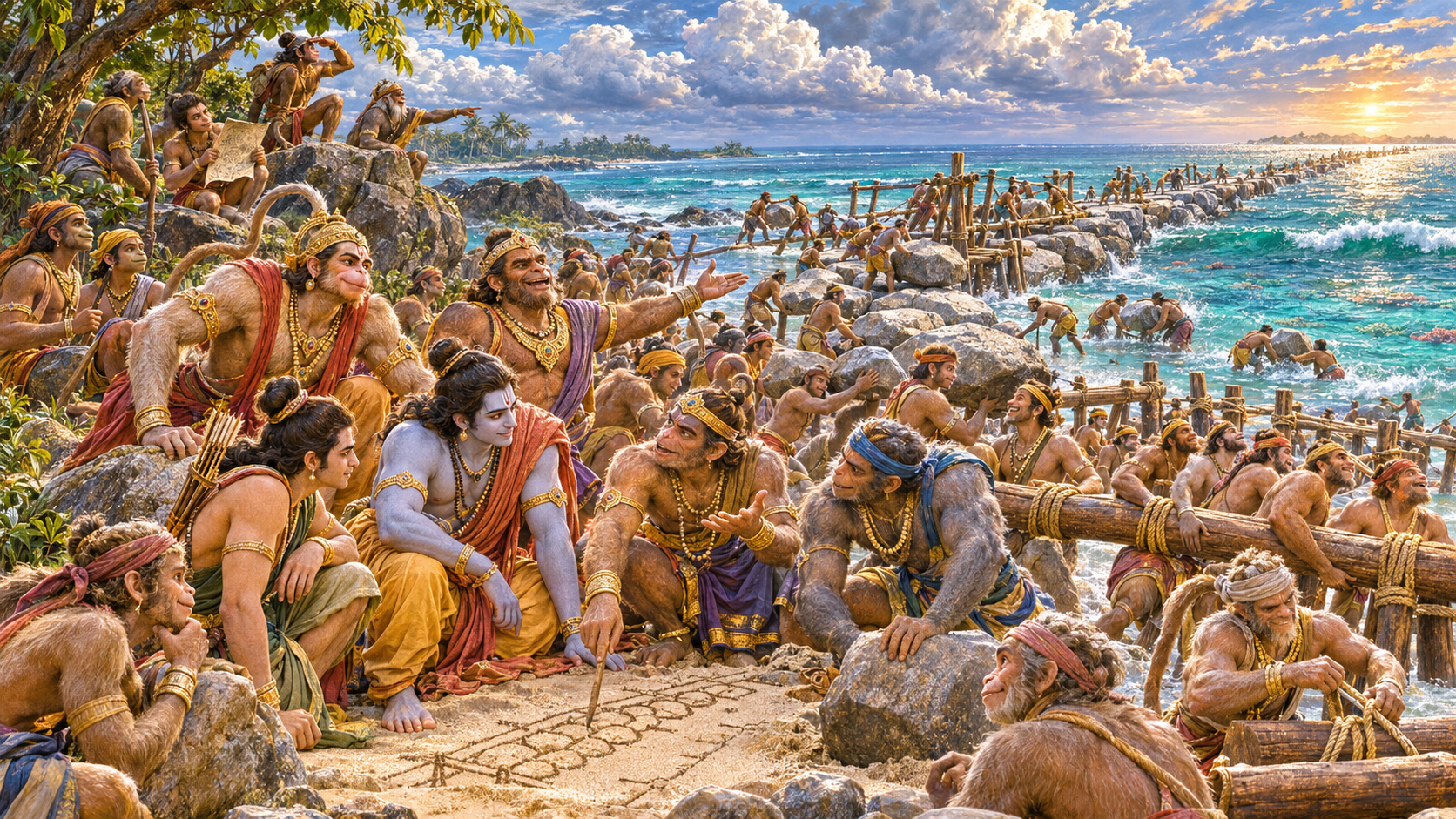
Rama remains central, but the restoration of Dharma is not depicted as an isolated performance. The Vanaras are deliberately prepared to help. Their existence shows a coordinated response in which the divine purpose works through many participants.
This distinction is useful when explaining the episode in a family discussion or study circle. Rama and the Vanaras are not competing centres of the narrative. Rama bears the central mission, while the Vanaras are purposefully prepared collaborators in it. Their service belongs to the mission rather than standing outside it.
You can carry that insight beyond this episode without turning it into a vague slogan. Dharma may have a central bearer, but its defence still calls for prepared allies. The passage gives that principle a concrete narrative form: the helpers are made ready before the decisive work begins.
Three misreadings that obscure the Vanaras’ role
First, do not treat them as a solution invented after Rama encounters difficulty. Their origin precedes his birth. The need for their service has already been recognised because Ravana’s oppression already exists.
Second, do not reduce them to colourful background figures. Within this episode, their defining importance is functional: they come into existence to assist Rama. Whatever questions a reader may ask about how Vanaras should be represented, the birth account first asks us to understand why they are present.
Third, do not read divine purpose as the absence of cooperation. The preparation of helpers is itself part of the response to adharma. The episode does not diminish Rama by giving him allies; it shows the scale and order of the mission for which those allies are prepared.
How to read Bala Kanda Chapter 16 closely
Use three questions when you return to the passage. Who is suffering? When are the helpers prepared? What are they prepared to do? The answers are precise: Ravana is troubling Devas, sages and ordinary people; the Vanaras arise before Rama’s birth; and their purpose is to help him remove the threat and restore Dharma.
Then keep those answers beside you when the Vanaras become active participants later in the Ramayana. Their service is not merely an alliance of circumstance. It completes a line of preparation begun before Rama entered the world.
The next time you read or hear the Vanara episodes, resist beginning with the question, “Where did Rama find these allies?” Ask instead, “Why had these allies already been prepared?” That change of question reveals what Bala Kanda wants you to notice: Dharma’s response to Ravana begins before the visible confrontation begins.
References

Leave a Reply
You must be logged in to post a comment.