

If you worship at a mandir in America, take your children to Hindu festivals, or help run a temple, the alleged Aurora plot leaves you with a difficult question: how do you protect the community without allowing fear to empty its sacred spaces?
The answer is neither denial nor panic. Treat credible threats as concrete security problems, document anti-Hindu bias precisely, and keep Hindu religious life visible. A community can become harder to harm without turning every devotee into a guard or every festival into a siege.
What is known about the Aurora temple case
The reported sequence is narrow but grave. Prosecutors identified the Sri Venkateswara Swami, or Balaji, Temple in Aurora, Illinois, as the target of an alleged mass-shooting plot. Alexandros Paporakis, a 19-year-old from Palatine, was arrested after a co-worker alerted authorities and was charged with making a terrorist threat and unlawfully possessing weapons.
Investigators reportedly found an AR-style rifle, hundreds of rounds of ammunition, and white-supremacist material. The rifle allegedly malfunctioned when the suspect tried to carry out the attack on the first day of Navaratri. Representative Raja Krishnamoorthi was reportedly inside the temple with his family when Paporakis drove past; he subsequently requested an FBI investigation.
Charges are not a conviction. The suspect’s conduct and motive remain allegations unless established through the legal process. That distinction should shape how you discuss the case: use words such as “alleged” and “reportedly,” do not circulate unsupported additions, and correct claims that go beyond the available facts.
Legal caution must not erase the alleged target. This was not described merely as a threat to an unspecified public building. Prosecutors identified a Hindu temple, and the alleged attempt coincided with the opening of Navaratri. Naming that context is necessary when evaluating possible religious bias and planning protection for future festivals.
Two reported points of interruption matter: a firearm malfunction and a co-worker’s decision to alert authorities. Neither is a security system on which a temple can rely. The first was chance. The second demonstrates why anyone who encounters a specific threat needs a clear, trusted route for reporting it quickly.
Measure anti-Hindu hate without exaggerating it

FBI data recorded 32 anti-Hindu hate-crime offenses in 2025. Temple vandalism has also been reported in California, Indiana, Utah, and North Carolina. These incidents warrant attention, but the number 32 does not by itself prove a year-on-year increase. Establishing a trend requires comparable figures across years, consistent classifications, and some understanding of underreporting.
You do not need to choose between minimization and an unsupported claim of an organized nationwide conspiracy. A credible attempted attack is serious even if it is the only such case in a locality. Repeated vandalism matters even when each incident has a different perpetrator. Record the cases accurately, distinguish their severity, and look for patterns in evidence rather than assuming a common command behind them.
A useful community incident log should contain the date, location, exact conduct, words or symbols indicating anti-Hindu bias, police-report number, damage or injury, available images, and case disposition. Separate a hateful social-media comment from targeted harassment, vandalism, a specific threat, weapons preparation, and an attempted attack. Combining them into one undifferentiated total may create a dramatic number, but it makes risk assessment less useful.
Clarity also requires distinguishing criticism from prejudice. Criticism addresses a teaching, institution, political movement, social practice, or government policy. Anti-Hindu prejudice assigns collective guilt to Hindus, treats devotees as inherently inferior, or attacks a person because of Hindu identity. A security threat goes further by identifying a person or venue, expressing violent intent, describing a method or time, acquiring weapons, conducting surveillance, or urging others to act.
Use three practical categories when deciding how to respond:
- Disagreeable or hostile speech: rebut it, ignore it, or answer it through education and public argument. Religious polemic that calls Hindu worship “pagan” or “demonic” may be offensive without being an actionable threat.
- Targeted harassment or vandalism: preserve the evidence, notify the affected person or temple, report it to the relevant platform or police, and document indications of religious bias.
- A specific or immediate threat: contact emergency services, warn the named venue privately, and let trained authorities investigate. Do not mobilize an online confrontation with the suspected person.
Anti-Hindu hostility can appear in religious-supremacist, racial, anti-immigrant, or political language. It can also reduce the whole of Hindu Dharma to accusations about caste or misogyny. That does not make every Christian, academic, journalist, immigrant critic, or political opponent responsible for hate. Collective blame is wrong when directed at Hindus, and it remains wrong when Hindus direct it at somebody else. Focus on identifiable conduct, named institutions, and evidence.
Build a one-page security plan before the next festival
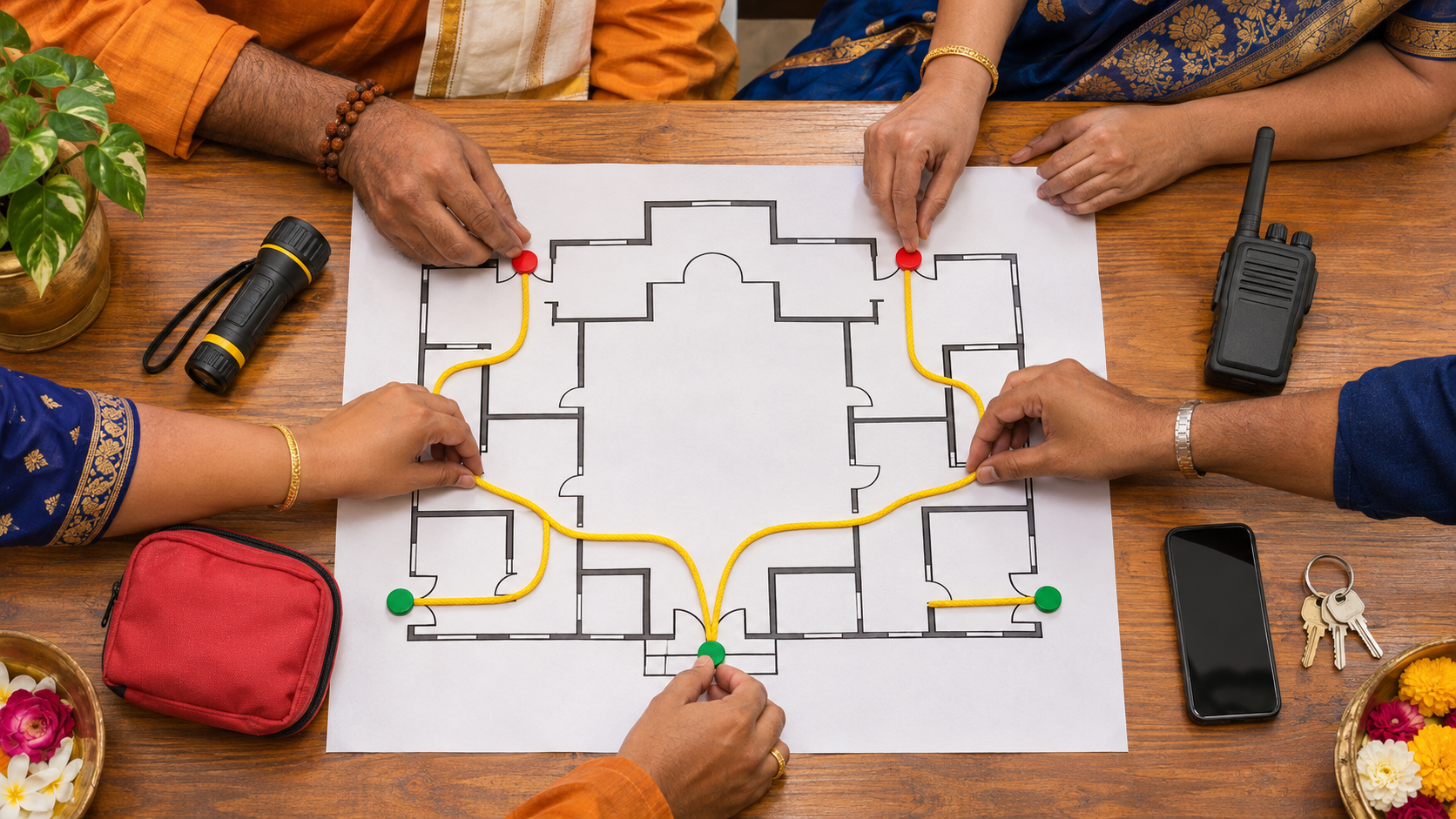
A crowded Navaratri evening creates different conditions from an ordinary weekday puja: more visitors, more vehicles, unfamiliar faces, longer entry lines, and more children moving through the premises. Temple leaders should therefore plan around the event calendar rather than treating security as a one-time purchase of cameras or locks.
The working plan can be one page, but it should name people and decisions. At minimum, it should cover these seven elements:
- Assign a safety lead and a backup. Everyone serving at the event should know who receives a concern, who calls emergency services, and who communicates with devotees. Do not leave these roles implicit.
- Establish a police liaison before the crowd arrives. Share the festival schedule, explain expected attendance, and request a walk-through when local authorities can provide one. Confirm which number to use for urgent and non-urgent reports.
- Design entry without trapping people outside. Monitor public entrances when feasible, but avoid creating a dense, unmanaged queue. Keep every legally required exit usable and never sacrifice emergency egress for access control.
- Train volunteers to observe behavior, not identity. A direct threat, visible weapon, attempt to force a restricted door, or repeated surveillance linked to threatening conduct deserves attention. A visitor’s race, clothing, accent, religion, or political appearance is not suspicious behavior.
- Map evacuation, shelter, and family reunification. Mark more than one exit, identify where children and caregivers will reunite, account for elderly and disabled devotees, and tell volunteers to follow emergency dispatchers and responding officers when an incident unfolds.
- Prepare two communication channels. One should reach volunteers quickly; the other should give devotees short, factual instructions. Avoid rumors, speculation about the attacker, and live publication of police or security positions.
- Preserve evidence and review the response. Retain threatening messages, camera footage, witness contact details, and report numbers. After any incident or drill, record what failed, assign corrections, and set a date to verify that they were completed.
A plan stored only in one trustee’s head will fail when that person is absent. Give every volunteer a brief role card. Include the temple’s full street address, the safety lead’s contact, emergency-call responsibility, assigned entrance, first-aid location, assembly point, and child-reunification location. Keep tactical details within the team rather than publishing them on social media.
Review the plan before each major observance. Construction, road closures, changing volunteer rosters, and unusually large attendance can make last year’s arrangement obsolete. The review does not need to be elaborate: walk the route, test the contact list, open every designated exit, and ask each volunteer to state what they would do after seeing a weapon or hearing a direct threat.
What you should do as a devotee or community member

At the mandir
You do not need to arrive frightened, but you should arrive oriented. Notice more than one usable exit. If you are with children, choose a reunion point away from the main doorway and tell them which known adult they should approach if separated. Save the temple’s address in your phone so you can give it accurately during an emergency call.
Report observable facts, not a theory about a stranger. Tell the safety lead the exact words you heard, what object you saw, where the person moved, and a vehicle description or licence plate if you can obtain it without approaching or following anyone. A precise description helps. “That person looks wrong” does not.
If there is a visible weapon, forced entry, violence, or an immediate threat, call 911. Move away from the exposed area if you can do so safely, otherwise take shelter and follow instructions from emergency dispatchers and responding officers. Do not stop to film, pursue the person, or return for belongings.
When a threat begins online
Preserve the original URL, account name, date and time, full context, and screenshots before a message can be deleted. Send the material privately to the temple’s designated contact. If it names an imminent time, target, or weapon, contact 911 as well. Ambiguous but targeted material can be sent through the local police non-emergency route.
Do not quote-post the threat to mobilize an audience. Repetition can expose the target to more harassment, contaminate witness accounts, and encourage amateur attempts to identify or confront a suspect. Preserve first, report through controlled channels, and publish only the safety information devotees actually need.
Do not improvise an armed congregation
An impulsive decision to carry a gun after a frightening incident is not a temple security plan. Firearm and concealed-carry laws vary by jurisdiction and venue, and an uncoordinated armed attendee may complicate a police response. No devotee should confront a suspected attacker or act as an informal guard merely because a weapon is available.
If a temple is considering armed protection, its board should obtain jurisdiction-specific legal and insurance advice, use appropriately qualified professionals, define authority in writing, and coordinate the arrangement with local law enforcement. Personal fear is understandable, but it is a poor substitute for selection, training, accountability, and a shared response plan.
Turn solidarity into measurable follow-through
Interfaith solidarity is most useful when it produces a concrete action. Neighboring congregations can share emergency-planning contacts, attend a public observance in support, help distribute accurate information, or join a clear statement against targeting places of worship. They should not be asked to endorse every Hindu political position in order to oppose violence against Hindus.
When evidence indicates religious bias, ask police to record it rather than reducing the incident to generic vandalism or disorder. Obtain an incident number and confirm how supplemental evidence should be submitted. Ask elected representatives for specific follow-up: the investigative status, the recorded bias category, available victim support, and the security contact for local houses of worship.
At the next temple meeting, ask three questions: Who owns the emergency plan? How does a devotee report a threat? When was the plan last reviewed or practiced? If nobody can answer, volunteer for a bounded task such as updating contacts, mapping exits, translating safety instructions, or organizing the police walk-through. Concern becomes protection only after it has an owner and a deadline.
Key takeaways
- The Aurora matter involves a serious alleged plot against a named Hindu temple during Navaratri, but the suspect’s guilt and final motive must still be established through the legal process.
- The 32 anti-Hindu hate-crime offenses recorded in 2025 establish a real reporting category, not by themselves a proven upward trend.
- Separate hostile speech, targeted harassment, vandalism, specific threats, and attempted violence. Each requires a different response.
- Temple security should rely on named roles, monitored access, usable exits, practiced communication, evidence preservation, and coordination with authorities.
- Report behavior rather than profiling identity, and do not confront, pursue, or publicly mobilize against a suspected person.
- Continue attending Hindu religious life. Visibility, accurate documentation, interfaith support, and disciplined preparation are stronger responses than either denial or retreat.
Before the next crowded observance, ask your temple for its one-page safety plan. If it exists, read it and learn your family’s reunion point. If it does not, help create it and request a walk-through with local authorities. Keep showing up, but turn concern into clear roles, preserved evidence, and coordination that has been practiced before it is needed.
References
- Hindu Post — Aurora Hindu Temple Mass-Shooting Plot Shows Rising Hate Against Hindus in America
- Firstpost — When Worship Becomes a Target of Hate: The Growing Fear of Being Hindu in America, 20 October 2026

Leave a Reply
You must be logged in to post a comment.