

If Rishi Jaratkaru’s departure from his pregnant wife strikes you as harsh, you do not need to silence that reaction in order to respect the Mahabharata. Your discomfort identifies the very problem that makes the episode worth examining: can an act serve a larger dharmic purpose and still trouble us at the level of marital duty?
A useful reading neither dismisses Jaratkaru nor turns everything he does into a rule for husbands. It asks a more disciplined question: what does this marriage reveal about purpose, obligation, consequence, and the danger of using dharma to excuse personal severity?
Keep all three parts of the moral tension in view

The episode becomes distorted when one fact is isolated from the others. Jaratkaru marries for a duty larger than personal happiness, his wife becomes pregnant, and he leaves after what appears to be a small domestic incident. Each part changes the meaning of the other two.
If you look only at the marriage’s larger purpose, the wife can disappear into that purpose. She becomes a means rather than a person to whom duties are owed. If you look only at the departure, you may miss why a man not primarily seeking domestic happiness entered marriage at all. If you focus only on the minor incident, you may reduce a conflict about vows and duty to a temperamental quarrel.
Hold the three facts together. The marriage is purposeful. The consequence for the wife is serious. The apparent disproportion between incident and response is morally significant. A mature reading must account for all three; it cannot use one to erase the others.
A dharmic purpose explains the marriage, not every action within it
Calling this a marriage made for dharma tells you why the union occurs. It does not automatically prove that every decision within the marriage is an ideal for ordinary household life. Purpose and permission are different things.
This distinction matters because marriage creates new obligations. Once two people enter a relationship, neither person’s original purpose is the only duty in the room. A vow may begin with one aim, but the relationship formed through that vow brings responsibilities toward another human being. Pregnancy makes that interdependence especially difficult to ignore.
You can therefore recognize Jaratkaru’s larger mission without treating his wife’s pain or vulnerability as irrelevant. Dharma is not made clearer by removing the person who bears the cost. It becomes clearer when you ask how competing duties are ordered, which duty is treated as decisive, and what remains unresolved after that choice.
Use this interpretive rule whenever a sacred narrative contains a severe act: an elevated purpose may explain the act, but explanation is not the same as universal endorsement. First identify the character’s particular duty. Then ask whether the response is meant as a general command, an exceptional decision, a warning, or a moral tension the reader is expected to confront.
How to distinguish dharma from personal preference

The word dharma can clarify an obligation, but it can also be misused to make a personal choice sound unquestionable. When someone invokes dharma to defend a harsh decision, apply four tests.
- Ask whether the obligation existed before the conflict. A duty that clearly shaped the original commitment deserves serious consideration. A supposed duty discovered only when someone wants to escape accountability may be a rationalization.
- Identify who bears the cost. If one person claims spiritual necessity while another person carries nearly every practical and emotional consequence, the explanation is incomplete. Cost does not by itself make a decision adharmic, but hidden cost makes moral evaluation impossible.
- Compare the response with the breach. A minor domestic failure and a permanent rupture are not morally equivalent merely because a prior condition can be invoked. Proportion matters, especially when the response affects a dependent or vulnerable person.
- Look for the duties that have been omitted. Truthfulness, fidelity to a vow, compassion, protection, restraint, and responsibility toward family cannot simply vanish when one preferred obligation is named. A serious dharmic judgment must explain why one duty prevails without pretending the others never existed.
These tests are not a device for placing an ancient rishi on trial according to a modern slogan. They protect you from a more immediate mistake: turning his exceptional story into a weapon against a spouse, child, or family member. The relevant question is not, “Can I find a revered figure who also left?” It is, “Have I honestly accounted for every duty my own commitment created?”
What Jaratkaru’s departure cannot justify today
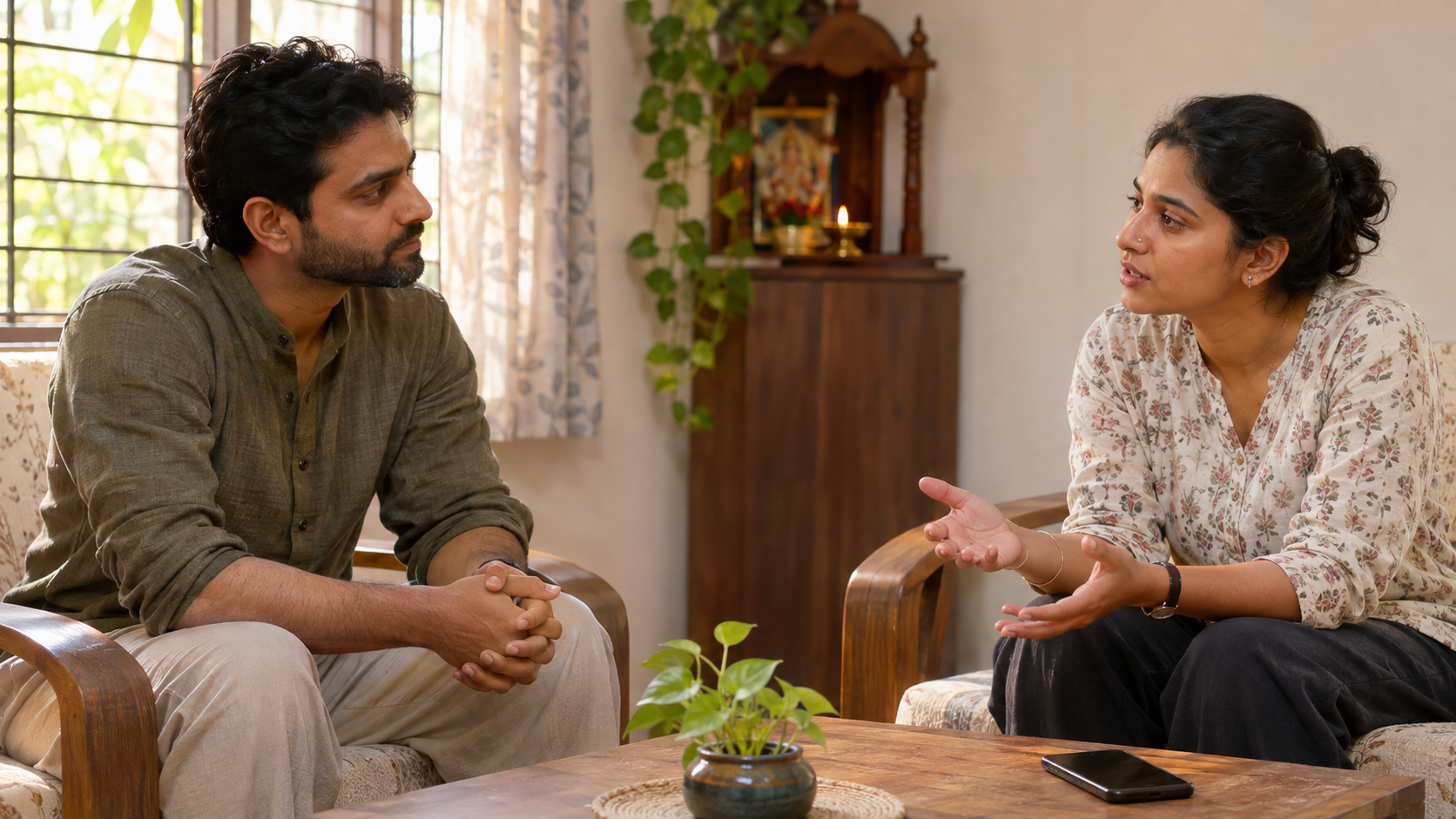
This episode is not a licence for abandoning a pregnant spouse, imposing punitive conditions, or treating spiritual status as immunity from accountability. An ancient narrative shaped by a particular dharmic purpose cannot be copied into a modern marriage by matching one outward detail.
Be especially cautious when the story is used in any of these ways:
- One spouse declares a private preference to be dharma and refuses to let the other spouse question it.
- A small mistake is used to justify a consequence far greater than the mistake itself.
- The more powerful person defines the vow, judges the alleged violation, and chooses the penalty.
- The language of renunciation hides duties created by marriage, pregnancy, parenthood, or dependence.
- Concern for the person harmed is dismissed as attachment, weakness, or ignorance.
If this story arises during a real marital conflict, treat it as a prompt for examination rather than a verdict. Each spouse should be able to name the promise at issue, the duty being claimed, the cost to the other person, the possibility of repair, and the responsibilities that would remain after separation. When the decision could alter a family’s safety, housing, finances, legal position, or care during pregnancy, do not make it through scriptural analogy alone. Seek qualified spiritual guidance and the appropriate professional help for the practical consequences.
The same discipline applies when teaching the episode. Do not ask children or students merely whether Jaratkaru was right or wrong. Ask which duties they can identify, whose perspective is easiest to overlook, why the scale of the response matters, and whether understanding a motive requires approving the result. Those questions train dharmic judgment instead of rewarding memorized allegiance.
Key takeaways
- Jaratkaru’s marriage is presented as serving a larger duty, not merely personal happiness.
- The marriage’s purpose explains why it occurs; it does not automatically make every later act a universal marital ideal.
- His wife’s pregnancy keeps the human consequence of departure at the centre of the moral question.
- A claim of dharma should be tested by its prior basis, proportionality, distribution of cost, and treatment of competing duties.
- The episode should invite examination of difficult obligations, not provide an excuse for unilateral abandonment or spiritualized control.
The next time someone cites Jaratkaru as a simple example of choosing dharma over attachment, slow the discussion down. Ask what duty made the marriage necessary, what duties the marriage then created, and who paid for the final choice. That is where this difficult episode becomes useful: not as permission to become harder, but as training in seeing the whole field of responsibility before you act.
References

Leave a Reply
You must be logged in to post a comment.