
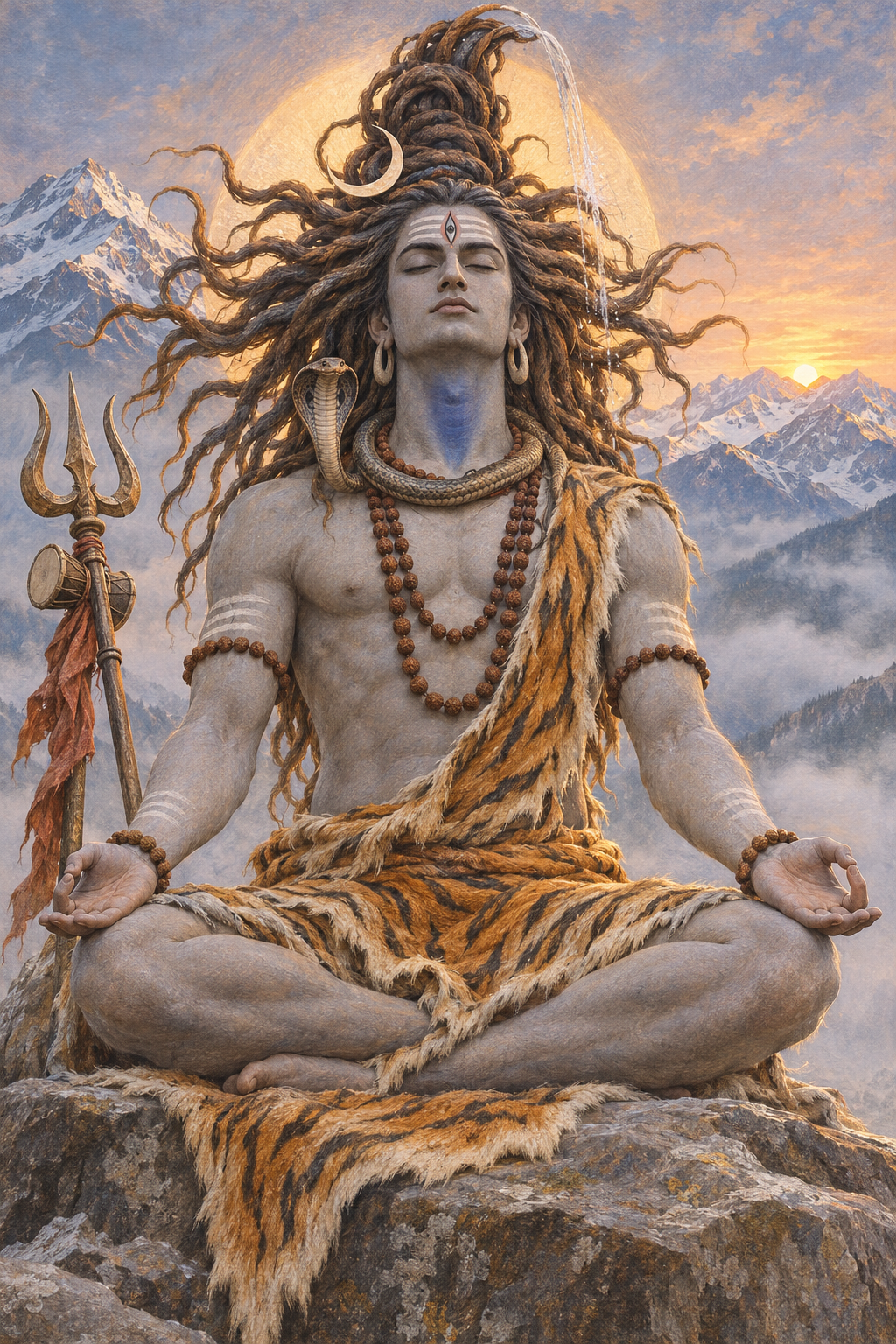
You notice the missing crown only after seeing what occupies its place. Shiva’s matted locks rise where a jewelled emblem of royal office might otherwise sit. If you have wondered whether this makes him less sovereign, less majestic, or somehow outside the language of divine authority, the answer is no. His crownlessness is itself a statement about authority.
Learning to read that statement will help you look at a murti or sacred image more carefully. It prevents two common mistakes: treating every deity as a variation of an earthly monarch, and mistaking simplicity for inferiority.
A crown signals a mode of sovereignty, not a rank in divinity
A crown is a familiar sign of divinity, sovereignty, splendour, and grace in Hindu sacred imagery. Vishnu is frequently represented with a resplendent crown, as are many forms of Devi and other celestial beings. Shiva, although revered as Mahadeva, is characteristically shown without that royal emblem.
That contrast gives you the first rule for reading Hindu iconography: do not turn differences between deities into a crude ranking system. If a crown were simply a measurement of divine importance, the crownless Mahadeva would make little sense. A symbol instead tells you something about how a particular divine form makes its nature visible.
A crown can express ordered kingship, public sovereignty, protection, and the dignity of sacred office. Shiva’s appearance directs attention toward another kind of command: authority that does not have to be conferred by a court, displayed through luxury, or secured by an institution. The absence of a crown does not diminish him. It keeps his greatness from being mistaken for an office granted by someone else.
When you compare images of Shiva, Vishnu, or Devi, therefore, ask what kind of divine presence each image reveals. Do not begin by asking which ornament looks more prestigious. The theological work is being done by the distinction, not by the market value of the ornament.
Shiva’s head is not undecorated: the matted locks are the sign
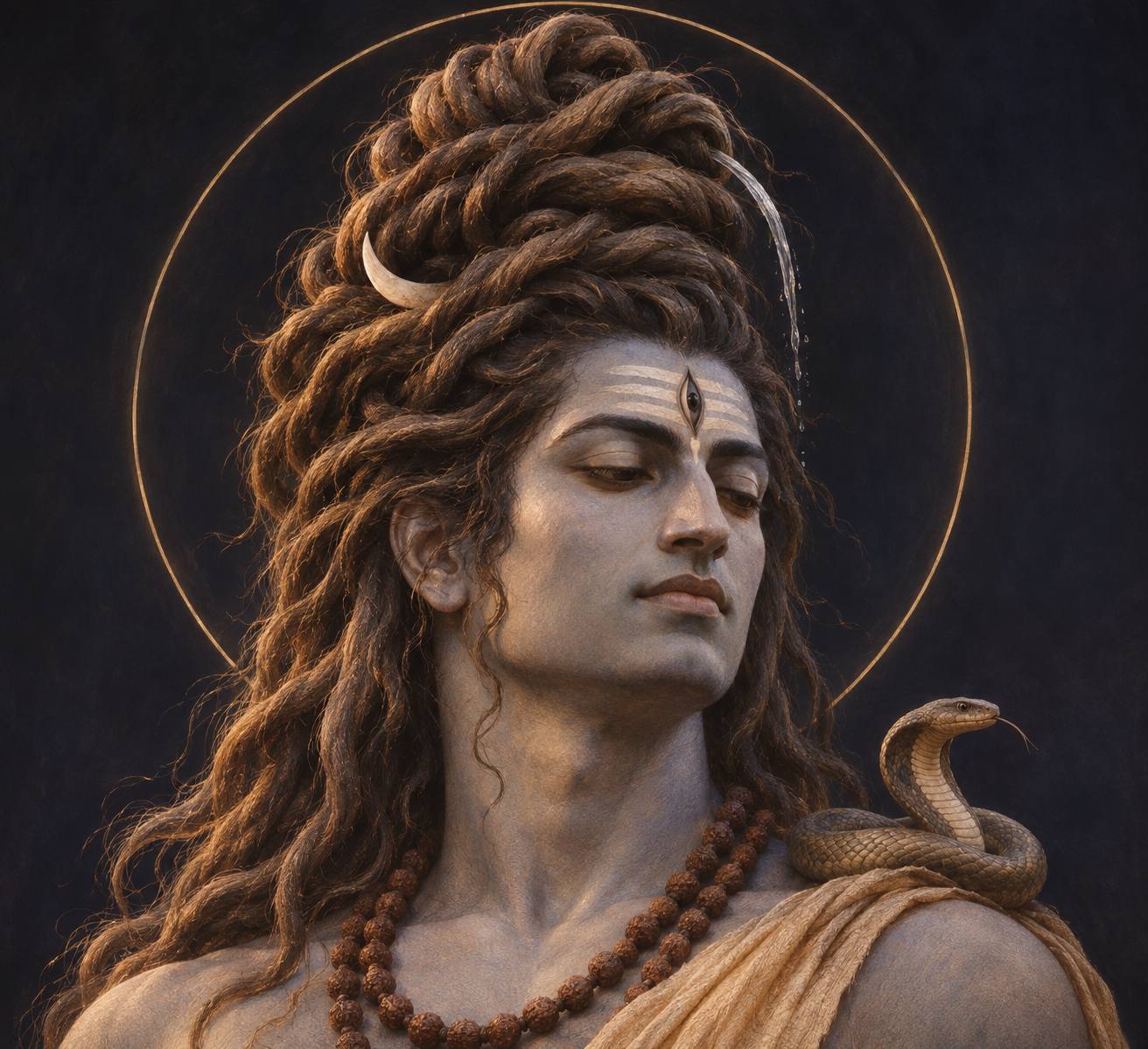
Calling Shiva merely crownless can leave the wrong impression. His head is not an iconographic blank. The royal crown is displaced by his own matted locks, or jata. In Hindu visual language, deliberately matted hair identifies the ascetic and yogic dimension of Shiva. It should not be read as neglect, disorder, or an artist’s failure to complete the figure.
This substitution matters. A conventional crown is fashioned outside the wearer and placed upon the head. It represents an office that can be recognised by others. Shiva’s matted hair belongs to his embodied way of being. It points toward discipline, renunciation, and power that has not been borrowed from the machinery of status.
The visual contrast can be read in three precise ways. The crown announces position; the matted locks disclose practice. The crown draws the eye toward public office; the locks turn it toward inner mastery. The crown distinguishes a ruler within an ordered realm; Shiva’s ascetic appearance suggests a sovereignty that cannot be contained by the usual signs of rule.
This is why you should describe the image positively. Do not stop at saying that Shiva lacks a crown. Say that Shiva bears matted locks instead of depending on a royal crown. The first sentence treats the image as deficient. The second notices the symbol that is actually present.
Hindu iconography is not a factory standard, and representations vary by form, region, temple tradition, and artistic setting. The interpretive point concerns the recognisable contrast in which Shiva bears matted hair rather than a conventional jewelled crown. It should not be converted into the brittle claim that every image made in every tradition must look identical.
Crownlessness places sovereignty beyond possession
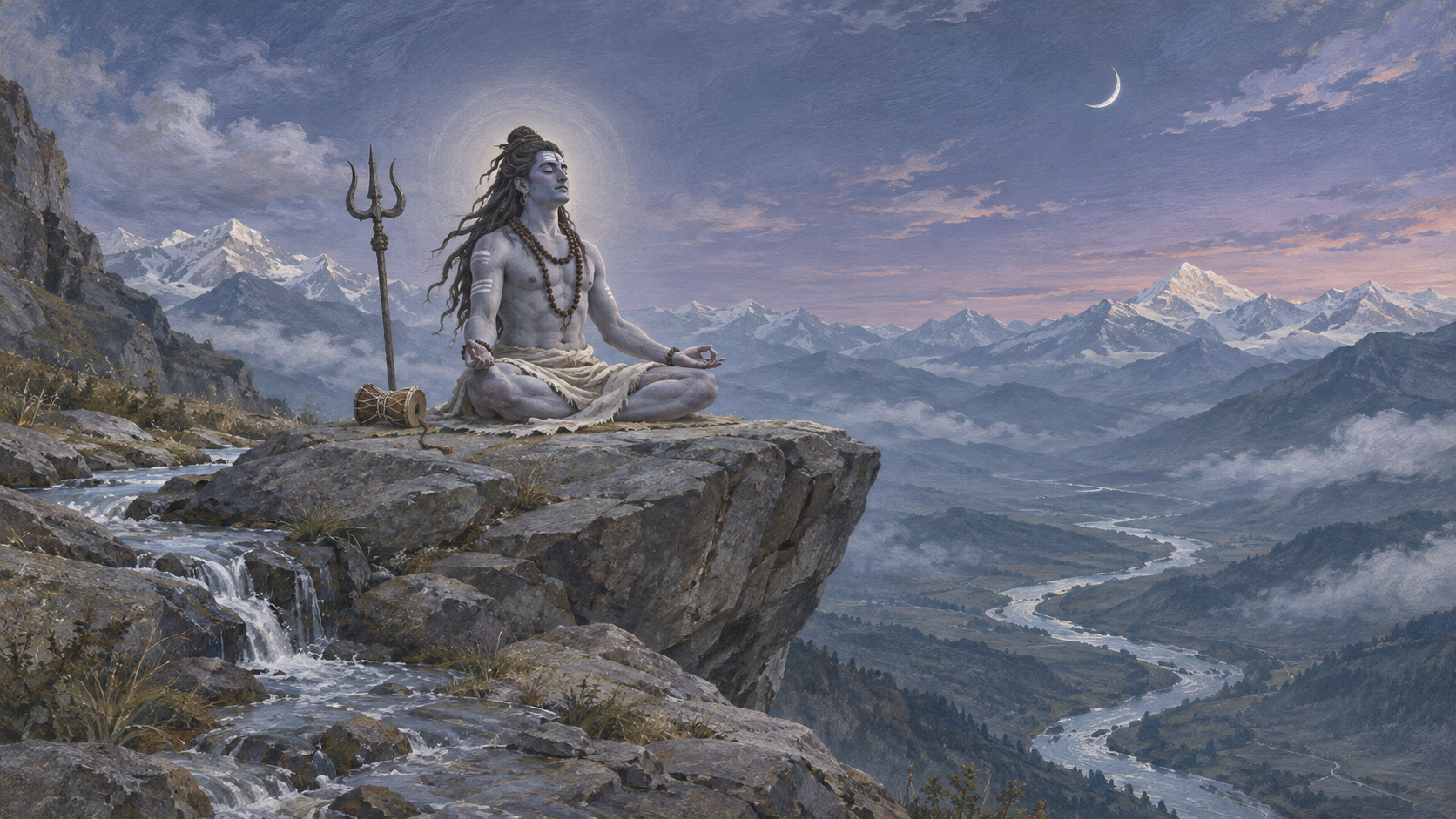
Shiva’s appearance holds together two identities that modern eyes often separate: the ascetic and the sovereign. We tend to imagine that a person must either renounce power or display it. Shiva’s iconography refuses that choice. He is Mahadeva without needing the costume of a court.
Renunciation here does not shrink sovereignty. It relocates sovereignty from possession to freedom from dependence on possession. Shiva does not become great because a crown authenticates him. The image presents greatness as already present, before any emblem of recognition is added.
Three distinctions will keep this interpretation clear:
- Authority is not the same as appointment. An appointment comes from an external institution. Shiva’s authority is represented as intrinsic rather than delegated.
- Majesty is not the same as luxury. A spare appearance can communicate vastness more effectively than an accumulation of precious objects.
- Freedom is not the same as incapacity. The absence of a crown means Shiva does not depend on it, not that sovereignty lies beyond him.
These distinctions also prevent an opposite mistake. Crownless Shiva is not a simple slogan against kings, institutions, wealth, or social responsibility. Nor does the image teach that every plainly dressed person possesses wisdom while every decorated ruler is spiritually empty. Hindu deities use different visual languages, and the crowned majesty of another deity need not conflict with Shiva’s ascetic majesty.
The sharper lesson concerns dependence. External signs can serve a legitimate purpose, but they cannot manufacture the reality they claim to represent. A title can identify responsibility; it cannot create character. An ornament can mark honour; it cannot produce inner command. Shiva’s crownlessness asks you to distinguish the sign of authority from its source.
How to read a crownless Shiva image carefully
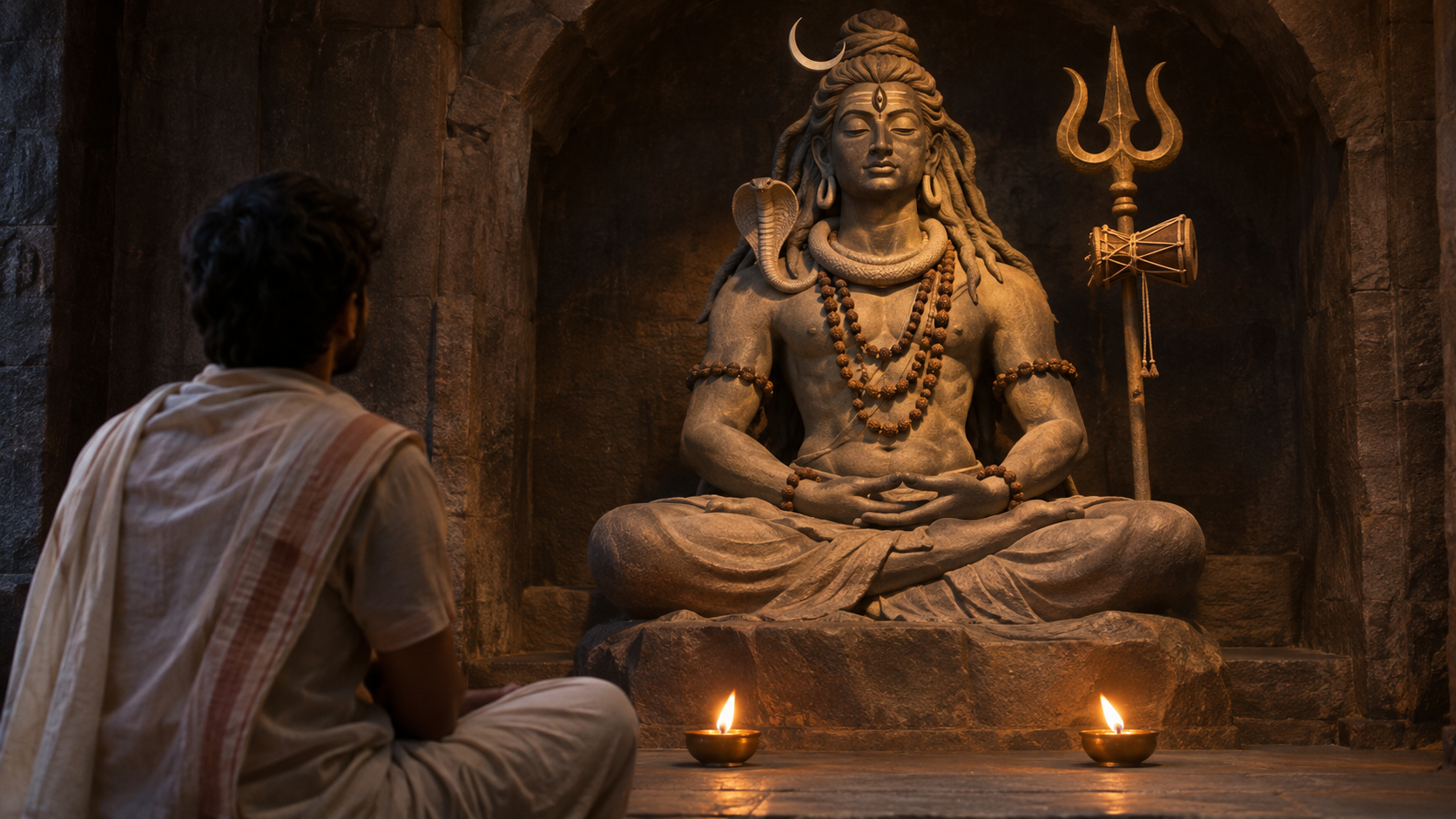
You do not need specialist training to make a sound first reading of a Shiva image. Use this sequence when visiting a temple, looking at sacred art, or explaining the murti to a younger person:
- Begin with the deliberate contrast. Recall that royal crowns are familiar in Hindu sacred imagery. Their absence from Shiva’s head is therefore meaningful rather than accidental.
- Identify what replaces the expected symbol. Look at the matted locks before interpreting the missing crown. Iconography communicates through what is present, not only through omission.
- Connect the replacement to Shiva’s character. The locks direct you toward the ascetic and yogic dimensions of Mahadeva. They shift the meaning of sovereignty from outward office toward disciplined freedom.
- Read the whole figure. Head, posture, clothing, objects, expression, and setting work together. No single attribute carries the entire theology of Shiva.
- Keep the conclusion proportionate. You can say that crownlessness presents Shiva’s greatness as independent of royal display. You should not claim that all crowns are spiritually suspect, that every Shiva image is identical, or that crowned deities are less transcendent.
If you are teaching a child or introducing someone to Hindu imagery, a clear explanation is enough: Shiva does not need a royal crown to make him great. His matted hair shows his ascetic nature, while his identity as Mahadeva shows that renunciation and supreme authority can belong together. That preserves the central meaning without turning a subtle symbol into a competition among deities.
Key takeaways
- Shiva’s missing crown is an intentional iconographic contrast, not an indication of lower divine status.
- His matted locks are a positive sign of ascetic and yogic identity, not an empty space where an ornament should have been.
- The image presents sovereignty as intrinsic and independent of public recognition, luxury, or delegated office.
- Crownlessness should not be turned into a rejection of every crown, ruler, institution, or form of sacred splendour.
- The soundest reading begins with what the image visibly presents and keeps its conclusion within that evidence.
Let the image test your idea of greatness
The next time you stand before Shiva, spend a few moments looking only at the head. Notice the matted locks before naming the absent crown. Then ask what would change if a conventional royal crown were placed there. The answer will show you how much of the image’s meaning lies in its refusal of borrowed splendour.
You can also bring the question into ordinary life: which external sign have you confused with the quality it is supposed to represent? A title is not competence. Visibility is not wisdom. Possession is not mastery. Plainness alone proves none of these things either. Shiva’s image gives you a more demanding measure: look for the reality on which the symbol rests.
At your next darshan, do not stop with the observation that Shiva wears no crown. Notice what takes its place, and let crownless Mahadeva widen your understanding of authority. The image does not strip Shiva of majesty. It asks whether majesty ever needed external permission.
References

Leave a Reply
You must be logged in to post a comment.