

You may have found ISKCON Zagreb while looking for a devotional community, or you may simply want to understand what a Sunday Feast is before watching. The immediate question is the same: how can you engage sincerely when the customs and vocabulary may be unfamiliar?
The ISKCON Zagreb Sunday Feast of 4 October 2026 features Arcita das. Treat this recording as an opportunity to hear and reflect, as well as an introduction to the character of a local Krishna-conscious community. Do not treat a dated recording as a current timetable.
Use the confirmed details without filling the gaps
The confirmed details are narrow but useful: this is an ISKCON Zagreb Sunday Feast, Arcita das is the named speaker or presenter, and the programme is dated 4 October 2026. Those details let you place the recording in a particular community and moment. They do not establish the schedule, language, duration, address, accessibility arrangements, or format of later gatherings.
That distinction matters if you are deciding whether to visit. A recording can help you notice the community’s devotional vocabulary and style of teaching. It cannot tell you whether the next gathering will have the same speaker, sequence, language, or practical arrangements.
- Use the recording to become familiar with the tone, concepts, and forms of participation.
- Note any terms or practices you would like a local devotee to explain.
- Verify the current time, place, language, and visitor arrangements before travelling.
- Ask directly about food allergies, mobility needs, translation, or any other practical concern rather than inferring an answer from the recording.
Watch it as an act of hearing, not as background media
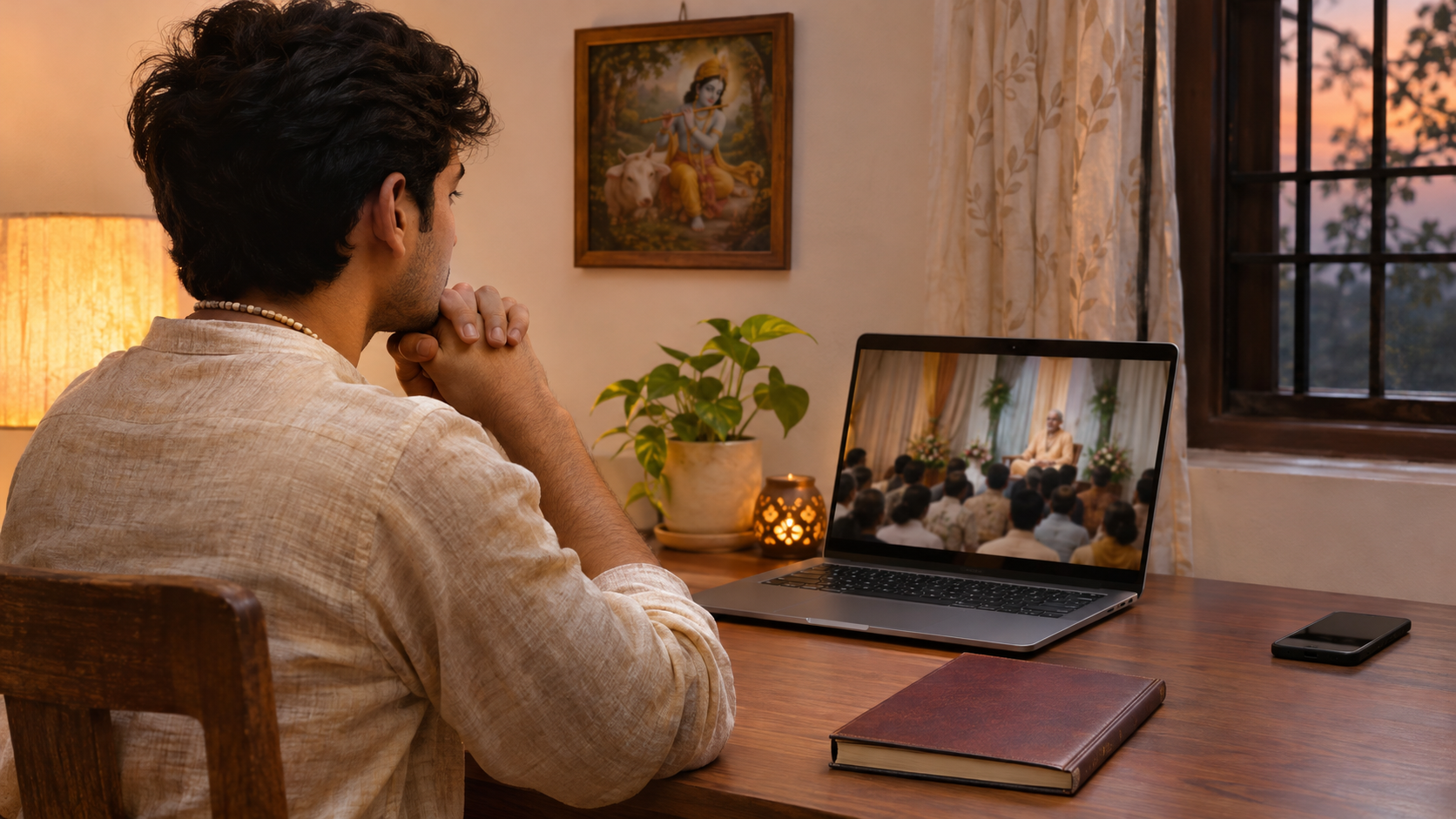
Devotional hearing asks for a different kind of attention from ordinary online viewing. You are not required to agree with every statement immediately, and you do not need prior knowledge to begin. Your task is to understand what is being taught before deciding what it means for your own practice.
- Begin with a clear question. You might listen for what devotion means, how Krishna is understood, or what kind of daily conduct the speaker encourages.
- Remove avoidable distractions. If the recording becomes background noise, unfamiliar Sanskrit terms and theological distinctions will blur together.
- Let the speaker complete a thought before searching every unfamiliar word. Context will often show whether a term refers to Krishna, the guru, scripture, service, or a devotional quality.
- After viewing, restate the central teaching in plain language. Then record a remaining question or a practice you want to examine further.
Keep separate notes for what was actually said and for your own interpretation. That small discipline prevents a first impression from becoming a claim about the tradition. If an important term remains unclear, ask a knowledgeable practitioner what it means in that specific context.
Recognise the elements commonly associated with a Sunday Feast
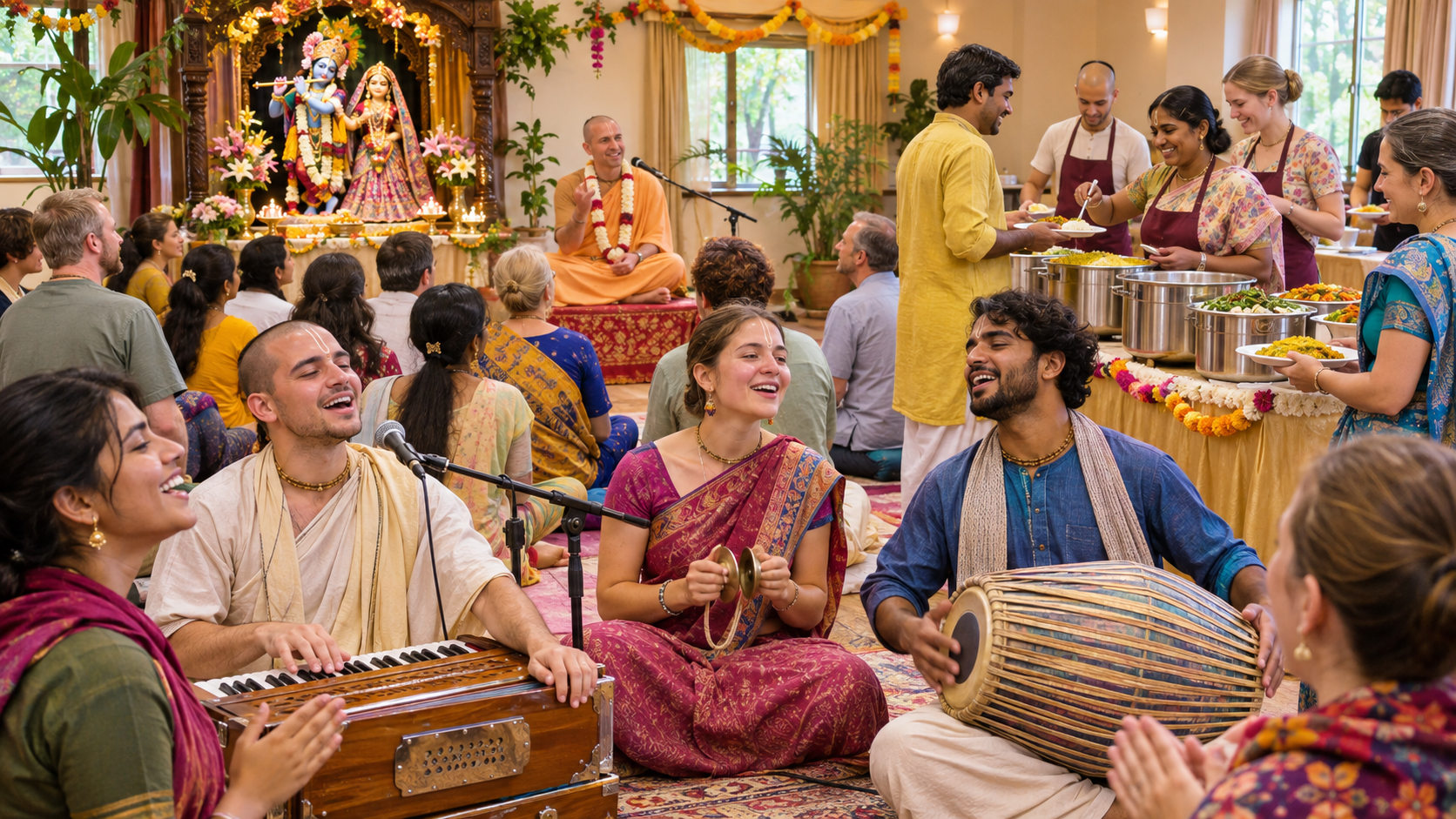
Within ISKCON, a Sunday Feast is generally more than a meal. It is a community setting in which devotional worship, teaching, association, and prasada may come together. Local programmes can arrange or omit elements differently, so use the following as a decoding key rather than a claimed running order for this particular recording.
Kirtana is participation through sound
Kirtana is congregational chanting or singing, often organised as a call and response. If it appears, you can listen quietly, follow the response when you feel comfortable, or observe until the pattern becomes clear. Sincere attention is already a form of participation; there is no need to imitate confidence you do not yet have.
The discourse should lead to a practicable point
A devotional talk is not merely a collection of religious information. Listen for the movement from principle to conduct: what view of the self or the Divine is being presented, what human difficulty is being addressed, and what response is proposed? If you can identify those parts, you can evaluate the teaching without getting lost in terminology.
Prasada is understood devotionally, not merely as food
Prasada means food that has been offered to Krishna and then received as grace. If you later attend a programme where prasada is served, accept the local host’s guidance rather than guessing at etiquette. If you have an allergy or dietary restriction, ask about ingredients before eating; vegetarian food can still contain ingredients that are unsafe for particular people.
Questions a newcomer may have before taking part
Do I need to be Hindu or initiated to watch?
No religious credential is needed to watch a publicly available recording. Approach it respectfully, but do not mistake unfamiliarity for exclusion. Listen first and ask precise questions where you need clarification.
Should I chant along if kirtana appears?
You may listen, follow the response, or chant when you are comfortable. Participation does not require a performance. Listening carefully is preferable to repeating words while ignoring their devotional setting.
What if I cannot understand the language or Sanskrit terms?
First identify the repeated words and the practical conclusion of the talk. Write down the terms that prevent you from following the reasoning. You can then ask for their meaning in context instead of trying to master an entire theological vocabulary at once.
Can this recording tell me when the next feast will happen?
No. It documents a programme associated with a specific past date. Confirm the current schedule and location directly with ISKCON Zagreb before making travel plans.
Prepare for an in-person visit with specific questions

If the recording makes you want to attend, contact the local community with questions that can be answered clearly. A vague request for “more information” may not surface the detail that matters most to you.
- Ask for the date, start time, current venue, and expected end of the programme you intend to attend.
- Confirm the principal language and whether translation is normally available.
- Ask whether newcomers should arrive before a particular part of the programme.
- Check accessibility and seating arrangements if standing, stairs, or floor seating may be difficult for you.
- Request ingredient information if you have food allergies or strict dietary requirements.
- Follow posted or spoken guidance about shoes, photography, sacred spaces, and the serving of prasada.
You do not need to master every custom before entering a devotional community. You do need to arrive observantly and be willing to ask. Start by watching the Zagreb programme with a definite question in mind. If you then decide to visit, confirm the present-day details and let the local hosts guide you through what cannot be learned from a screen.
References

Leave a Reply
You must be logged in to post a comment.