
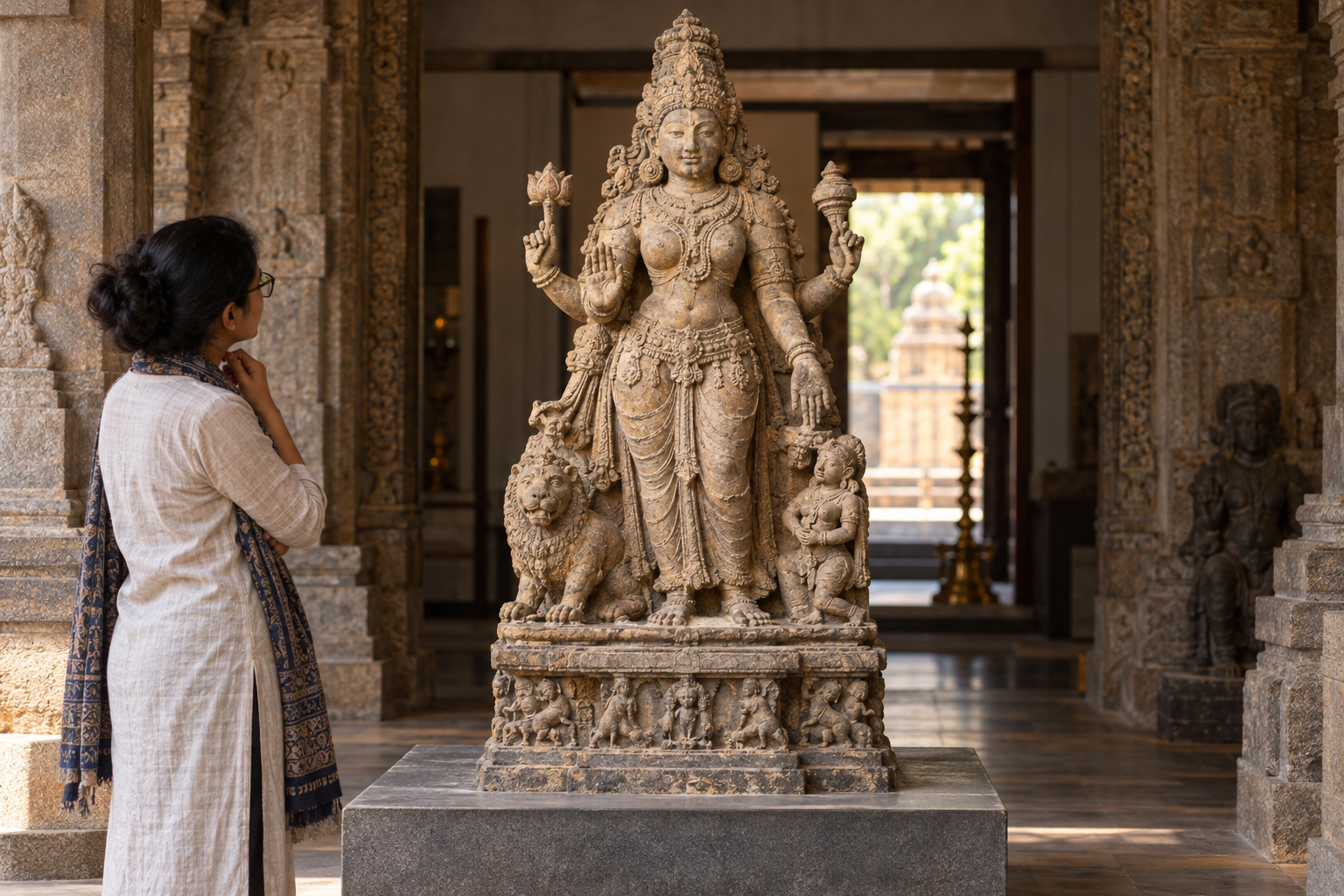
You may have found a photograph or sculpture labelled “Saubhagya Vageshwari” and want to know whether the identification is sound. The honest answer cannot come from one familiar-looking ornament, one object in a hand, or the general resemblance of the figure to Saraswati.
This is a rare form with limited textual documentation, so you need to read the whole sculptural program: name, gestures, attributes, posture, subsidiary figures, pedestal, inscription, provenance, and living temple tradition. That method will help you distinguish a defensible identification from an attractive guess.
Begin with what the identification can securely mean
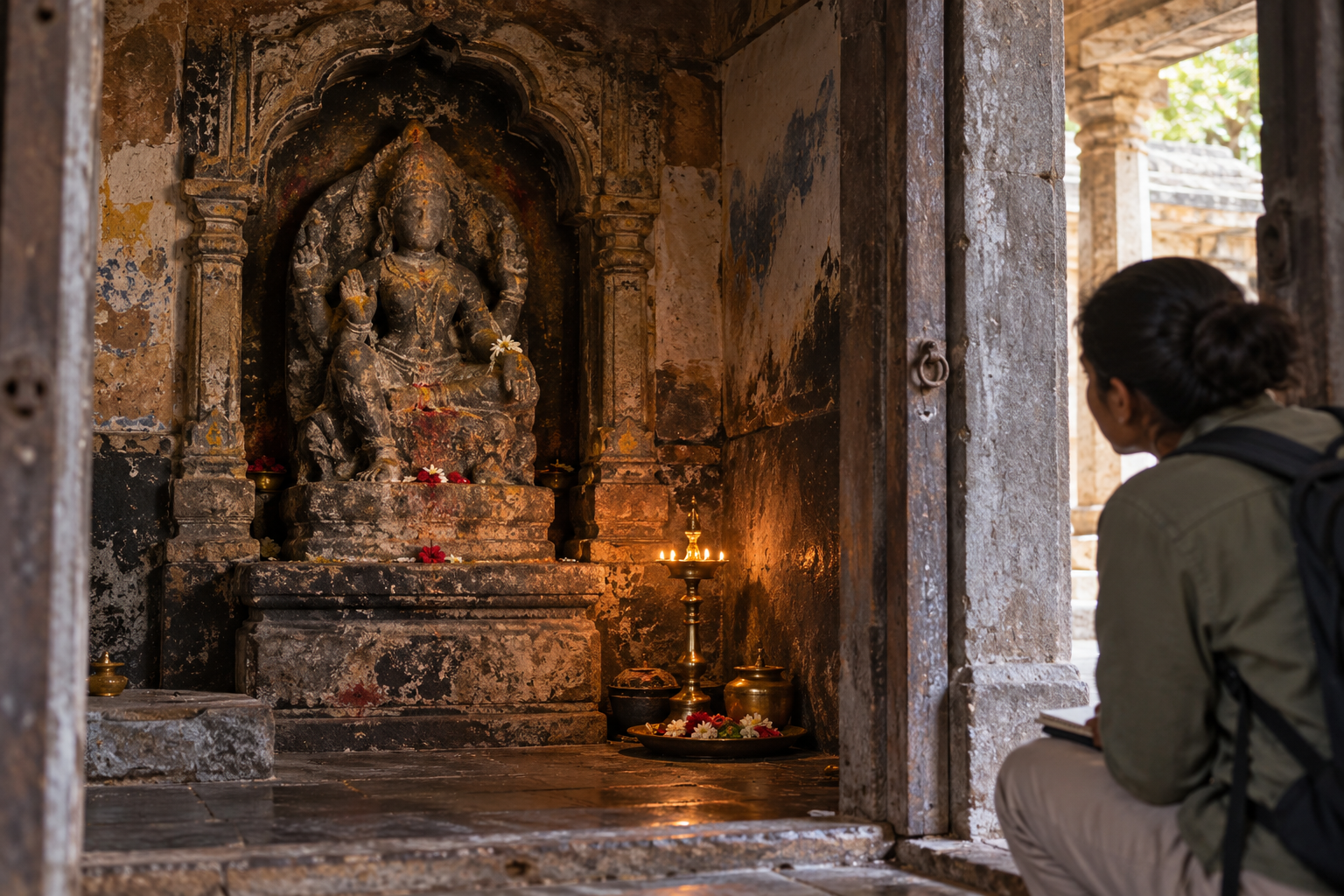
Saubhagya Vageshwari belongs to the lesser-known field of Hindu divine forms. Her relative rarity matters. A widely represented deity may have hundreds of securely identified images available for comparison. With an uncommon manifestation, a repeated label on websites or image boards can create the appearance of certainty without supplying the evidence behind it.
Start by separating three questions that are often collapsed into one:
- Who is the goddess? This asks about the divine identity expressed by the image.
- Which manifestation is represented? A deity may appear in more than one form, with different emphases and ritual settings.
- Why is this particular object called Saubhagya Vageshwari? The answer may rest on an inscription, a temple’s inherited name, a ritual manual, an old catalogue, or a modern attribution.
A label answers the third question only provisionally. It does not automatically settle the first two. When you encounter an image online, look for the reason attached to the name. “Identified by a pedestal inscription” carries more weight than “captioned as Saubhagya Vageshwari” with no provenance.
The comparison with Saraswati requires the same discipline. Vageshwari’s connection with speech makes the comparison understandable, but resemblance to Saraswati cannot by itself prove that a sculpture represents Saubhagya Vageshwari. Shared qualities do not make every related form iconographically interchangeable.
Read the name as theology, not as a list of objects
The name gives you an interpretive direction. “Vageshwari” joins the Sanskrit idea of vāk, speech or sacred utterance, with īśvarī, the feminine sovereign or mistress. “Saubhagya” carries the field of auspicious fortune, wellbeing, flourishing, and blessedness.
Read together, the name points toward the sovereignty of sacred speech as a source or expression of auspicious flourishing. That is a theological reading of the name. It is not yet a complete iconographic identification.
This distinction protects you from a common error: turning an etymology into imaginary anatomy. The association with speech does not authorize you to assume a particular manuscript, instrument, rosary, hand gesture, mount, colour, or number of arms unless the sculpture or a relevant tradition supplies that detail. Likewise, “saubhagya” should not be converted into a random collection of prosperity symbols.
Use the name to ask better questions instead:
- Does the image emphasize teaching, recitation, sound, knowledge, blessing, sovereignty, or auspiciousness?
- Do the hand attributes support that emphasis, or are they being interpreted only after the label has been accepted?
- Does a local ritual context explain why this form of divine speech is qualified by saubhagya?
- Is the name ancient to the object’s setting, or was it assigned in a recent catalogue or social-media caption?
The name establishes a field of meaning. The image, context, and tradition must establish the form.
Inspect the whole sculptural program in a fixed order
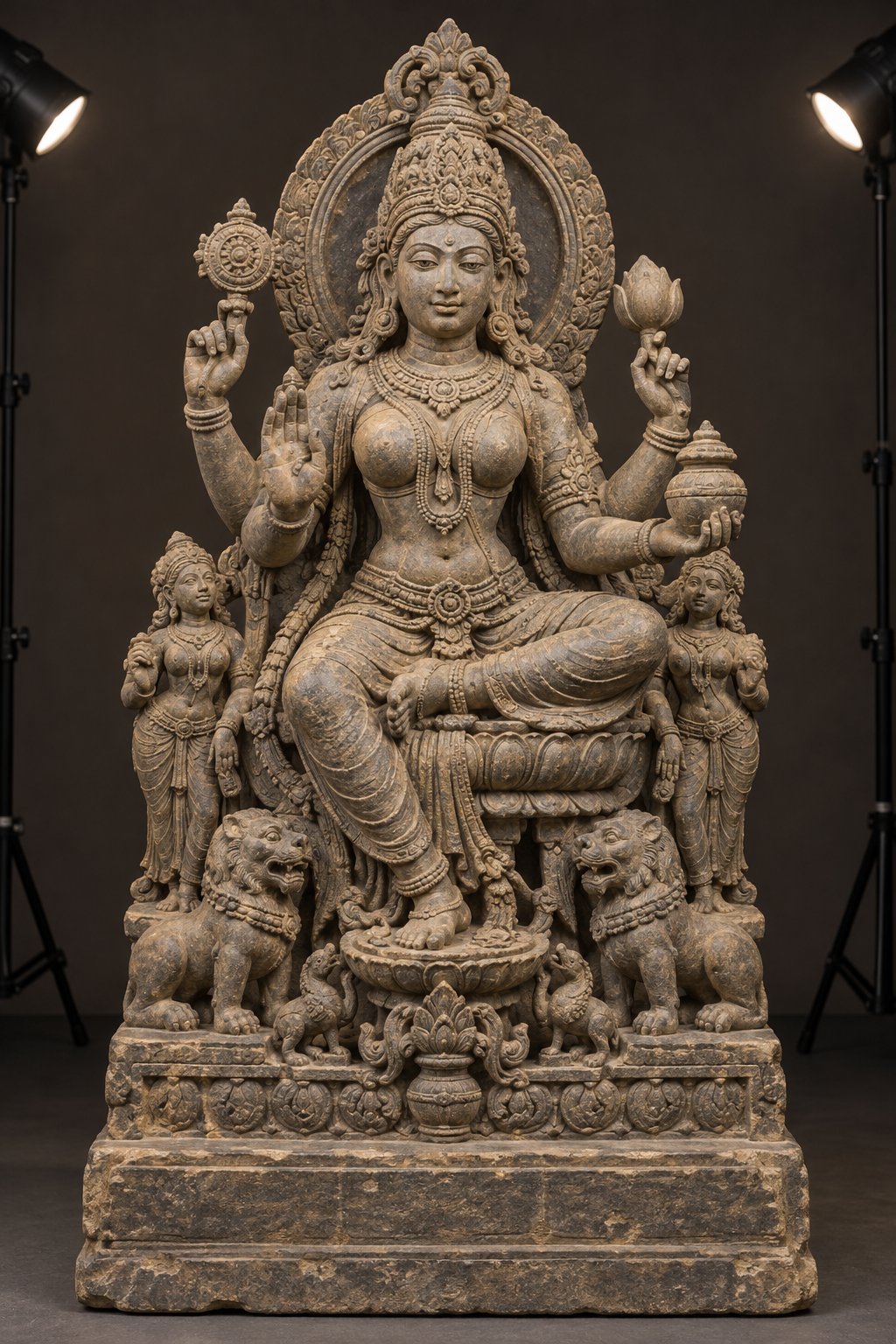
If you are trying to identify a murti, do not begin with the feature that looks most familiar. Record the image systematically before interpreting it. This prevents one assumed attribute from controlling everything else you see.
- Record the object’s context. Note whether it remains in worship, stands in an architectural niche, belongs to a museum collection, or appears without provenance. Record the temple, region, and original placement when these are known.
- Describe the complete figure. Count visible faces and arms. Record whether the deity sits or stands, the direction and crossing of the legs, the shape of the seat, and any halo or back-slab. Mark damaged or hidden areas instead of filling them in mentally.
- Map every hand. Work clockwise from the figure’s upper right. For each hand, record the object or gesture and whether the identification is certain, probable, or unclear. Do not treat a broken stem as a confirmed flower or a worn shape as a confirmed manuscript.
- Examine the pedestal and surrounding figures. Vehicles, attendants, donors, guardians, subsidiary deities, and the form of the seat may be more diagnostic than jewellery. Record their positions as well as their identities.
- Look for writing. Inspect the pedestal, back-slab, frame, architectural setting, old inventory cards, and temple records. Never chalk, scrape, oil, rub, or move a sacred or historic object to make faint marks visible; use careful lighting and ask the custodian for permission.
- Document the inherited name. Ask the priest, hereditary custodian, local devotees, museum registrar, or collection owner what the image is called and how that name was preserved. Write down the exact wording rather than silently normalizing it to a familiar Sanskrit name.
- Compare complete configurations. A meaningful comparison should match several independent features and an appropriate context. One common attribute is not enough.
Photographs should support this record. Take a straight frontal view, both three-quarter views, close images of the hands, pedestal, attendants, crown, and any inscription, plus one photograph showing the object in its setting. If photography is restricted, honour the restriction and rely on written observation.
| Evidence | What it can establish | Its main limitation |
|---|---|---|
| Legible inscription naming the deity | A strong connection between the recorded name and the object or its installation | The inscription still needs to be read in context and dated where possible |
| Continuous temple tradition | The living identity under which the murti is worshipped | It may not by itself explain the image’s original historical classification |
| Ritual or iconographic prescription tied to the form | A pattern against which the sculpture can be tested | A prescription from another lineage or context may not apply |
| Securely provenanced comparison | Whether multiple features form a recognizable configuration | A single matching object or gesture is weak evidence |
| Unattributed online caption | A lead worth investigating | It does not establish identity on its own |
This evidence is cumulative. A living name, a compatible sculptural configuration, and a relevant textual or epigraphic connection reinforce one another. When those supports are absent, the responsible result may remain “possibly Saubhagya Vageshwari.”
Keep description, interpretation, and identification separate
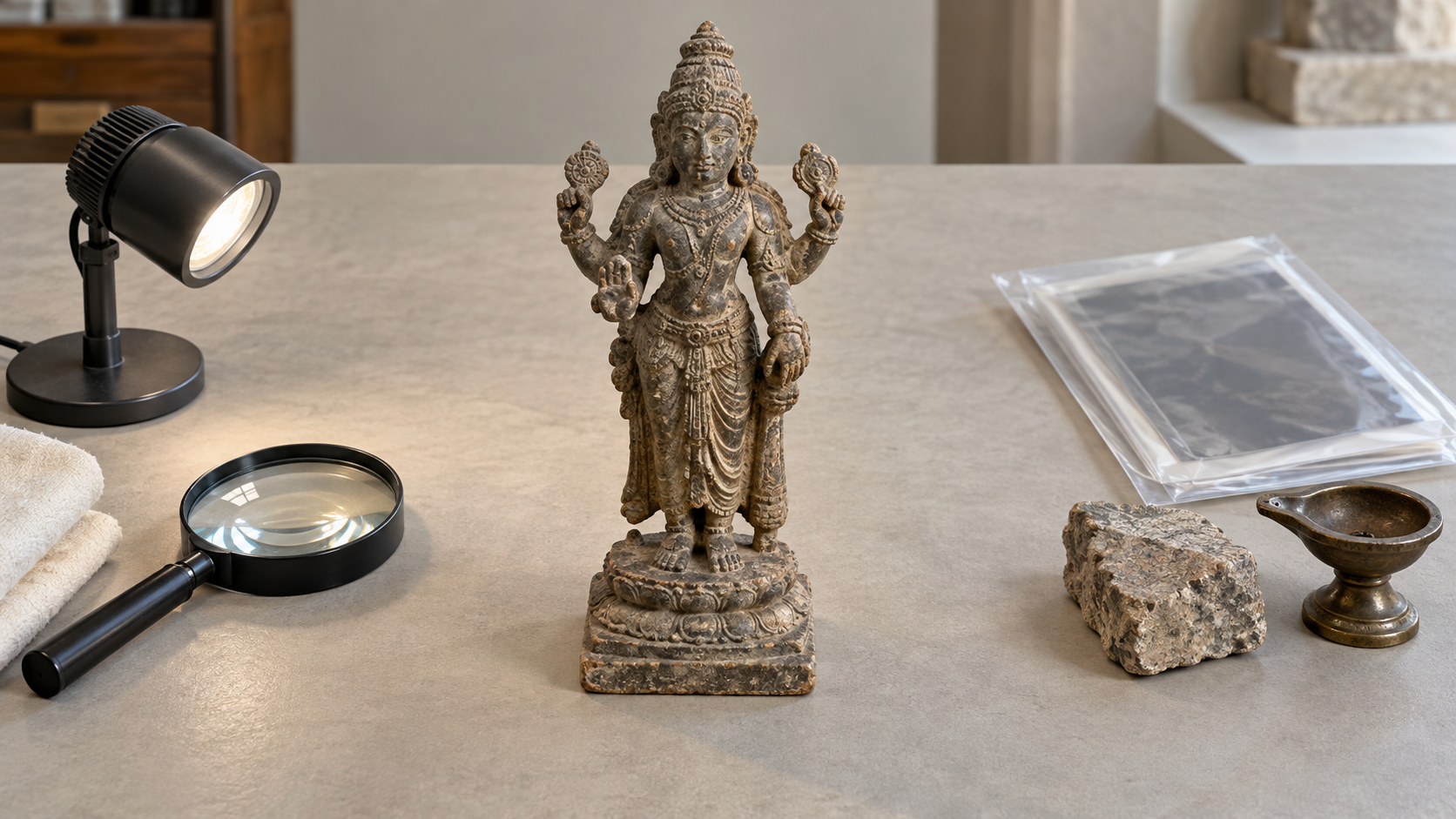
A useful record lets another person see where observation ends and judgement begins. Write each claim at the right level.
- Description: “The seated goddess has four visible arms; the upper-left object is damaged.” This reports what can be seen.
- Attribute interpretation: “The damaged object may be a book.” This proposes what a feature could be.
- Theological interpretation: “If it is a book, it may support an association with knowledge or sacred speech.” This explains possible meaning without pretending that the object proves the name.
- Identification: “The image may represent Saubhagya Vageshwari.” This evaluates the complete body of evidence.
Confidence language is not a weakness. Use “identified as” when the name rests on strong evidence, “traditionally worshipped as” when the living tradition is the central fact, “probably” when several independent features agree, and “possibly” when the proposal remains tentative. Use “unidentified goddess” when the evidence does not justify greater precision.
This also matters devotionally. A living temple identity is not disposable merely because an outside observer wants a neater museum classification. At the same time, reverence does not require inventing a mantra, meditation formula, ritual procedure, or promised benefit for a little-documented form. If you wish to worship the murti, follow the established practice of the temple or lineage connected with it. If no such connection is available, respectful contemplation of the divine qualities expressed by the name is more honest than presenting a newly assembled procedure as inherited tradition.
When publishing a photograph, preserve the distinction in the caption. Include the stated identity, location or collection if permitted, the basis of the attribution, and the uncertainty. A caption such as “Goddess traditionally worshipped locally as Saubhagya Vageshwari; precise date and attributes not established” gives future readers something they can evaluate. A bare, confident label does not.
Key takeaways
- Saubhagya Vageshwari is a rare form, so a repeated online label should not be mistaken for independent confirmation.
- The name links auspicious flourishing with sovereignty over speech, but that meaning does not supply an unsupported inventory of arms, objects, colours, or ritual details.
- Identify the complete sculptural program: posture, hands, attributes, pedestal, attendants, inscription, provenance, and living tradition.
- A legible inscription or continuous temple identity normally carries more weight than resemblance based on one common attribute.
- State your confidence openly: “traditionally worshipped as,” “probably,” and “possibly” are different claims.
- Do not manufacture a mantra, promised result, or worship procedure when the relevant lineage or ritual authority is unknown.
Your next step is simple: return to the image and make a feature-by-feature record before searching for another label. If the evidence supports Saubhagya Vageshwari, you will know why. If it does not, preserving the uncertainty is itself an act of care toward Bharatiya sacred heritage.
References

Leave a Reply
You must be logged in to post a comment.