
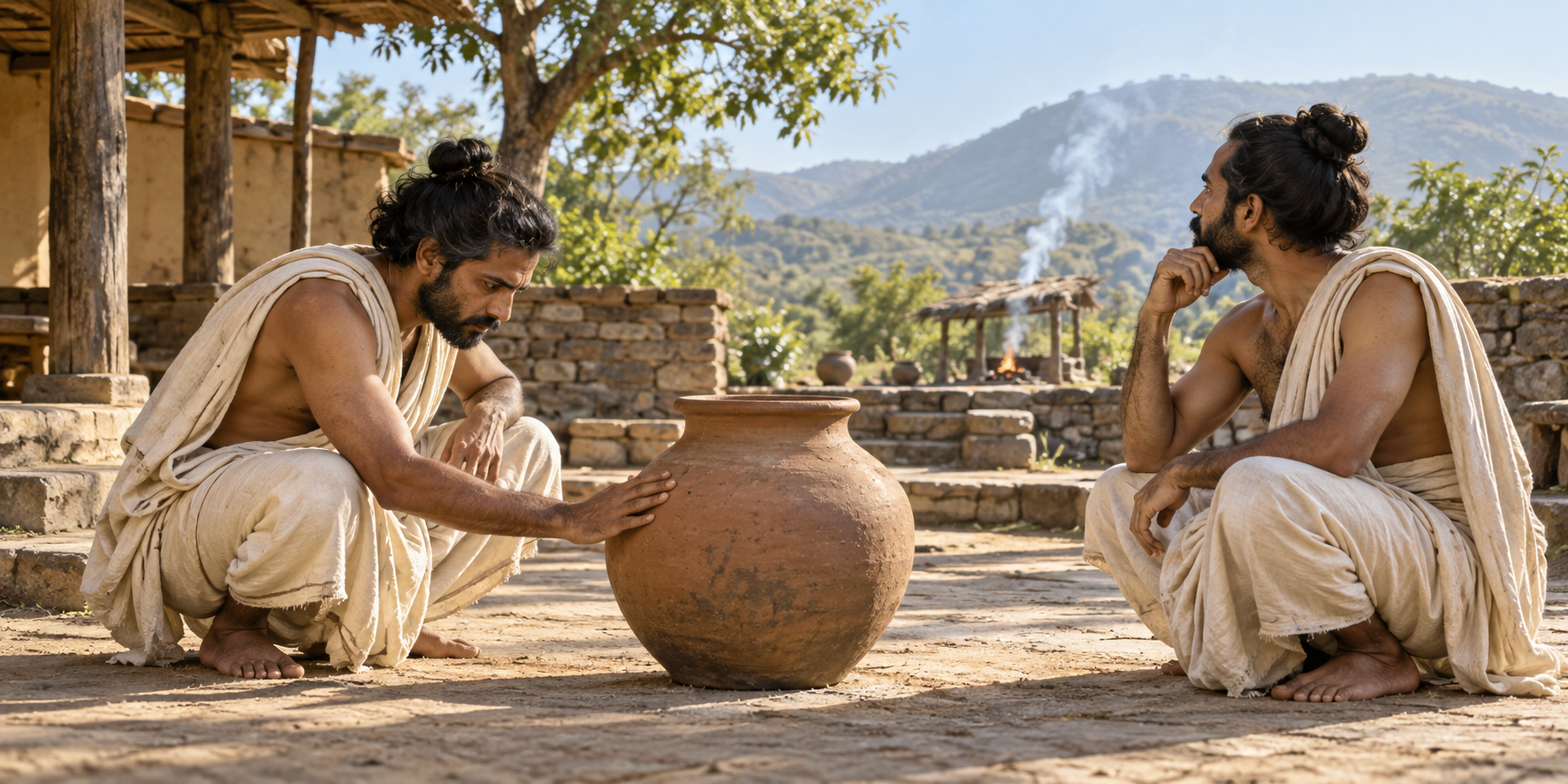
You are probably looking for a clean answer to a deceptively small question: what are the divisions of Charvaka philosophy? The short answer is Dhurta and Sushikshita. The useful answer is that they represent different degrees of skepticism, especially over whether inference can produce knowledge.
That distinction matters because Charvaka is often flattened into a few claims about materialism, pleasure or disbelief. Once you examine its divisions, a sharper philosophy appears: one tendency recognizes only direct perception as secure, while the other permits carefully limited inference within ordinary experience.
Two philosophical tendencies, not two rival religions
Charvaka, also called Lokayata, was a materialist and skeptical current of Indian philosophy commonly placed around the sixth century BCE. It disputed religious authority and metaphysical claims associated with Vedic, Buddhist and Jain traditions. Its importance lies not in the number of positions it accepted, but in the pressure it placed on every claim to knowledge: how do you know this, and what experience supports it?
The names Dhurta and Sushikshita organize two answers to that question. Dhurta represents the more radical position. Sushikshita, usually rendered as the learned or refined position, preserves a restricted role for inference. The difference can be stated compactly:
| Division | Secure basis of knowledge | Treatment of inference | Metaphysical result |
|---|---|---|---|
| Dhurta Charvaka | Direct perception | Inference cannot serve as an independently certain means of knowledge | Claims about an immortal soul, afterlife, unseen karma and other supersensible entities remain unproved |
| Sushikshita Charvaka | Perception remains primary | Ordinary inference may be used when grounded in observed experience | Inference still cannot establish transcendent entities beyond possible perception |
Use this as a map of philosophical positions, not as a census of two formally organized communities. The labels tell you how an argument handles evidence. By themselves, they do not establish separate institutions, lineages or bodies of scripture.
Dhurta Charvaka takes skepticism to its hardest edge

The technical issue is pramana, a recognized means by which knowledge is obtained. Dhurta Charvakas give that status to pratyaksha, direct perception. You see a flame, hear a sound or feel heat. The object is presented to your senses rather than supplied by a chain of reasoning.
Inference, or anumana, goes beyond what is immediately perceived. You see smoke and conclude that there is fire behind a wall. To make that conclusion certain, however, you need an invariant relation between smoke and fire. Indian philosophers call such a relation vyapti. The radical Charvaka objection asks how anyone could establish that universal relation without already relying on inference.
Repeated observation can show that smoke and fire occurred together in the cases you witnessed. It cannot place every past, present, future and hidden case before your senses. If another inference is used to bridge that gap, the attempt to justify inference has begun by assuming inference. Dhurta skepticism therefore refuses to treat it as an independently certain route to knowledge.
This does not have to mean that a person stops forming expectations or becomes unable to act. A likely outcome can guide conduct without being elevated into infallible knowledge. The important distinction is between using a pattern provisionally and claiming that the pattern proves something necessarily true.
The same demand bears directly on metaphysics. An immortal self, an unseen store of karmic merit or punishment after death cannot be directly perceived. If inference and religious testimony cannot securely establish such entities, the Dhurta position withholds belief. When you encounter the statement that Charvakas rejected inference, therefore, ask whether it means that they rejected all practical expectation or denied inference the status of certain knowledge. Those are not the same claim.
Sushikshita Charvaka allows inference within limits

Sushikshita Charvakas retain the priority of perception but do not treat every step beyond present sensation as equally defective. They allow a practical kind of inference rooted in repeated worldly experience. The conclusion remains accountable to perception rather than becoming a license to populate reality with entities that no experience can reach.
Suppose you find fresh footprints leading around a building and infer that someone recently passed that way. You did not perceive the person, so the conclusion is inferential. Yet it concerns an ordinary event that could, in principle, be confirmed, corrected or defeated by further observation. A hidden person, animal or artificial mark could change your conclusion. The reasoning remains answerable to the material situation.
Now compare that with an argument claiming that a ritual produces an imperceptible merit which guarantees a reward in another existence. The conclusion does not merely extend an observable pattern to an unseen nearby event. It introduces a postmortem mechanism that cannot be returned to ordinary perception for confirmation. Sushikshita Charvaka can accept the first kind of reasoning without accepting the second.
A practical way to recognize this boundary is to ask three questions:
- Did the reasoning begin with an observed pattern rather than an inherited assertion?
- Does the conclusion concern an event or object within ordinary material experience?
- Could further perception correct the conclusion if it proves mistaken?
These questions are a reading tool, not a claim that Sushikshita thinkers formulated the modern scientific method. The resemblance is limited to their insistence that inference remain tied to experience. Refined Charvaka is still Charvaka: admitting worldly inference does not restore scriptural infallibility, an immortal soul, supernatural karma or an afterlife.
Use a three-level test when reading a Charvaka argument

You can make the distinction operational by marking each proposition with one of three letters: P for perception, E for empirical inference and T for a transcendent conclusion. Then ask what each division would permit.
- P – Direct perception: The object or event is presently available to the senses. Both divisions treat this as the secure starting point.
- E – Empirical inference: The conclusion goes beyond what is presently sensed but remains connected to observed worldly regularities. Sushikshita Charvaka permits this within limits; Dhurta Charvaka denies that it becomes certain knowledge.
- T – Transcendent conclusion: The argument claims to prove an entity or process beyond possible perception, such as a disembodied immortal self or an unseen reward after death. Both divisions reject this move.
This test also stops you from confusing epistemology with ethics. A denial of postmortem reward does not logically prove that immediate pleasure is always the wisest choice. Pain, bodily consequences, dependence on other people, damaged trust and social retaliation all occur within this life. Moving from materialism to a complete ethical doctrine requires additional arguments; the theory of knowledge does not supply them automatically.
The same caution applies to the familiar claim that Charvaka is simply atheism. Disbelief in divine or supernatural entities may follow from its demands concerning evidence, but the more revealing question is how the conclusion was reached. Charvaka’s distinctive contribution is methodological: it challenges the route by which an unseen reality is declared known.
Frequently asked questions about the two divisions
Were Dhurta and Sushikshita separate organized sects?
You should not assume that from the labels alone. The distinction is most useful as a classification of philosophical tendencies: radical rejection of inference on one side, limited acceptance of experience-based inference on the other. It does not by itself prove the existence of separate institutions, founders, initiation systems or membership rolls.
Did Dhurta Charvakas reject reasoning altogether?
No such conclusion is necessary. Denying inference the rank of a secure pramana is different from never anticipating an outcome. A Dhurta Charvaka can recognize that a pattern is useful while refusing to call it universally certain. The philosophical target is inference’s authority, not the human ability to make a practical guess.
Does the refined division accept spiritual doctrines?
No. Sushikshita means refined in the handling of knowledge, not reconciled with religious metaphysics. Allowing an inference about an ordinary material event does not validate an inference about an immortal soul, an unseen karmic mechanism or another world.
Should Charvaka be called Hindu philosophy?
The answer depends on what the word Hindu is being asked to mean. Doctrinally, Charvaka opposes Vedic authority and metaphysical teachings accepted by many Hindu schools, so calling it orthodox Hindu thought would erase a real disagreement. Civilizationally, it belongs to the philosophical history of Bharat and participated in debate with Hindu, Buddhist and Jain traditions. Calling it foreign to Indian thought would be equally misleading.
The next time you meet a sweeping statement about Charvaka, mark its claims P, E or T before accepting the description. You will quickly see whether it belongs to Dhurta skepticism, Sushikshita empiricism or a caricature that has confused the two.
References

Leave a Reply
You must be logged in to post a comment.