
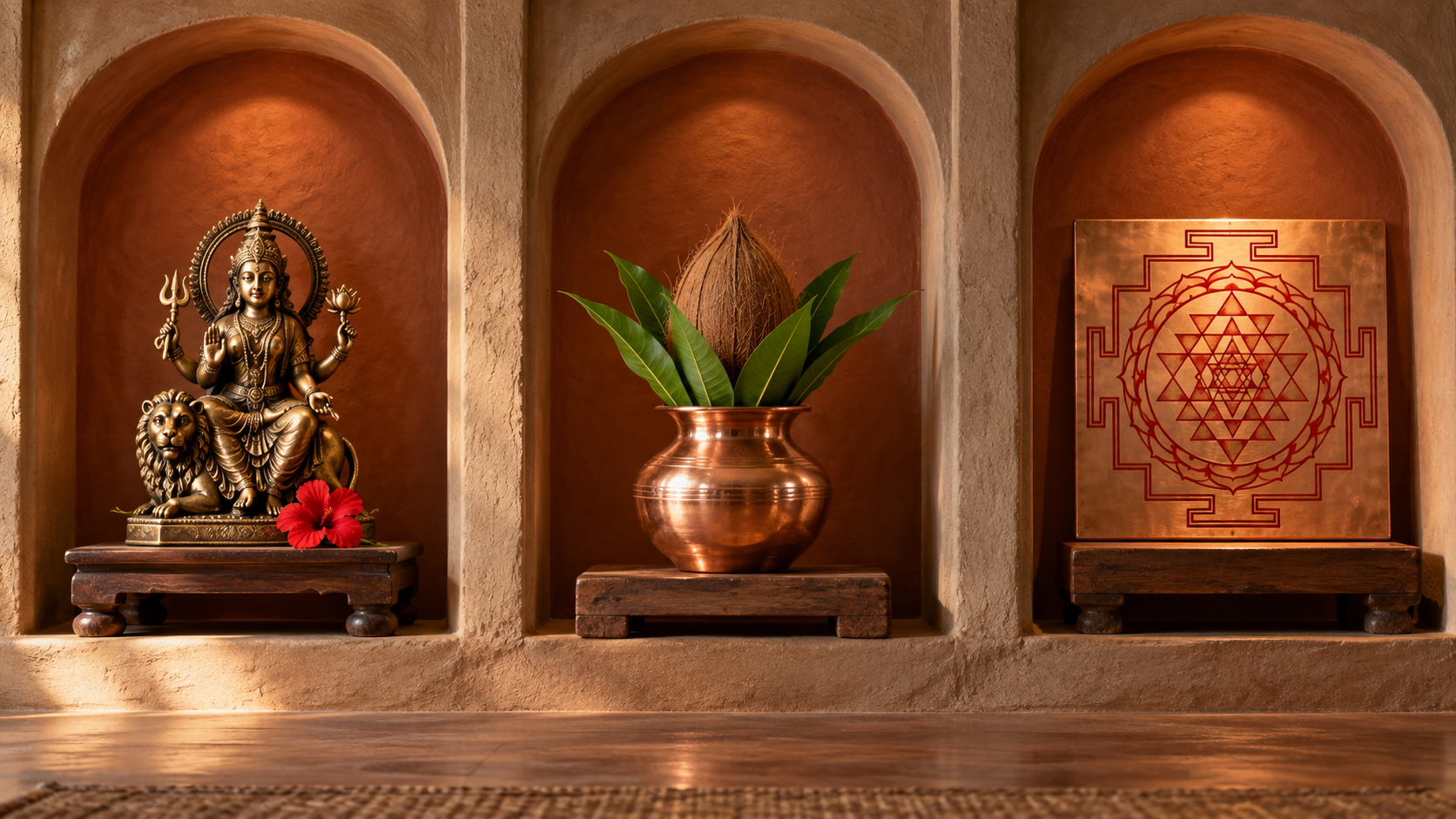
If you are preparing a place for Devi worship, the difficult question is often not whether to worship Shakti, but how to give that worship a visible centre. Should you place a murti or painted image before you, establish a sacred vessel, or use a yantra?
You do not need to rank these forms or collect all three. You need to understand what each one asks of you. The right choice is the form you can identify correctly, approach through a trustworthy tradition, and care for consistently.
Three forms, three ways of approaching Shakti
Icons, vessels, and yantras are not rival theories about where the Goddess resides. They are different ritual languages. A useful way to distinguish them is through three verbs: an icon invites you to behold, a vessel teaches you to receive, and a yantra asks you to contemplate.
The use of a ghata and yantra belongs to a longstanding repertoire of Shakti worship that is not dependent on an elaborate temple or anthropomorphic image. This matters when you are establishing a home practice: simplicity is not spiritual inferiority, and visual complexity is not proof of greater depth.
| Ritual focus | What it emphasizes | When it may fit | Common mistake |
|---|---|---|---|
| Icon or murti | Relationship with a named and recognizable form of Devi | You know whom you are worshipping and want a personal devotional centre | Choosing an unfamiliar image only for its appearance |
| Ghata or sacred vessel | Presence received and honoured in a prepared receptacle | Your inherited or temple practice calls for a vessel, especially within a defined observance | Treating an established vessel like an ordinary household container |
| Yantra | Concentration through an exact sacred diagram | You know the yantra’s identity and have reliable instructions for approaching it | Using unidentified geometry as a generic charm |
These are practical distinctions, not universal rules imposed on every sampradaya. Family customs, regional traditions, temple procedures, and initiated disciplines may organize them differently. Where you have received specific instruction, that instruction should govern your practice.
Choose an icon when the Goddess’s form guides devotion
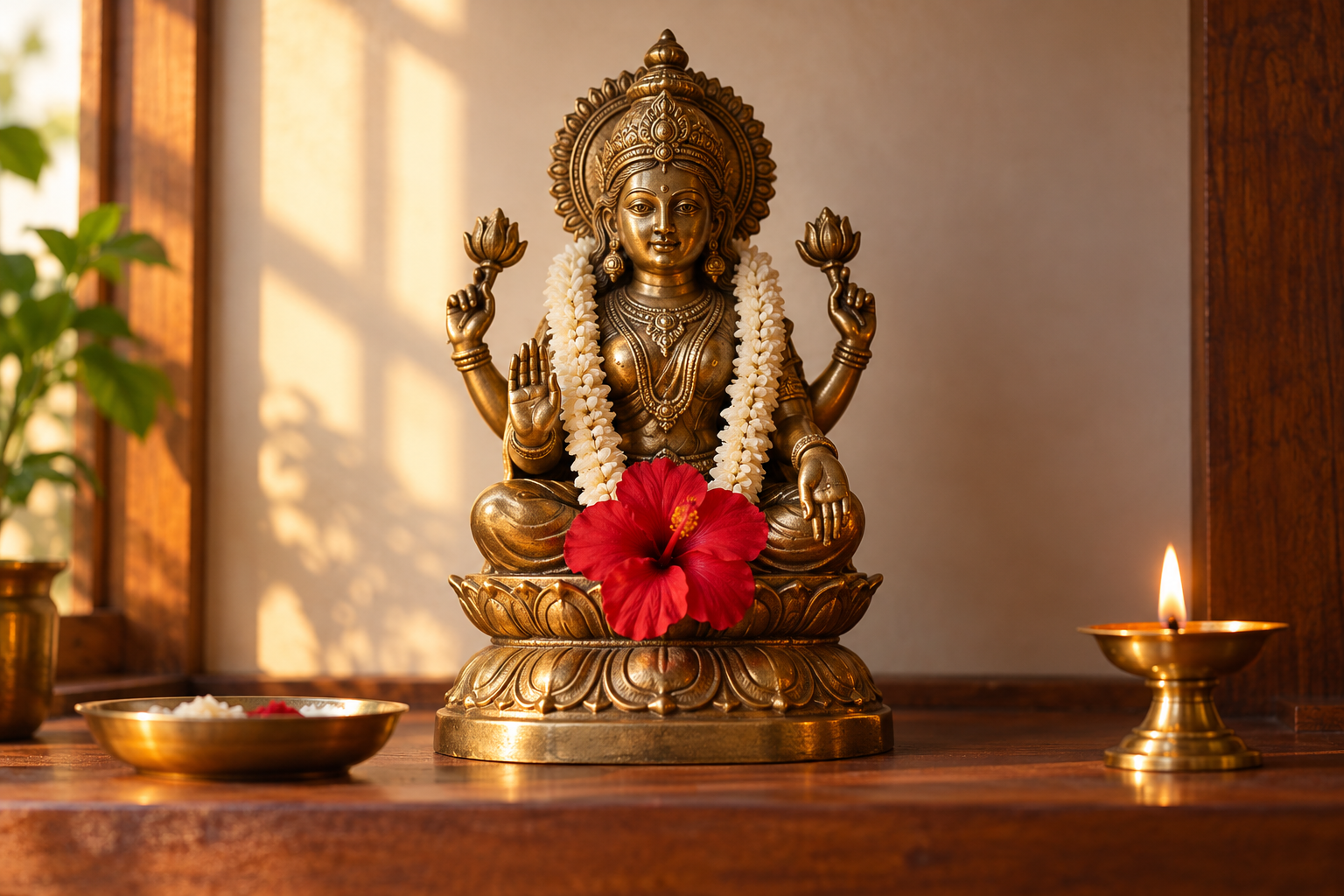
A murti or painted image is the clearest choice when your worship is centred on a named form of Devi. Her face, posture, gestures, implements, ornaments, vehicle, and surrounding figures can communicate aspects of her nature. Iconography is therefore not ornamental packaging. It helps tell you whom you are facing and how that form is understood.
This becomes especially important with less familiar manifestations. Dhenu Vageshwari is a specialized form within the Srividya tradition, understood as a variant of Vageshwari and associated with sacred speech and wisdom. If such an image is detached from its identity and ritual setting, its distinctive theology can be reduced to an attractive picture.
Before making an unfamiliar icon the centre of your altar, ask four questions:
- Can you name the form accurately rather than merely calling every female figure “Devi”?
- Do you know what its principal features signify, at least at a basic level?
- Does this form belong to a practice you have inherited, learned, or can responsibly learn?
- Can you provide a clean, stable, and respectful place without repeatedly moving the icon for convenience?
If the answer to the first two questions is no, pause before treating the image as your principal ritual focus. Learn its name and context first. An icon chosen because it is fashionable, dramatic, or commercially labelled “powerful” may draw you toward a ritual identity you do not actually understand.
It is also useful to distinguish a devotional image from a formally installed or consecrated murti. Do not assume that every printed picture, newly purchased statue, and temple murti carries identical ritual obligations. Consecration, installation, daily service, and decommissioning are governed by traditions more specific than the object’s material. If you are unsure whether a formal rite has created continuing duties, ask the priest, guru, temple, or family elder responsible for that rite.
Choose a ghata when worship is organized around receiving presence
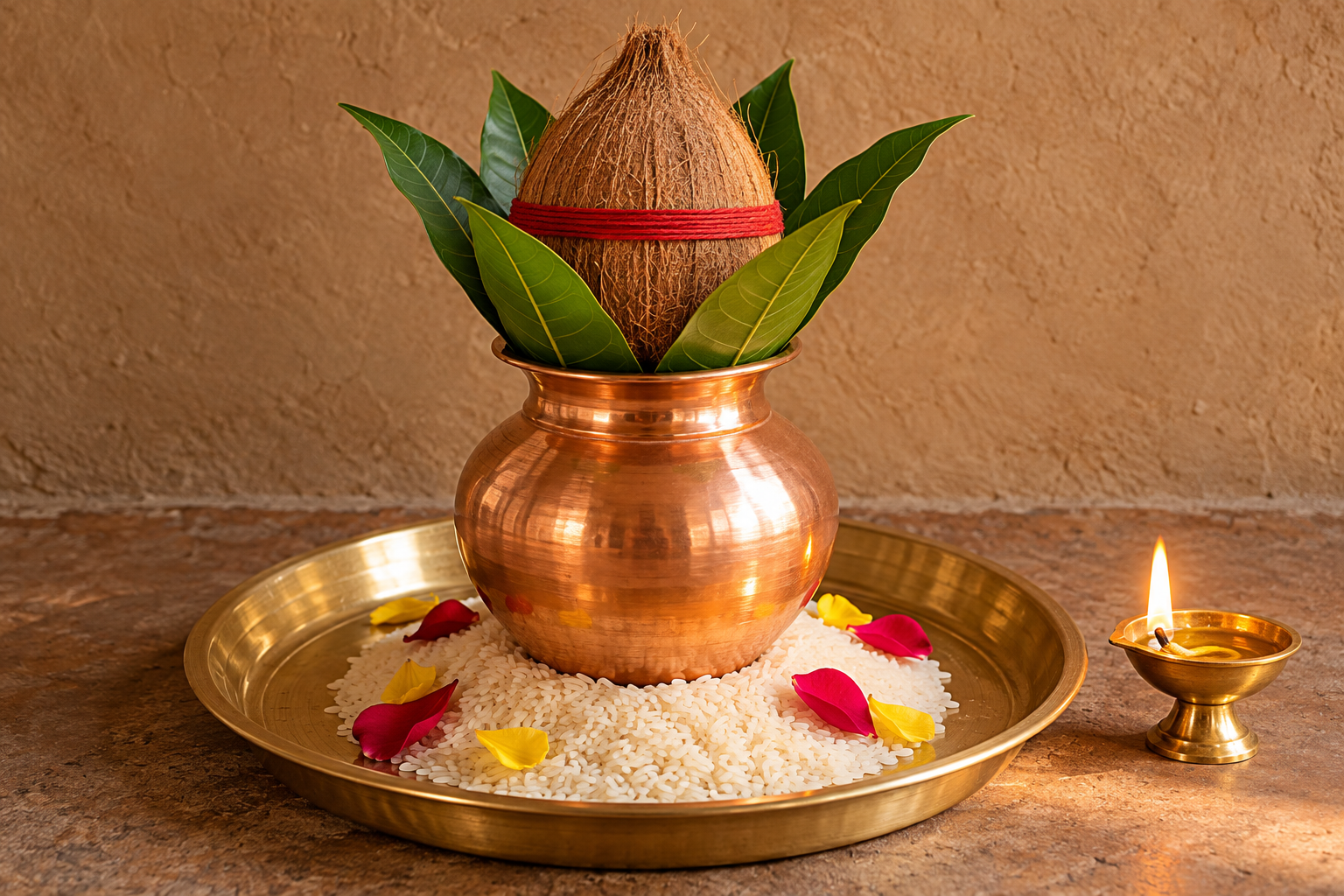
A ghata does not portray the Goddess anatomically. It provides a prepared vessel through which her presence is invoked and honoured. That difference is easy to miss. The icon places a meaningful form before your eyes; the vessel emphasizes readiness, containment, hospitality, and sacred designation.
This is why vessel worship should not be dismissed as a makeshift substitute for a murti. The worship of Shakti through sacred pots belongs to an ancient mode of approaching the Divine Mother. Its relative simplicity of appearance does not make the act casual.
A ghata may be the better choice when your family, festival, vrata, or temple procedure explicitly calls for it; when the observance has a clear beginning and completion; or when you need a non-anthropomorphic focal form and possess reliable instructions. It is not the better choice merely because acquiring a pot is easy.
Prepare for vessel worship in this order:
- Learn the procedure before assembling anything. The vessel’s material, contents, adornment, mantras, and placement can vary. Do not build a universal recipe from fragments taken from unrelated traditions.
- Choose an intact and stable vessel. It should stand securely in the place where the observance will occur. A precarious arrangement creates distraction and can turn ordinary movement into disrespect or damage.
- Set it apart from ordinary use. Once a vessel has been designated for worship, do not casually return it to kitchen or storage use during the observance.
- Know who will maintain it. If the rite extends beyond one sitting, decide who will keep the area clean and complete the required daily attention.
- Plan the completion before the invocation. Ask how your tradition concludes the worship and handles the vessel and its contents. Beginning without knowing the closing procedure is the most avoidable form of confusion.
The object is not sacred simply because its shape resembles a ritual pot. Preparation, intention, invocation, and the rules of a living practice give the ghata its role. That is also why you should not leave an established vessel unattended, repurpose it midway, or improvise its conclusion.
Choose a yantra when exact form disciplines attention
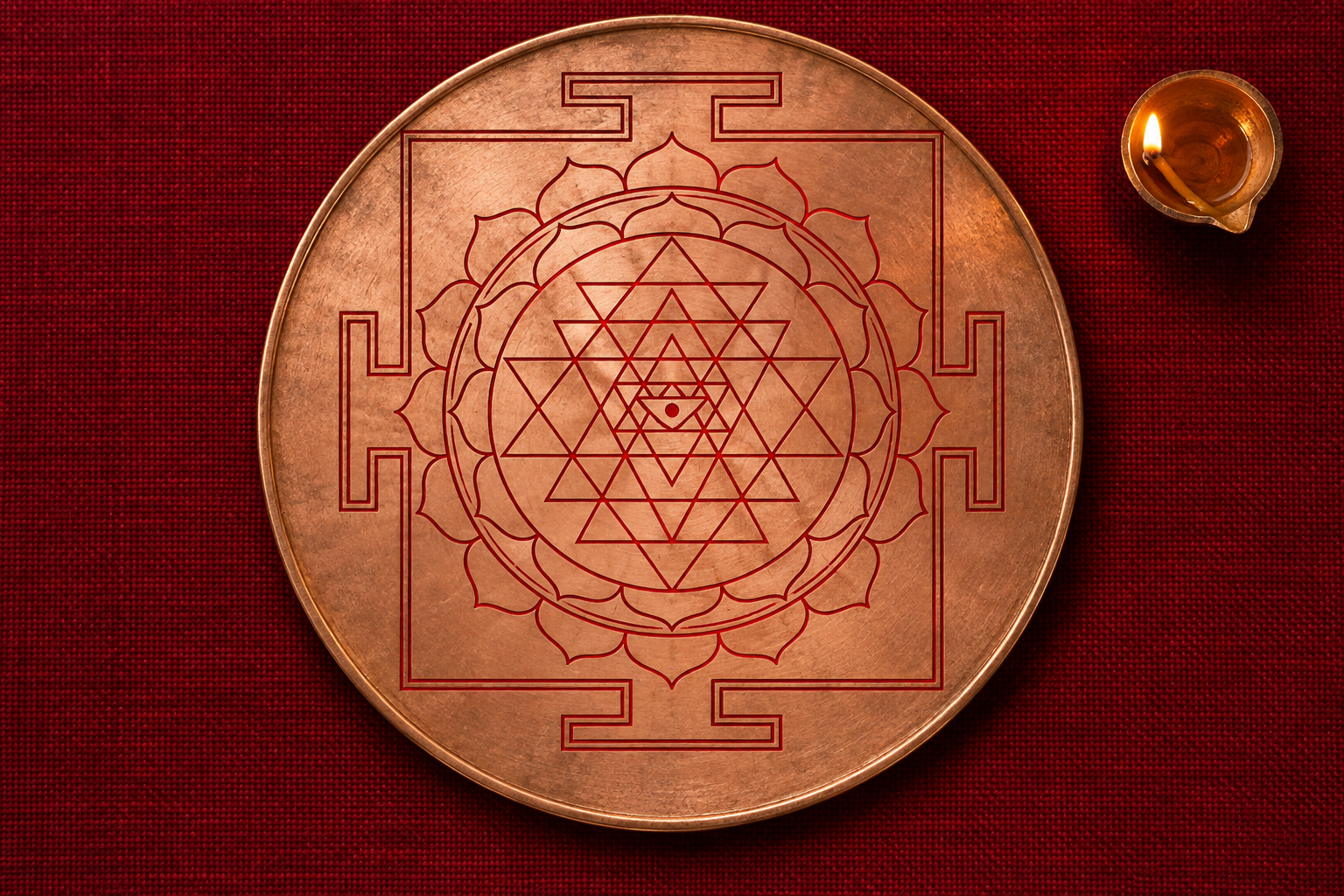
A yantra is not generic “spiritual geometry.” It is a particular sacred diagram whose arrangement matters. Its boundary, lines, intersecting forms, petals, centre, inscriptions, and orientation may all participate in its ritual identity. Two designs that look similar to an untrained eye should not be assumed to be interchangeable.
Yantra worship can be visually spare while remaining ritually demanding. The diagram limits wandering attention and directs it toward an ordered whole. That makes it useful for disciplined contemplation, but it also makes accuracy more important than decoration.
Before placing a yantra on your altar, check the following:
- Identity: You should know the yantra’s proper name and the deity or tradition with which it is associated.
- Integrity: Confirm that the design is complete and has not been cropped, mirrored, stylized, or altered to suit a product.
- Orientation: Learn how it is meant to be placed rather than rotating it until it looks pleasing.
- Level of practice: Distinguish respectful devotional attention from rites that require initiation, mantra transmission, nyasa, or detailed lineage instruction.
- Legibility: If the diagram contains syllables or inscriptions you cannot verify, do not guess what they say or retrace them from an unclear reproduction.
A mass-produced yantra is not automatically unsuitable, but commercial claims are not ritual authority. Phrases such as “instant protection,” “guaranteed prosperity,” or “works without worship” should make you more cautious, not more confident. Verify the diagram through the temple, teacher, family practice, or sampradaya from which you are learning.
This caution matters particularly in specialized traditions such as Srividya. You can appreciate the theological meaning of a diagram without pretending to possess an initiated practice. If a mantra or internal rite has not been transmitted to you, do not reconstruct it from disconnected instructions. Respectful restraint is not lack of devotion.
Build one coherent practice instead of an altar collection
You may encounter households and temples where an icon, ghata, and yantra are used together. That does not mean that assembling the same objects will reproduce the same worship. In an established ritual system, each has a place, relationship, and sequence. Without that structure, adding objects usually adds uncertainty rather than depth.
Use this decision sequence when beginning or simplifying your own space:
- Name your devotional centre. Decide which form of Devi you are actually approaching. “Shakti” is the broad theological reality; your practice may still require a particular name and form.
- Name the authority for the practice. This might be your family custom, a temple procedure, a guru, or a recognized sampradaya. Do not switch authorities from one ritual step to the next merely because an online instruction is more convenient.
- Choose one primary support. Let the icon, vessel, or yantra organize the space. Additional objects should have a known purpose rather than competing for attention.
- Match complexity to sustainable care. A small, regular practice is more coherent than an elaborate arrangement you cannot maintain. Complexity increases duties; it does not guarantee concentration.
- Separate permanent and temporary elements. Know what remains on the altar, what belongs only to a defined observance, and how temporary worship is respectfully concluded.
- Review before expanding. If you cannot explain why an object is present, set it aside until you can identify it and learn how it belongs.
Key takeaways
- An icon supports devotion through the recognizable form and attributes of a named Devi.
- A ghata emphasizes sacred presence received in a prepared vessel and requires a clear completion procedure.
- A yantra supports concentrated attention through an exact diagram; it should be identified and verified before ritual use.
- Older, simpler, or more abstract does not automatically mean more authentic or spiritually advanced.
- Where a practice requires initiation or lineage instruction, visual familiarity is not a substitute for transmission.
- The best starting form is the one you understand, can maintain, and can approach without inventing missing steps.
Begin by looking at the centre of your present altar. Identify every object, remove anything you cannot place within your practice, and choose the single form that will organize your attention. Then learn its proper mode of care before adding anything else. Shakti worship becomes clearer when every material form has a reason to be there.
References
- Hindu Blog — Dhenu Vageshwari: Goddess of Word and Wisdom – Iconography & Symbolism
- Hindu Blog — Before the Image – How Was Shakti Worship Performed?

Leave a Reply
You must be logged in to post a comment.