
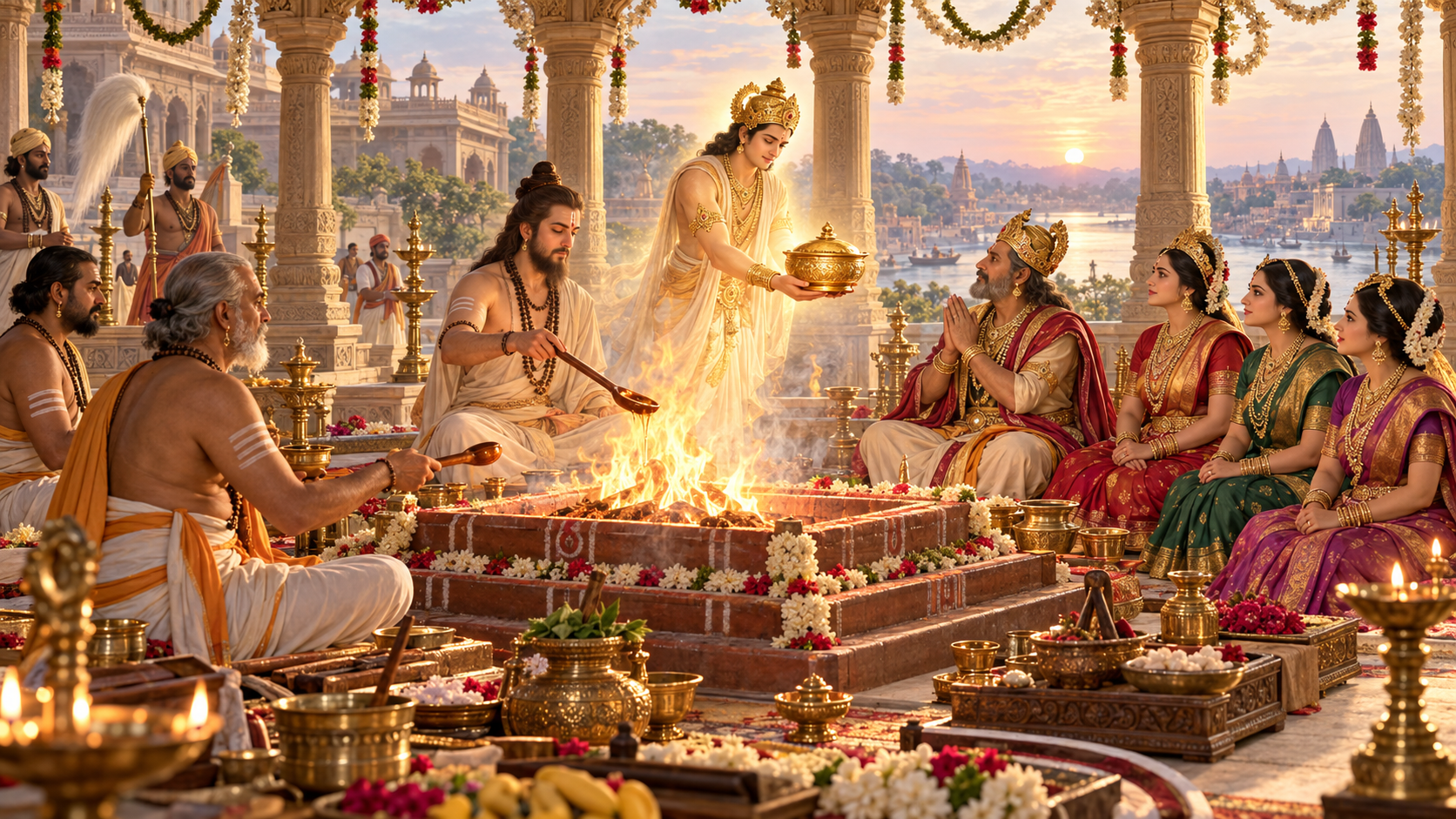
You may have arrived with a deceptively simple question: did King Dasharatha perform the horse sacrifice or Putrakameshti Yajna for the birth of Rama? Both belong to the account, but they are not two names for the same event. The horse sacrifice came first. The son-seeking yajna followed.
That sequence helps you read the birth of Rama without reducing it either to a magical formula or to an empty symbol. Putrakameshti is a sacred response to a crisis of lineage, responsibility and hope. Its meaning lies in the relationship between a rightful desire, disciplined ritual action and an outcome received as grace.
Dasharatha’s two sacrifices should not be confused
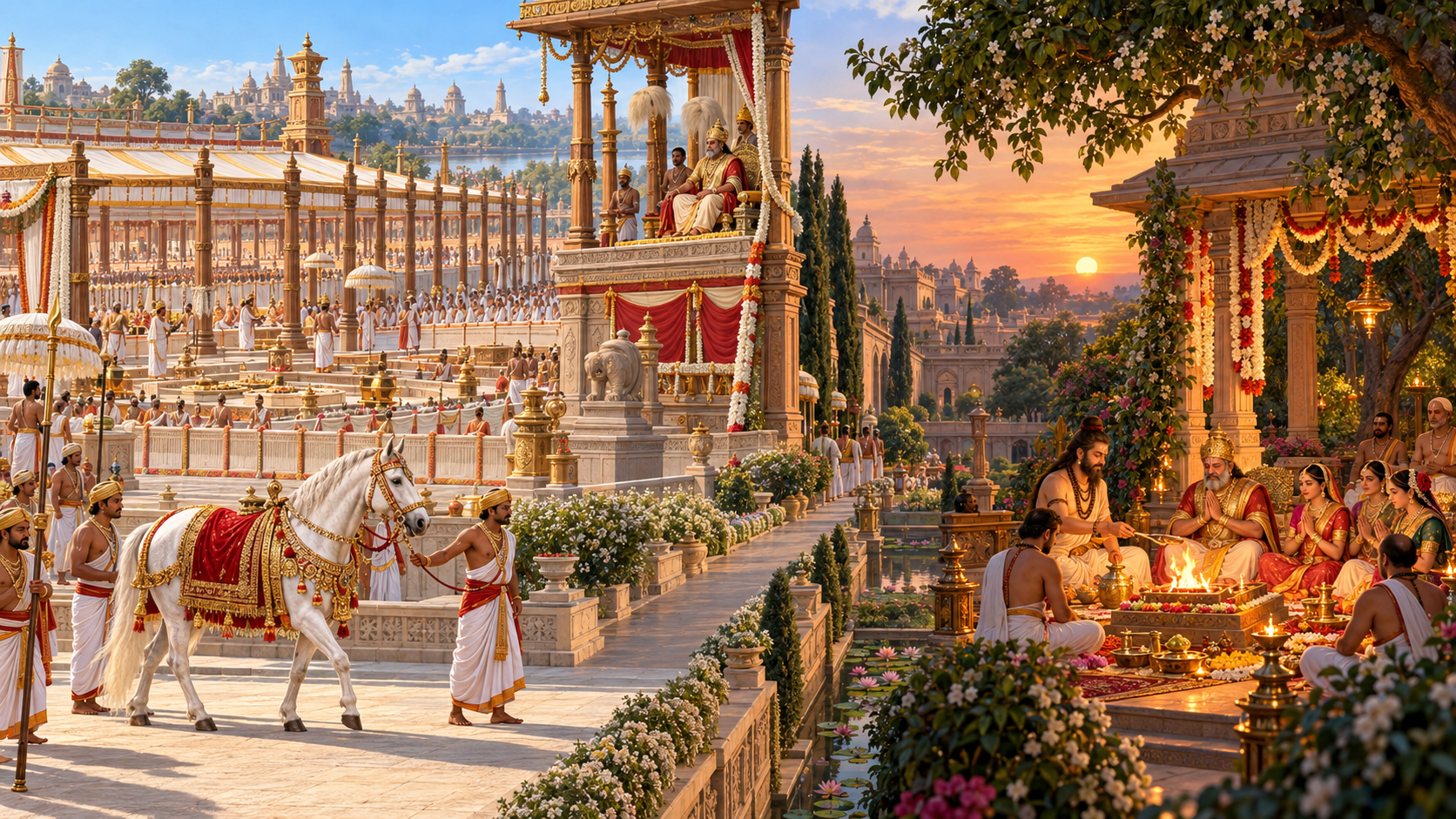
Bala Kanda frames the crisis plainly: Dasharatha had remained without a son for many years and feared that his lineage would not continue. This was personal sorrow, but it was also a problem of kingship. In a hereditary kingdom, uncertainty about succession reaches beyond the royal household.
Dasharatha first performed a horse sacrifice. Putrakameshti, the special yajna directed toward obtaining sons, came afterward. Remembering that order prevents a common misunderstanding: the horse sacrifice and Putrakameshti had related places in the narrative, but they were not interchangeable rites with identical purposes.
The name itself identifies the intention. Putra refers to a son, kama to desire, and ishti to a sacrificial offering or rite. In Dasharatha’s situation, the desire was not presented as a passing private preference. It concerned the continuation of a royal lineage and the future discharge of dynastic duties.
This distinction matters if you hear the story in a discourse or discuss it at home. Ask which stage is being described. If the speaker is discussing royal consecration, sovereignty or the horse sacrifice, that is the preceding stage. If the focus is the prayer for sons and the births of Rama and his brothers, Putrakameshti is the relevant rite.
Why Atharva Veda mantras belong to Putrakameshti
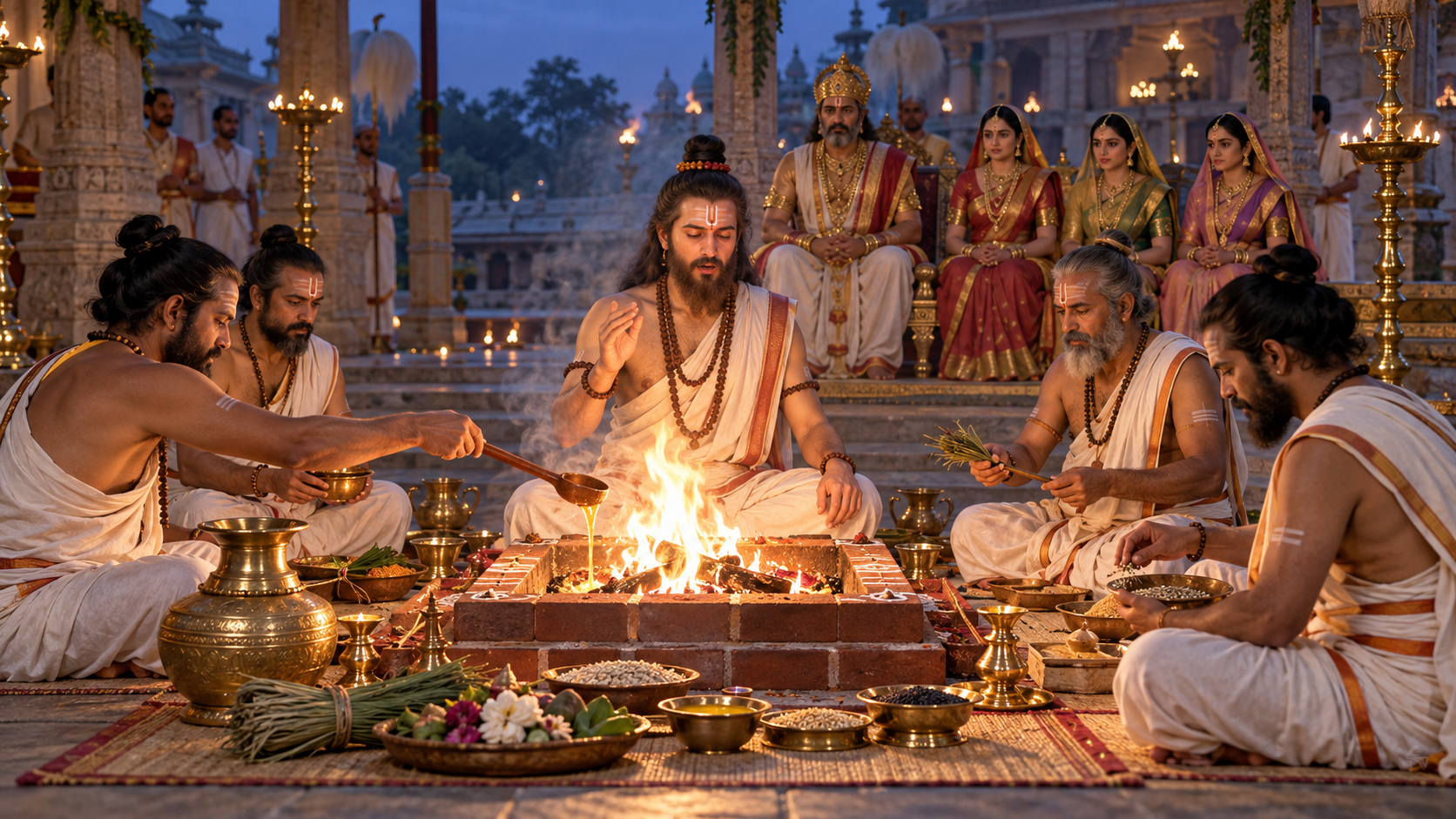
The Atharva Veda connection is not a decorative detail. Atharvan sacred speech is closely concerned with needs that enter embodied and household life, including protection, well-being, family continuity and the fulfilment of legitimate human aims. A rite concerning offspring therefore belongs within a Vedic world in which household responsibilities are not treated as spiritually trivial.
The Atharva Veda mantras associated with the birth of Rama and his brothers should not be imagined as passwords that work independently of everything around them. In a yajna, mantra, intention, offering, discipline and proper performance form one sacred action. Isolating a few syllables while ignoring that larger order changes the nature of the practice.
This also explains how you should treat claims about hidden mantras. Hidden may simply mean overlooked in popular retellings, which often move quickly from Dasharatha’s anxiety to the princes’ births. It does not automatically mean that a secret formula has been discovered for casual repetition. Vedic mantras have context, pronunciation and ritual application; searching for a detached formula misses the structure that gives the words their place.
The larger insight is distinctly dharmic: spirituality does not begin only after family, society and embodied life have been left behind. The Vedic householder brings those concerns into a sacred discipline. The desire is acknowledged, examined and placed within an order greater than personal appetite.
How the yajna is connected to Rama’s birth
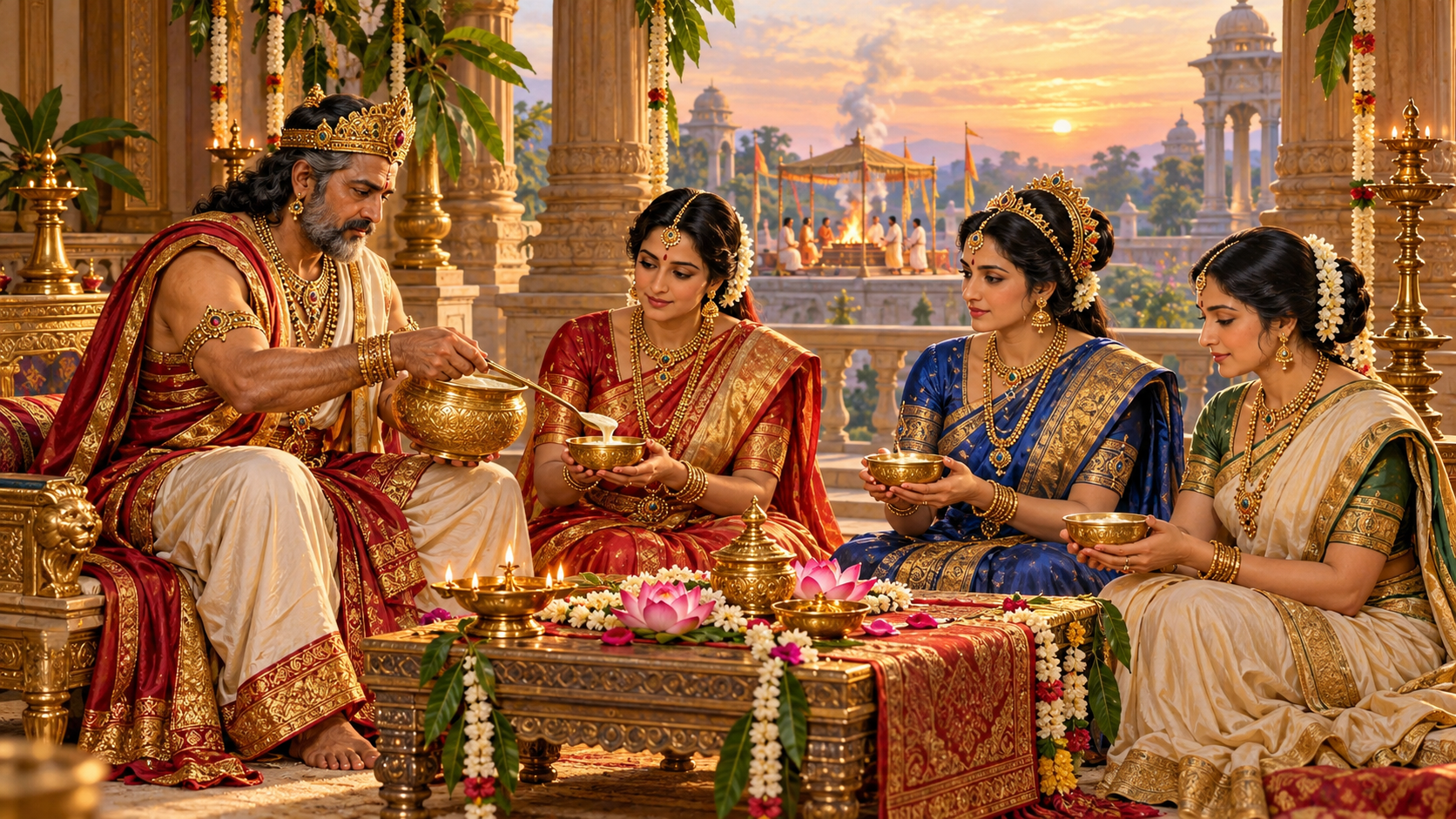
Within the sacred narrative, the connection is direct. Dasharatha lacks an heir, undertakes the prescribed rites, and the birth of Rama and his brothers resolves the crisis. Putrakameshti is therefore not incidental background. It is the ritual turning point between a kingdom without continuity and a royal household through which the Ramayana’s central action can unfold.
You can recognize three dimensions in that connection without forcing them into competition. At the narrative level, the yajna moves the story from barrenness to birth. At the devotional level, the births are received as the fruit of sacred action and divine grace. At the ethical level, Dasharatha’s wish is submitted to discipline rather than pursued by impulse alone.
None of this requires you to turn the Ramayana into a modern clinical claim. A sacred account of an efficacious yajna is not evidence that a ceremony guarantees conception in every individual case. But it would be equally careless to erase the rite’s efficacy from the devotional reading and call it merely theatrical. The narrative asks you to take the yajna seriously within its own sacred world.
The careful reading therefore avoids two extremes. One treats Putrakameshti as a mechanical technology that compels a result. The other treats it as an irrelevant ornament attached to a birth that would have happened in exactly the same narrative way without it. The Ramayana’s pattern is subtler: human beings act through dharmic means, while the fruit is ultimately received rather than controlled.
Putrakameshti disciplines desire rather than denying it
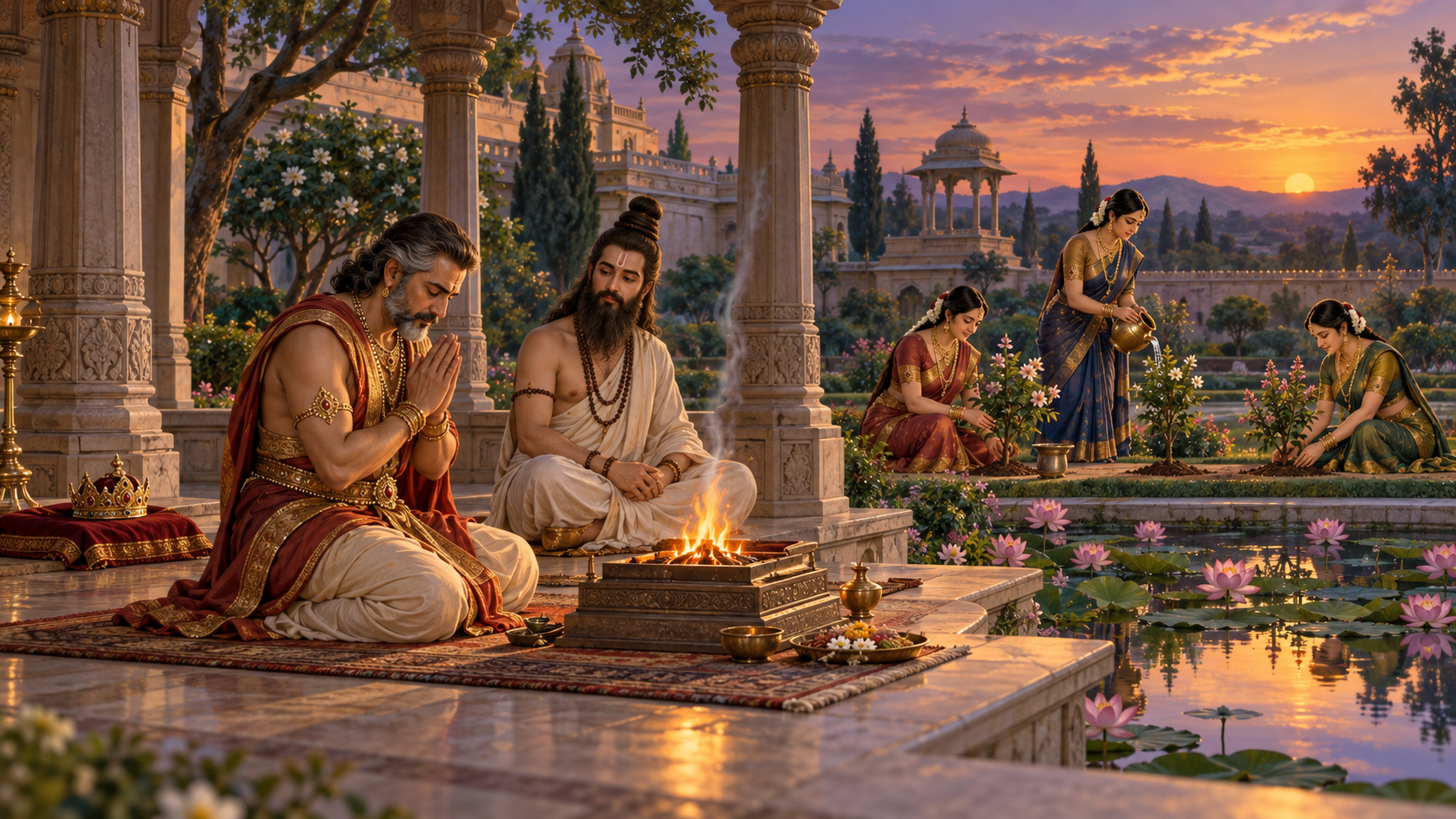
Dasharatha’s longing is not condemned simply because it is a longing. Dharma asks a different set of questions. Is the desire legitimate? What duties accompany its fulfilment? Are the means worthy of the end? Can the person act sincerely without claiming ownership over the result?
Those questions make Putrakameshti relevant even to a reader who will never commission the rite. A wish becomes dharmic not merely because it feels intense, but because it is placed within responsibility, restraint and sacred order. Dasharatha seeks continuity, but the sons he desires will not exist merely for his emotional satisfaction. Their birth carries obligations to family, kingdom and dharma.
If you are considering a Putrakameshti today, begin by asking a qualified acharya what will actually be performed. Request the name and textual basis of the rite, the Vedic tradition being followed, the preparation expected of the participants, the materials required and the complete cost. A responsible explanation should distinguish the ritual intention from a guaranteed outcome.
Be cautious when someone markets a mantra or yajna as a certain way to conceive. That promise turns sacred practice into a transaction and can exploit people at a vulnerable moment. No fee, offering or recitation gives a seller control over the fruit of karma or grace.
If delayed conception is part of your own situation, spiritual observance and medical care address different needs. A yajna may express faith, prayer and family commitment, but it should not replace assessment by an appropriately qualified medical professional. Keeping both in their proper places protects you from having to choose between shraddha and responsible care.
Key takeaways
- Dasharatha’s lack of a son created both a personal sorrow and a problem of royal succession.
- The horse sacrifice came first; Putrakameshti was the subsequent yajna specifically directed toward obtaining sons.
- The Atharva Veda connection places family continuity within the sacred concerns of Vedic household life.
- Mantras belong to a complete ritual discipline and should not be treated as detached magical formulas.
- The Ramayana connects the yajna with the births of Rama and his brothers, but that sacred connection is not a modern medical guarantee.
- If you plan to commission the rite, verify its lineage, procedure, expectations and full cost, and reject promises of a certain result.
When you next read Bala Kanda, pause at the sequence instead of rushing directly to Rama’s birth. Dasharatha first recognizes a duty that cannot be solved by royal power alone, then submits his desire to sacred order. If the story moves you toward action, let your next step carry the same combination of faith and discernment: consult a qualified acharya, keep medical care in view where needed, and approach the fruit as grace rather than a purchase.
References

Leave a Reply
You must be logged in to post a comment.