
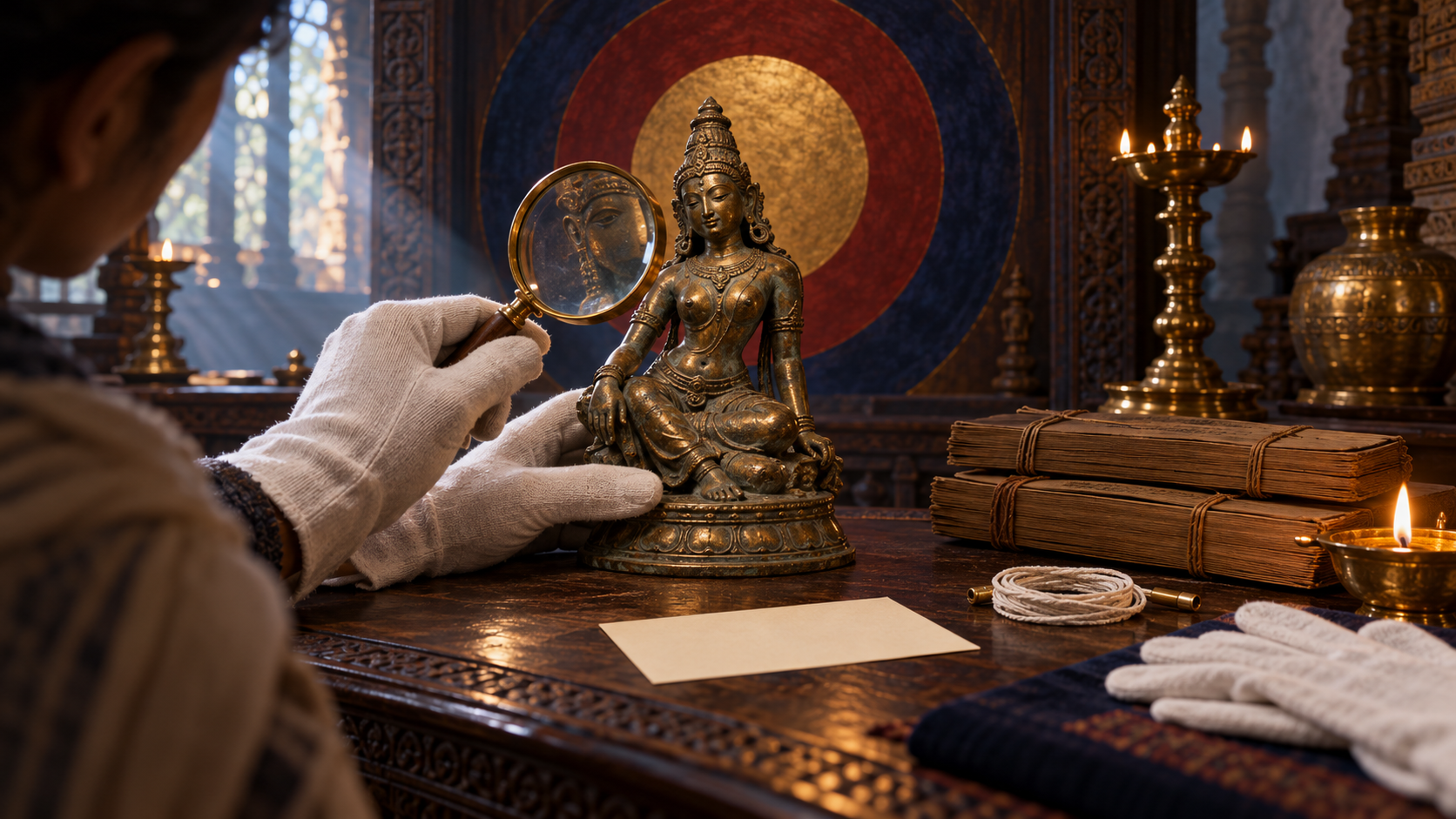
You may have found the name Samvid Tripura Devi beneath an unfamiliar image and expected a simple identification: a colour, a hand count, a set of objects, or one decisive gesture. That kind of checklist is not presently secure for this rare Srividya form. Borrowing one from a better-known Devi may create a confident misidentification.
You can still read the form meaningfully. Begin with what the name establishes, document only what the image actually shows, and let regional or lineage-specific evidence determine the rest. That approach gives you a defensible interpretation without turning uncertainty into invented tradition.
The name is the safest doorway into the image

Samvid means consciousness, awareness, or the power of knowing. It does not merely describe a goddess who possesses wisdom. It directs attention to wisdom as divine presence: the knower, the act of knowing, and the light by which anything becomes knowable.
Tripura is a threefold designation. Different Shakta settings can connect such threefold language with different triads, so the word should not be forced into one fixed explanation without evidence from the tradition responsible for the image. What you can safely notice is the theological movement: consciousness is not confined to one layer of experience.
Devi completes the reading. Consciousness is approached here not as a cold abstraction but as sacred, feminine presence. The name therefore gives you a sound interpretive centre even when the visible attributes remain uncertain: Samvid Tripura Devi is wisdom or conscious awareness encountered as the Goddess.
This also prevents a common error. A shared word such as Tripura may indicate a relationship among forms, but it does not prove that two named Devis have identical iconography. Do not silently replace Samvid Tripura Devi with a more familiar Tripura form simply because more images of the latter are available.
Rarity changes the burden of proof
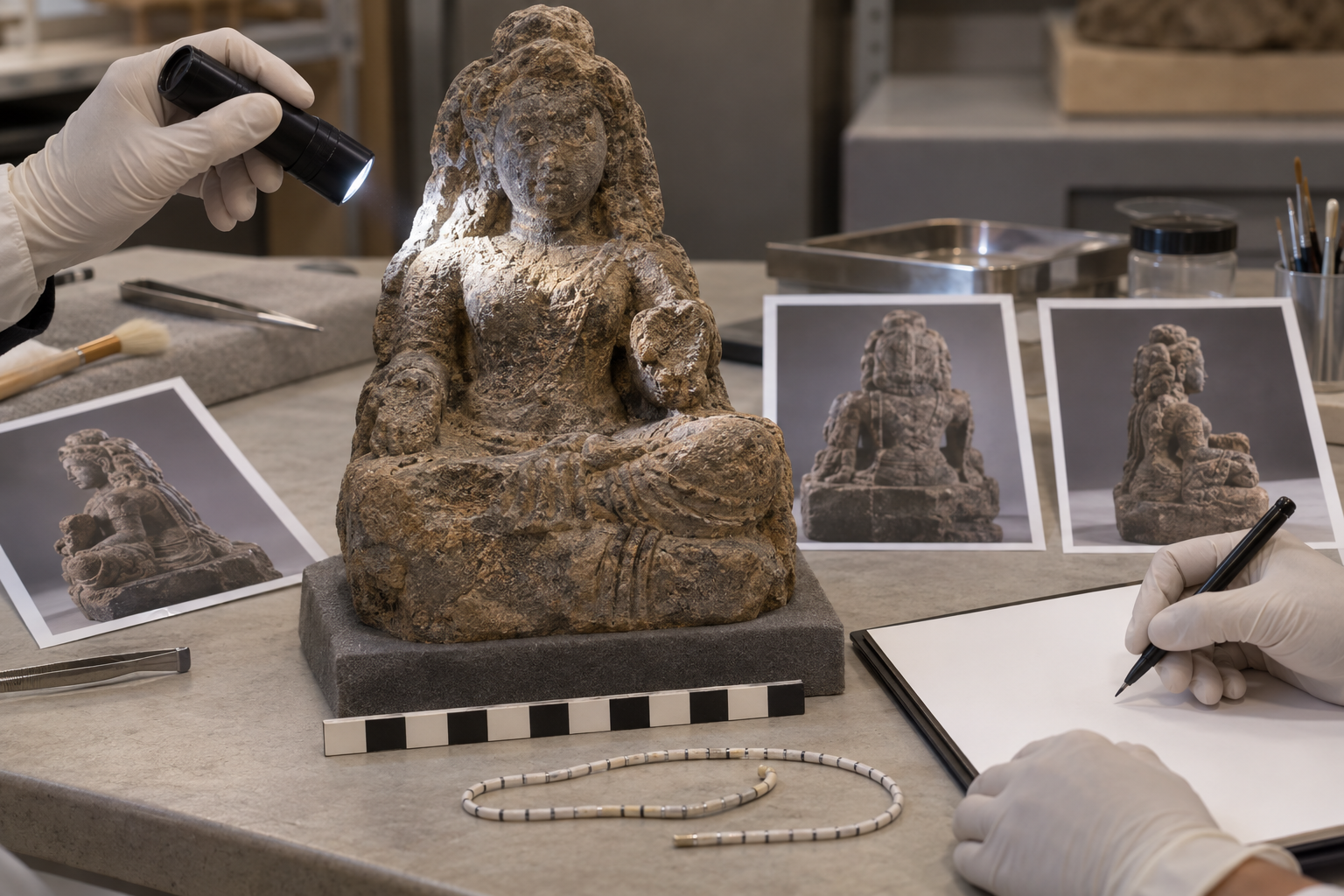
Samvid Tripura Devi belongs among those Hindu forms whose identity has been preserved less through a universally circulated visual manual than through regional references, oral continuity, and localized ritual practice. Rarity does not mean that the form lacks an authentic tradition. It means that public descriptions may not preserve the full local context.
That distinction matters whenever you see an uncited claim about her complexion, number of arms, implements, mudras, crown, seat, attendants, or vehicle. Any of those details could belong to a particular representation, but none should be promoted into a universal rule merely because it appears in one modern image.
Use three levels of confidence when recording a representation. A secure detail is plainly visible or explicitly named in its original setting. A probable detail is supported by the surrounding figures, inscription, temple context, or continuous local identification. A possible detail is a symbolic interpretation that fits the form but has not been established for that particular image. Keeping those levels separate is more useful than pretending every observation carries equal weight.
Provenance usually deserves more weight than resemblance. An image maintained under a particular name within a living worship context carries evidence that a visually similar, anonymously uploaded picture does not. Conversely, an online caption copied many times does not become a lineage identification through repetition.
Inspect an image in five disciplined passes
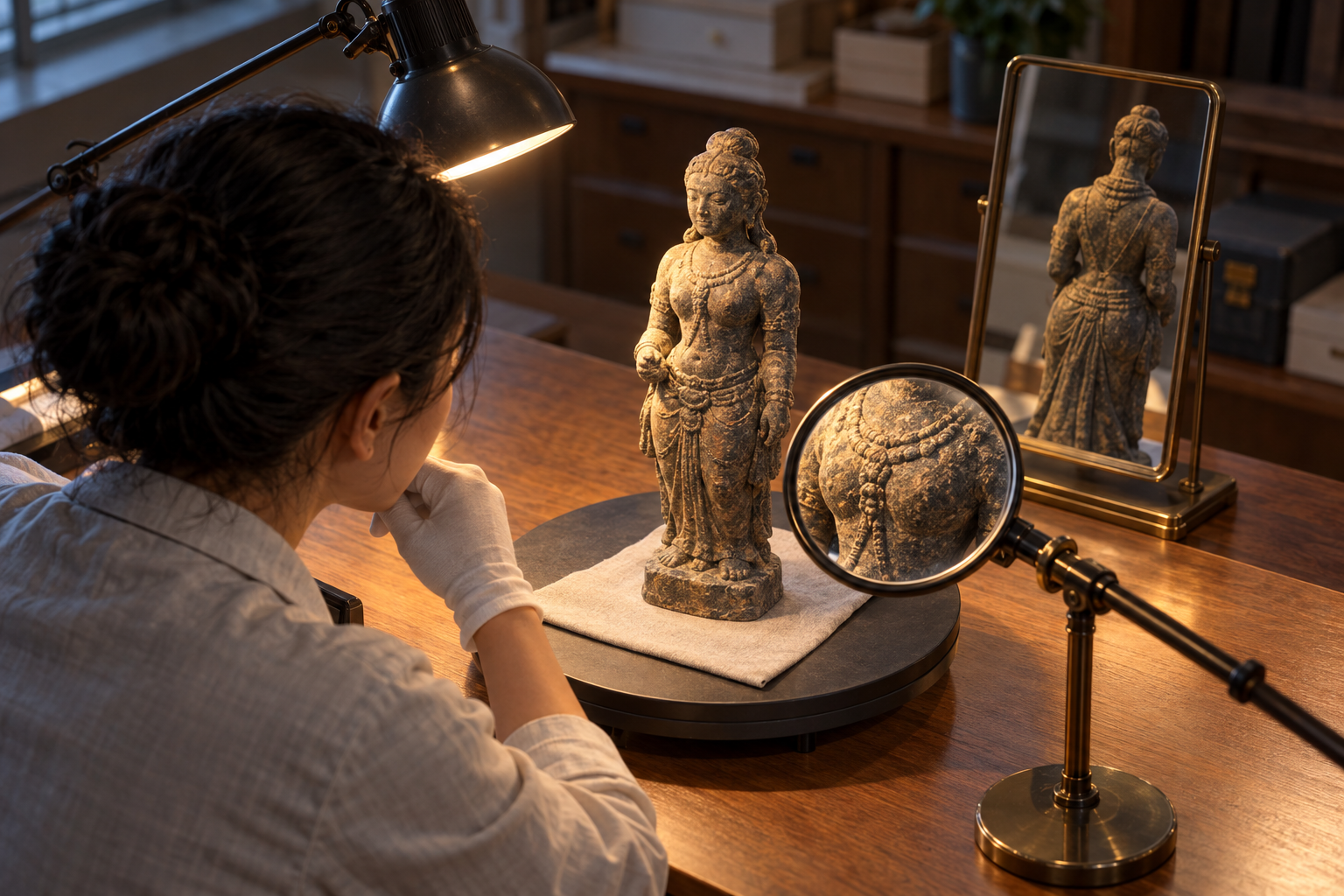
If you are documenting a murti, painting, print, manuscript illustration, or digital image, work from description toward interpretation. The order matters because an early guess can make you notice only the features that appear to confirm it.
- Preserve the exact name. Record the spelling, script, language, and capitalization used with the image. Do not normalize an unfamiliar local name into a better-known divine name before checking whether the difference is meaningful.
- Record provenance. Note the temple, shrine, household tradition, collection, publication, region, or person from whom the identification came. Save the original caption and the uncropped image when possible.
- Describe before interpreting. Write down posture, number of visible faces and arms, hand gestures, held objects, ornaments, seat, surrounding figures, and directional placement. If a detail is obscured, say that it is obscured rather than completing it from expectation.
- Read the whole setting. Nearby deities, yantras, inscriptions, ritual objects, architectural placement, and a sequence of related panels may identify a form more reliably than one isolated attribute.
- Verify locally. Ask the custodian, practitioner, hereditary community, or scholar familiar with that regional tradition what identifies the Devi and whether the displayed form is considered general or specific to that place.
When asking for verification, avoid the vague question, What does this image mean? Ask instead: Which visible feature identifies her here? Is that feature prescribed, inherited locally, or chosen by the artist? Does the same community represent her differently elsewhere? Precise questions make it easier to distinguish iconographic rule from local convention.
Restoration and reproduction also require care. A repainted hand, missing implement, mirrored photograph, cropped attendant, or modern colour choice can alter the apparent identification. If you cannot inspect the original, mark those limitations in your notes.
Let Samvid govern the symbolic reading

Once description and provenance are secure, return to the name. Samvid tells you what should organize the interpretation: consciousness itself. A gesture, object, expression, or compositional feature should not be explained in isolation if its proposed meaning has no connection to knowing, illumination, awareness, or wisdom.
This does not license unlimited symbolism. If a representation appears serene or contemplative, you may explore stillness as an expression of awareness, but you should not declare serenity to be her canonical identifying mark without supporting tradition. Symbolic suitability and iconographic proof are different things.
The same discipline applies to threefold interpretations. Tripura invites attention to a triple structure, but the exact triad must come from the relevant teaching rather than from whichever three-part scheme happens to be familiar. Record the lineage explanation when one is available. When it is not, retain the broader idea of threefoldness and state that the precise correspondence remains open.
A devotional image also does more than encode concepts. In a Dharmic setting, a divine form is not simply a rebus whose objects must be decoded before it has value. Its iconography trains attention. With Samvid at the centre, the practical question becomes: does your reading turn awareness back toward the ground of knowing, or does it leave you collecting disconnected visual trivia?
Keep ritual instruction separate from visual interpretation. An image can support contemplation, but appearance alone does not establish a mantra, initiation, worship sequence, or ritual entitlement. For those matters, follow the living tradition that preserves the form rather than reconstructing a practice from visual clues.
Key takeaways
- Samvid places consciousness, awareness, and knowing at the theological centre of the form.
- Tripura signals threefoldness, but the precise triad should not be assigned without the relevant traditional context.
- No arm count, colour, implement, gesture, vehicle, or seat should be presented as universally canonical without provenance.
- A local identification with continuous context carries more evidential weight than resemblance to a widely circulated image.
- Describe what is visible first, label the degree of certainty, and interpret only after checking the setting in which the image is preserved.
- Do not derive ritual instructions from iconography alone.
If you are preparing a caption, lesson, archive entry, or devotional note, begin by recording where the name came from. Then separate the local identification from your visual description and your symbolic interpretation. That one habit preserves what is known, makes room for living tradition, and prevents a rare Devi from being overwritten by a more familiar image.
References

Leave a Reply
You must be logged in to post a comment.