
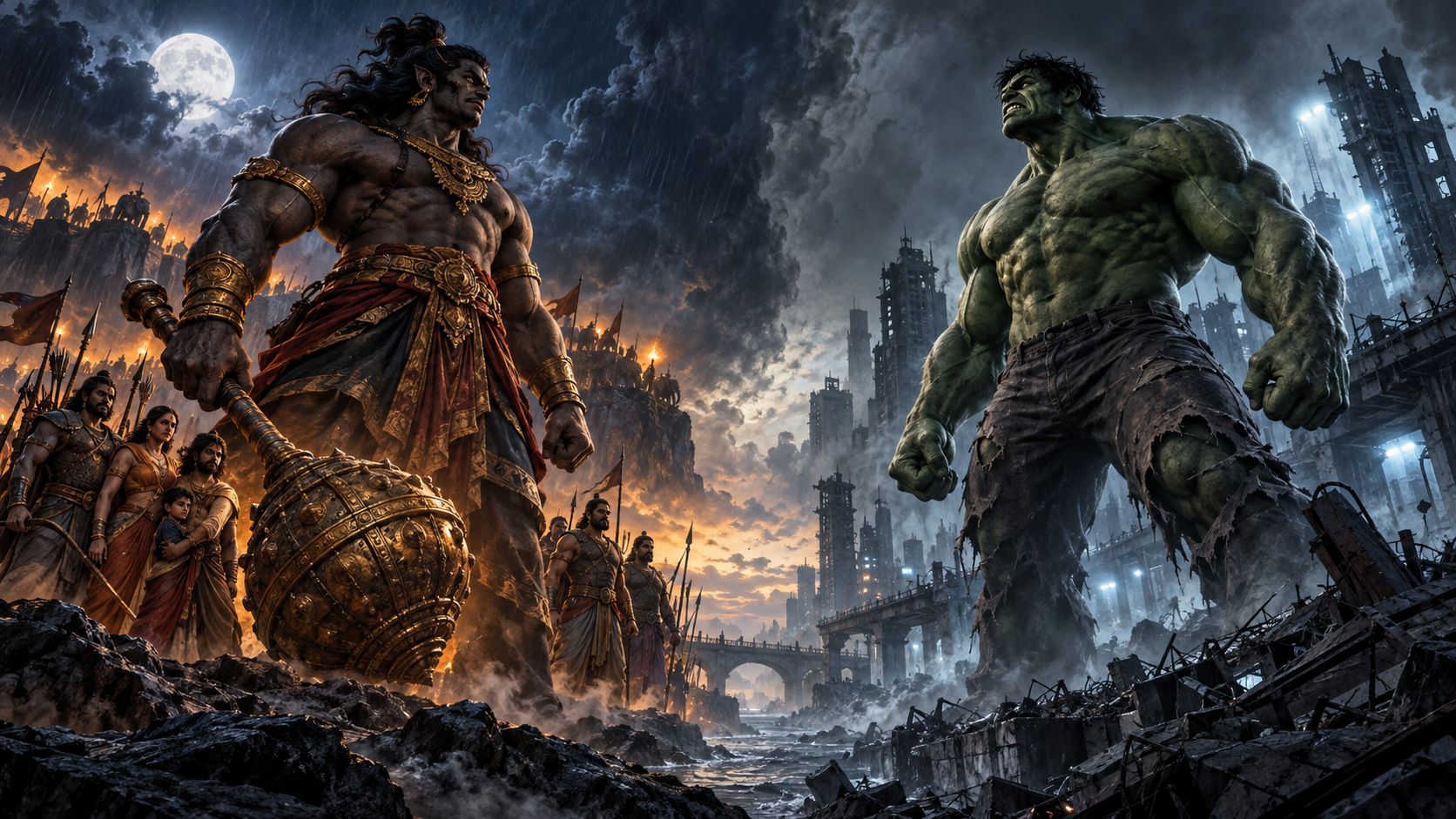
Calling Ghatotkacha the Hulk of the Mahabharata sounds like an easy way to introduce him. It gives you an immediate picture: a gigantic warrior whose presence changes the scale of a battle. But if you stop at that picture, you miss the more important question.
The useful comparison isn’t about who is stronger. It is about what strength means. Hulk turns overwhelming power into a crisis of identity and control. Ghatotkacha places formidable power inside kinship, duty, and a larger moral struggle. They resemble each other as silhouettes, but they lead you toward different ideas of heroism.
The resemblance is visual before it is moral
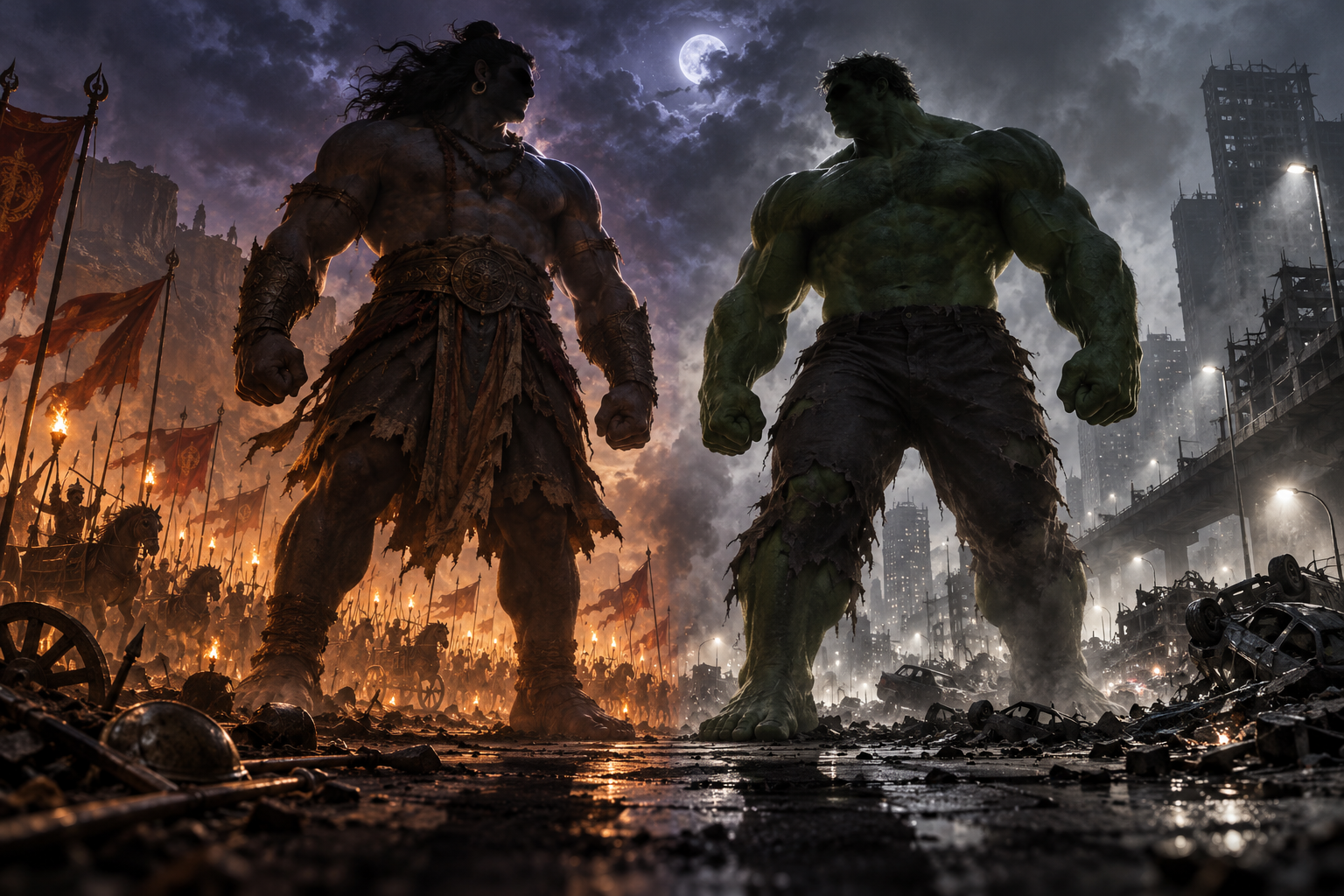
The common ground is real but limited. Ghatotkacha is Bhima’s son, an enormous and frightening warrior who fights at Kurukshetra in the Mahabharata. Hulk is likewise recognised in modern popular culture through extraordinary size, physical force, and an intimidating appearance.
That resemblance is enough to begin a conversation, not enough to finish one. Size tells you what a hero can do. It doesn’t tell you why he acts, what restrains him, whom he serves, or what makes his action worthy. Those questions reveal the archetype beneath the muscles.
| Question | Ghatotkacha’s centre of gravity | Hulk’s centre of gravity |
|---|---|---|
| Where does identity begin? | With kinship and a place in an epic conflict | With tension between an ordinary self and an overwhelming form |
| What is the central problem? | What immense power should serve | Whether immense power can be governed |
| How does society matter? | Relationships help define the warrior’s obligations | Other people may fear the same power they need |
| What does the frightening body mean? | Appearance doesn’t determine moral alignment | Outer transformation makes inner conflict visible |
| What is the shallow reading? | Reducing an epic character to a precursor of a modern superhero | Reducing a conflicted hero to anger and destruction |
An archetype is not a catalogue of abilities. It is a recurring answer to a human problem. Once you make that distinction, the comparison becomes more illuminating and more respectful to both figures.
Hulk makes strength an inner crisis
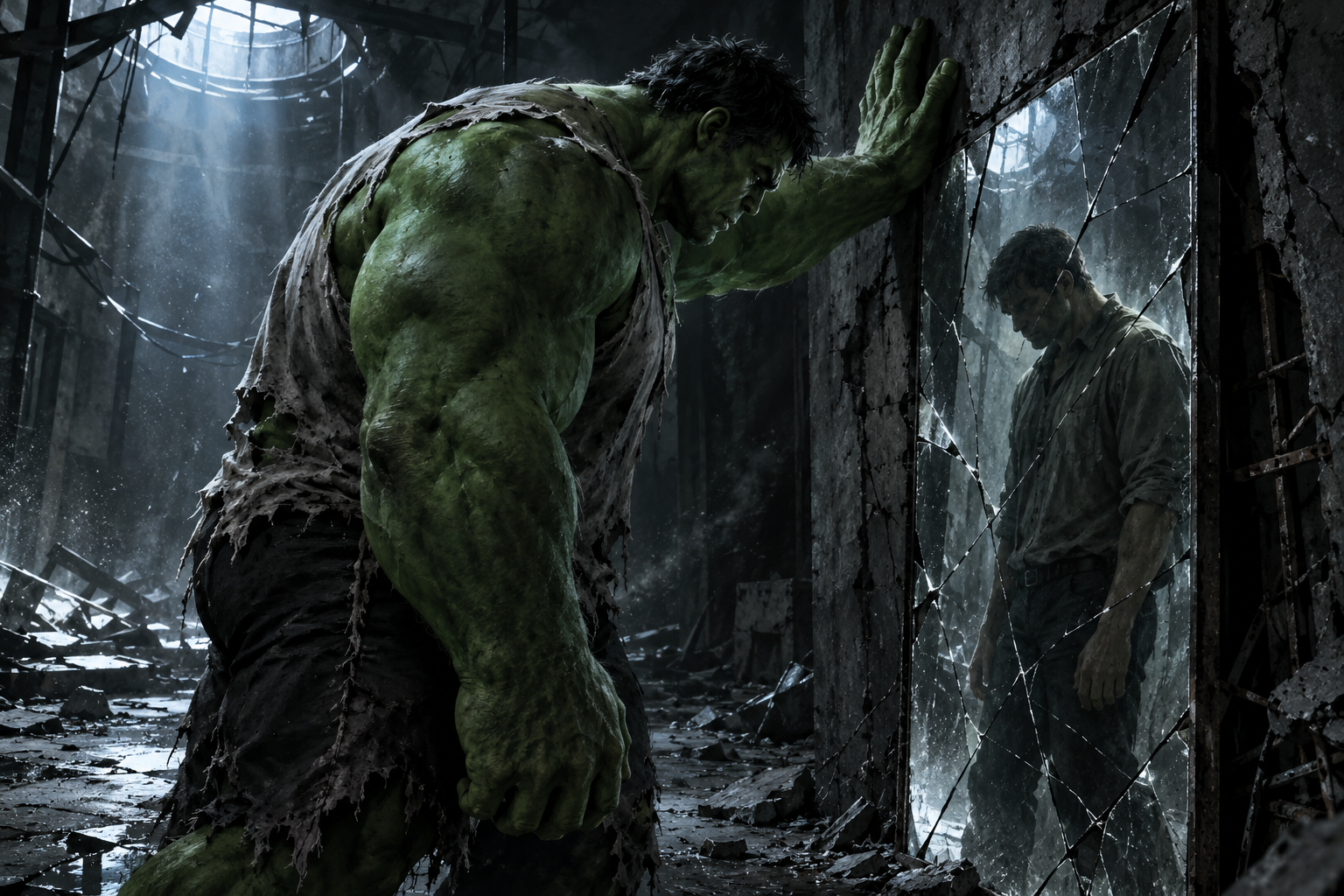
Hulk’s familiar dramatic engine is inward. Power erupts through transformation, commonly in association with anger or extreme pressure. The giant body is therefore more than a weapon. It makes a divided condition visible: intelligence and impulse, restraint and release, vulnerability and invincibility occupy the same person.
This produces a hero of unstable agency. Hulk may protect others, but protection alone doesn’t settle the story. You are also asked whether intention, instinct, or fury is directing the force. The tension survives even after an enemy has been defeated because the underlying problem isn’t merely external. Power itself must be integrated.
That is why it is too simple to say that Hulk represents anger. Anger is the trigger or dramatic language; the deeper subject is proportion. Can a person possess enormous capacity without being possessed by it? Can strength answer a threat without becoming another threat? Can the feared part of the self be accepted without being allowed to rule?
When you watch or discuss a Hulk story, separate three things that are often collapsed: the emotion that releases power, the intention behind an action, and the consequences of that action. A good deed, a good motive, and controlled conduct are not automatically the same. That distinction explains why Hulk can remain heroic while still being dangerous.
Ghatotkacha makes strength answerable to relationship
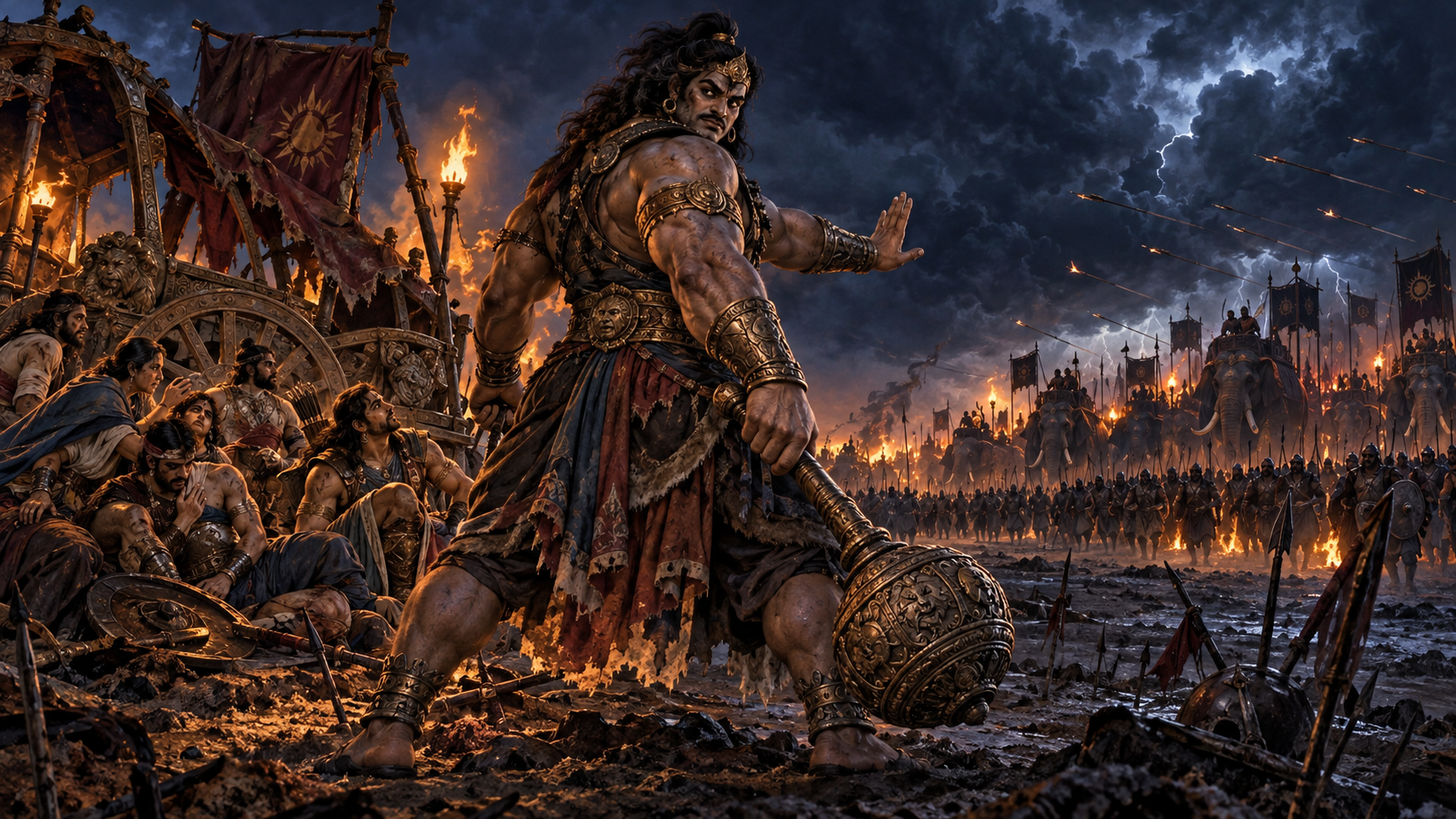
Ghatotkacha enters the imagination differently. His moral coordinates precede any discussion of his size: he is Bhima’s son and a warrior situated within the Kurukshetra conflict. He is not introduced as an isolated individual who happens to possess astonishing power. He already belongs to a network of ancestry, allegiance, and obligation.
That shift matters in a Dharmic reading. Dharma is not simply obedience, and it is not a label automatically attached to the stronger side. It requires discernment about role, circumstance, means, and consequence. The heroic question is therefore not merely whether Ghatotkacha can unleash force. It is whether formidable ability can be directed toward a responsibility larger than the self.
His frightening form also carries a useful correction. Modern visual shorthand often treats beauty as evidence of goodness and monstrosity as evidence of evil. Ghatotkacha disrupts that shortcut. An intimidating appearance can belong to someone acting within bonds of duty. The moral quality of power must be judged by its orientation and use, not by whether its bearer looks reassuring.
This doesn’t mean that relational heroism demands blind submission. A Dharmic framework makes obligation morally serious precisely because duties can collide. Loyalty, protection, justice, and the effects of violence must be weighed rather than treated as interchangeable commands. Strength becomes heroic when it is disciplined by that moral field.
If Hulk asks, “How do I live with the force inside me?”, Ghatotkacha prompts another question: “What does the force entrusted to me require of me?” One begins with the divided self. The other begins with the self in relationship.
A six-question method for comparing heroes responsibly
Cross-cultural comparisons are useful when they reveal structure. They become misleading when resemblance is treated as identity. Use these questions when you compare an epic figure with a superhero, whether in a classroom, a family conversation, a video, or a social-media thread.
- Fix the version. Distinguish the Mahabharata character from later retellings, and identify which portrayal of Hulk you mean. Different tellings can emphasise different motives even when the name remains the same.
- Separate capacity from character. Size, strength, transformation, and battlefield effectiveness describe what a figure can do. They do not establish virtue, self-mastery, or rightful purpose.
- Locate the primary conflict. Ask whether the decisive struggle lies within the hero, between the hero and society, against an external enemy, or among competing obligations. More than one may be present, but one usually organises the story.
- Identify the source of restraint. Does restraint come from self-control, affection, social fear, kinship, duty, counsel, or concern for consequences? A hero’s limits often tell you more than his maximum strength.
- Ask what makes victory moral. Defeating an opponent is an outcome, not yet a moral judgment. Examine whom the action protects, why it was undertaken, what means were used, and what cost accompanied it.
- Keep resemblance distinct from influence. A shared image of gigantic strength can support comparison. By itself, it cannot prove that one tradition borrowed from, copied, or directly inspired the other.
Using that method, the most defensible contrast is one of emphasis. Hulk foregrounds the governance of immense power within a divided individual. Ghatotkacha foregrounds the direction of immense power through relationship and duty. This is not an absolute boundary: Hulk can act for others, and Ghatotkacha need not be stripped of inner complexity. Archetypes identify the dominant moral question, not every possible feature of a character.
Key takeaways
- Ghatotkacha and Hulk share an immediately legible image: the immense, frightening warrior whose physical presence changes a battle.
- Hulk commonly turns strength into a problem of anger, divided identity, restraint, and social fear.
- Ghatotkacha’s place as Bhima’s son and a Kurukshetra warrior makes power relational before it becomes spectacular.
- A frightening body is not a moral verdict. Purpose, restraint, obligation, means, and consequences determine whether strength is heroic.
- The comparison works best as a contrast between two moral questions: can power be governed, and what should power serve?
The next time someone calls Ghatotkacha a Hindu Hulk, don’t argue first about who is stronger. Ask what each figure believes strength owes to the world around him. That one change turns a surface-level resemblance into a serious conversation about dharma, identity, and the rightful use of power.
References

Leave a Reply
You must be logged in to post a comment.