
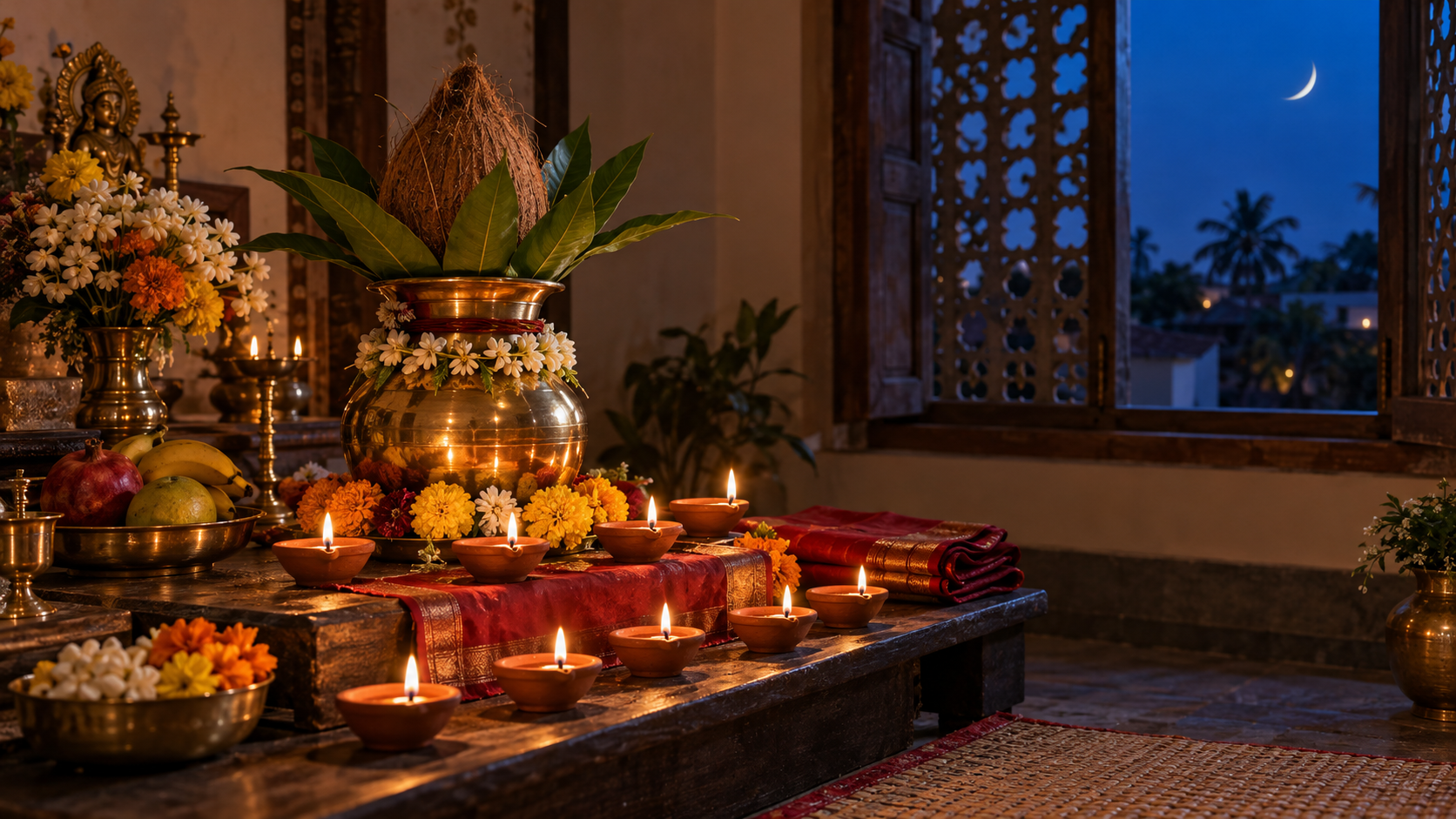
If you are planning Navaratri from a Gregorian calendar, the tenth day can look like a contradiction: why does a festival of nine nights culminate on Dashami? Then one family prepares a Kolu, another establishes a Garbi, and a community programme seems to emphasise something else again.
You do not need to assemble every regional custom into one crowded observance. You need to understand three layers: the tithi that orders sacred time, the devotional rhythm your household can actually maintain, and the inherited or regional form through which that devotion becomes visible.
Begin with tithi, not a midnight date
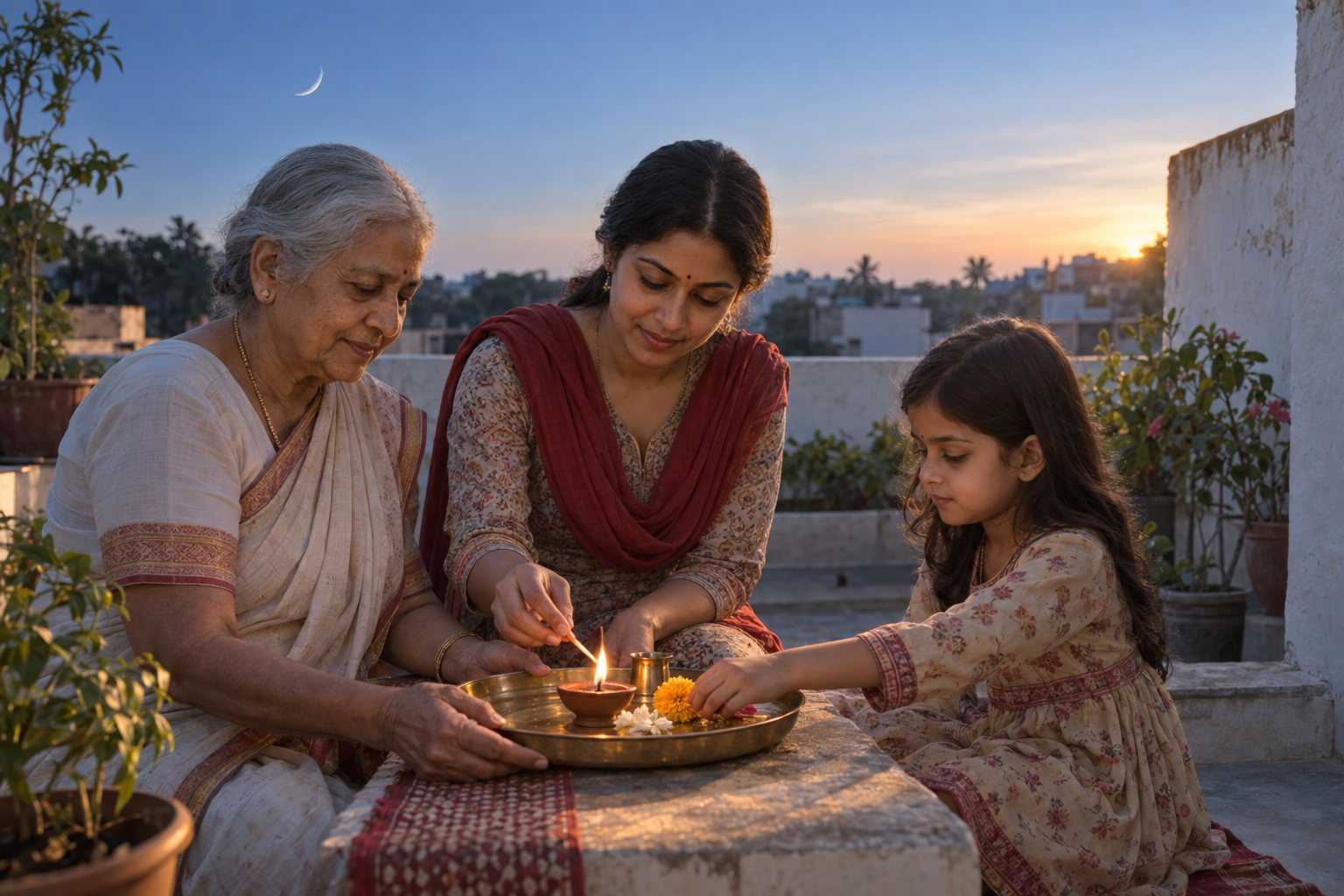
The first practical distinction is between a civil date and a tithi. A civil date changes at midnight. A tithi is a lunar day, so it can change during the morning, afternoon, or night. The Sharad Navaratri observance moves through nine nights toward Dashami as its tenth-day culmination; the number nine describes the nights of worship, while Dashami completes the sacred arc.
Tuesday, October 20, 2026 gives a useful example. In most regions, Shukla Paksha Navami continues only until 9:34 AM, after which Shukla Paksha Dashami begins. A calendar square marked Navami or Dashami therefore does not necessarily describe the entire civil day.
This matters when you are deciding when to conclude a vrata, perform a particular puja, visit a temple, or mark Vijayadashami. Do not infer the ritual time from the date label alone. Use the local panchang followed by your temple or sampradaya, because the relevant calculation and ritual rule must be applied together.
- Set your panchang to the place where you will perform the observance.
- Write down the beginning and ending times of Navami and Dashami, not merely their printed date labels.
- Check which tithi your family or temple requires at the time of the actual ritual. A transition at 9:34 AM does not, by itself, tell you which rule your tradition applies.
- If a temple programme is central to your observance, use its published schedule rather than combining timings from unrelated calendars.
- Mark Dashami as the culmination when you prepare your nine-day plan. Do not treat it as an unexpected extra day.
The shared calendar gives communities a common sacred sequence. It does not erase regional expression: Navaratri is kept on a common festival arc through markedly different local traditions. Calendar unity and ritual diversity are not rival explanations of the festival. They are two parts of its design.
Give the nine nights a coherent household rhythm
A useful Navaratri plan begins with its theological centre, not with a shopping list. In the Devi Mahatmyam narrative, Mahishasura’s boon makes him invulnerable to man or god. Brahma, Vishnu, and Shiva unite their powers in the manifestation of Devi Mahishasuramardini, while the devas surrender their weapons and energies so that she can confront the disorder Mahishasura represents.
The story gives you a practical principle for the festival: gather scattered attention around the Devi. The devas do not compete for prominence; their powers become aligned with the restoration of dharmic order. Your household observance should have the same coherence. Nine elaborate but disconnected activities are less meaningful than one devotional commitment sustained through all nine nights.
- Choose the centre. Decide which form of Devi, inherited family practice, temple tradition, or established altar will anchor the observance.
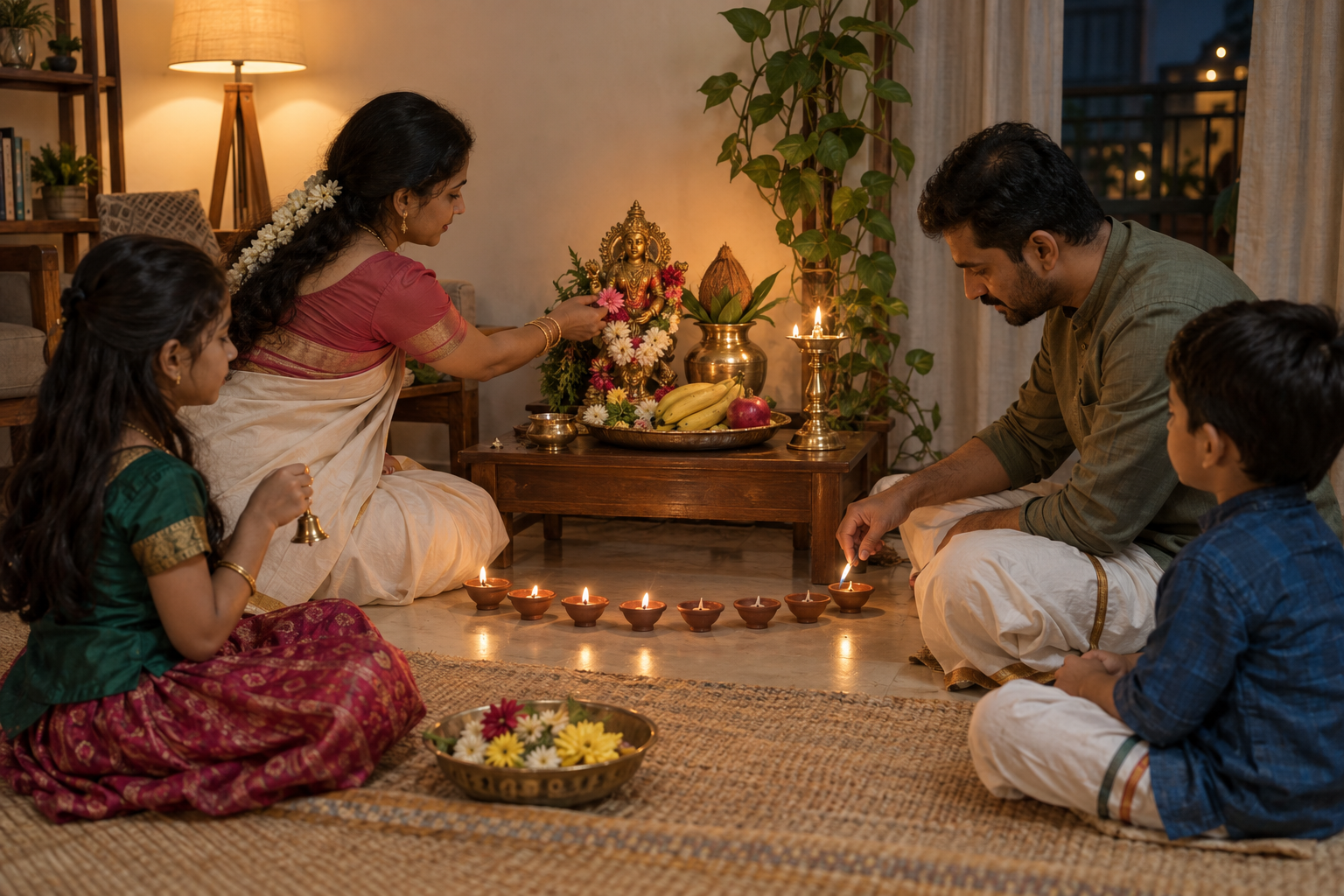
- Choose a repeatable daily act. A lamp, flowers, prayer, song, and naivedyam can form a steady rhythm. Households maintaining a Kolu commonly honour it with lamps, flowers, kolam, and offerings in the morning and evening.
- Choose a realistic time. If your family cannot gather twice daily, select one time that can be protected. Consistency is better than making a large promise that collapses after two days.
- Give each person a real responsibility. One person can prepare the altar, another the offering, another a prayer or song, and a child can learn the meaning of one displayed figure. Participation should carry meaning, not merely distribute chores.
- Plan the culmination before the opening day. Decide how Dashami will complete the observance so that the tenth day grows from the previous nine rather than becoming an unrelated social event.
This framework is intentionally modest. It does not prescribe one universal fast, mantra, or sequence, because those details belong to particular traditions. Begin with what your family has received. If that knowledge has become thin, ask an elder, acharya, or the temple you actually attend before importing a practice from a generic festival checklist.
If you build a Kolu, make every tier teach something
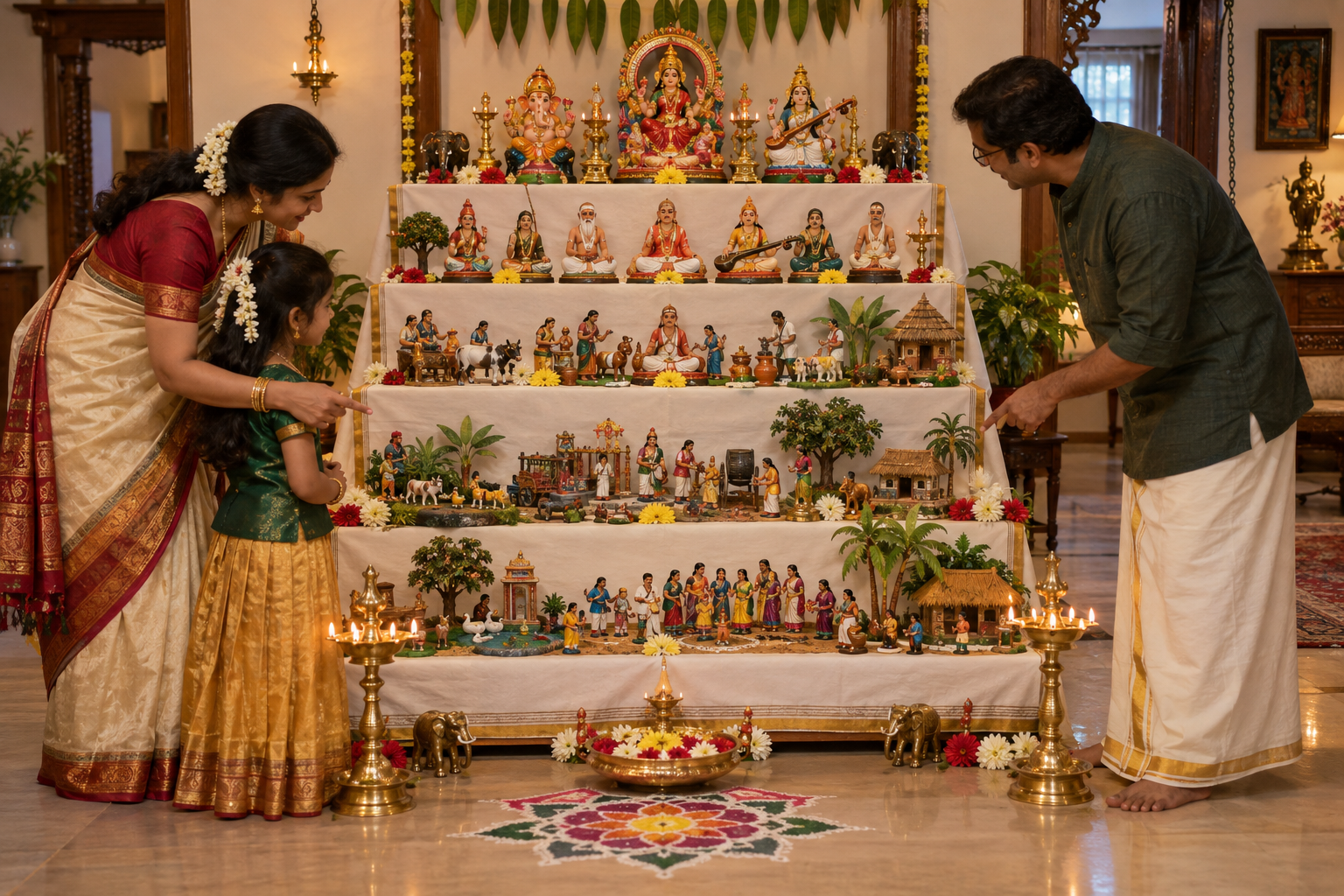
In Karnataka, Andhra Pradesh, Telangana, and Tamil Nadu, many temples and homes arrange dolls and figurines on stepped displays known as Gombe Habba, Bommala Koluvu, or Bommai Kolu. A Kolu is not simply seasonal decoration. Its structure can present the cosmos, ordinary society, spiritual aspiration, sacred history, and the presence of the deities in one visual field.
The steps traditionally appear in an odd number: 3, 5, 7, 9, or 11 tiers. Choose the smallest number your household can arrange securely and tend with reverence. A three-step Kolu with a clear idea is preferable to an eleven-step display treated as storage for every figurine available.
- Lowest area: Place birds and animals at the base, followed by scenes of ordinary human life. Farmers, labourers, musicians, weddings, vendors, and the familiar Chettiar shopkeeper figures make daily society part of the sacred picture.
- Middle area: Place saints, gurus, spiritual teachers, poets, scholars, and epic heroes here. They represent the people and paths that lead human life toward higher understanding.
- Highest area: Reserve the uppermost tiers for deities such as Shiva, Vishnu, Durga, Lakshmi, and Saraswati. The arrangement directs the eye from embodied life toward divine reality.
- Narrative area: Use one portion to tell a complete episode rather than scattering unrelated characters. The childhood lilas of Krishna, the Dashavatara, and an episode from the Mahabharata are established choices.
Read from bottom to top, the display can represent the soul’s movement through dharma and bhakti toward higher consciousness. Another traditional explanation connects the still figures with the devas surrendering their individual weapons and energies to Durga. Both interpretations turn the arrangement itself into instruction.
That teaching function also fits Kolu’s historical development. The custom was popularised under the Vijayanagara Empire in the 14th century, when royal Navaratri displays demonstrated artistic skill and agricultural wealth. It later appears in the royal courts of Tanjavur and Pudukottai before becoming a household tradition. The name Bommala Koluvu, often understood as a court of dolls, still preserves something of that ceremonial character.
Once the Kolu is installed, treat it as part of the mandir rather than as an exhibit that can be ignored between visitors. Keep the daily lamp, flowers, kolam, and offering within the routine you established. If your custom includes inviting neighbouring women for thamboolam, let prayer, song, and prasada remain central to the gathering. Hospitality should extend the worship into the neighbourhood, not displace it.
Keep the sacred centre visible in public celebration
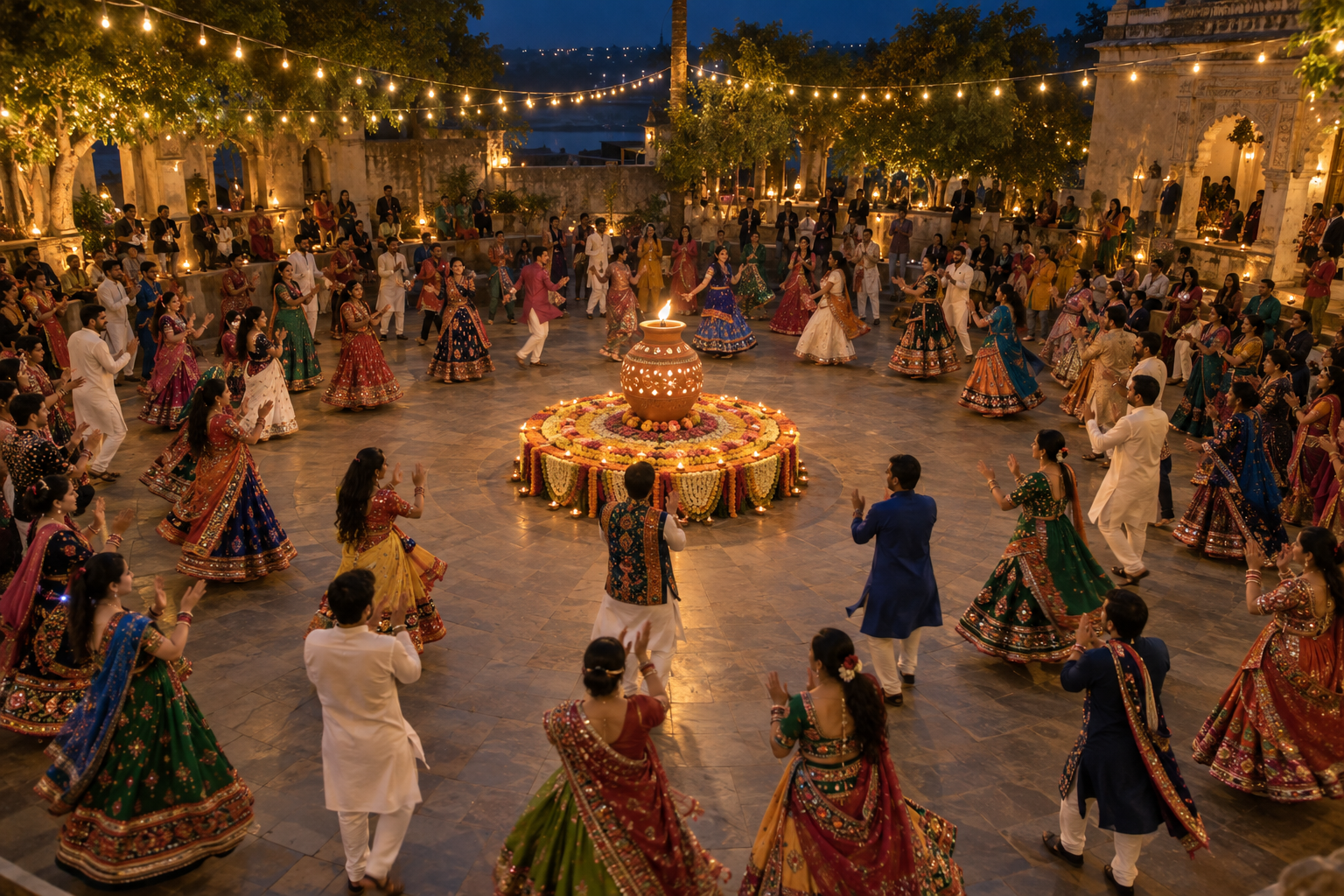
Garba is widely recognised as an energetic communal dance, but its sacred vocabulary begins further inward. In Gujarat, many households establish a Garbi during Navaratri. The word is connected to the Sanskrit garbha, meaning womb. A perforated clay pot represents the Devi holding the universe’s absolute energy in an unmanifest condition before her nine-day battle with Mahishasura.
If Garbi belongs to your observance, establish and explain that sacred centre before concentrating on clothing, music, or choreography. Do not reduce the pot to a decorative prop. A child or guest should be able to learn, in one clear sentence, that the symbol points to divine energy held within before it becomes manifest in the restoration of order.
The same test can be applied to any local form:
- What is being worshipped or remembered?
- Which object, image, story, or daily act carries that meaning?
- What must remain consistent through the nine nights?
- How does the community celebration arise from the worship?
- What does Dashami bring to completion?
These questions help you distinguish a living tradition from festival branding. They also prevent a common mistake: assuming that respect for Bharata’s diversity requires every household to perform every custom. You can honour a Kolu without building one, recognise the meaning of a Garbi without claiming it as an inherited practice, and participate in a regional celebration without pretending that all ritual forms are interchangeable.
The Rig Vedic maxim Ekam Sat Vipra Bahudha Vadanti is roughly rendered as one truth spoken of by the wise in many ways. Applied carefully, it supports reverence across forms without dissolving their distinctions. Unity does not mean that every custom has the same history or procedure. It means that distinct forms can orient worshippers toward divine reality without requiring cultural uniformity.
When family members come from different regions, make the layers explicit. First preserve any inherited or temple obligations. Next choose one household form that can be maintained coherently. Then add community celebrations that do not compete with that core. This approach produces a shared observance without turning Navaratri into a collection of disconnected attractions.
Key takeaways for planning your Navaratri
- Plan by local tithi timings, not by the civil date alone; Navami and Dashami can occupy different parts of the same date.
- Treat Dashami as the culmination of the nine nights and include it in your plan from the beginning.
- Choose one daily devotional rhythm that your household can sustain instead of accumulating unrelated practices.
- If you arrange a Kolu, use its tiers to show a meaningful ascent from living creation and human society through teachers and heroes to the deities.
- If you keep a Garbi or join Garba, preserve the symbolism of contained divine energy at the centre of the public celebration.
- Respect regional diversity without treating traditions as interchangeable or turning them into a completeness checklist.
Before the first night, open the panchang your community follows and write the relevant tithi transitions beside your household schedule. Then settle three decisions: what will be at the centre of worship, what you will repeat every day, and how Dashami will complete it. Once those are clear, decoration, invitations, music, and community events can support the sacred rhythm instead of competing with it.
References
- Indica Today — Navaratri – One Festival, Diverse Traditions
- Hindu Blog — October 20 2026 Tithi – Panchang – Hindu Calendar – Good Time – Nakshatra – Rashi

Leave a Reply
You must be logged in to post a comment.