
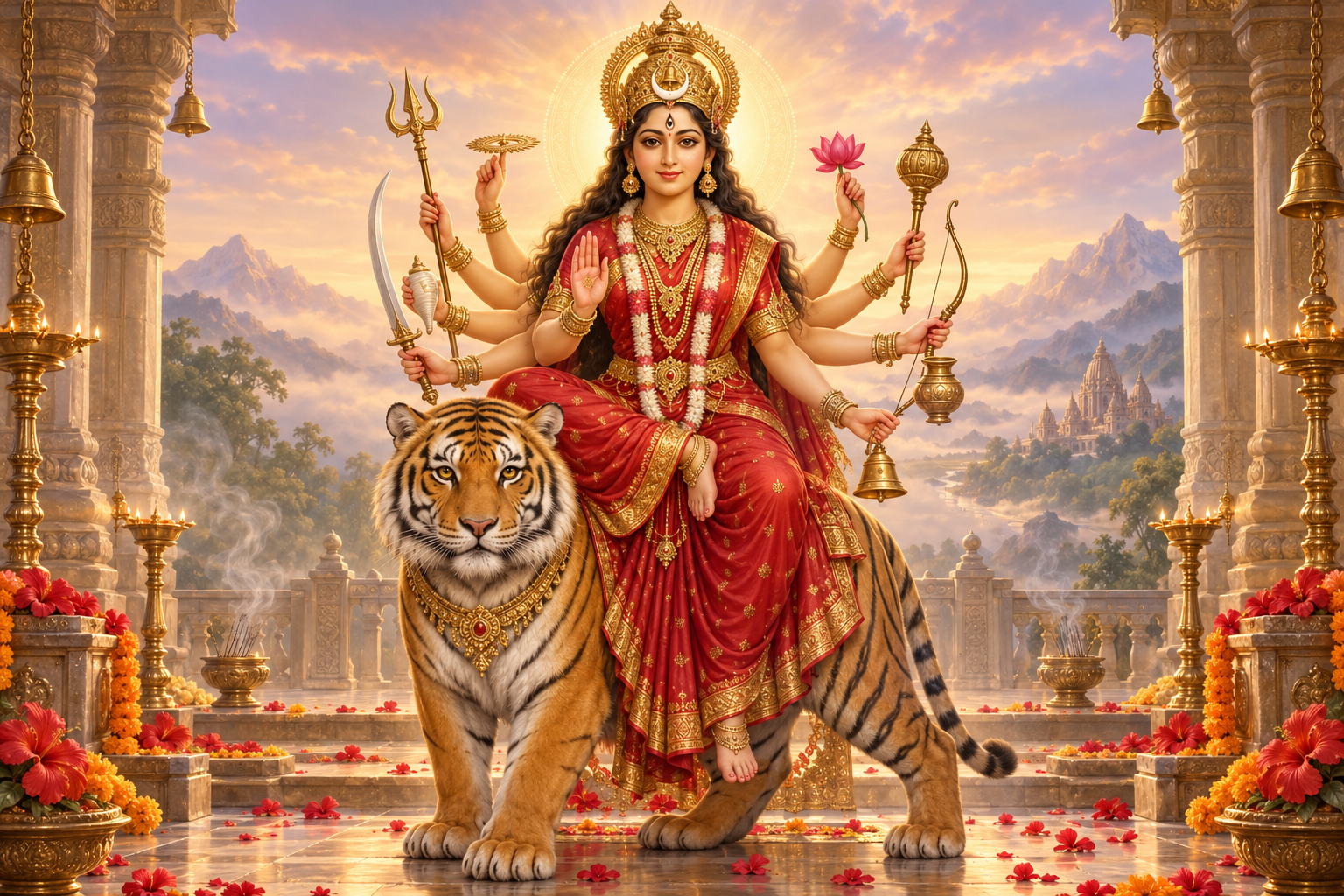
On Navratri’s third day, you may be standing before your shrine with two practical questions: What should you actually do, and does the connection with Shukra change the worship? You do not need to turn a home puja into an elaborate astrological procedure. Keep the ritual coherent, and let the astrological theme guide your sankalpa rather than dictate promises about the future.
The method below is suitable for a simple home observance. If your family, guru, sampradaya, or temple follows a prescribed vidhi, continue with that tradition; a general method should not displace instructions you have formally received.
Key takeaways
- Maa Chandraghanta is the third form in the Navadurga sequence and is worshipped on the third day of Navratri.
- A workable home puja can use turmeric, kumkum, rice, water, a kalash where customary, and camphor for aarti.
- Recite one established mantra carefully instead of collecting several versions whose pronunciation you have not learned.
- Her astrological association is with Shukra, or Venus, particularly the themes of love, beauty, harmony, prosperity, and emotional balance.
- Worship may be undertaken as a traditional Shukra remedy, but it is not a guarantee of marriage, wealth, attraction, or a particular astrological outcome.
Begin with the third day, not with a planetary shortcut
Maa Chandraghanta is worshipped as the third Navadurga on Navratri’s third day. That position in the festival gives you the first practical rule: establish the correct Navratri day before adding astrological interpretations.
For the exact day in your location, use the panchang or temple schedule your household normally follows. Do not move the observance to a different day merely because another weekday is associated with Shukra. A separate planetary observance may have its own rules, but it is not the same decision as following the Navadurga sequence.
Before beginning, choose one clear sankalpa. You might direct the worship toward harmony in your conduct, steadiness in relationships, responsible treatment of prosperity, or freedom from agitation around appearance and approval. That is a personal intention, not a canonical mantra and not a request for a guaranteed result.
A simple Maa Chandraghanta puja you can perform at home
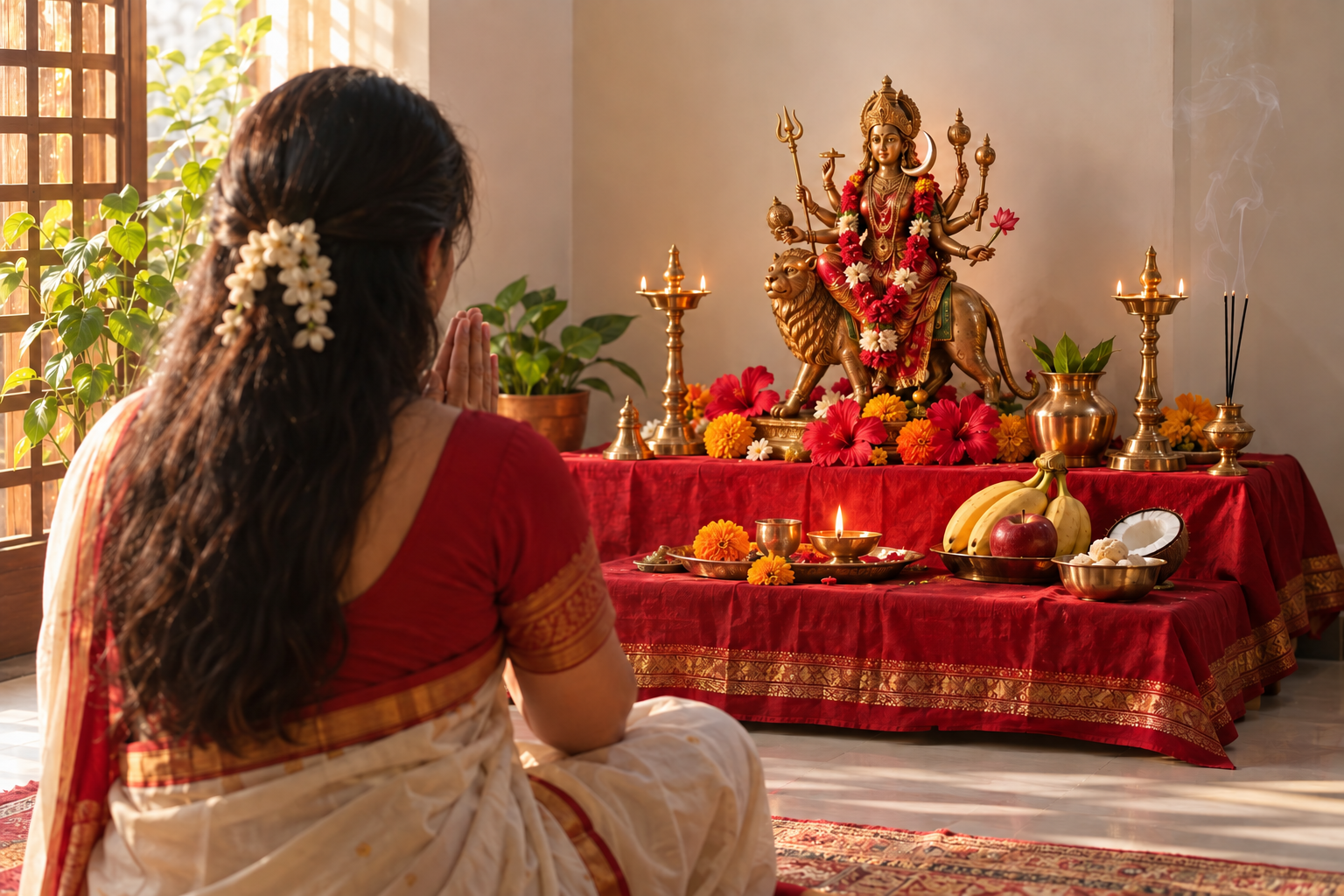
The materials named for Chandraghanta puja include haridra churna, or turmeric powder; kumkum; rice; a kalash; water or Gangajal; and camphor. Treat this as a practical starting inventory, not proof that every regional tradition requires an identical list.
- Prepare the place. Clean the worship surface and arrange the murti or image respectfully. Wash your hands, settle your breathing, and put away anything that will interrupt the recitation.
- Arrange the water. If kalash establishment is part of your household practice, prepare it in the way you were taught. If you have not learned a formal kalash vidhi, do not improvise a consecration from incomplete instructions; you may keep a clean vessel of water as an ordinary offering.
- State your sankalpa. Keep it brief enough to remember. Name the quality you want to cultivate rather than demanding a particular person, sum of money, or prediction.
- Make the offerings. Place small amounts of turmeric, kumkum, and rice before Maa according to your custom. If you are using a printed image, do not apply substances directly where they may damage it.
- Recite the mantra. Use the same wording throughout the sitting. A slow, attentive recitation is more coherent than switching among several unfamiliar variants.
- Perform aarti. Camphor may be used where this is customary and safe. Keep the flame on a stable, heat-resistant holder, away from loose cloth, children, animals, and anything combustible. If an open flame is unsafe in your setting, close with namaskara rather than creating a fire risk.
- Sit quietly before closing. Give yourself a short pause after the mantra and aarti. Bring the mind back to the sankalpa, offer your pranam, and remove or distribute the offerings according to your household practice.
Do not let a missing accessory become the centre of the worship. If you are undertaking a formally prescribed vrata, obtain the complete instructions in advance. For an ordinary home prayer, orderly attention and respect are more useful than hurriedly copying rites you do not understand.
How to use the Chandraghanta mool mantra responsibly
Chandraghanta worship includes a mool mantra as well as dhyana and stotra recitations. These are not interchangeable labels. A dhyana verse supports contemplation of the Devi, while a stotra offers praise; you do not have to assemble every available text into one sitting.
Pindaj Pravarudha Chandkopastrakaiyurta | Prasand Tanute Mahayam Chandraghanteti Vishruta ||
Chandraghanta Mool Mantra
Roman-script spellings can vary, and a transliteration on a screen is not a complete pronunciation lesson. If your prayer book or family tradition uses an established version, keep that version. If Sanskrit pronunciation is unfamiliar, learn the mantra from a trusted practitioner who can recite it and hear you repeat it; guessing from English spelling can change where you divide the sounds.
Use three checks during practice:
- Text: settle on one version before the puja begins. Do not splice together words from different transliterations.
- Pace: recite slowly enough that you can complete each line without swallowing syllables. Speed is not evidence of mastery.
- Count: follow a count only when your teacher, vrata instructions, or family tradition gives you one. Do not treat an unsupported number circulating online as a universal rule.
If you have not received a count, use a modest, repeatable practice rather than making a large vow you may abandon. You can also read the verse once with attention, sit in remembrance of Maa, and conclude respectfully. Do not add a bija mantra merely to make the practice appear more advanced; lineage-specific mantras should be approached through the lineage that transmits them.
Use the Shukra association as a lens, not a prediction
Astrologically, Maa Chandraghanta is associated with Shukra, or Venus. The connected themes include love, beauty, harmony, prosperity, and emotional balance. Her worship is also believed to reduce malefic effects attributed to Shukra.
The word “believed” matters. This is a traditional devotional and astrological claim, not a mechanical promise that one puja will produce romance, wealth, social approval, or a changed horoscope. Shukra also should not be reduced to marriage alone: love and relationship are only part of the stated field, alongside harmony, beauty, prosperity, and emotional equilibrium.
If someone has simply told you that your Venus is weak or afflicted, ask what placement, relationship, and interpretive tradition produced that conclusion. A general association cannot diagnose an individual birth chart. Before buying an expensive gemstone, changing a financial commitment, or making a serious relationship decision, obtain a complete reading from a qualified Jyotisha practitioner and evaluate the real-world decision on its own merits. Devotional worship can accompany responsible judgment; it should not replace it.
You can still make the Shukra connection practical without pretending to predict an outcome. After the puja, choose one action aligned with your sankalpa: soften an unnecessarily harsh exchange, care for a neglected sacred or beautiful space, review one avoidable expense, or restore fairness in a relationship. This carries the worship from the altar into conduct, where its dharmic meaning becomes visible.
For your next observance, decide on the mantra version and gather the small set of materials before the third day begins. Then keep the puja simple enough that attention remains on Maa Chandraghanta rather than on anxiety about performing every possible rite.
References
- Hindu Pad – Astrological Significance of Chandraghanta Pooja
- Hindu Pad – Chandraghanta Puja Vidhi | Maa Chandraghanta Pooja Method
- Hindu Pad – Chandraghanta Mantras – Mool Mantra, Dhyana Sloka, Stotra

Leave a Reply
You must be logged in to post a comment.