
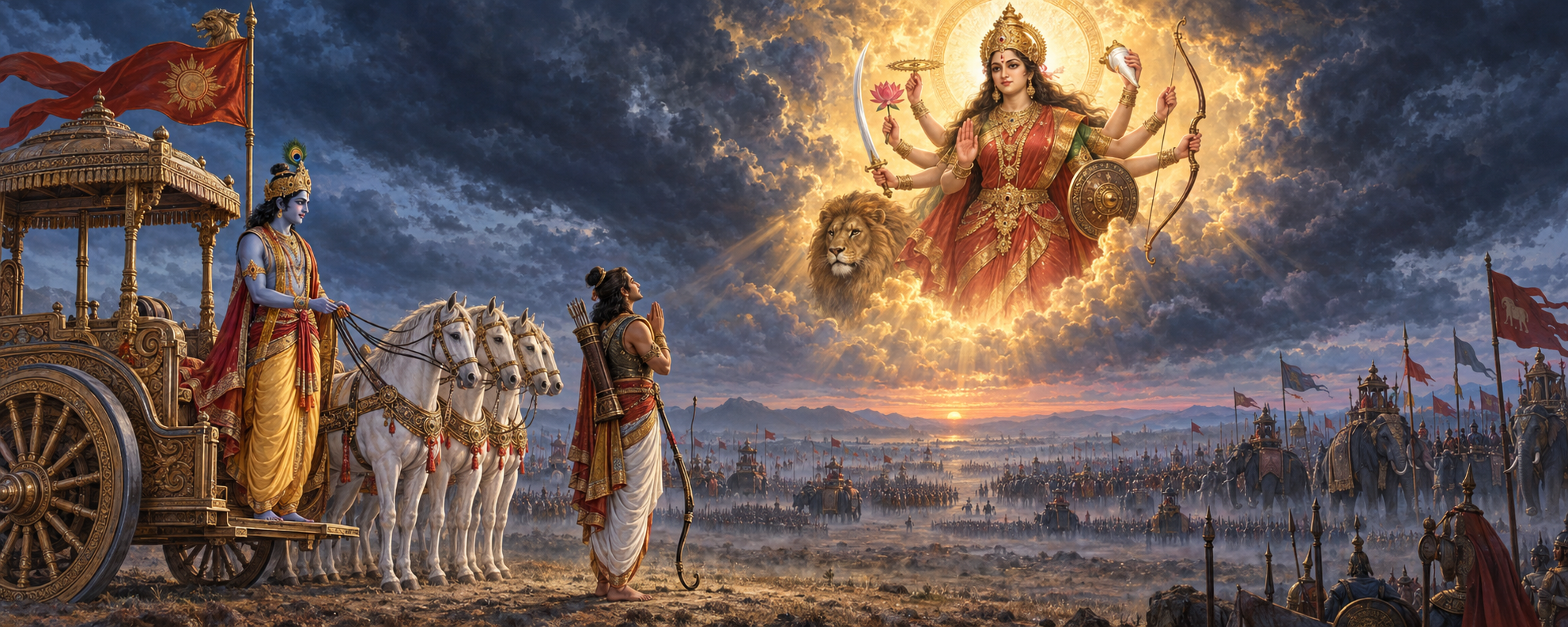
If your memory of the Bhagavad Gita begins with the conches, Arjuna’s anguish and Krishna’s counsel, a crucial action has slipped out of frame. In the Gita Press recension of the Mahabharata’s Bhishma Parva, Krishna first directs Arjuna to invoke Durga. The warrior steps down from his chariot, folds his hands, praises the Goddess and asks for victory. Only after her assurance does he return to Krishna and move toward the crisis that opens the Gita.
That order matters. It prevents you from treating the Durga Stotra as an isolated victory charm or the Bhagavad Gita as a dialogue untouched by devotion to the Goddess. Grace, martial resolve, moral bewilderment and discernment appear in succession. Each has work to do that the others do not replace.
Key takeaways from the battlefield sequence
- The episode occurs in Bhishma Parva 23 of the Gita Press recension, with both armies already arrayed for battle.
- Krishna initiates the worship. His imperative, durgāstotram udīraya, means that Arjuna is to recite the Durga Stotra.
- Arjuna obeys bodily as well as verbally: he leaves the chariot, stands with joined palms and invokes the Goddess by a wide range of names.
- Durga appears, assures him that his enemies will soon be defeated, points to his identity as Nara and to Narayana beside him, and then disappears.
- The promise of victory precedes Arjuna’s loss of certainty. Divine assurance does not spare him from the moral and spiritual inquiry that follows.
The physical movement is easy to overlook. Arjuna does not offer a hurried prayer while remaining ready to shoot. He interrupts his battle posture, descends and joins his palms. The act places reverence before combat. When the boon-giving Goddess has spoken, she vanishes kṣaṇena, “in an instant,” and Arjuna returns to the chariot. Krishna is again at the reins, and the two sound their celestial conches.
Keep one textual qualification attached to this account: the placement and verse numbering discussed here belong to the cited Gita Press recension. When discussing the episode, name that recension instead of silently making a claim about every printed or transmitted form of the Mahabharata. Precision strengthens the Dharmic case; exaggeration does not.
Durga’s names prevent a one-dimensional reading
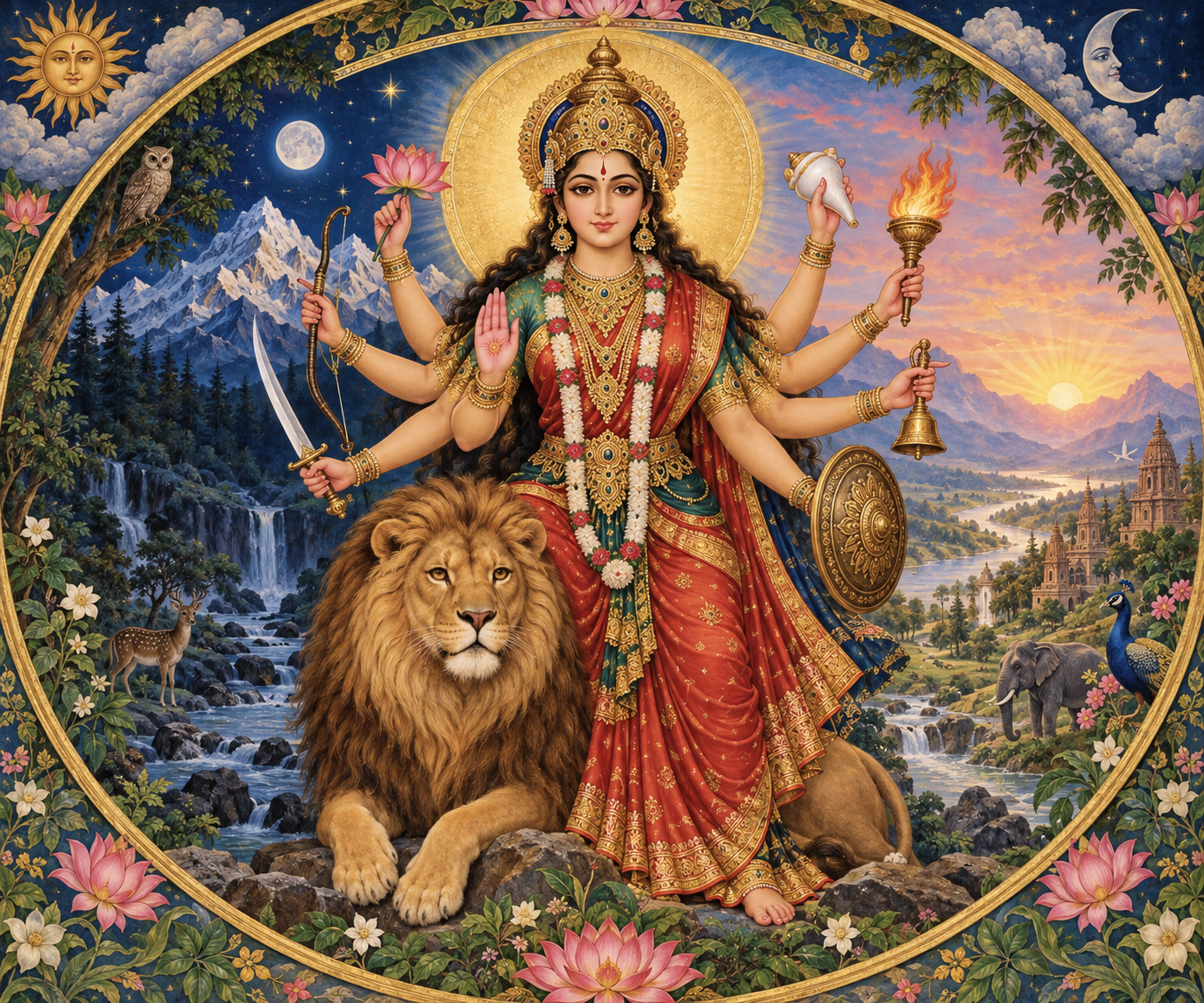
Arjuna does not appeal to an abstract force called “power.” He addresses a recognisable Goddess through names carrying martial, protective, maternal, ritual and philosophical meanings. Their range is an interpretive guardrail: no single epithet is allowed to define the whole invocation.
| Dimension | Names and attributes | What you should notice |
|---|---|---|
| Fierceness and victory | Kali, Bhadrakali, Mahakali, Chandi, Karali, Vijaya, Jaya and raṇapriyā | The prayer does not conceal its battlefield setting. Durga is invoked as the power able to confront and overcome danger. |
| Passage and protection | Tarini and Durga who dwells in difficult, inaccessible places | Victory is joined to the capacity to carry the devotee through peril, not merely to the destruction of an opponent. |
| Knowledge and revelation | Brahmavidya, Saraswati, Savitri, Vedamata and Vedanta | The Goddess praised with martial names is also identified with sacred knowledge, the Vedic mother and the culmination of inquiry. |
| Cosmic, ritual and maternal presence | Mahanidra, Svaha, Svadha, Kala, Kashtha, Skandamata and Bhagavati | Her scope exceeds the immediate battle. The hymn places embodied life, ritual offering, time and motherhood within her field. |
One of the hymn’s sharpest expressions is mahiṣāsṛkpriye, addressing her as one who delights in the blood of the buffalo. Alongside Kaushiki, the great laugh and the fierce visage, the buffalo reference immediately recalls Mahishasuramardini. It should not be sanitised into a vague metaphor. Yet it should not be detached from the later identifications with Brahmavidya, Saraswati and Vedanta either.
If you read or recite the hymn, resist selecting only the names that fit a theology already settled in your mind. Do not quote raṇapriyā while ignoring Brahmavidya. Do not celebrate Vedanta while erasing the spear, sword, shield and battlefield. The hymn’s distinctive claim lies in their conjunction: the fierce power that confronts adharma is not separate from the wisdom by which action must be understood.
Krishna and Durga are not competing for jurisdiction
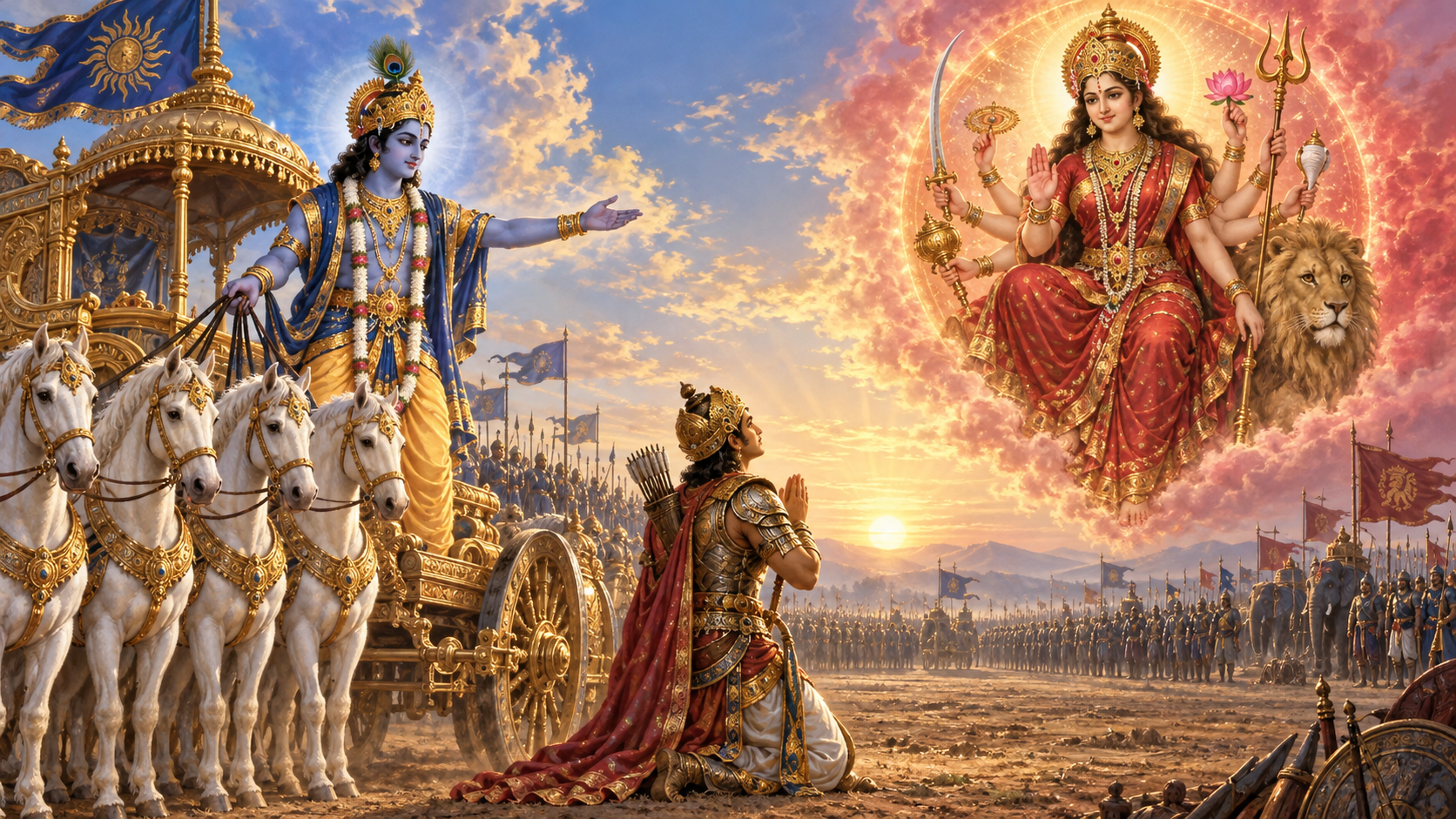
A natural question arises: if Krishna is already beside Arjuna, why does the warrior need to invoke Durga? The narrative answers more cleanly than a debate about divine rank would. Krishna gives the instruction. Arjuna addresses Durga. Durga appears and grants assurance. Her assurance then points back to Arjuna as Nara and to Narayana accompanying him.
Arjuna is therefore not appealing over Krishna’s head, as if one deity must correct another. Nor is Durga an ornamental presence with no agency of her own. Krishna deliberately sends the warrior into her worship, while she confirms the decisive meaning of Krishna’s presence. The scene is a poor fit for modern attempts to make Vaishnava and Shakta devotion mutually exclusive.
The petition itself is direct. Arjuna says that he has praised Mahadevi with a purified inner self and asks that victory be his tvatprasādāt, “by your grace.” He possesses Gandiva, has Krishna as charioteer and is ready to enter a war for which vast forces have assembled. Even so, he does not describe victory as his autonomous achievement.
When this episode is recruited for a sectarian argument, return to three questions. Who commands the invocation? Krishna. Who receives the prayer and bestows the assurance? Durga. What reason does she give for Arjuna’s invincibility? He is Nara, and Narayana is with him; with Krishna present, even Indra cannot defeat him. Those answers preserve every participant’s role without forcing the scene into a contest it does not stage.
Victory is promised before Arjuna loses his certainty
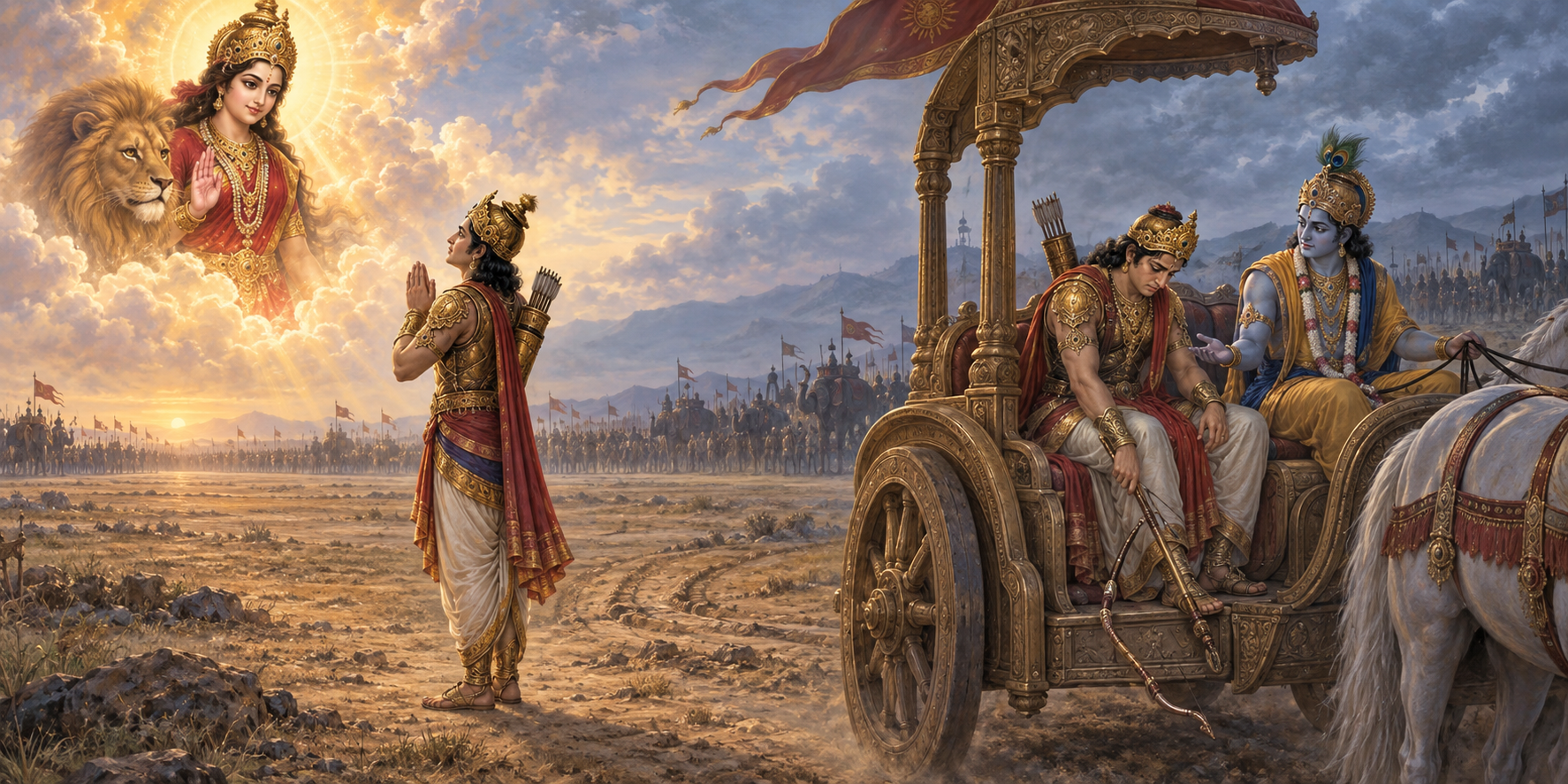
The most important feature of the episode may be what the boon does not accomplish. Durga assures Arjuna that his enemies will soon be defeated. She disappears, he returns to the chariot, and the martial narrative resumes. Yet Arjuna will soon ask Krishna to position the chariot between the two armies. Seeing Bhishma, Drona, relatives, teachers and friends, he loses his resolve and Gandiva slips from him.
There is no contradiction. Assurance about an outcome does not automatically settle the meaning of an action. Arjuna can be promised victory and still need to understand duty, agency, attachment and the cost of acting. The Gita’s dialogue opens precisely because success alone cannot answer the crisis before him.
This gives you a disciplined way to bring the sequence into your own spiritual life:
- Purify the intention. Before asking to prevail, state the duty without naming the person you resent. If the aim disappears when anger and humiliation are removed, it may not yet be a clear duty.
- Ask for grace without pretending to control the result. Tvatprasādāt leaves room for effort while refusing the fantasy of self-sufficiency.
- Return to the chariot. Prayer is followed by action. It is also followed by honest examination when conscience, grief or uncertainty arises.
- Do not suppress the next question. Arjuna’s later anguish is not proof that his prayer failed. It reveals another layer of the problem, one that requires Krishna’s teaching rather than a second promise of victory.
The battlefield metaphor needs restraint. A disagreement, wounded pride or political rivalry does not automatically make your opponent an embodiment of adharma. Arjuna’s prayer occurs within a specific war and is followed by searching moral instruction. Using Durga’s fierce names to sanctify an unexamined grievance reverses that sequence.
How to study or recite the episode responsibly
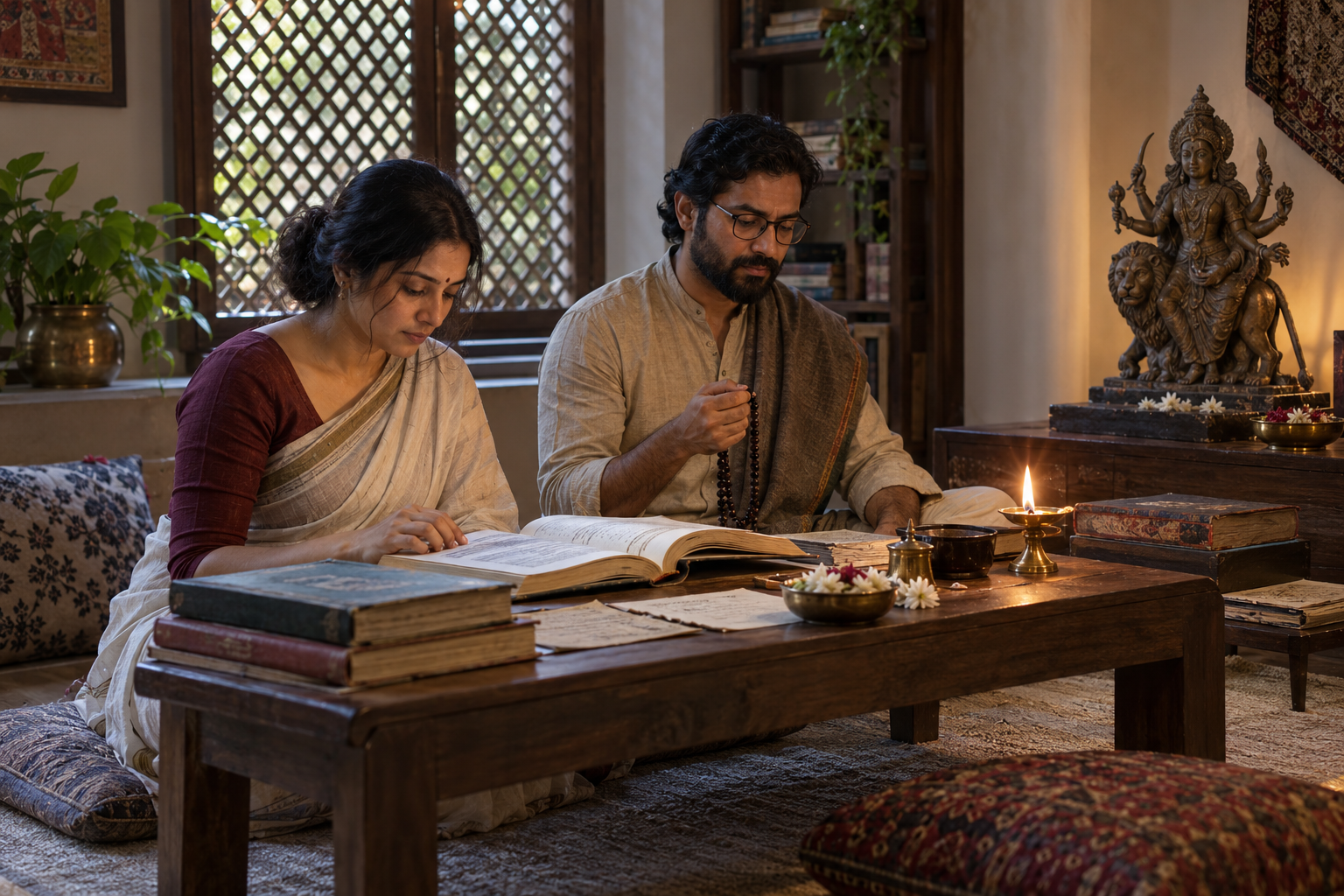
You do not need to begin with a grand theory of Shaktism, Vaishnavism or the relationship among their traditions. Begin with the textual movements and let each one correct an easy misreading.
- Identify the text precisely. Mark Bhishma Parva 23 in the Gita Press recension rather than referring vaguely to “something before the Gita.”
- Read verses 2 and 3 for posture. Krishna calls for purification and recitation; Arjuna responds by descending and joining his palms. Devotion is expressed through the body before it becomes petition.
- Read the names as a complete movement. Place the fierce and victory-bearing names in one column and the knowledge, ritual and maternal names in another. Then notice that Arjuna addresses one Goddess through both columns.
- Pause at tvatprasādāt. Ask what it would mean to seek grace while retaining responsibility for preparation, judgement and action.
- Continue into Arjuna’s crisis. Do not stop when Durga promises victory. Follow him back onto the chariot and into the bewilderment that makes the Gita necessary.
The elements visible in this episode are specific: purification, orientation toward battle, descent from the chariot, joined palms, invocation through divine names and a petition for victory. A compulsory modern recitation count, guaranteed material result or initiation rule would require some further authority; none should be invented from this scene alone. You can honour the Stotra devotionally while remaining exact about what this particular Mahabharata passage establishes.
The next time you open the Bhagavad Gita, begin one movement earlier, where Krishna asks the warrior to pray. Read Durga’s names without separating fierceness from knowledge, follow Arjuna back onto the chariot, and allow his next crisis to remain real. That sequence will show you why grace, courage and discernment all belong at the threshold of dharma.
References

Leave a Reply
You must be logged in to post a comment.