
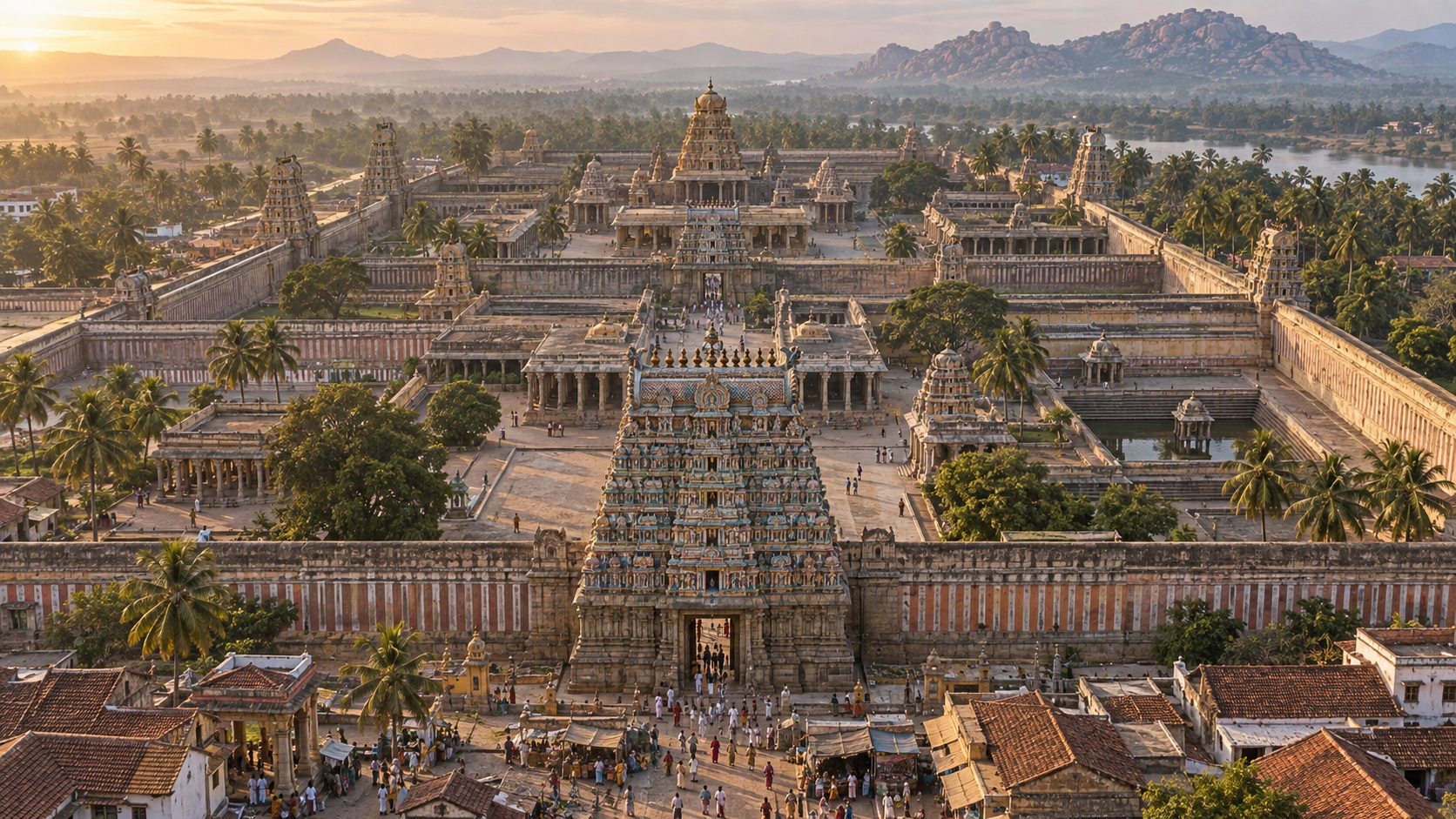
When you approach a large South Indian temple, the structure dominating the skyline may be a gateway rather than the shrine itself. If you judge the whole complex by that first tower, you can miss the architectural logic that leads from the public street to the presence of the presiding deity.
You will understand far more if you read the temple as a sequence of thresholds, enclosures, halls and sacred spaces. Learn a few structural terms, slow down at the transitions, and the apparent profusion of towers and carvings begins to form a coherent map.
Read the temple as a route, not a single building
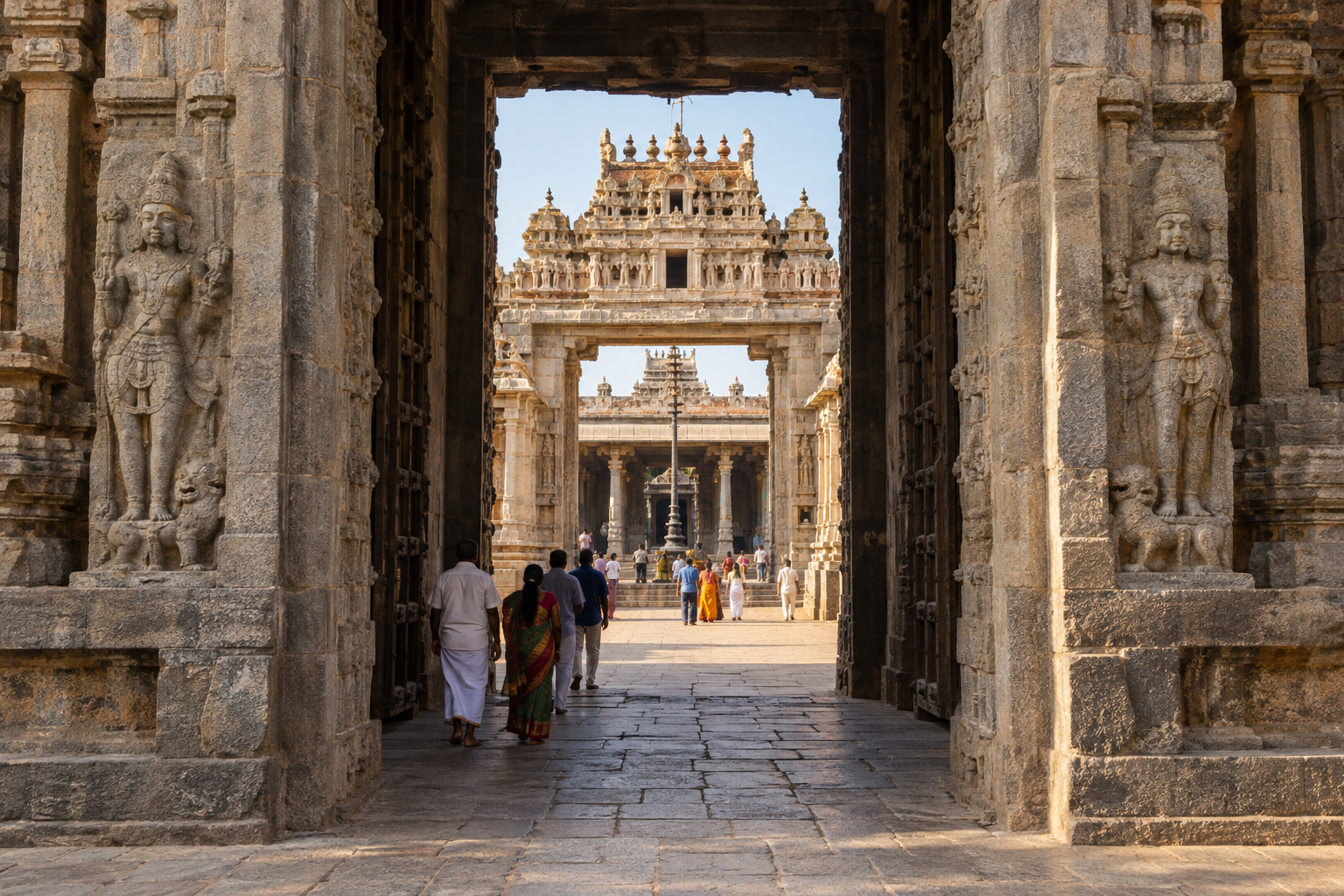
A major Dravidian temple is often a complex of related structures rather than one isolated monument. Its enclosure walls define precincts; gateways regulate entry; pillared halls gather people; subsidiary shrines create additional centres of devotion; and the principal sanctum holds the presiding deity. The architecture becomes intelligible when you ask how these parts guide movement.
A useful reading order is:
- Find the enclosure. Look for the wall, or prakara, that establishes the sacred precinct. A large complex may have more than one enclosure.
- Locate the gateway passage. The tower above it is the gopuram. Walk through the opening and notice how crossing the threshold changes your view, pace and access.
- Identify the gathering spaces. A mandapa is a hall, commonly supported by pillars. Its position and scale can indicate whether it serves approach, assembly, ritual or procession.
- Trace the approach inward. Follow the principal alignment where the plan permits it, while remembering that later additions can make a large complex less visually simple.
- Find the sanctum. The garbhagriha is the innermost chamber housing the principal sacred image or emblem. The superstructure directly above it is the vimana.
This sequence is more useful than counting sculptures or photographing the tallest tower. It lets you notice how architecture moves you from an open, socially active exterior toward a more concentrated interior. Actual routes and permitted access vary, so follow temple instructions and observe the sanctum’s alignment from the nearest place open to you.
Do not confuse the gopuram with the vimana
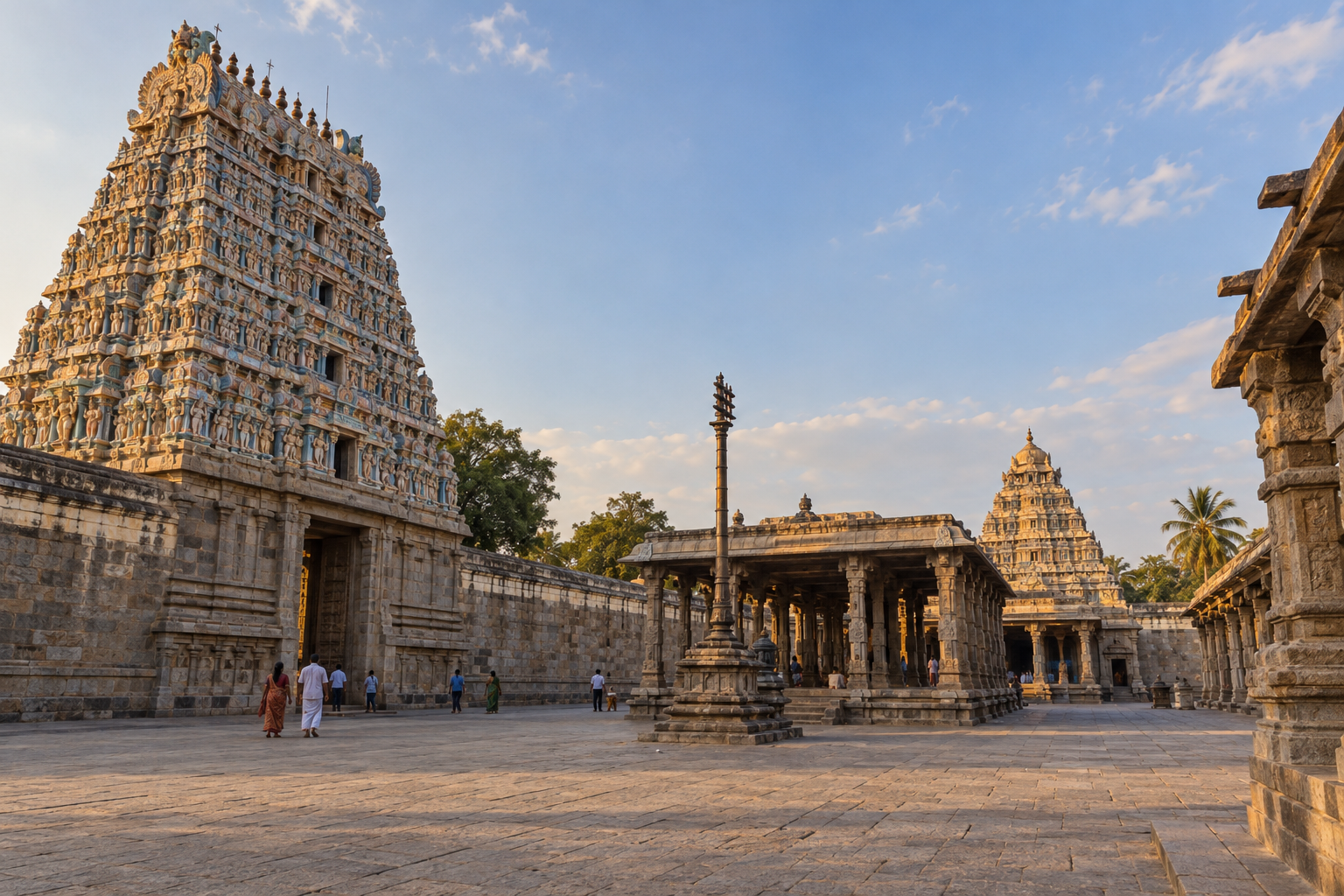
The most common first-time misreading is to call every tower a gopuram, or to assume that the tallest tower must stand over the principal deity. The distinction is functional before it is visual: a gopuram marks an entrance through an enclosure, while a vimana rises over a sanctum.
| Element | Where to find it | What it does | How to check |
|---|---|---|---|
| Gopuram | At an opening in an outer or inner enclosure wall | Announces and monumentalises a threshold | Trace the tower downward: a gateway passage should run through its base |
| Vimana | Immediately above a sanctum | Marks the sacred chamber within the temple | Trace it downward to the shrine rather than to a boundary entrance |
| Mandapa | Along the approach or beside a shrine | Provides a pillared space for gathering and ritual activity | Look for an inhabitable hall rather than a solid tower |
| Prakara | Around a shrine or group of buildings | Defines an enclosure and channels circulation | Follow the wall and note which gateways penetrate it |
In an extensive temple, successive gateways can frame one another and draw your eye inward. Yet the visually dominant entrance need not belong to the earliest phase of construction. Before assigning importance or age from height alone, establish what the structure stands over.
Read carvings by location before trying to name them
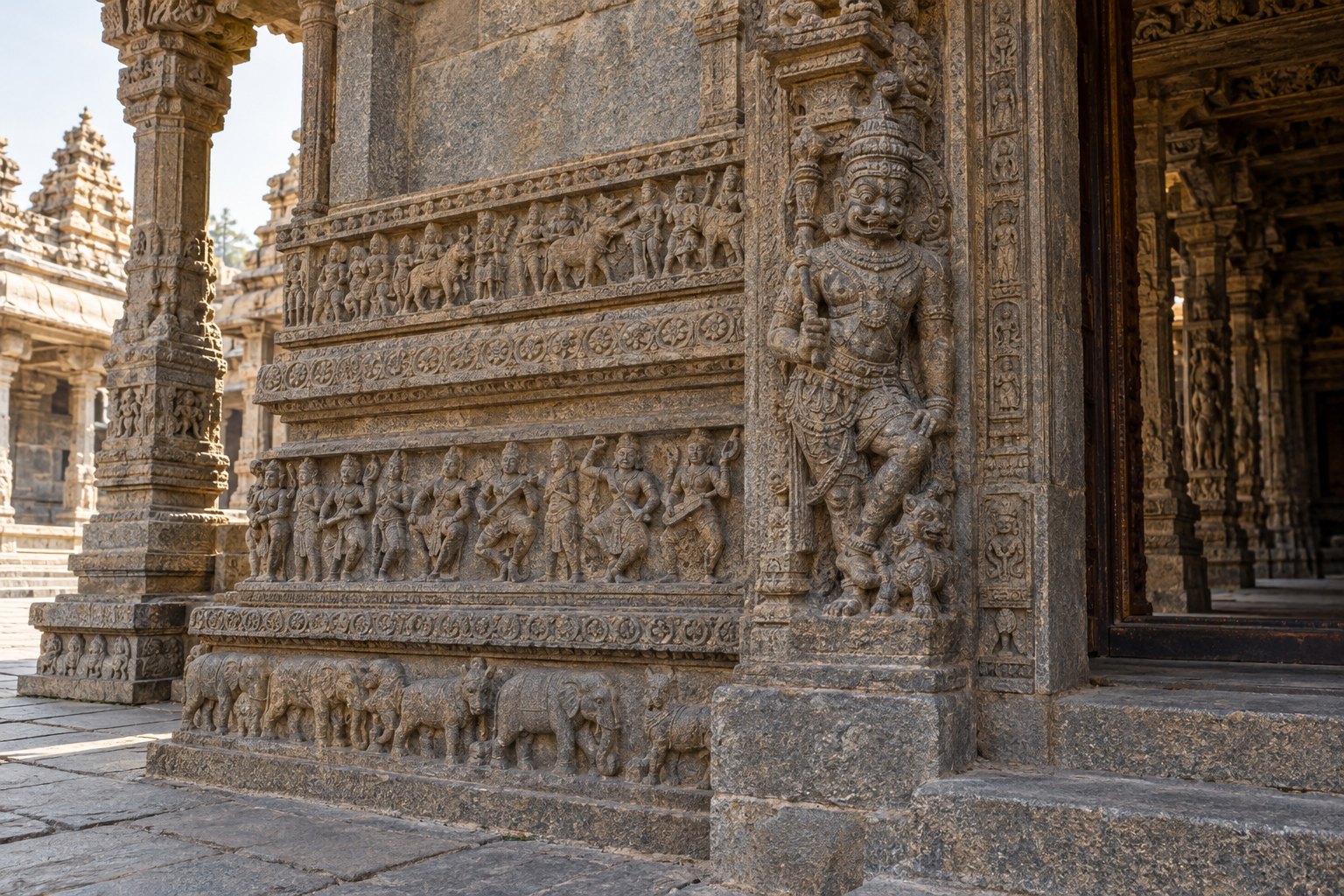
Monumental towers and intricate carving are defining features of the tradition, but carving is not merely material added to fill a surface. Its placement helps you interpret its purpose.
Begin with location. Guardians near a doorway prepare you to cross a boundary. Images arranged around a shrine relate to that shrine’s sacred identity. Narrative bands encourage sequential viewing. Figures on pillars belong to the experience of moving through a hall, where changing angles and light reveal different details. Ceiling designs ask you to look upward at a point where the building may be directing attention or gathering people.
Use this method when a figure is unfamiliar:
- First record where it appears: gateway, wall, base, pillar, ceiling or shrine niche.
- Then look for attributes such as posture, hand-held objects, vehicle, attendants or surrounding figures.
- Compare it with nearby images. A sequence often explains more than one sculpture viewed alone.
- Check temple signage or a reliable plan before making a firm identification.
- Do not infer the affiliation of an entire temple from one subsidiary image. A living complex can contain several related shrines and many divine forms.
Photography can help you review a sequence later, where permitted. Touching, rubbing or climbing on sculpture cannot: it risks damaging surfaces and disregards the temple’s sacred use. Observe closely without treating the building as an object detached from worship.
Expect historical layers rather than one dynastic signature
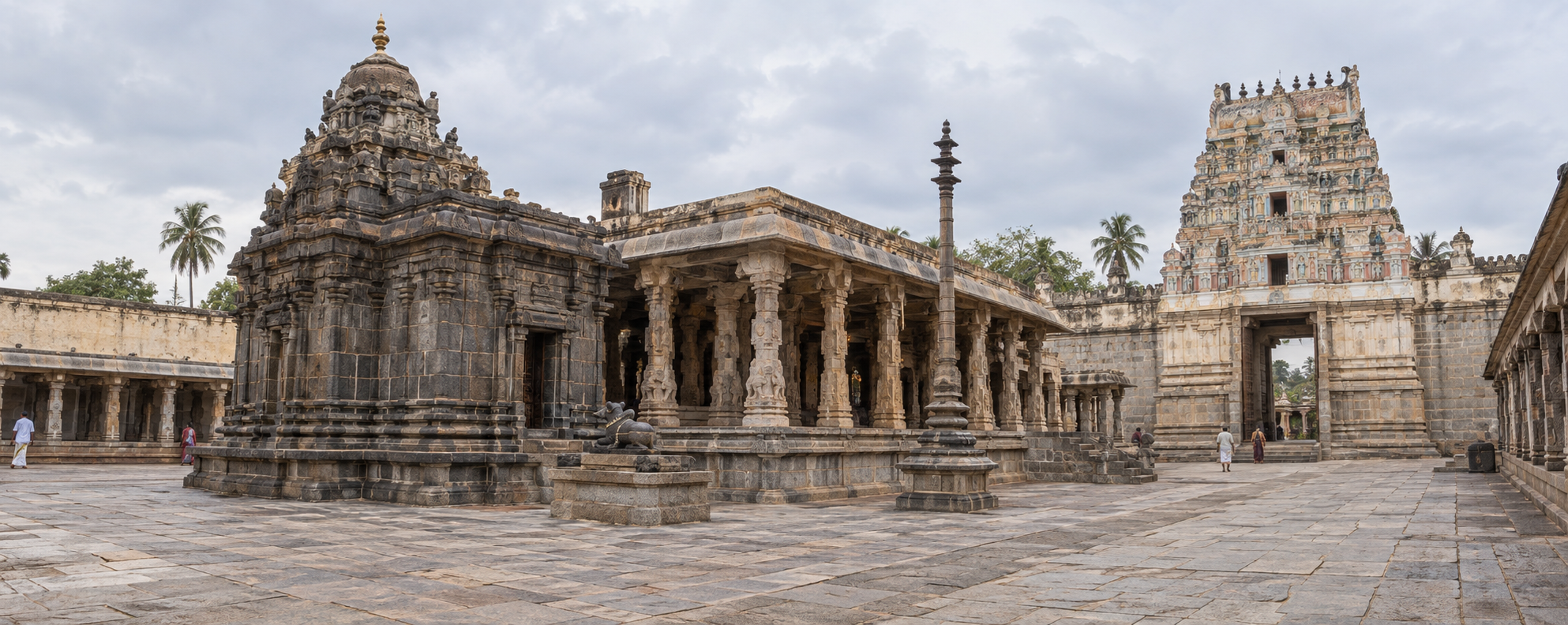
Dravidian temple architecture originated in the southern Indian peninsula and flourished under the Pallavas, Cholas, Pandyas, Hoysalas and the Vijayanagara Empire. That succession should warn you against imagining a fixed design produced in one period or a uniform style repeated across the South.
Regional traditions developed distinct proportions, plans, sculptural treatments and building practices. Individual complexes could also grow as patrons added gateways, halls, walls and shrines. The name attached to a temple may identify its foundation, its most celebrated phase or its present identity without dating every visible part.
You can look for possible building phases without pretending to date them from appearance alone:
- Compare masonry, colour, weathering and the depth of carving between adjoining sections.
- Look for joints where a hall, enclosure or corridor meets another structure.
- Notice changes in pillar form, moulding pattern, tower profile and sculptural density.
- Check whether gateways, halls and sanctum share a clean axis or whether additions alter the route.
- Record inscriptions when photography is allowed, but rely on a qualified reading rather than guessing from script alone.
These clues generate questions; they do not prove a chronology. Restoration, repairs and the use of different stone can imitate the appearance of separate periods. Treat the visible change as evidence to investigate, not as a dynasty label you can confidently attach on sight.
Key takeaways for your next temple visit
- Start with the plan: identify the enclosure, gateway, hall, shrine and route between them.
- Trace every tower to its base. A passage indicates a gopuram; a sanctum indicates a vimana.
- Interpret sculpture through placement, attributes and neighbouring images rather than visual resemblance alone.
- Distinguish the principal shrine from subsidiary shrines before drawing conclusions about the complex.
- Assume that a large temple may contain multiple building phases, then test that possibility against masonry, joints, alignments and reliable historical information.
- Remember that you are entering a place of worship. Local rules and ritual use take priority over the ideal viewing angle or photograph.
On your next visit, pause immediately inside the first gateway. Turn back to identify the threshold you crossed, then face inward and locate the sanctum’s direction. That small act changes the temple from a crowded collection of monuments into a sacred landscape you can begin to read.
References

Leave a Reply
You must be logged in to post a comment.