
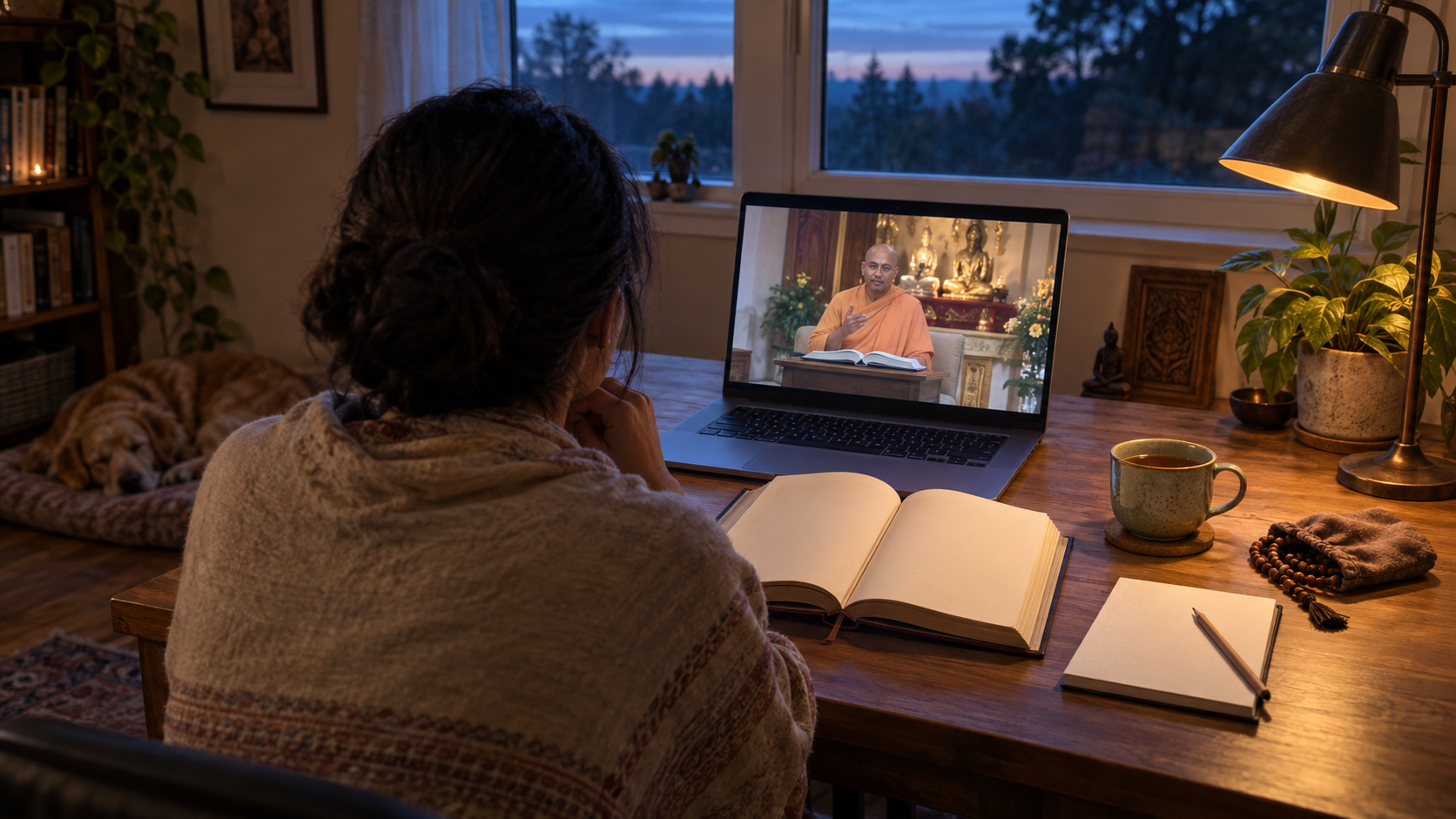
You have found an ISKCON Srimad Bhagavatam broadcast, but pressing play is the easy part. The harder question is how to hear it as scriptural instruction rather than letting it become another devotional video running in the background.
A small amount of preparation changes the experience. If you identify the passage, choose whether you are studying or joining darshan, and leave a traceable note afterward, a broadcast can become part of sustained sadhana instead of disappearing into your viewing history.
Decode the title before you press play

A Srimad Bhagavatam class is normally identified by a three-part reference: canto, chapter and verse. Thus, 11.5.50 means Canto 11, Chapter 5, Verse 50. A leading zero does not change the passage: 11.05.11 means Canto 11, Chapter 5, Verse 11.
This matters when a title contains several numbers. The letters SB tell you that the parenthetical number is a scriptural reference, while a nearby date identifies the broadcast. For example, SB 11.5.50 was taught by H.G Mukund Datta Prabhu in an ISKCON Juhu class dated 8 October 2026. A separate broadcast presents His Grace Deena Bandhu Prabhu speaking on SB 11.05.11 on 9 October 2026 through ISKCON Vrindavan.
Before listening, write down the complete reference, speaker, temple or channel, date and link. That takes little effort, yet it prevents a common problem: remembering a striking teaching while forgetting which verse and context gave rise to it. If the spoken introduction and the displayed title identify different passages, record both and verify the verse in the text before filing your notes.
Key takeaways
- Read an SB reference as canto, chapter and verse, not as a date or episode number.
- Open the named verse before listening so that the class remains connected to the text.
- Decide in advance whether you are studying a class or participating attentively in darshan.
- Separate the scriptural wording, the speaker’s explanation and the practical application in your notes.
- Save each broadcast by passage and speaker, with one unresolved question that can direct your next reading.
Use two hearings and one disciplined note

Constant pausing can break the movement of an oral class. Never pausing can leave you with only a mood and a few memorable phrases. A two-pass method gives you both continuity and precision.
- Open the same verse in the edition you normally study. Read its translation and, where available, the surrounding verses and purport. The surrounding passage matters because a teacher may assume that regular listeners already know the argument.
- Hear the class once for its overall movement. Note only the main question being addressed and any additional verse reference you need to locate later.
- Return to the portions that carried the central reasoning. Divide your page into three parts: text, explanation and application.
- Under text, record the exact verse, phrase or scriptural idea being discussed. Under explanation, paraphrase how the speaker develops it. Under application, record what the teaching asks a practitioner to notice or change.
- Finish with one open question. A precise question such as whether an application arises from this verse or from a wider teaching is more useful than writing that you need to understand the class better.
Do not give every sentence the same authority
A spoken class can move among scriptural words, explanation, illustration and practical counsel. These elements cooperate, but they are not interchangeable.
- A direct reading or quotation can be checked against the named text.
- An explanation should be traced to the verse, its immediate context or another passage identified by the speaker.
- An illustration can make an idea memorable without becoming scriptural proof by itself.
- An application may be spiritually valuable even when its wording does not appear in the verse. Record it as application rather than later repeating it as though it were a quotation from the Bhagavatam.
This distinction is not a device for listening suspiciously. It is a form of respect. You preserve what the scripture says, what the teacher explains and what you have inferred, without blending the three into a sentence that none of them actually stated.
Class and darshan ask different things of you
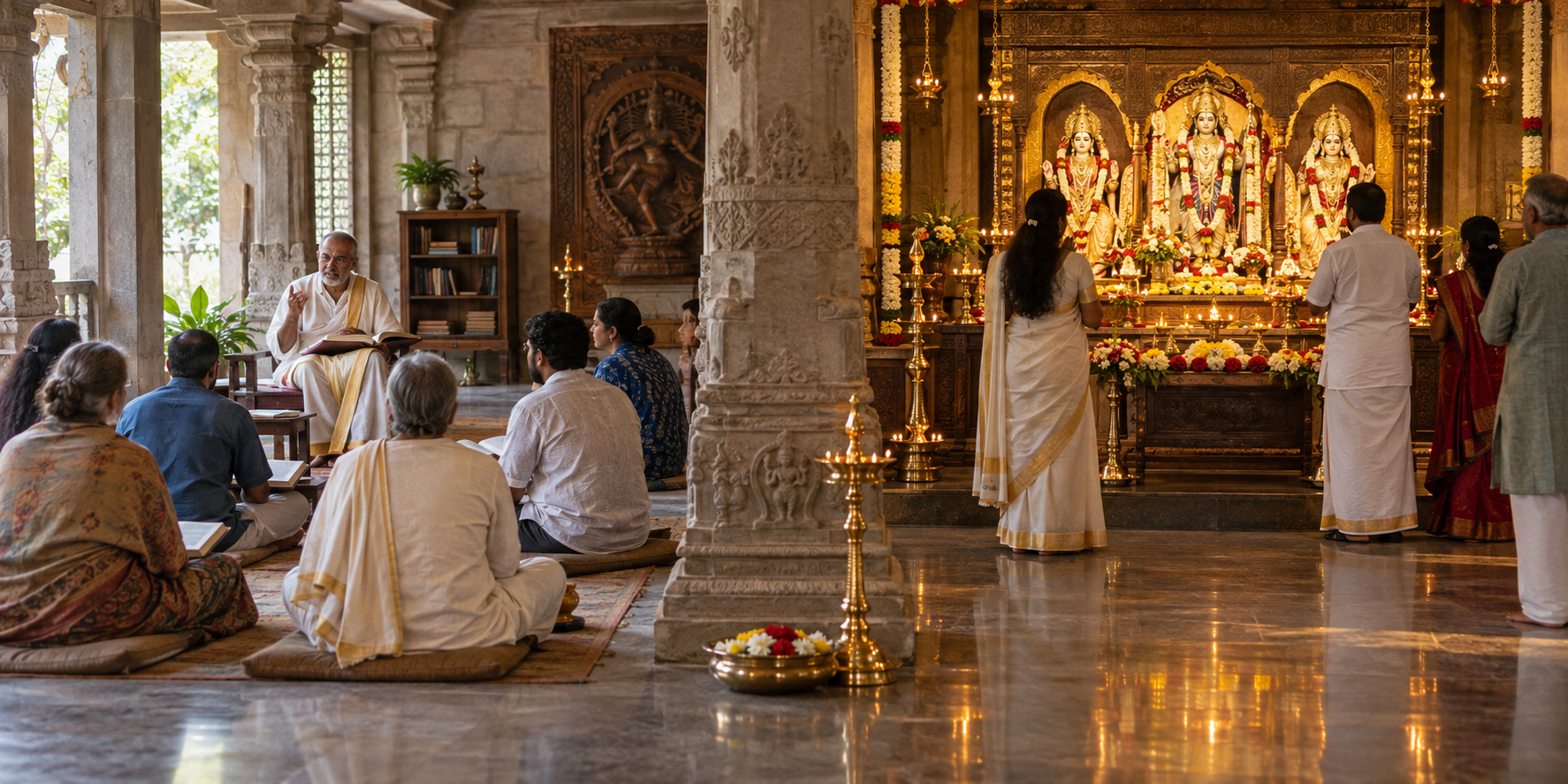
An ISKCON media stream may place scriptural teaching and temple darshan close together. Viewers of the Vrindavan broadcast can also encounter live Mangal Arati darshan from Sri Sri Krishna Balaram Mandir. Both belong within devotional life, but they call for different forms of attention.
A class asks you to follow an argument, remember a passage and distinguish textual teaching from explanation. Keep the scripture and your notes within reach. Darshan asks for attentive participation in worship. Silence competing media, stop treating the screen as scenery, and follow the worship according to your established practice.
Confusion begins when you expect one form to perform the work of the other. Darshan does not replace close study of a verse. A lecture playing beneath messages, chores and other tabs is not automatically serious hearing merely because its subject is sacred. Before opening a stream, decide on the verb: are you studying, hearing prayerfully or joining darshan? Then arrange your attention accordingly.
Build an archive that leads you back to the scripture

A useful archive is organised by the Bhagavatam, not merely by upload order or thumbnail. Give each entry a consistent heading: scripture reference, speaker, temple or channel, date and link. After listening, add a one-sentence theme, one textual anchor, one application and one unanswered question.
Do not assign the theme before hearing the class. The verse number tells you where the class begins, but it does not tell you which aspect the speaker will develop. Writing the theme afterward keeps your archive descriptive rather than forcing every lecture into a preconceived category.
The broadcasts on SB 11.5.11 and SB 11.5.50 can both sit under Canto 11, Chapter 5, but they should not be treated as consecutive parts of one argument. Many verses stand between them. Read that intervening portion before drawing a thematic line from one class to the other. Shared chapter metadata is a prompt to study the chapter; it is not evidence that two talks make the same point.
Over time, this structure gives you several useful paths back into the material. You can revisit a particular verse, follow a speaker’s treatment of different passages, review applications connected with one spiritual difficulty, or return to questions that remain unresolved. The broadcast then serves its best purpose: it sends you back to the Bhagavatam with sharper attention.
Choose one recording for your next sitting. Write its full reference before playing it, hear it once without fragmenting the argument, and leave with one textual anchor and one question. That modest discipline is enough to turn the next broadcast from something you watched into something you can continue to study.
References
- Dandavats — Today’s Featured Video: Srimad Bhagavatam Class 11.5.50 | By H.G Mukund Datta Prabhu | 8th Oct 2026
- Dandavats — His Grace Deena Bandhu Prabhu || (SB-11.05.11) || (09-10-2026)

Leave a Reply
You must be logged in to post a comment.