
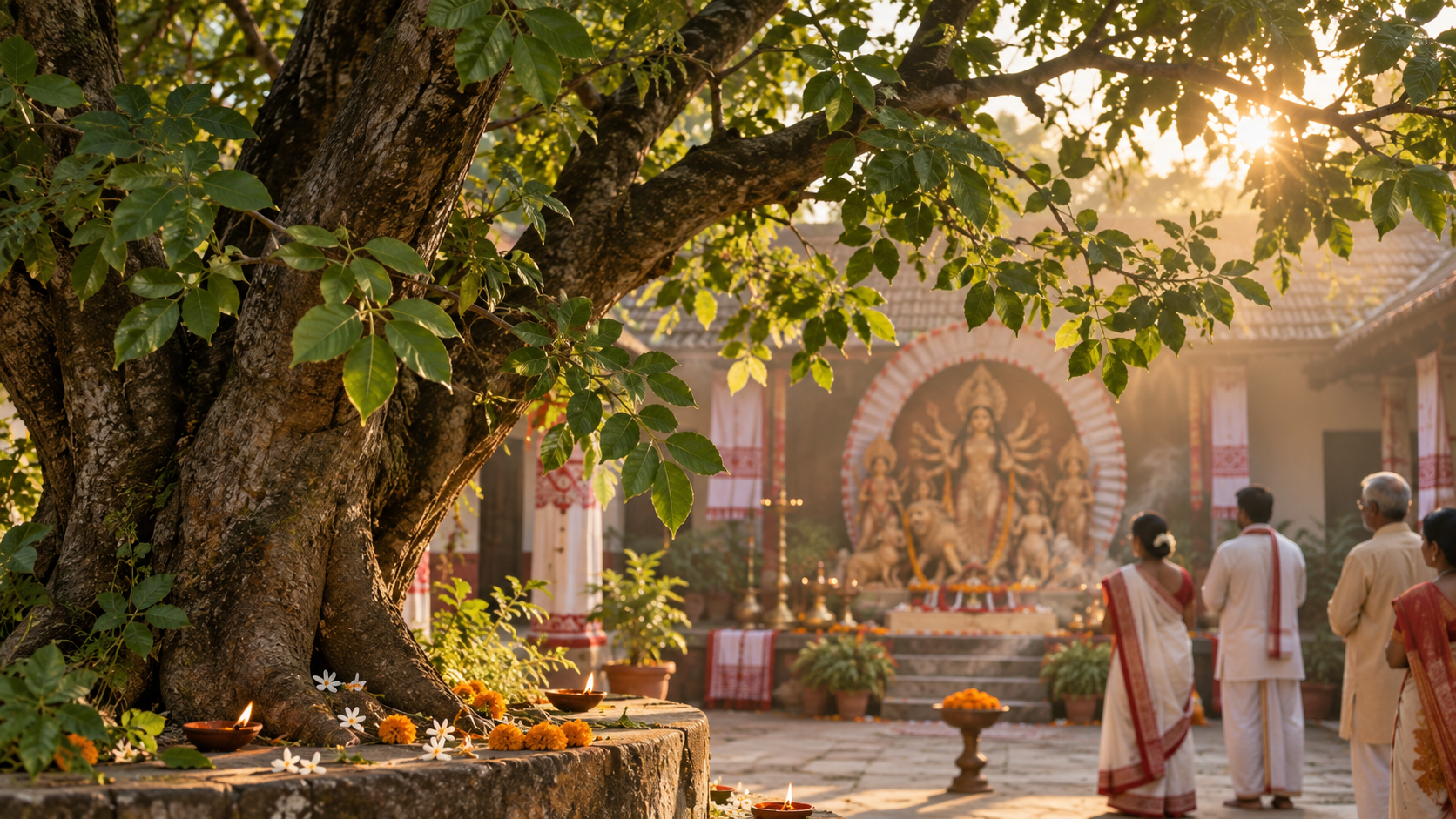
If you know Bilva chiefly through the worship of Lord Shiva, its place in Durga Puja may seem puzzling. It is not an accidental borrowing. The tree carries a distinct connection with Goddess Durga, and that connection changes how you should see and approach it during the Puja.
The practical lesson is simple: do not reduce Bilva to a leaf on a ritual tray. Look first at the living tree, the sacred memory associated with it, and the conduct that such reverence should produce.
Why Bilva belongs in Durga Puja
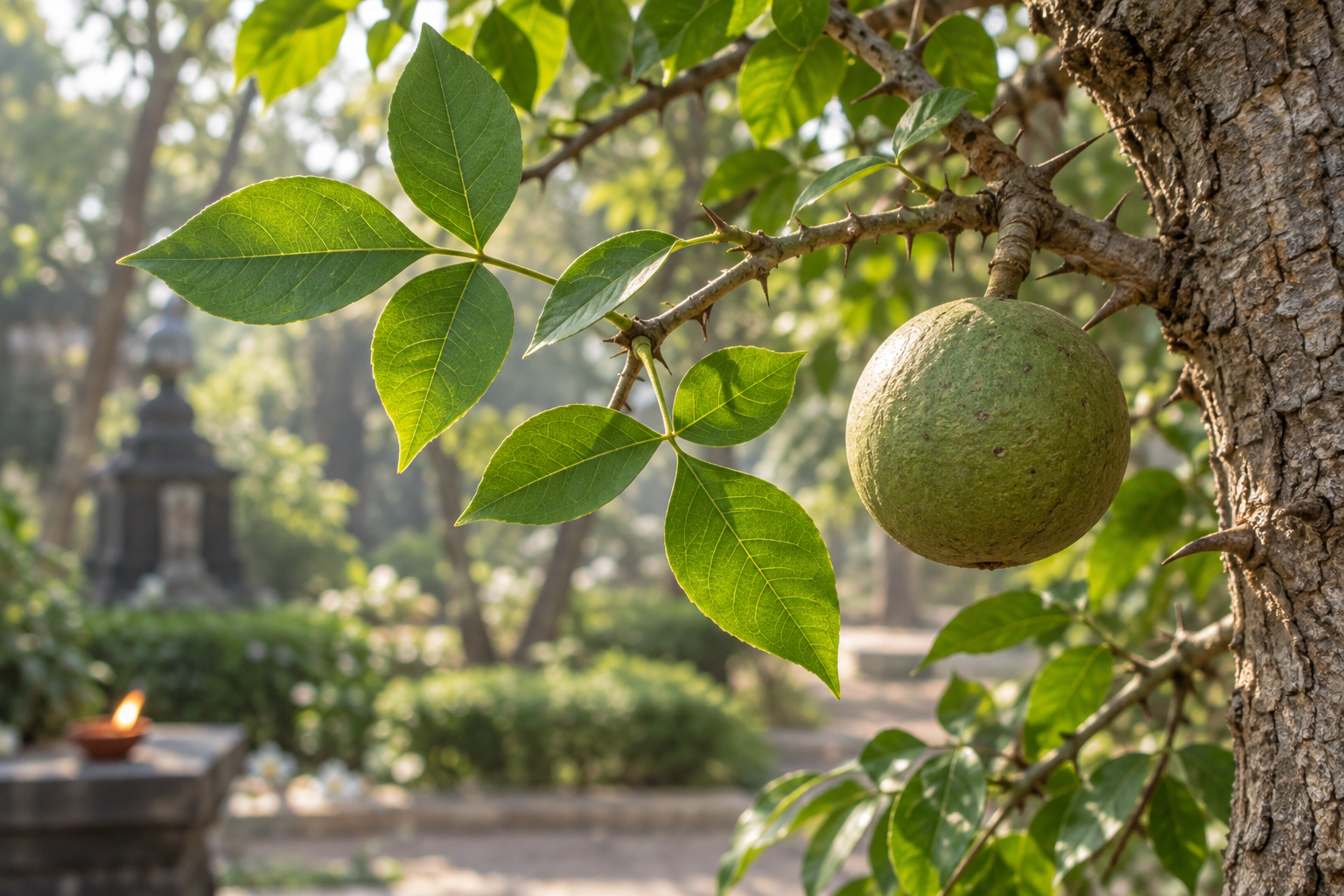
Bilva, also called Bael and botanically identified as Aegle marmelos, is revered in Hindu tradition and associated with Lord Shiva, Goddess Durga, and auspicious observances. Remembering only its Shaiva association therefore gives you an incomplete picture.
Its special place in Durga Puja comes from the sacred memory of the divine awakening of Goddess Durga beneath the tree’s shade. Bilva consequently points to more than the presence of vegetation in a ceremony. It evokes awakening: divine power becoming manifest and the worshipper becoming ready to recognise it.
This is why the whole tree matters. A detached offering can be carried, arranged, used, and forgotten. A living tree confronts you with continuity. It existed before the ceremony, sustains the material used in worship, and remains after the festival has ended. If you encounter Bilva during Durga Puja, notice that larger relationship before concentrating on the individual ritual object.
What the tree asks you to notice
The association of Bilva with both Shiva and Durga discourages a narrow habit of assigning every sacred object to a sealed religious compartment. You do not have to erase the distinct forms, names, or modes of worship to recognise their relationship. The same tree can carry more than one sacred association without those associations cancelling one another.
For a devotee, the image of Durga awakening beneath Bilva offers a demanding question: what in you remains dormant after the ritual is over? Courage that never becomes action, knowledge that never governs conduct, and reverence that never protects anything remain incomplete. The symbolism becomes useful when it moves you from passive admiration toward responsible behaviour.
Bilva also corrects the idea that auspiciousness is a kind of magic stored in an object. Sacred material is not a shortcut around attention, discipline, or right conduct. Its purpose is to organise your attention. The tree directs that attention toward awakened Shakti, the connectedness of Dharmic worship, and the living world through which ritual becomes possible.
How to honour Bilva without turning it into a prop
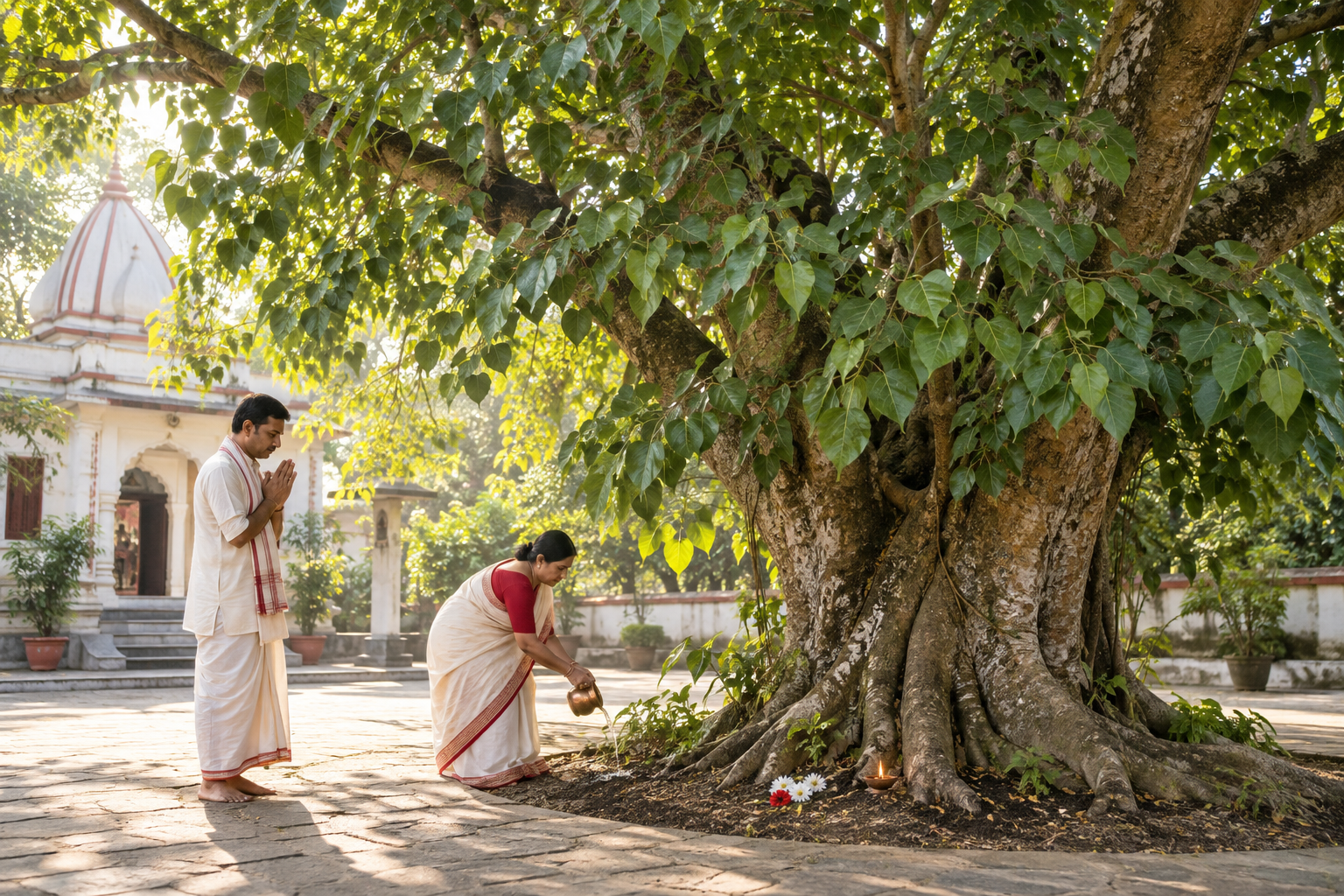
Exact observances can differ among families, temples, and Puja communities. That makes careful participation more important, not less. If you are organising a home worship or helping at a community Puja, use this sequence.
- Find out which practice you are following. Ask the responsible priest, family elder, or Puja organiser what role Bilva has in that particular observance. A visible action copied from a photograph or brief video may represent only one part of a larger rite.
- Confirm the plant. Bilva is Aegle marmelos. If you cannot identify it confidently, ask someone who can. Do not select an unrelated plant merely because its foliage seems similar.
- Seek permission before taking plant material. A sacred designation does not make a tree ownerless. This is especially important when the Bilva stands on temple grounds, private land, or in a maintained public space.
- Take only what the observance requires. Avoid stripping foliage or breaking branches for abundance or display. Excess does not make an offering more reverent; it merely transfers the cost of the display to the tree.
- Protect the living tree during worship. Do not drive nails into the trunk, fasten wire around it, tie anything tightly enough to injure the bark, or place flame where heat could scorch the tree. Decorations should be removable without leaving damage.
- Keep organic material separate from plastic and synthetic decorations. After the Puja, follow the temple’s or community’s established arrangements for sacred plant material. Do not assume that throwing everything into water is respectful, particularly when packaging, thread, foil, or plastic is mixed with it.
- Carry the symbolism into one decision. Choose a concrete act that reflects awakening: complete a neglected duty, intervene against an injustice you have been avoiding, support the care of a sacred grove, or help maintain the Bilva tree used by your community.
If Bilva is unavailable, do not damage a distant tree or declare a random substitute equivalent on your own authority. Ask the person guiding your observance what is appropriate within that tradition. Restraint is preferable to an invented ritual presented as established practice.
Common mistakes that obscure the meaning
- Calling Bilva exclusively a Shiva tree: its association with Shiva is important, but it does not exhaust the tree’s sacred identity. Its connection with Durga is precisely why it has significance here.
- Treating the tree as festival scenery: the relevant image is not simply a decorated plant. It is the awakening of the Goddess beneath a living sacred presence.
- Confusing imitation with tradition: seeing plant material at one Puja does not tell you its name, purpose, timing, or ritual treatment. Ask before reproducing what you saw.
- Equating quantity with devotion: gathering more than a rite requires can injure the very life being honoured.
- Remembering symbolism but neglecting the site: litter, bark damage, or careless disposal contradicts the reverence expressed during worship.
These errors share one cause: they separate the ritual object from the relationship that makes it sacred. Bilva is not important merely because it appears in a ceremony. It is important because Hindu tradition recognises the tree as sacred and remembers Durga’s awakening in connection with it.
Key takeaways
- Bilva is associated with Goddess Durga as well as Lord Shiva, so its place in Durga Puja is integral rather than accidental.
- The central image to remember is the divine awakening of Durga beneath the tree’s shade.
- The living tree deserves attention alongside any plant material used in worship.
- Local ritual details should be learned from the priest, elder, or organiser responsible for the observance.
- Correct identification, restrained gathering, and protection of the tree are practical expressions of reverence.
- The symbolism reaches completion when awakened devotion becomes responsible action after the Puja.
At your next Durga Puja, pause when you encounter Bilva. Learn what the local observance asks of you, protect the tree from needless harm, and let the memory of the Goddess’s awakening move one neglected dharmic duty into action.
References

Leave a Reply
You must be logged in to post a comment.