

You want to observe Ekadasi sincerely, but the practical questions arrive quickly. Which calendar should you follow? Must you avoid all food, or only certain foods? What happens if work, medicine, travel, or family duties make a strict fast unwise?
Begin with four decisions: the correct local date, the tradition whose rules you will follow, a safe level of abstinence, and the proper time for parana. Once those are settled, you can stop negotiating with yourself and give the day to remembrance, prayer, self-restraint, and seva.
Fix the date before you plan the fast

Ekadasi is the eleventh tithi in each half of the lunar month. A tithi does not necessarily begin at midnight or occupy one civil date from dawn to dusk. That is why an Ekadasi date copied from a distant city, a generic phone calendar, or an old social-media message may be wrong for your location.
Differences between published dates do not always mean that one calendar has made a simple mistake. Sampradayas may apply different rules concerning the tithi at sunrise and its relationship to Dvadasi. A Smarta calendar, a Vaishnava calendar, and a local temple schedule may therefore direct their communities differently.
Choose one competent authority that matches your practice. This could be your guru or sampradaya, the temple where you worship, or the panchanga that community consistently follows. Do not combine the observance date from one calendar with the parana time from another.
- Set the panchanga to the city where you will physically be, not merely your home city.
- Confirm whether the listed date is intended for your sampradaya.
- Record the beginning and end of the observance as instructed by that tradition.
- Write down the local parana window before Ekadasi begins.
- If you will cross a time zone, ask your temple or teacher which location should govern the observance.
Resolve a calendar disagreement before the vrata, not while you are hungry and searching for a rule that suits the moment. Consistency with a trusted tradition is more useful than collecting several calendars and trying to average them.
Choose a vrata your body and duties can sustain

The food rule is important, but it is not the whole vrata. Ekadasi loses its centre when the day becomes a contest in endurance, a special-diet project, or a reason to judge another devotee. The restriction should support recollection of Bhagavan and mastery of habit.
Forms of observance vary. Some practitioners undertake complete abstinence from food and water. Some take water or other permitted liquids. Others eat one or more simple meals while excluding grains and any additional foods prohibited by their lineage. These forms are not universal or automatically interchangeable. Follow the standard you have actually received rather than assembling a personal rule from fragments of several traditions.
Choose the level before the day begins. Making the rule stricter whenever enthusiasm rises, then relaxing it whenever hunger appears, turns the vrata into continuous bargaining. A modest commitment kept attentively is more coherent than an extreme commitment repeatedly renegotiated.
Food or fluid restriction is not appropriate for everyone. Pregnancy or breastfeeding, childhood, frailty, illness, strenuous physical work, a history of disordered eating, or medicine that must be taken with food can materially change what is safe. Do not stop medicine or alter its dose or timing to preserve a fast. Ask an appropriate clinician about the medical constraint and a qualified spiritual teacher about a suitable religious accommodation.
If strict fasting would be unsafe, you can still keep a meaningful vrata within the discipline permitted by your tradition. Simpler food, greater attention to japa, reduced entertainment, careful speech, charity, and seva can carry the day without pretending that a health risk is a spiritual achievement. If you become unwell during the fast, end the restriction safely and obtain appropriate medical help. Religious guilt should never delay necessary care.
A short written sankalpa prevents confusion. Use a sentence such as: “On this Ekadasi, following [calendar or teacher], I will observe [food commitment], complete [devotional practice], refrain from [habit or distraction], and perform parana during [local time window].” Fill in every bracket the previous evening.
Make the day devotional, not merely food-free
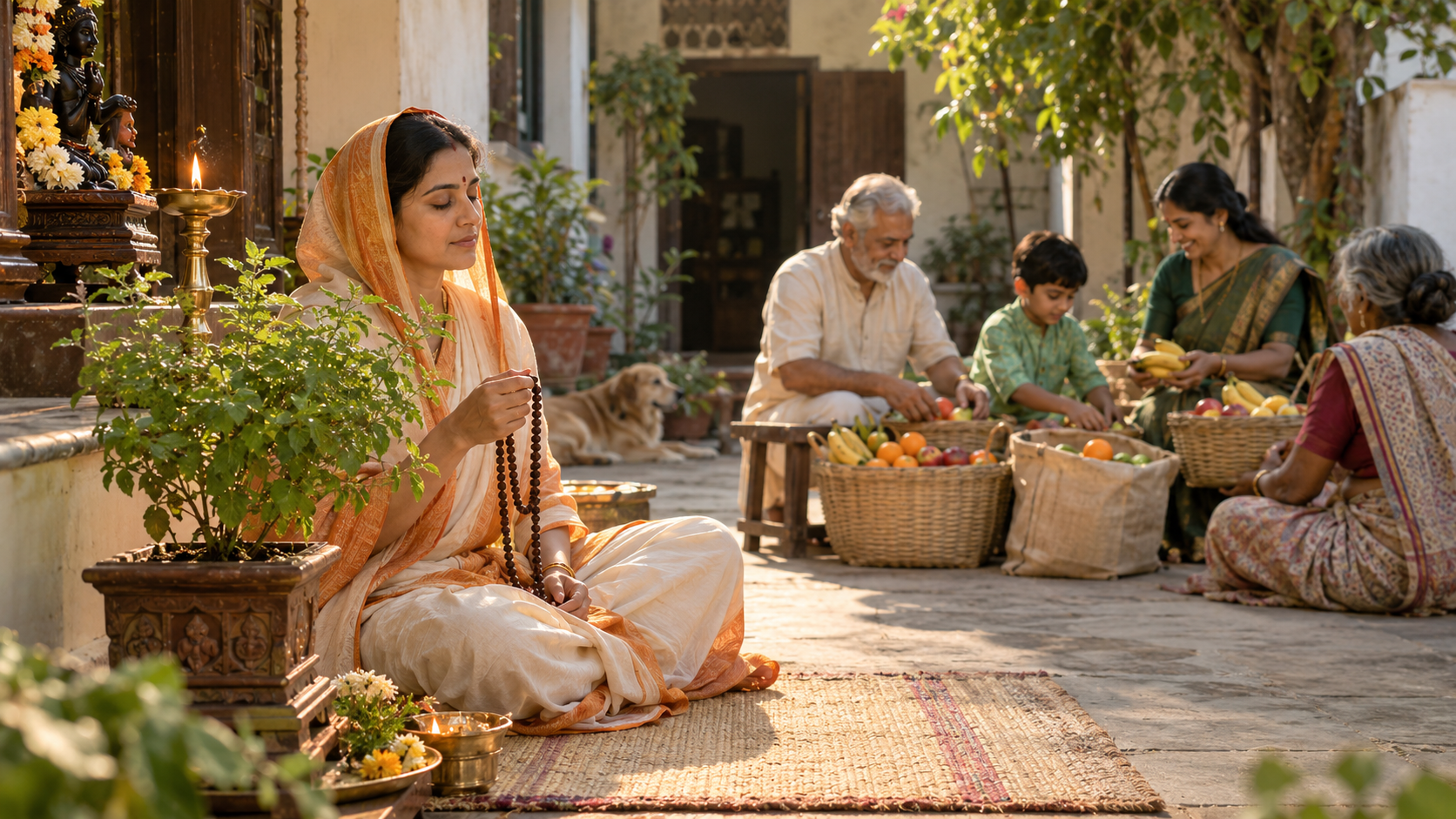
A fast creates space, but it does not decide what will fill that space. If the time normally spent cooking and eating disappears into scrolling, shopping, gossip, or arguments about permitted ingredients, the body may be fasting while the mind follows its ordinary appetites.
Give the day a simple structure:
- Prepare the previous evening. Confirm the calendar, obtain any permitted food you genuinely need, simplify the next day’s duties, and place your mala or chosen sacred reading where you will use it.
- Begin consciously. After your customary morning purification and worship, state the sankalpa. Naming the purpose turns abstinence from an accident of scheduling into an offering.
- Assign the saved time. Decide in advance when you will do japa, nama-sankirtana, puja, sacred reading, quiet reflection, temple worship, or seva. A defined practice is easier to keep than an intention to “be more spiritual.”
- Guard speech as carefully as food. Avoid needless quarrels, ridicule, and fault-finding. A controlled plate joined to uncontrolled speech is an obvious signal that the vrata needs rebalancing.
- Reduce sensory clutter. Keep necessary work, but limit entertainment and compulsive browsing. Do not spend the day searching for elaborate substitutes that reproduce an ordinary feast under a different list of ingredients.
On a workday, make the observance smaller and clearer rather than vague. Carry whatever your tradition and health permit, reserve a realistic period for prayer before or after work, and protect that period as you would an appointment. You do not need to announce the fast to colleagues unless a practical accommodation requires it.
In a household, do not turn your vrata into another person’s burden. Discuss meals in advance, prepare separately where necessary, and let family members follow the discipline appropriate to their age, health, and instruction. Children should not be pushed into an adult restriction merely to make the household appear uniform. Their participation can centre on prayer, listening, service, and food decisions made by responsible caregivers.
Notice what hunger or interrupted routine exposes. Irritation, impatience, preoccupation with taste, and the desire to display austerity are not reasons to declare the day ruined. They are useful observations. Meet them with the next round of japa, a quieter response, or a small act of service rather than self-congratulation or shame.
Complete the vrata carefully and recover from mistakes
Treat parana as part of the observance
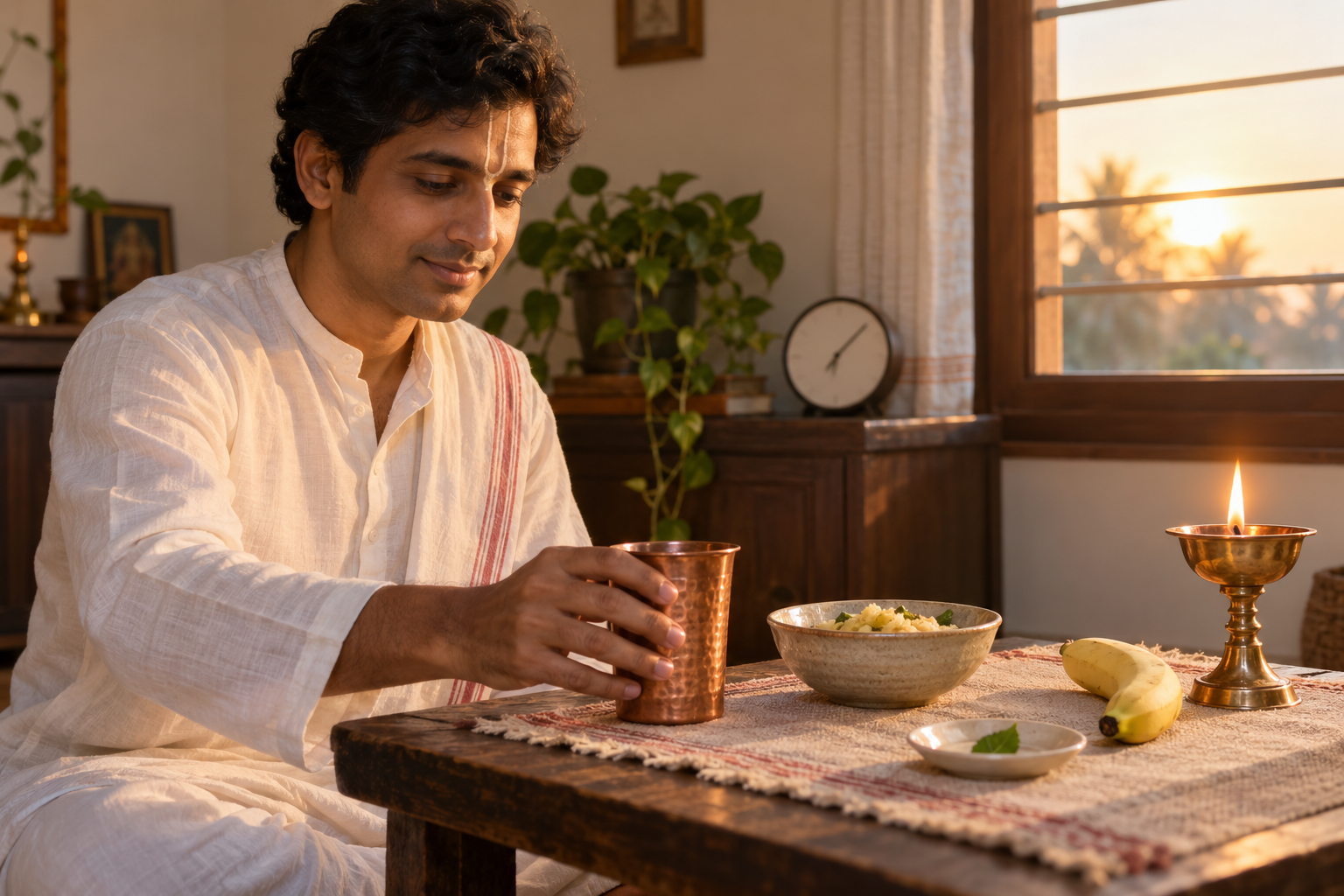
Parana, the formal breaking of the fast, belongs to the vrata rather than being an afterthought. Use the local window supplied by the same authority that gave you the Ekadasi date. Record it in an alarm or calendar entry, especially when the window falls during a busy morning.
- Recheck the location if you travelled after beginning the vrata.
- Complete any customary prayer or offering associated with breaking the fast.
- Break the fast with the item and procedure prescribed by your tradition.
- Eat deliberately rather than treating Dvadasi as compensation for deprivation.
- If duties may prevent timely parana, ask your temple or teacher beforehand instead of improvising after the window has passed.
A large compensatory meal can shift the mind straight from restraint to indulgence. Let the first meal be governed by gratitude and ordinary bodily care. The point is to complete the discipline, not to collect a reward for having endured it.
If something goes wrong, take the next right step
An accidental ingredient, a missed practice, an angry exchange, or confusion about the date can make you want to abandon the entire observance. That all-or-nothing reaction compounds one mistake with a second. Acknowledge what happened, correct what can still be corrected, and continue with the devotional commitments that remain.
- You ate something unintentionally: stop when you notice, do not hide the mistake, and continue the day according to guidance from your tradition.
- You knowingly broke the food commitment: be honest about the choice. Resume prayer and restraint instead of declaring that nothing else now matters.
- You followed the wrong date: consult the authority whose calendar you normally use. Do not invent an extra fast or severe penance to settle your anxiety.
- You missed parana: seek lineage-specific guidance rather than guessing, because completion rules differ.
- You became unwell: attend to health first. You can discuss a safer form of future observance after the immediate problem has passed.
- You became harsh with others: apologise directly. Dietary precision does not cancel the need to repair harm caused by speech or conduct.
Vrata develops steadiness through repeated return. Honest correction protects that purpose better than either casualness or panic.
Key takeaways
- Use a local panchanga or temple calendar aligned with your sampradaya.
- Take the date, food rule, and parana window from one consistent authority.
- Choose a form of fasting that respects health, medicine, age, and unavoidable duties.
- Write a concrete sankalpa before the observance begins.
- Schedule japa, worship, sacred reading, or seva so that fasting serves devotion.
- Do not police another person’s observance or measure sincerity by severity.
- If you make a mistake, correct the next action instead of abandoning the day.
Before your next Ekadasi, put four lines in your calendar: the local date, the rule you will follow, the devotional practice you will complete, and the parana window. That small preparation lets the vrata become what it should be: a disciplined return of attention to the sacred.
References

Leave a Reply
You must be logged in to post a comment.