
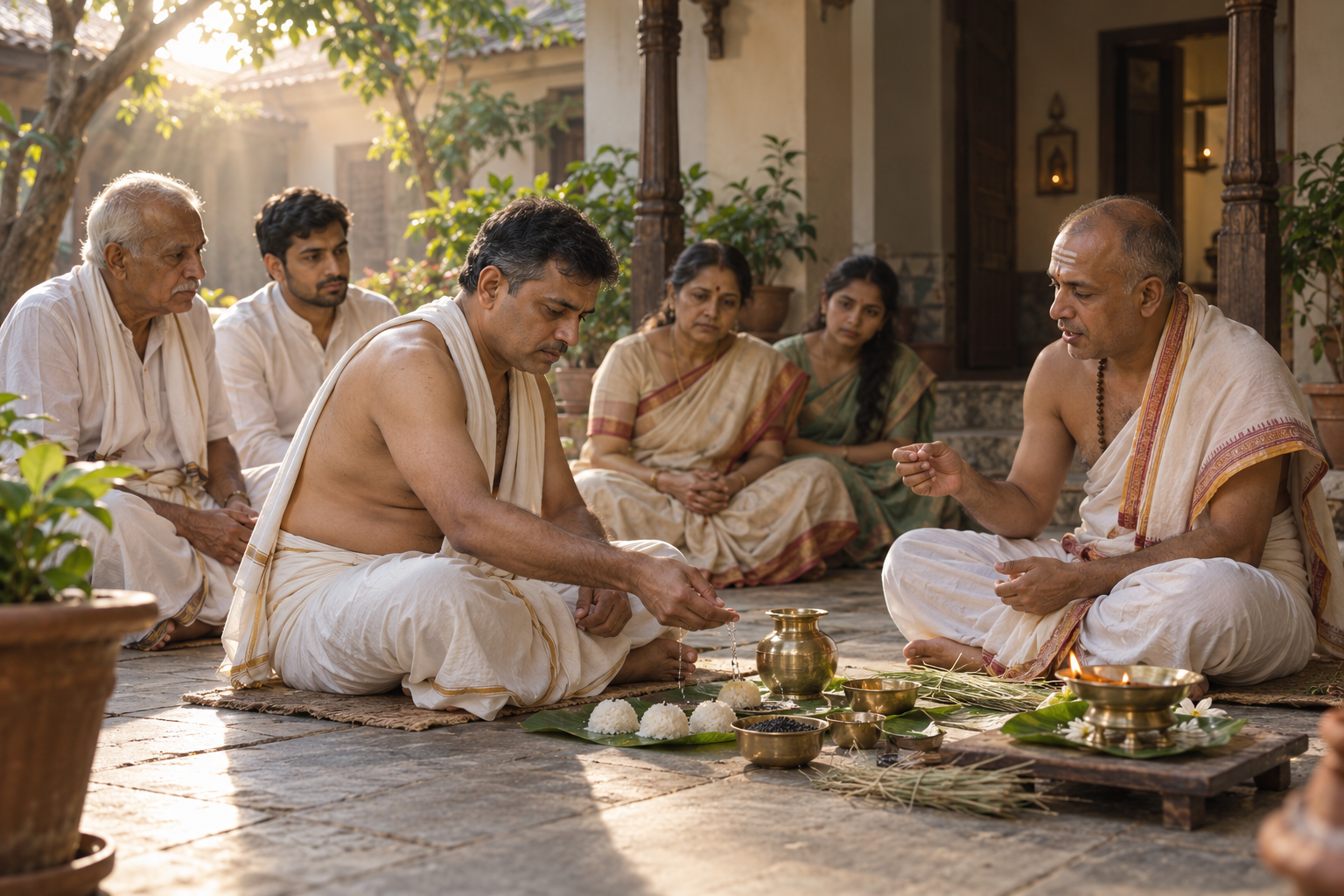
You may know that your family observes Shraddha yet still be unsure which procedure belongs to you. One relative remembers a Rigvedic method, another mentions a Yajurvedic priest, and an online video presents a third sequence as though it were universal. The practical question is not which version looks most elaborate. It is which inherited method your family can follow coherently and sincerely.
The Rigvedic, Yajurvedic, and Samavedic forms differ, but that does not make two of them mistakes. Each places a shared duty to the ancestors within its own ritual discipline. Once you understand that distinction, you can stop comparing ceremonies by appearance and start asking the questions that actually identify your tradition.
The real choice is lineage, not personal preference
Shraddha means faith or sincerity, and the ancestors remembered through it are called pitrus. That meaning establishes the inner disposition of the rite: remembrance, gratitude, and duty performed with a clean intention. It does not erase the importance of form.
A Vedic school supplies an inherited ritual grammar. It shapes the recitations, the order of actions, and the arrangement of offerings. Rigvedic, Yajurvedic, and Samavedic families are not honouring three different classes of ancestors. They are carrying out the same ancestral obligation through distinct lines of preservation.
This is why you should not select a method because its mantras sound familiar, its video is shorter, or its list of materials is easier to obtain. Begin with your family’s affiliation. Then establish the particular procedure that has actually been followed in the family. A broad Vedic label may not settle every detail because family and regional customs can operate within that larger affiliation.
The distinction also protects you from a common misunderstanding: variation is not necessarily evidence that a ritual has been corrupted. A different number or placement of ritual participants, a different sequence of pindas, or a different recitation may belong to another coherent school. The right test is whether the elements form one recognised procedure, not whether they match a ceremony you saw elsewhere.
What remains common, and what may legitimately differ
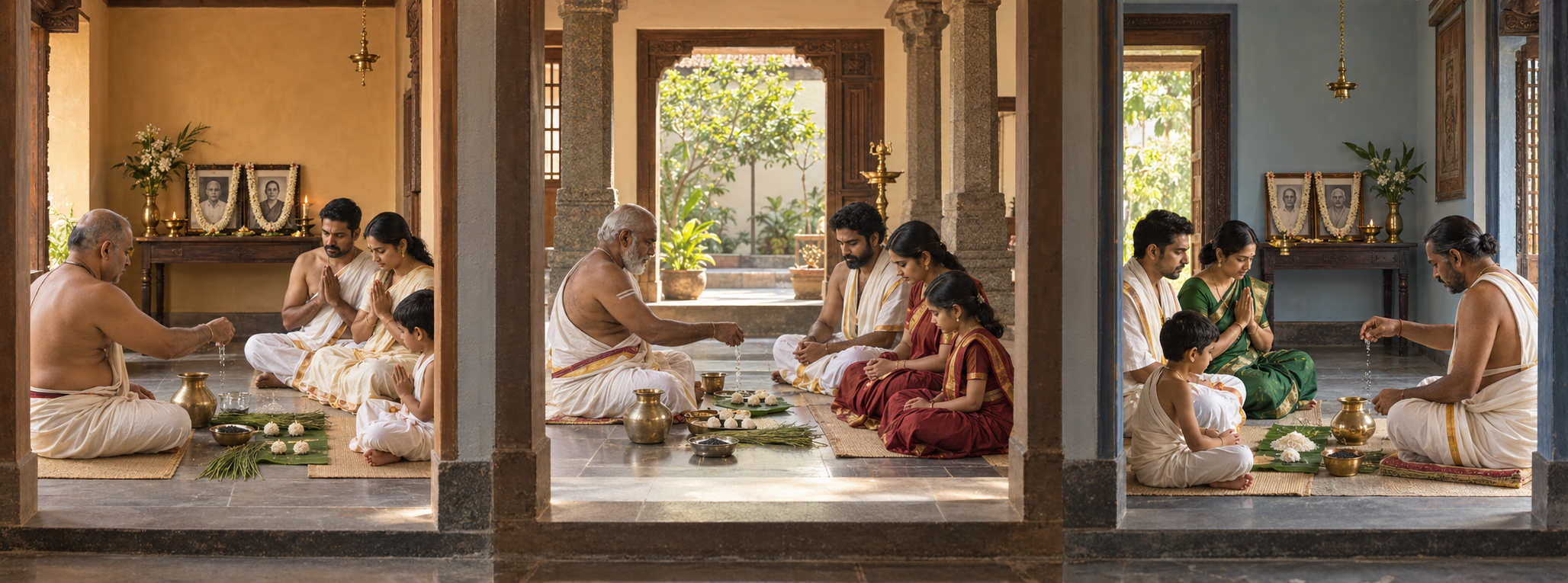
Followers of the Rigveda, Yajurveda, and Samaveda traditionally perform Shraddha in different ways. The schools nevertheless share a recognisable centre: the pitrus are remembered, offerings are made, Brahmanas have defined ritual roles, and pindas carry the act of ancestral offering into a tangible form.
- The intention remains stable. Shraddha is an act of remembrance and gratitude undertaken with faith and sincerity. A technically elaborate ceremony without attention to that duty misses its centre.
- The mantras need not be identical. Each Vedic affiliation preserves its own recitational inheritance. Do not splice verses from one procedure into another merely because you found a clearer recording.
- The Brahmanas have ritual roles. Their number, placement, or assigned function may depend on the procedure being followed. Confirm those roles with the officiant instead of treating attendance as an informal head count.
- The pindas are not incidental decorations. They are formed food offerings associated with the pitrus. Their preparation, number, designation, placement, and sequence should therefore come from the same procedure as the accompanying recitations.
- The order carries meaning. A set of individually traditional actions does not automatically become a traditional Shraddha when assembled at random. Mantra, recipient, offering, and sequence belong together.
You can use these distinctions to evaluate apparently conflicting instructions. If two priests give different counts or sequences, first ask whether they are describing different Vedic schools or family customs. Do not begin by demanding that one of them be declared wrong. Ask each priest to identify the tradition behind the full procedure and to explain which parts must remain together.
At the same time, do not use diversity as an excuse for improvisation. Traditional plurality means that several complete methods can exist. It does not mean that every mixture of their parts becomes valid simply because the intention is good.
How to identify the procedure your family should follow
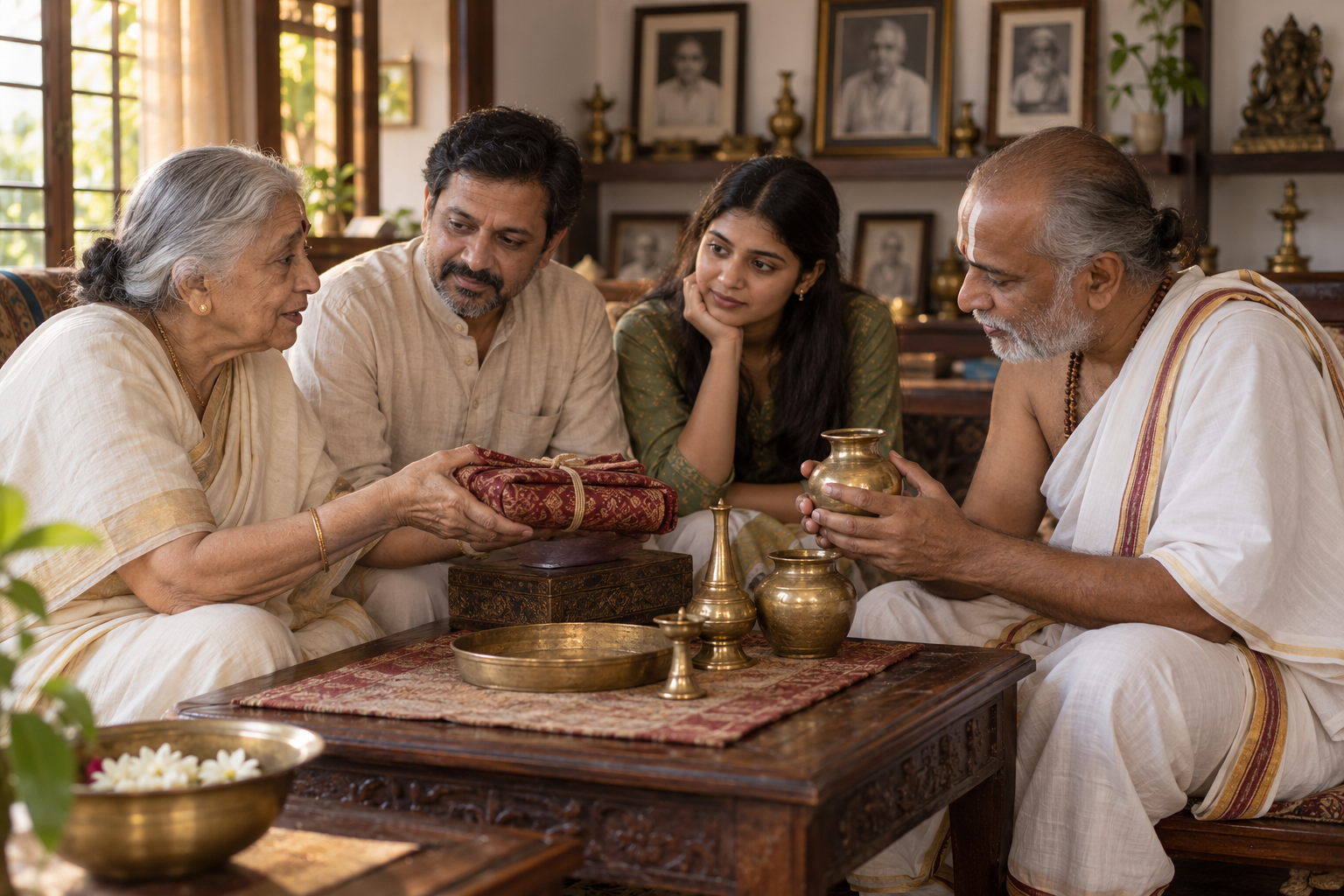
Start this work before purchasing materials or fixing the final arrangements. The visible items are usually easier to organise than the lineage information, and a late change of procedure can alter both the list of requirements and the people needed.
- Find the last person who organised the family Shraddha. Ask who officiated, which Vedic affiliation was named, and whether the same family priest had conducted earlier rites.
- Ask for actions, not just labels. A relative may confidently remember the word “Yajurvedic” while remembering little else. Ask where the pindas were placed, how many ritual recipients were arranged, who performed the offerings, and whether any written instructions survive. These details give a priest something concrete to assess.
- Separate three kinds of information. Record the broad Vedic school, the family’s established custom, and any local adaptation as separate notes. This prevents a regional habit from being mistaken for a universal Vedic rule.
- Consult an officiant trained in the relevant method. Ask directly whether the priest regularly conducts Shraddha for that school. General familiarity with Hindu rites does not by itself establish familiarity with every Vedic procedure.
- Request one complete sequence. Have the officiant specify the required participants, pindas, other materials, order of actions, and recitations as one plan. Resolve discrepancies before the rite begins.
- Record what was finally followed. Keep the school, the officiant’s name, the sequence, the ancestor names used in the recitation, and the material list with the family’s religious records. The next generation should not have to reconstruct the entire tradition from scattered memories.
If your family no longer knows its Vedic affiliation, say so plainly. Do not invent one from a surname, an online chart, or a neighbour’s practice. Gather whatever evidence remains, including old ritual notes and the recollections of elders, and present it to a knowledgeable priest. If the affiliation still cannot be recovered, ask the priest to guide you through one complete and recognised procedure suited to the family’s known tradition. Honest uncertainty handled under guidance is better than false certainty followed by a hybrid ritual.
Where relatives disagree, write down both recollections without forcing an immediate verdict. One person may remember the family’s older practice while another remembers a later local adaptation. A qualified officiant can evaluate concrete details more usefully than a family argument over which memory sounds more authoritative.
Prepare the rite without mixing Vedic methods
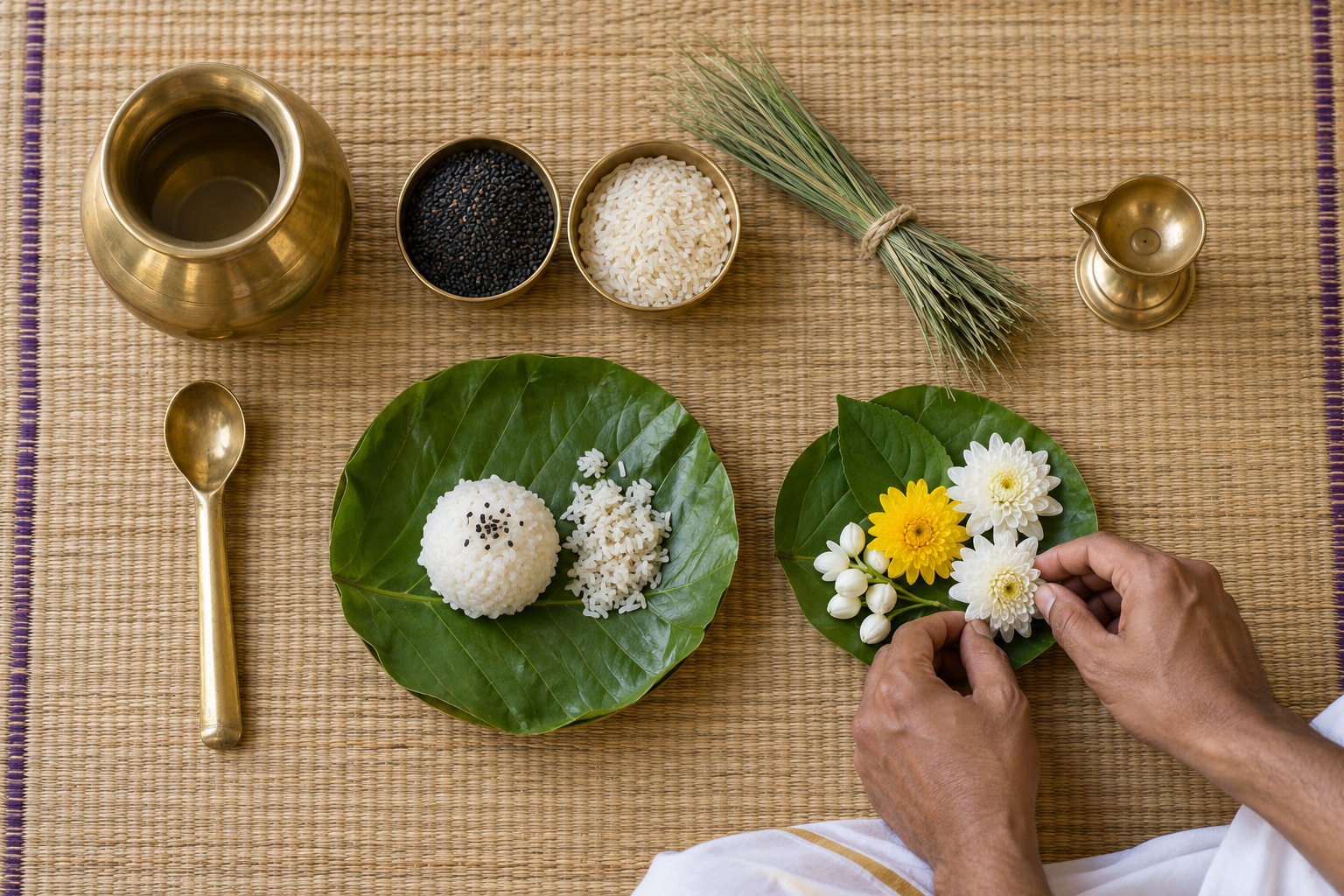
Once the procedure is identified, preparation should protect its internal consistency. A generic “Shraddha checklist” is not enough, because it may silently assume a different school from yours. Use a list supplied or approved by the person who will conduct the ceremony.
- Put the affiliation at the top of the plan. Everyone helping with arrangements should know which procedure is being prepared.
- Confirm the Brahmana arrangements. Ask how many are required, what roles they will fulfil, when they should arrive, and what hospitality the procedure expects.
- Confirm every pinda-related detail. Ask what they are made from, how many the chosen procedure requires, whom each one is associated with, and when and where each is offered. Follow the answer belonging to your ceremony rather than a count copied from another school.
- Prepare the ancestral information carefully. Write the names and family relationships clearly. Check pronunciation with an elder before the ceremony instead of trying to settle it while recitations are under way.
- Ask about substitutions in advance. If you cannot obtain an ingredient or arrange the expected participants, let the same officiant decide how the procedure should be adapted. Replacing an element from an unrelated online checklist can disturb the sequence.
- Resolve shortened forms before beginning. If time, location, or family circumstances require a shorter observance, agree on the coherent shortened procedure beforehand. Do not simply omit whichever stages appear repetitive to an untrained observer.
- Keep one ritual authority for the event. Advice from relatives can preserve valuable memory, but several people issuing instructions during the ceremony is a reliable way to combine incompatible sequences.
This discipline is not empty rigidity. In Shraddha, form is one way a family receives memory rather than inventing it anew. The inherited sequence connects your act with those who performed the duty before you. Sincerity and precision therefore support each other: sincerity gives the rite its moral centre, while precision keeps that intention within a recognisable tradition.
Key takeaways
- Shraddha is an act of faith, sincerity, remembrance, and gratitude directed toward the pitrus.
- Rigvedic, Yajurvedic, and Samavedic Shraddha are distinct inherited forms, not a ranking from better to worse.
- The shared elements include ancestral remembrance, defined roles for Brahmanas, and the offering of pindas.
- Mantras, participant arrangements, pindas, and sequence should come from one coherent procedure rather than several mixed checklists.
- Your family’s Vedic school is the starting point, but established family and regional customs may still affect the details.
- If the affiliation is unknown, preserve the uncertainty, collect family evidence, and follow one complete method under knowledgeable guidance.
Your next step is simple: contact the relative or priest connected with the last family Shraddha and ask for the Vedic affiliation and the complete sequence that was followed. Record the answer now. Even if this year’s arrangements are already settled, that record can spare the next generation from having to choose its ancestral practice by guesswork.
References

Leave a Reply
You must be logged in to post a comment.